
ISO 45001 Certification in Qatar
Quick Answer
ISO 45001 is the international standard for occupational health and safety management systems, and in Qatar it has become close to a practical necessity rather than an optional credential, QatarEnergy mandates it as a prerequisite for contractor prequalification, and Ministry of Labour (MoL) mobile inspection teams conduct genuinely unannounced site visits, including strict enforcement of the seasonal midday outdoor work ban. Get certified through a body accredited by the Global Accreditation Bureau (GAB) or another body recognized under the new Global Accreditation Cooperation (GAC) framework. Budget QAR 18,000 to QAR 70,000 depending on workforce size and site risk profile, and plan for two to five months from kickoff to certificate.
What Is ISO 45001?
ISO 45001 is the international standard for occupational health and safety management systems, published in 2018 to replace the older OHSAS 18001 standard. It requires organizations to identify workplace hazards, assess and control the risks they create, and build a structured system for continually reducing work-related injury and illness rather than simply reacting after incidents occur. Unlike prescriptive safety codes that specify exact technical requirements, ISO 45001 requires organizations to build genuine risk-based thinking into how they manage people, equipment, and sites, worker participation and consultation are woven into the standard’s core requirements, not treated as an afterthought.
Why This Matters So Much in Qatar Specifically?
Qatar’s labor market operates under conditions that make occupational safety a genuinely high-stakes issue rather than a compliance checkbox. Qatari law prohibits outdoor work between 10:00 and 15:30 daily from June 1 through September 15 each year, a rule the Ministry of Labour enforces through mobile inspection teams that conduct unannounced site visits during the ban period, not scheduled compliance checks. Beyond the heat-ban enforcement, Qatar’s construction, energy, and infrastructure sectors operate at a scale and pace, driven by continued North Field gas expansion, Lusail City development, and ongoing national infrastructure projects, where a serious safety lapse carries real human and reputational consequences, not abstract risk.
QatarEnergy, one of the country’s largest employers and project owners, mandates ISO 45001 certification as a prerequisite for contractor prequalification, requiring contractors to demonstrate a functioning HSE management system and typically a project-specific HSE plan alongside it. For any company hoping to win energy-sector or major infrastructure contract work in Qatar, ISO 45001 has effectively become a market-entry requirement, not a differentiator.
What are the steps to get ISO 45001 Certification in Qatar?
our services
- ISO Certification Qatar
- ISO 9001 Certification Qatar
- ISO 14001 Certification Qatar
- ISO 27001 Certification Qatar
- ISO 22000 Certification Qatar
- ISO 27701 Certification Qatar
- ISO 45001 Certification Qatar
- ISO 20000-1 Certification Qatar
- ISO 13485 Certification Qatar
- ISO 17025 Certification Qatar
- ISO 31000 Certification Qatar
- ISO 42001 Certification Qatar
- ISO 37001 Certification Qatar
- ISO 22301 Certification Qatar
- ISO 50001 Certification Qatar
- CE Mark Certification Qatar
- GDPR Certification Qatar
- GMP Certification Qatar
- Halal Certification Qatar
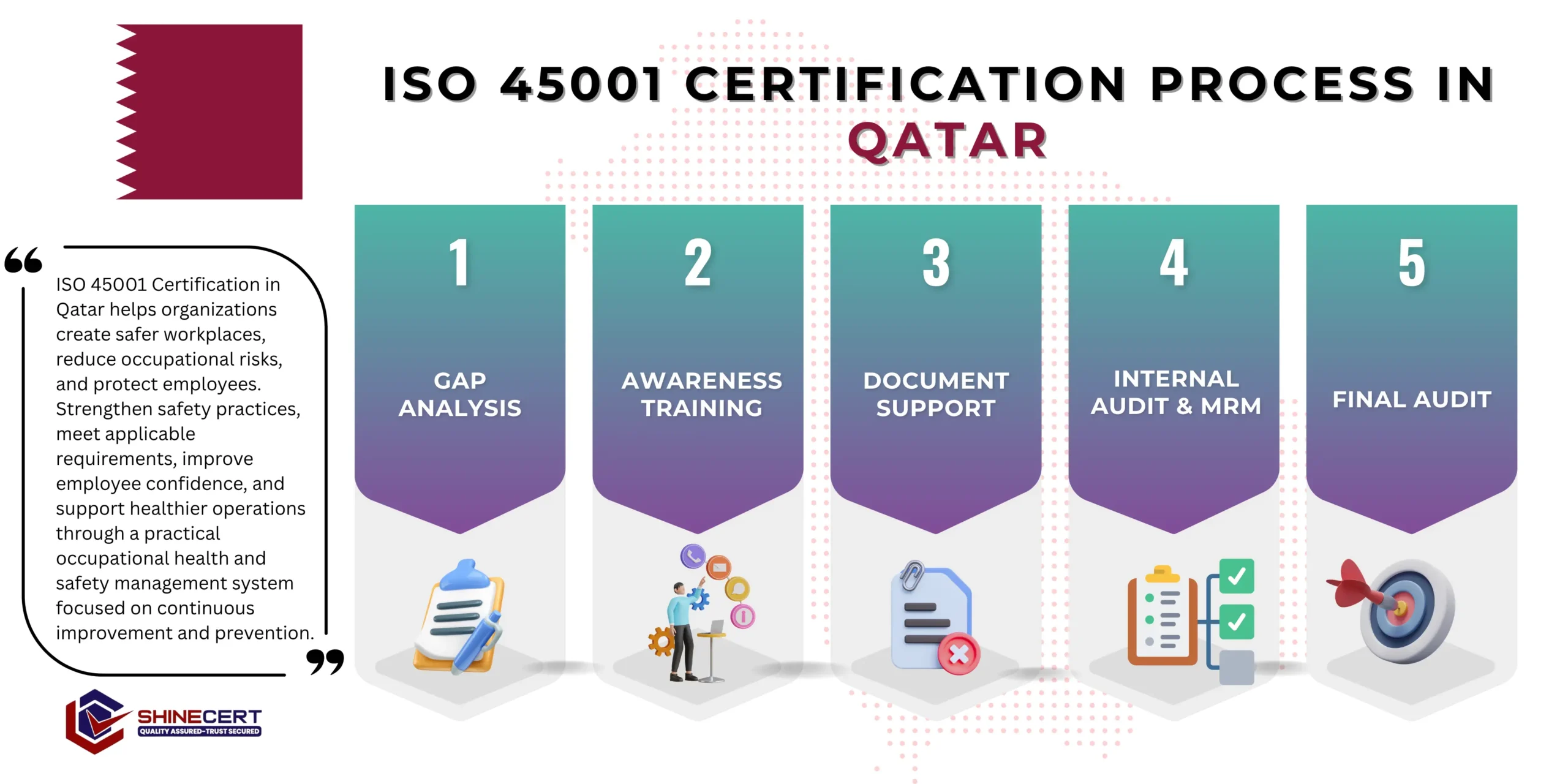
Our Five-Step ISO 45001 Certification Process
Hazard Identification and Risk Assessment
We map your genuine occupational hazards across all sites and operations, calibrated to your specific work, construction site risks differ meaningfully from office-based or light-industrial risks, and identify applicable MoL and project-owner HSE requirements.
A hazard identification and risk assessment register, plus a legal and regulatory compliance obligations register specific to Qatar.
Documentation Development
Your OHS policy, operational control procedures, including heat stress management and permit-to-work systems where relevant, and worker consultation mechanisms get built around your actual risk profile, not a generic template.
A complete ISO 45001 documentation set addressing your specific hazards and Qatar regulatory obligations.
Implementation and Training
Operational controls roll out across your sites, with staff trained by role on hazard-specific procedures, and genuine worker consultation channels get established and tested.
Training records, evidence of functioning operational controls, and documented worker consultation activity.
Internal Audit and Management Review
A genuine internal audit tests whether your safety controls actually function under real site conditions, with findings feeding into a management review where leadership commits to specific corrective actions.
An internal audit report with real findings and management review minutes demonstrating genuine leadership engagement with safety performance.
Certification Audit
We coordinate Stage 1 and Stage 2 with a GAB-accredited or GAC-recognized certification body experienced in Qatar's construction, energy, and industrial sectors.
Your ISO 45001 certificate and a clear surveillance audit schedule.
Hazard Identification and Risk Assessment
We map your genuine occupational hazards across all sites and operations, calibrated to your specific work, construction site risks differ meaningfully from office-based or light-industrial risks, and identify applicable MoL and project-owner HSE requirements.
A hazard identification and risk assessment register, plus a legal and regulatory compliance obligations register specific to Qatar.
Documentation Development
Your OHS policy, operational control procedures, including heat stress management and permit-to-work systems where relevant, and worker consultation mechanisms get built around your actual risk profile, not a generic template.
A complete ISO 45001 documentation set addressing your specific hazards and Qatar regulatory obligations.
Implementation and Training
Operational controls roll out across your sites, with staff trained by role on hazard-specific procedures, and genuine worker consultation channels get established and tested.
Training records, evidence of functioning operational controls, and documented worker consultation activity.
Internal Audit and Management Review
A genuine internal audit tests whether your safety controls actually function under real site conditions, with findings feeding into a management review where leadership commits to specific corrective actions.
An internal audit report with real findings and management review minutes demonstrating genuine leadership engagement with safety performance.
Certification Audit
We coordinate Stage 1 and Stage 2 with a GAB-accredited or GAC-recognized certification body experienced in Qatar's construction, energy, and industrial sectors.
Your ISO 45001 certificate and a clear surveillance audit schedule.
What It Costs: The Factors That Actually Drive ISO 45001 Price
- Workforce size and site count : More workers and more physical sites mean more hazard assessment, training rollout, and audit time.
- Risk profile of the work : Construction, energy, and heavy industrial operations require considerably more extensive risk assessment and operational controls than office-based or light-commercial operations.
- Existing safety maturity : Companies with informal but functioning safety practices already in place need less foundational work than those building an OHS system from scratch.
- Seasonal heat management scope : Organizations with significant outdoor workforce exposure need dedicated heat stress management documentation and controls, adding to implementation scope.
- Bundling with ISO 9001 or ISO 14001 : Meaningful cost efficiency is available for companies pursuing multiple management system certifications together, given shared documentation infrastructure.
- Quick answer : Budget QAR 18,000 to QAR 70,000, with the low end reflecting a smaller, lower-risk operation and the high end reflecting a larger, multi-site construction or industrial workforce.
ISO 45001 vs Qatar Construction Specifications (QCS) Safety Requirements
- These operate at different levels, and understanding the distinction genuinely matters for Qatar contractors. The Qatar Construction Specifications, issued by Ashghal, set detailed technical and safety requirements for specific construction activities and project types, scaffolding standards, excavation safety, and similar prescriptive site rules tied to particular work. ISO 45001 certifies your organization’s broader occupational health and safety management system, the ongoing discipline of identifying hazards, managing risk, and involving workers across your operations generally, not tied to any single project’s technical specifications.
- We generally recommend Qatar contractors treat ISO 45001 as the organizational backbone that makes consistent QCS compliance considerably easier to sustain project after project, since a functioning OHS management system produces exactly the hazard assessments, training records, and monitoring data that QCS compliance and project HSE plans typically require anyway. Contractors who only address QCS requirements project-by-project, without an underlying management system, tend to rebuild the same compliance groundwork repeatedly rather than genuinely building on it.
Benefits: What Certification Actually Changes
Certification is a prerequisite for QatarEnergy contractor prequalification and increasingly expected by other major project owners across infrastructure and construction.
A functioning OHS management system genuinely reduces workplace injuries, which reduces both direct costs and the operational disruption incidents cause.
Workers who see genuine safety investment, including real consultation on hazards, tend to show greater engagement and lower turnover, a meaningful advantage in Qatar’s competitive skilled-labor market.
A documented, functioning safety system reduces the likelihood of adverse findings during MoL inspections, including during the heightened scrutiny of the seasonal work-ban period.
Insurers increasingly recognize certified OHS management systems when pricing liability and workers’ compensation coverage.
Companies already holding or pursuing ISO 9001 or ISO 14001 find the shared management system structure makes ISO 45001 implementation considerably faster to build.
Mandatory Documents Required for Implementation
Genuine leadership commitment addressing your specific hazard profile and worker consultation approach.
Documented, specific to your sites and operations, not a generic industry checklist.
Documented obligations under MoL regulations and any project-specific HSE requirements from clients.
Covering identified significant hazards, including heat stress management and permit-to-work systems where applicable.
Documented plans for workplace incidents, genuinely tested through drills where feasible.
Evidence of genuine root-cause analysis, not superficial documentation.
Evidence that hazard identification and safety decisions genuinely involve the workforce, a distinctive ISO 45001 requirement.
Applicable Standards by Industry
Construction
Beyond ISO 45001, Qatar construction contractors typically need to demonstrate compliance with Ashghal's QCS safety provisions and project-specific HSE plans.
Read moreEnergy and Industrial Services
Companies working with QatarEnergy face specific HSE prequalification requirements alongside ISO 45001, including additional process safety expectations for high-hazard facilities.
Read moreManufacturing
Industrial producers typically need ISO 45001 alongside sector-specific machinery and process safety requirements suited to their production environment.
Read moreFacilities Management and Hospitality
Large developments and hotel operations increasingly reference occupational safety certification in contractor and vendor qualification, alongside building-specific fire and life-safety compliance.
Read moreLogistics and Transportation
Companies moving goods and materials across Qatar typically need ISO 45001 alongside transport-specific safety requirements covering driver fatigue and vehicle safety management.
Read moreWhat a Stage 2 Audit Looks Like for a Construction Contractor in Qatar?
- It helps to know concretely what to expect. Your certification body’s lead auditor typically begins with an opening meeting reviewing audit scope and site access, then moves to direct site observation, watching actual work in progress, checking permit-to-work compliance for any high-risk activity underway, and reviewing PPE use in real time rather than relying solely on paperwork. Worker interviews are a genuine, required part of the process: auditors typically speak directly with site workers, not just supervisors, to verify that safety training and hazard consultation are real and understood, not just documented.
- Document review runs alongside the site observation, hazard registers, incident logs, training records, and heat stress management procedures during the relevant season all get checked against what the auditor actually observes on site. A closing meeting summarizes findings, which fall into either nonconformities requiring corrective action before certification, or observations for improvement that don’t block certification but should genuinely be addressed. Companies that treat this as a real operational review, not a paperwork exercise ahead of a single visit, consistently move through Stage 2 with fewer findings.
Occupational Health and Safety Requirements, Clause by Clause
- Context of the Organization. Understand the genuine occupational hazards specific to your operations and sites, and the interested parties, workers, MoL, project owners like QatarEnergy or Ashghal, who have a stake in your safety performance.
- Leadership and Worker Participation. Top management must demonstrate visible commitment to safety, and, distinctively for this standard, workers themselves must be genuinely consulted and involved in hazard identification and safety decisions, not merely informed after the fact.
- Planning. Systematic hazard identification and risk assessment across all your operations and sites, plus identification of applicable legal requirements, MoL regulations, the seasonal work-ban rules, and any project-specific HSE requirements set by clients like QatarEnergy.
- Support. Competence and safety training calibrated by role and genuine risk exposure, a site worker performing physical labor in Qatar’s summer heat needs meaningfully different training and monitoring than office-based administrative staff.
- Operation. Operational controls over identified hazards, including heat stress management during the ban period and beyond it, permit-to-work systems for high-risk activities, and genuinely enforced PPE and procedural discipline on site.
- Performance Evaluation. Monitoring and measurement of actual safety performance, incident rates, near-miss reporting, heat-related illness tracking, with internal audits testing whether operational controls function in practice, not just on paper.
- Improvement. A structured response to incidents and near-misses, including genuine root-cause investigation, a repeated incident type is itself evidence the corrective action process needs to change, not just be repeated.
A Genuine Qatar-Specific Complication: The Seasonal Heat Ban Isn’t Just a Scheduling Rule
- It’s worth being clear about how the June 1 to September 15 midday outdoor work ban interacts with ISO 45001 certification, because treating it as a simple calendar rule undersells what genuinely functioning compliance requires. The ban itself, no outdoor work between 10:00 and 15:30, is enforced through unannounced Ministry of Labour site visits during the period, meaning your operational controls need to genuinely function without advance warning, not just look compliant during a scheduled audit.
- But heat stress risk in Qatar doesn’t switch off cleanly at the ban’s calendar boundaries. Outdoor work outside the banned hours, and indoor work in poorly ventilated or unshaded structures, still carries real heat stress risk during Qatar’s extended hot season. We’ve generally found that organizations that build heat stress management as a genuine year-round risk assessment item, not a seasonal compliance switch that gets flipped on June 1 and off September 15, end up with meaningfully better real-world safety outcomes and considerably smoother MoL inspection experiences, since inspectors are checking for a functioning safety culture, not just calendar-driven rule-following.
Why ShineCert?
We coordinate Qatar engagements from ShineCert’s Riyadh and Lebanon offices, with direct familiarity with Ministry of Labour requirements and QatarEnergy’s contractor HSE prequalification expectations. As the best ISO 45001 consultant in Qatar, our team has guided more than 10,000 organizations through ISO certification globally.
The ISO 45001 Revision: What’s Coming
- ISO 45001 is currently undergoing its first formal revision since original publication in 2018, with Technical Committee 283 having confirmed the revision and moved it into the Committee Draft phase as of 2026. Formal publication is expected around Q1 to Q2 2027, with certified organizations then given a three-year transition period to move to the new edition. Expected changes include alignment with the updated ISO high-level structure, including a new standalone clause on planning and managing organizational change; explicit integration of climate change considerations into the standard’s context requirements, similar to the direction already taken in the ISO 9001 and ISO 14001 revisions; and a notably stronger emphasis on psychosocial risk, mental health, stress, burnout, and harassment, reflecting a broader global shift in how occupational safety is understood beyond purely physical hazards.
- For Qatar companies certifying now, this means building your OHS management system with genuine attention to worker wellbeing and psychosocial factors already makes practical sense, since the eventual 2027 revision will likely formalize expectations many well-run organizations are already moving toward. Companies certifying to the current 2018 edition today should not expect to need major rework once the new edition arrives, the anticipated changes build on, rather than replace, the current standard’s core structure.
Ready to Get Started?
ShineCert supports Qatar businesses end to end, from hazard assessment through certification audit, with direct experience navigating Ministry of Labour and QatarEnergy HSE requirements. Book a free consultation or contact us directly, and we’ll review your operations before proposing a fixed-scope plan.
Frequently Asked Questions
It’s the international standard for occupational health and safety management systems, requiring organizations to identify workplace hazards, manage risk, and continually reduce work-related injury and illness.
Typically QAR 18,000 to QAR 70,000, depending on workforce size, site count, and risk profile.
It’s not legally mandatory for all businesses, but QatarEnergy requires it for contractor prequalification, making it a practical necessity for energy-sector and major infrastructure work.
Typically two to five months.
Not by name, but a genuine ISO 45001 heat stress management program directly supports compliance with the Ministry of Labour’s June 1 to September 15 outdoor work restrictions.
No, QCS sets detailed technical safety rules for specific construction activities, while ISO 45001 certifies your organization’s broader occupational health and safety management system, the two are complementary.
No, certifying now to the current 2018 edition is worthwhile, the expected 2027 changes build on the existing structure, and a three-year transition period will apply once the new edition publishes.
Genuine worker participation is a core, distinctive requirement of ISO 45001, auditors typically interview site workers directly during Stage 2, and a system built without real worker consultation is unlikely to pass certification or function effectively afterward.
We coordinate Qatar engagements from our Riyadh and Lebanon offices, with consultants traveling on-site as needed.