
ISO 14001 Certification in Angola
Quick Answer
ISO 14001 certification is an internationally recognized Environmental Management System credential confirming an organization systematically identifies, controls, and reduces its environmental impact. In Angola it’s voluntary, verified through independent accredited audit, typically takes three to six months, and directly supports the environmental licensing process businesses already navigate through MINAMB. As of April 2026, the standard itself has moved to a new edition, ISO 14001:2026, with a live three-year transition window already underway.
About ISO 14001
ISO 14001 is the world’s most widely used environmental management standard. It doesn’t dictate specific environmental targets; it specifies how systematically you identify your environmental impacts, control them, and improve over time, through documented processes, defined responsibilities, and continual improvement built into the system itself.
Certification means an independent, accredited certification body has audited your actual environmental controls on-site, not just reviewed a policy, and confirmed they genuinely meet the standard’s requirements. It’s reissued on a three-year cycle with annual surveillance audits in between.
A brief history of the standard : ISO 14001 was first published in 1996, one of the first international environmental management standards of its kind, building on the earlier British Standard BS 7750. It was significantly revised in 2004 and again in 2015, when it adopted the same High-Level Structure used across other ISO management standards like ISO 9001, making integrated management systems easier to run. The 2015 edition also strengthened requirements around life-cycle thinking and leadership accountability. On April 15, 2026, ISO published the next edition, ISO 14001:2026, which sharpens the standard’s focus on climate change, biodiversity, and natural resource use, detailed further down this page.
Why It Matters in Angola?
Angola already requires environmental licensing for many activities, and certification strengthens that position. The Environmental Licensing Law (Decree 59/07) governs licensing for activities likely to cause significant environmental impact, and Presidential Decree 117/20 sets out the Environmental Impact Assessment process businesses submit to MINAMB, the Ministry of Environment, to obtain that license. A certified environmental management system gives you documented, auditable evidence to support that submission, rather than starting the conversation from scratch each time.
What not being certified actually costs you? Environmental licensing delays are common when businesses can’t demonstrate systematic environmental controls beyond a one-time assessment. International partners and financiers increasingly expect certified environmental governance before committing capital, particularly in oil and gas, mining, and industrial sectors central to Angola’s economy. And without structured monitoring, environmental noncompliance tends to surface during a MINAMB inspection rather than being caught and corrected internally first.
Why is this happening in Angola right now? As Angola pursues economic diversification beyond oil, agriculture, manufacturing, and industrial sectors that never previously needed to think hard about environmental governance are now operating under the same Framework Environment Law (Law 5/98) that has long applied to the extractive sector, and certified environmental management is becoming a genuine differentiator as more businesses enter this space.
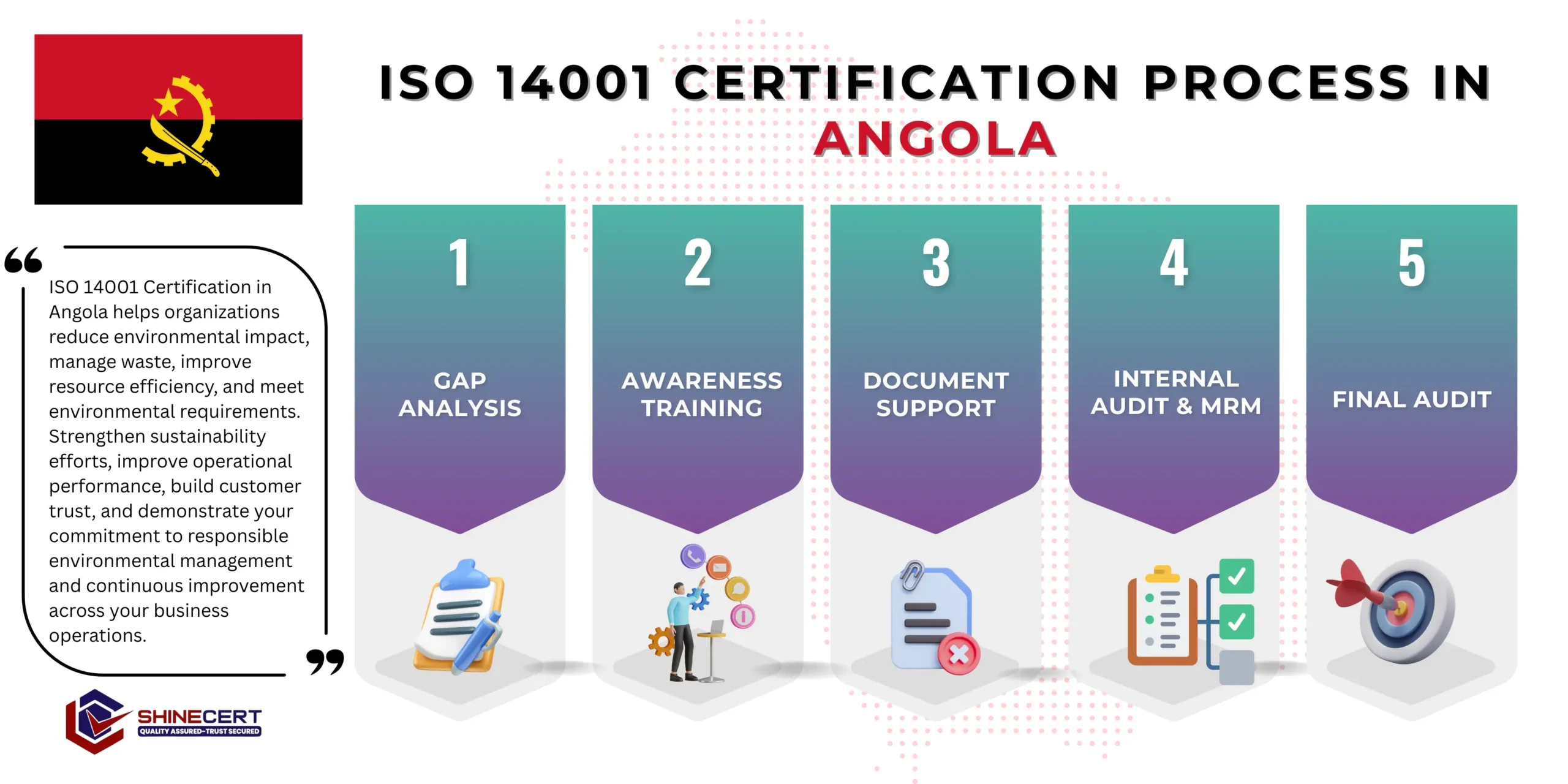
What are the steps to get ISO 14001 Certification in Angola ?
our services
- ISO Certification Angola
- ISO 9001 Certification Angola
- ISO 14001 Certification Angola
- ISO 27001 Certification Angola
- ISO 22000 Certification Angola
- ISO 20000-1 Certification Angola
- ISO 45001 Certification Angola
- ISO 13485 Certification Angola
- ISO 17025 Certification Angola
- ISO 31000 Certification Angola
- ISO 22301 Certification Angola
- ISO 27701 Certification Angola
- ISO 37001 Certification Angola
- ISO 50001 Certification Angola
- CE Mark Certification Angola
- GMP Certification Angola
- GDPR Certification Angola
- Halal Certification Angola
- SOC Certification Angola
The Certification Process
Gap Assessment
Over one to two weeks, we walk your actual site, production areas, storage, waste handling, and compare what we find against the 2026 edition's requirements, including its sharpened expectations on biodiversity and natural resource use. You get an honest picture of what environmental controls already exist informally and what's genuinely missing before any documentation begins.
Documentation Development
Over three to six weeks, we build your environmental policy, aspects and impacts register, and operational procedures, written to reflect your actual site conditions rather than generic environmental language. This is where climate, biodiversity, and resource-use factors specific to your operations get properly documented, not just referenced in passing.
Implementation and Training
Over four to eight weeks, environmental controls go live and staff across relevant roles are trained on them, not just handed a policy to read. This is usually the longest phase because it involves real changes to how waste, emissions, or resource use are actually managed day to day.
Internal Audit and Management Review
Over two to three weeks, we run an internal audit against the same criteria the real auditor will use and complete a formal management review. This step exists specifically to catch gaps while they're still cheap and quick to fix.
Certification Audit
Over two to four weeks, an accredited certification body audits your actual environmental controls on-site and issues the certificate once satisfied. Expect this to include physical inspection of waste handling, storage, and emissions points, not just a documentation review.
Gap Assessment
Over one to two weeks, we walk your actual site, production areas, storage, waste handling, and compare what we find against the 2026 edition's requirements, including its sharpened expectations on biodiversity and natural resource use. You get an honest picture of what environmental controls already exist informally and what's genuinely missing before any documentation begins.
Documentation Development
Over three to six weeks, we build your environmental policy, aspects and impacts register, and operational procedures, written to reflect your actual site conditions rather than generic environmental language. This is where climate, biodiversity, and resource-use factors specific to your operations get properly documented, not just referenced in passing.
Implementation and Training
Over four to eight weeks, environmental controls go live and staff across relevant roles are trained on them, not just handed a policy to read. This is usually the longest phase because it involves real changes to how waste, emissions, or resource use are actually managed day to day.
Internal Audit and Management Review
Over two to three weeks, we run an internal audit against the same criteria the real auditor will use and complete a formal management review. This step exists specifically to catch gaps while they're still cheap and quick to fix.
Certification Audit
Over two to four weeks, an accredited certification body audits your actual environmental controls on-site and issues the certificate once satisfied. Expect this to include physical inspection of waste handling, storage, and emissions points, not just a documentation review.
How Long Does Certification Take?
- Single-site facilities with a limited environmental footprint (around 3 months) : With one location and a narrower range of environmental aspects, waste streams, emissions points, resource use, there’s simply less to document and fewer processes to align, so certification tends to move faster.
- Multi-site or moderate-footprint operations (4 to 5 months) : Once environmental aspects span several locations or a wider range of processes, the aspects and impacts register grows accordingly, and aligning environmental controls consistently across sites takes real coordination time beyond the paperwork itself.
- Complex industrial or extractive facilities (5 to 6 months) : Oil, gas, and mining operations typically have the most extensive range of environmental aspects to document, emissions, waste, water use, land impact, which means a longer gap assessment, more extensive documentation, and a longer implementation phase to get controls genuinely operating before the certification audit.
- The variable that matters most: how mature your current environmental controls already are : A facility with an existing MINAMB-compliant environmental license and organized informal practices starts from a stronger position than one building environmental governance from scratch, regardless of size.
- A real example : A manufacturing facility we worked with near Luanda had a current MINAMB license but no aspects register beyond what the original EIA covered years earlier; because environmental practices had evolved informally since then without being redocumented, we spent extra time in the gap assessment reconciling current practice against outdated paperwork, which added roughly three weeks to the documentation phase compared to a facility whose environmental records had stayed current.
What Affects the Cost?
- Facility complexity and environmental footprint. More significant aspects, emissions, waste, water use, mean more controls to document.
- Current MINAMB compliance standing. A facility with existing licenses and a clean assessment history starts from a stronger position.
- Number of sites. Multi-site operations require aspects of registers documented per location.
- Certification body fees, separate from consulting costs.
Answering the Objections Every Owner Has
- “We already have an environmental license, isn’t that enough?” A license confirms a point-in-time assessment; certification confirms an ongoing management system, which is what supports smoother renewals and fewer inspection surprises.
- “Isn’t this just paperwork?” Only if implemented badly. Done properly, it documents environmental controls you should be running anyway, just consistently enough for an auditor and a new employee alike to follow.
- “We’re too small for this.” Size affects scope and timeline, not whether certification is worth pursuing.
- “Can’t we just do this ourselves?” You can attempt it, but most businesses underestimate how much genuine, working documentation the standard’s monitoring and internal audit requirements need beyond a downloaded template.
Benefits of ISO 14001 Certification
- Stronger standing during MINAMB licensing and inspections. A functioning environmental management system gives inspectors documented evidence, not just a one-time assessment.
- Access to financing and partnerships with environmental conditions. International lenders and buyers increasingly require certified environmental governance as an investment condition.
- Reduced risk of licensing delays and enforcement action. Systematic monitoring catches compliance gaps before MINAMB does.
- Genuine cost savings from resource efficiency. Identifying environmental aspects frequently surfaces waste and energy inefficiencies worth fixing regardless of certification.
- Credibility with international partners entering Angola’s diversifying economy. Certification signals environmental governance maturity to partners unfamiliar with Angola’s regulatory detail.
- A foundation for pursuing ISO 45001 or ISO 50001 later. These standards share much of the same underlying management-system structure.
Common Mistakes We See
- Treating the EIA as the finish line rather than the starting point : A one-time assessment doesn’t replace ongoing monitoring, which is exactly what certification demonstrates.
- Documenting aspirational controls instead of real ones : Auditors verify against actual site conditions, not what the policy claims.
- Skipping internal audits to save time : This is where gaps surface before the real audit does, at lower cost.
- Choosing a certifier based on speed alone : An unusually fast timeline is often a shortcut on rigor, not efficiency.
Transitioning to ISO 14001:2026
- Unlike some ISO standards still awaiting their next edition, ISO 14001 has already moved. ISO 14001:2026 was published on April 15, 2026, and certified organizations now have an active three-year transition window, running to approximately April 2029, after which certificates to the 2015 edition will no longer be valid.
- What’s changed, in plain terms. The 2026 edition sharpens rather than overhauls the 2015 requirements. Climate change, biodiversity, natural resource use, and pollution levels are now explicit, required considerations woven into Clause 4.1 (context), Clause 4.2 (interested parties), and Clause 6.1 (risks and opportunities), rather than optional or implied topics. Leadership accountability for environmental performance is more directly emphasized, and life-cycle thinking, including supply chain and sourcing responsibility, carries more explicit weight than before.
- What this means for your documentation. If you’re newly pursuing certification now, go directly for the 2026 edition; there’s no reason to certify against the outgoing 2015 edition when the transition deadline is already running. If you’re already certified to the 2015 edition, expect to update three things during your transition audit: your context analysis under Clause 4.1 and 4.2, to explicitly document climate, biodiversity, and resource-use considerations rather than referencing them loosely; your risk and opportunity planning under Clause 6.1, to reflect climate-related risks specifically; and your leadership documentation, to demonstrate accountability for environmental performance more directly than the 2015 edition required. For most organizations with a reasonably current environmental management system, this is an update and sharpening exercise, not a rebuild from scratch.
- Our recommendation. Don’t wait until close to the April 2029 deadline. Use your next scheduled surveillance audit as the checkpoint to begin updating your documentation against the 2026 requirements, so the transition audit itself is a formality rather than a scramble.
Standards and Clauses: What ISO 14001 Actually Requires
- Context of the Organization (Clause 4) : requires identifying environmental issues relevant to your operations, understanding interested-party expectations including MINAMB, and now, under the 2026 edition, explicitly considering climate change, biodiversity, pollution levels, and natural resource availability as part of your external context, not just as optional considerations.
- Leadership (Clause 5) : requires top management to set an environmental policy and take visible ownership, with the 2026 edition placing sharper emphasis on demonstrated leadership accountability for environmental performance, not just formal sign-off.
- Planning (Clause 6) : requires identifying environmental aspects and impacts and planning actions to address risks, compliance obligations, and, under the 2026 edition, climate-related risks and opportunities specifically woven into this clause.
- Support (Clause 7) : covers competence, awareness, and documented information needed to run the system, including training staff on newly emphasized topics like biodiversity impact where relevant to your operations.
- Operation (Clause 8) : covers operational controls, emergency preparedness, and management of environmentally significant activities, the clause where most day-to-day environmental documentation lives and where auditors spend the most time verifying practice matches paperwork.
- Performance Evaluation (Clause 9) : requires monitoring environmental performance, internal audits, and management review, checking whether the system is actually reducing environmental impact over time, not just documenting that it exists.
- Improvement (Clause 10) : requires acting on nonconformities and continually improving environmental performance, closing the loop between what you monitor and what you actually change.
Case Study: An Industrial Facility Near Luanda
- An industrial facility near Luanda needed ISO 14001 certification to satisfy an international lender’s environmental governance condition attached to an expansion loan.
- Our gap assessment found the facility’s MINAMB licensing was current, but there was no formal environmental aspects register and no documented emergency response plan for chemical handling incidents.
- Over four months, we built the environmental policy and aspects register directly against the 2026 edition, documented emergency preparedness procedures, and ran the facility’s first internal audit. The certification audit found no major nonconformities.
- The facility secured its certificate in time to satisfy the lender’s condition, and the expansion proceeded on schedule.
Required Documentation
The scope statement defines exactly what the certification covers, and which sites and activities are included. The environmental policy sets out top management’s genuine commitment to environmental performance, not generic sustainability language. The interested parties analysis identifies what MINAMB, regulators, financiers, and communities actually expect from your operations.
The environmental aspects and impacts register is the core of the system: a documented, regularly updated list of how your operations affect the environment and what you’re doing about it, now expected to explicitly address climate, biodiversity, and resource-use factors under the 2026 edition. The compliance obligations register tracks MINAMB licensing requirements and other legal obligations so nothing is missed at renewal.
Competence and training records prove staff handling environmentally significant activities are properly trained. The document control procedure keeps outdated environmental procedures from circulating and causing confusion.
Operational control procedures describe exactly how environmentally significant activities, waste handling, emissions control, are actually managed day to day. The emergency preparedness and response plan documents how you’d respond to a spill, leak, or other environmental incident, which auditors and MINAMB both scrutinize closely.
The internal audit program and reports show you’re checking your own environmental performance before an external auditor does. Management review minutes demonstrate leadership is genuinely engaged, not just delegating environmental responsibility entirely.
Who Actually Needs This?
Oil, gas, and mining operators
Environmental licensing is already a core compliance requirement. ISO 14001 certification strengthens every renewal and demonstrates systematic environmental governance beyond baseline regulatory obligation.
Read moreManufacturers and industrial facilities
Many entering Angola's diversifying non-oil economy face structured environmental expectations for the first time. Certification formalizes impact management and positions them competitively in the modern economy.
Read moreAgricultural processors
Those seeking international partnerships or export relationships increasingly face environmental governance expectations. ISO 14001 demonstrates responsible resource stewardship critical for international market access.
Read moreConstruction and infrastructure contractors
Working on Lobito Corridor and major infrastructure projects face environmental conditions frequently attached to financing. ISO 14001 demonstrates compliance capability and secures project viability with lenders and partners.
Read moreWhich Certification Body Should You Choose?
Confirm accreditation through a recognized international or regional framework. Be skeptical of unusually fast timelines. Ask whether the consultant can explain what a specific requirement means for your facility, not just hand you a document pack. Confirm the audit includes a genuine site visit, and that the certification body is already auditing against the 2026 edition.
Choosing the Right Partner?
| DIY | Generic Consultant | ShineCert | |
|---|---|---|---|
| Aspect identification | Often incomplete | Templated, generic | Mapped to your actual operations |
| Timeline realism | Often underestimated | Sometimes overpromised | Set to your real starting point |
| MINAMB alignment | Not considered | Rarely integrated | Built to support your licensing position |
| 2026 transition readiness | Often overlooked | Sometimes unaware of the update | Built directly against the current edition |
Why Businesses Choose ShineCert in Angola?
We’ve spent 10 years helping more than 10,000 businesses worldwide get certified, coordinated through our Riyadh and India offices. We build systems that strengthen your MINAMB licensing position directly and are currently against ISO 14001:2026, not generic environmental documentation disconnected from Angola’s actual regulatory process or the standard’s latest edition.
Ready to Get Started?
Whether you’re strengthening your MINAMB licensing position or transitioning to ISO 14001:2026, we’ll assess your real situation and give you a clear, honest quote. ShineCert is the best ISO consultant in Angola. Book a free consultation or contact us to get started.
Frequently Asked Questions
No, but MINAMB’s environmental licensing requirements under Decree 59/07 create a strong regulatory foundation certification that demonstrates compliance more credibly.
It depends on facility footprint, site count, and current MINAMB compliance standing. We quote individually.
Usually three to six months, depending on how mature your existing environmental controls already are.
No, it strengthens your licensing position with ongoing documented evidence, but the license itself remains a separate legal requirement.
Oil, gas, mining, manufacturing entering the diversifying non-oil economy, agricultural processors, and infrastructure contractors.
Documentation development can happen remotely; the certification audit requires a site visit.
Certification directly against the 2026 edition; it was published in April 2026 and the 2015 edition is already partway through its three-year phase-out.
In 1996, revised in 2004 and 2015, with the current 2026 edition published April 15, 2026.