
ISO 14001 Certification in Uganda
Quick Answer
ISO 14001 certifies that a business has a structured, independently verified environmental management system, a genuinely different thing from a NEMA Certificate of Approval, which is a legal environmental clearance under Uganda’s National Environment Act rather than an ISO certification. NEMA coordinates and regulates environmental management in Uganda and issues project-level approvals, but ISO 14001 certification itself comes through an accredited, independent certification body. The standard carries real weight in Uganda right now because of the country’s active wetland enforcement drive: wetland cover has grown from 8.9% to 13.9% since the early 2020s as NEMA carries out restoration orders and, in 2026, issued fresh 30-day eviction notices to businesses and residents occupying wetland systems around Kampala. Certification typically takes three to six months, and cost depends on real factors like your organization’s size, sector, and existing environmental practices.
Understanding ISO 14001: What It Actually Is, and Why It Matters in Uganda
ISO 14001 is published by the International Organization for Standardization and sets out requirements for an environmental management system: a structured way of identifying an organization’s environmental impacts, setting genuine objectives to reduce them, and building the monitoring and corrective processes needed to keep improving over time. It covers everything from how a business identifies its environmental aspects and impacts, to how it manages waste and resource use, to how it responds when something goes wrong. Certification means an accredited, independent auditor has formally verified this system is real and functioning, not a policy statement filed away and forgotten.
Why this carries specific weight in Uganda comes down to a genuinely active regulatory environment. NEMA’s 2026 enforcement drive against wetland encroachment, covering systems including Lubigi, Namuwongo, Luzira, Bugolobi, Kansanga, Ggaba, and Munyonyo, has already resulted in demolitions and displaced business operators who had built or operated on wetland land without proper environmental clearance. Beyond wetlands specifically, any business whose activities fall under Schedule 4 or Schedule 5 of the National Environment Act, 2019 needs either a Project Brief or a full Environmental and Social Impact Assessment before it can legally operate, processed through NEMA’s Environmental Licensing and Management Information System. A certified environmental management system doesn’t replace this legal clearance, but it gives a business the internal discipline to stay ahead of enforcement rather than discovering a gap only when an inspector arrives.
Benefits of ISO 14001 Certification for Ugandan Organizations
Here’s what certified Ugandan businesses actually gain from ISO 14001, explained in full rather than as a one-line summary:
With NEMA’s active 2026 wetland crackdown demonstrating how quickly enforcement can escalate from a notice to a demolition, a certified environmental management system gives a business the internal monitoring to catch an encroachment or compliance gap long before an inspector does, rather than being caught in a 30-day eviction window with no plan.
Development-funded infrastructure projects, and an increasing number of private-sector supply agreements, now require environmental management evidence as part of vendor evaluation, particularly for construction, manufacturing, and extractive-sector contracts where environmental risk is a genuine screening criterion.
Buyers in the European Union, the Gulf, and Asia increasingly expect environmental management evidence from suppliers in agriculture, textiles, and manufacturing, treating ISO 14001 as a baseline credibility signal rather than a differentiator for businesses with export ambitions beyond the East African region.
ISO 14001 requires genuine measurement of resource use, water, energy, raw materials, and a documented response when waste is identified. Businesses that take this seriously typically find real, measurable reductions in utility and material costs as a direct byproduct of the system, not just an environmental side benefit.
Rather than an ad hoc scramble when a spill, discharge, or compliance breach occurs, a certified system requires a documented emergency preparedness and response procedure that’s been tested before it’s ever actually needed.
Banks and development finance institutions financing larger projects increasingly build environmental management requirements into lending conditions, and certification gives a business documented evidence to satisfy those conditions without a project-specific environmental audit each time.
Before certification, environmental compliance is often treated as a legal or facilities-team afterthought. ISO 14001 requires named roles, defined responsibilities, and leadership sign-off on environmental objectives, removing the ambiguity about who actually owns a compliance gap when one surfaces.
Informal environmental practices that work for a small single-site operation break down as a business adds production capacity, sites, or product lines, a certified system is built to scale alongside genuine operational growth rather than quietly eroding under it.
Businesses that later pursue ISO 45001 or ISO 50001 find that the risk assessment discipline, document control habits, and management review cycles built for ISO 14001 carry over directly, meaningfully shortening the path to the next certification.
What are the steps to get ISO 14001 Certification in Uganda?
our services
- ISO Certification Uganda
- ISO 9001 Certification Uganda
- ISO 14001 Certification Uganda
- ISO 27001 Certification Uganda
- ISO 22000 Certification Uganda
- ISO 27701 Certification Uganda
- ISO 45001 Certification Uganda
- ISO 20000-1 Certification Uganda
- ISO 13485 Certification Uganda
- ISO 17025 Certification Uganda
- ISO 31000 Certification Uganda
- ISO 42001 Certification Uganda
- ISO 37001 Certification Uganda
- ISO 22301 Certification Uganda
- ISO 50001 Certification Uganda
- CE Mark Certification Uganda
- GDPR Certification Uganda
- GMP Certification Uganda
- Halal Certification Uganda
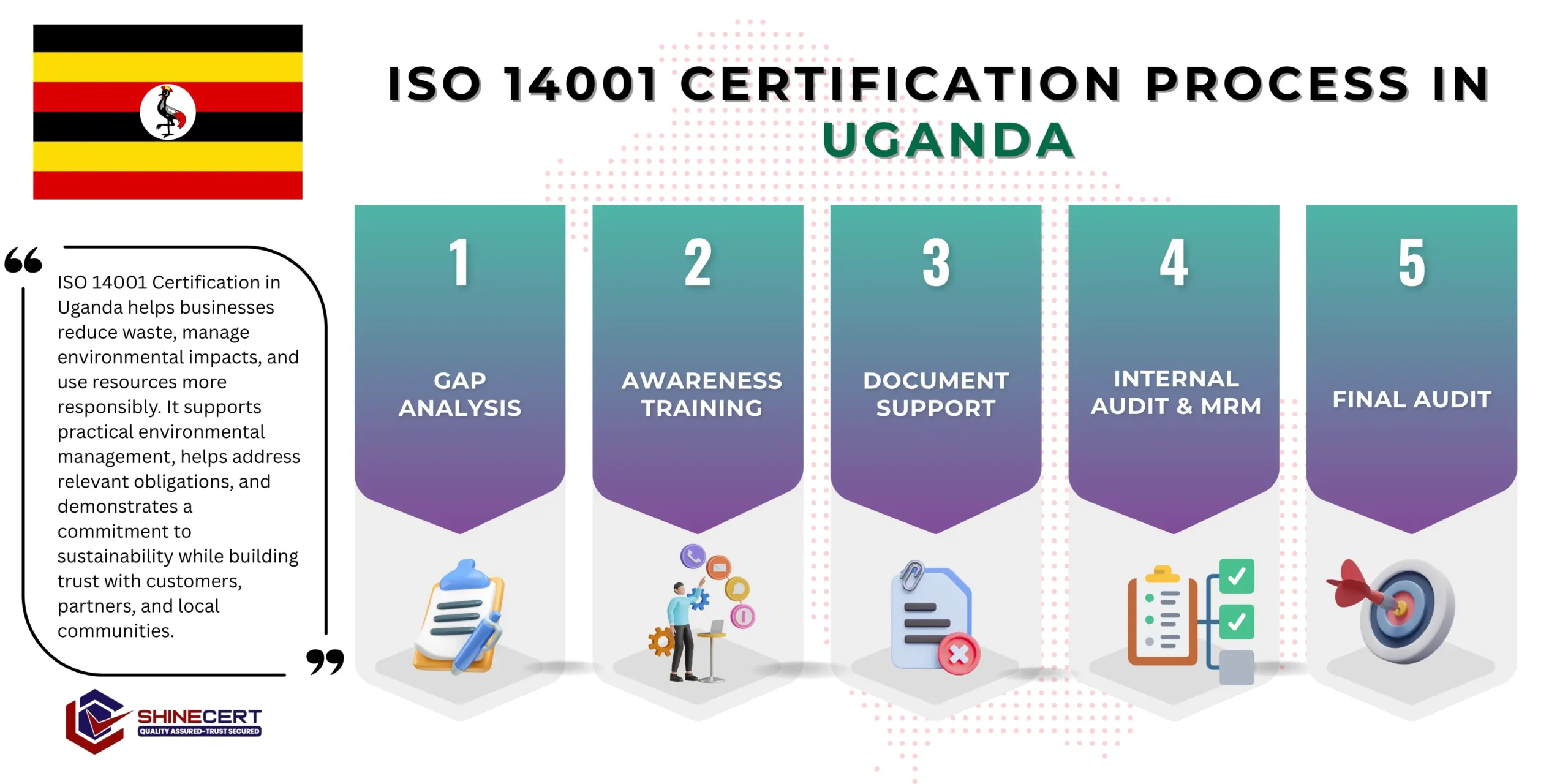
ISO 14001 Certification Process in Uganda
Getting certified is a five-stage journey, and understanding what actually happens at each stage makes the difference between a smooth certification and a stressful one.
Gap Assessment
This is where we walk through your actual site, production areas, storage, waste handling, proximity to any wetland or sensitive area, and compare what we find against what ISO 14001 genuinely requires.
A Kampala manufacturer operating near a wetland system and a Jinja agro-processor drawing water from the Nile face very different real gaps, and the assessment reflects that.
A written gap report that becomes the roadmap for everything that follows.
Documentation
This stage builds the environmental policy, the aspects and impacts register, and every operational procedure your business genuinely needs, written to reflect how your team actually works rather than generic template language borrowed from another sector.
A complete, genuinely usable EMS documentation set.
Implementation
Documentation on paper means nothing until it’s actually how your business runs.
This stage trains staff on new procedures, begins genuine monitoring of water, energy, and waste, and lets the system generate real operational evidence.
A functioning environmental management system with weeks of real operational data behind it.
Internal Audit and Management Review
Before any external auditor sees your system, we test it ourselves, clause by clause, looking specifically for the gaps a certification auditor — or a NEMA inspector, would flag.
A list of corrective actions, already closed out, before the real audit begins.
Certification Audit
Stage 1 is a documentation review confirming your system is ready to be tested.
Stage 2 is the real test, the auditor is physically present, reviewing your actual records and watching your actual processes.
Your ISO 14001 certificate, valid for three years, and a clear schedule for the surveillance audits that follow.
Staying Certified: Surveillance and Renewal
An ISO 14001 certificate runs for three years, with annual surveillance audits in years one and two reviewing whether your environmental management system is genuinely still functioning. A full recertification audit at the three-year mark determines whether the certificate continues. Given NEMA’s active enforcement posture, we recommend treating surveillance audits as a genuine operational checkpoint rather than a formality, since a system left unattended between audits is exactly the kind of gap that turns into a compliance incident.
Realistic Timelines for Ugandan Businesses
| Business Profile | Typical Total Timeline | What Drives This |
|---|---|---|
| Small business, single location | 2.5–3.5 months | Narrower environmental scope and simpler documentation |
| Medium business, multiple sites or processes | 3.5–5.5 months | Broader environmental aspects across sites |
| Larger business with complex environmental exposure | 5.5–8 months | Extensive environmental scope, permits, and site conditions |
ISO 14001 Certification Cost in Uganda
- There’s no flat price for ISO 14001 certification in Uganda, because cost genuinely tracks a specific set of factors rather than a fixed fee schedule. Headcount matters, since a larger workforce means more people to train on environmental procedures and more roles to define within the management system, but the number of departments and distinct operational processes in scope matters just as much, a business with separate production, storage, and dispatch operations needs a broader environmental aspects register than one with a single, tightly defined process, and each area typically needs its own operational controls and internal audit coverage.
- The nature of the business is often the single biggest cost driver for this particular standard. A manufacturer handling emissions, effluent, or hazardous waste, or a business operating near a regulated wetland system, needs meaningfully deeper documentation and monitoring than a professional services firm whose environmental footprint is largely energy use and general office waste; agro-processing, manufacturing, and construction generally sit at the more document-intensive end, while general trading and services sit at the lighter end. The number of locations adds cost in a similar way, since each additional site typically needs its own environmental aspects assessment and its own share of the certification audit.
- How much environmental documentation already exists also shapes the timeline and therefore the cost, businesses that already hold a NEMA Certificate of Approval or have conducted an ESIA aren’t starting from a blank page, since much of that environmental data feeds directly into the ISO 14001 aspects register. Certification body fees sit outside all of this: whichever accredited body actually conducts your audit sets and bills that fee directly, and it is never bundled into our quote. Finally, businesses combining ISO 14001 with ISO 9001 or ISO 45001 share real documentation groundwork across the two projects, which brings the combined cost down compared to running them separately.
Where Certification Matters Most Across Uganda’s Economy?
Manufacturing
Manufacturing sits close to the center of this issue, given genuine emissions, effluent, and solid waste exposure, and given NEMA’s active enforcement posture around industrial compliance.
Read moreConstruction and real estate development
Construction and real estate development face particular scrutiny given the wetland enforcement drive specifically, since a growing share of NEMA’s 2026 restoration orders and eviction notices have targeted development and construction activity encroaching on protected wetland systems around Kampala.
Read moreAgro-processing and agricultural export
Agro-processing and agricultural export businesses, particularly those handling water-intensive processes like coffee washing or tea processing, have genuine environmental exposure around water use and effluent discharge, and increasingly need to demonstrate environmental management to international buyers alongside quality credentials.
Read moreHospitality and tourism
Hospitality and tourism operators, especially lodges and resorts near Uganda’s national parks, lakes, and wetland systems, use ISO 14001 to formalize environmental practices that protect the natural assets their business depends on.
Read moreExtractive and energy-adjacent businesses
Extractive and energy-adjacent businesses, including those supporting Uganda’s growing oil and gas sector around Lake Albert, face some of the most rigorous environmental scrutiny in the country and increasingly need certified environmental management systems to satisfy both regulatory and international financing requirements.
Read moreHealthcare facilities
Healthcare facilities managing medical waste, and logistics and transport businesses managing fuel storage and vehicle emissions, round out the sectors where a certified system addresses a genuine, specific operational risk rather than a generic compliance checkbox.
Read moreA Ugandan Business We’ve Worked With
- A construction materials supplier operating near a wetland system on Kampala’s outskirts approached us after receiving a NEMA compliance notice flagging insufficient documentation around its storm water discharge and site drainage.
- Our gap assessment found the company’s actual drainage infrastructure was reasonably sound, but there was no documented environmental aspects register, no compliance obligations tracking, and no internal process for responding to a NEMA notice beyond informal phone calls.
- We built a documented environmental management system covering the aspects register, compliance obligations tracking, and a formal incident response procedure. Certification took just under five months, and the business resolved its NEMA notice with documented evidence of the corrective steps taken, avoiding further enforcement action.
- We see this pattern often enough to name it directly: businesses with genuinely adequate physical infrastructure that had never formalized the environmental documentation NEMA and ISO 14001 both expect, This describes a recurring situation, not one specific client.
The Documentation NEMA-Conscious Auditors Expect, Clause by Clause
- Clause 4 — Context of the Organization : Document: Scope of the EMS Statement. A written boundary defining exactly which sites, activities, and processes your environmental management system covers.
- Clause 5 — Leadership : Document: Environmental Policy. Top management’s signed commitment to environmental objectives and legal compliance, genuinely reflecting how the business actually operates.
- Clause 6 — Planning : Document: Environmental Aspects and Impacts Register. A record identifying every genuine environmental aspect of your operations, water use, emissions, waste, wetland proximity where relevant, and the impact each one carries. Document: Compliance Obligations Register. A living record of every NEMA requirement, permit, and legal obligation that applies to your specific operations.
- Clause 7 — Support : Document: Competence and Training Records. Evidence staff have the environmental training their role genuinely requires. Document: Document Control Procedure. A defined process for how environmental documents are created, reviewed, and kept current.
- Clause 8 — Operation : Document: Operational Control Procedures. Documented procedures for how activities with genuine environmental impact are actually managed day to day. Document: Emergency Preparedness and Response Procedure. A tested plan for spills, discharges, or other incidents, not a document that’s never been rehearsed.
- Clause 9 — Performance Evaluation : Document: Internal Audit Records. Evidence the internal audit schedule was actually carried out against every clause, not just written into a manual. Document: Management Review Minutes. A record that leadership genuinely reviewed environmental performance and made real decisions in response.
- Clause 10 — Improvement : Document: Nonconformity and Corrective Action Records. A functioning log tracking environmental issues from discovery through to genuinely closed corrective action.
ISO 14001 Certification Across Uganda’s Business Hubs
ISO 14001 in Kampala
ISO 14001 in Jinja
ISO 14001 in Mbarara
ISO 14001 in Entebbe
ISO 14001 in Gulu
The Real Challenges Organizations Face While Implementing ISO 14001
Getting certified is rarely blocked by a lack of willingness, it’s the practical, day-to-day implementation work that trips organizations up. Here’s what we actually see Ugandan businesses struggle with:
- Environmental aspects get identified informally and inconsistently : Many businesses know, in a general sense, that they generate waste or use water, but struggle to translate that into the specific, documented aspects-and-impacts register an auditor expects to see, especially when environmental responsibility has never had a named owner before.
- Compliance obligations tracking gets built once and never updated : NEMA’s regulatory requirements and enforcement priorities genuinely shift, as the 2026 wetland enforcement drive demonstrates, and a compliance register built once during certification and never revisited quickly falls out of date.
- Staff treat environmental procedures as facilities-team paperwork, not something everyone owns : When environmental documentation is handed down without explanation, employees on the production floor tend to see it as somebody else’s job, which undermines the system exactly where day-to-day environmental impact actually happens.
- Emergency response procedures get written but never rehearsed : It’s common for a business to have a documented spill or incident response plan that has genuinely never been tested, which is precisely the gap a certification auditor is trained to probe.
- Environmental monitoring data gets collected but not reviewed : Water, energy, or waste data sometimes gets logged consistently but never actually analyzed by management to drive a real decision, which defeats the purpose of collecting it in the first place.
Why Businesses Choose ShineCert in Uganda?
ShineCert brings 10 years of ISO consulting and certification experience to Uganda’s market, coordinated through our Riyadh and India offices with services delivered remotely or on-site depending on what your engagement genuinely needs. We’ve guided more than 10,000 organizations through ISO certification worldwide, and as the best ISO 14001 consultant in Uganda, ShineCert builds every environmental management engagement around your actual site conditions, regulatory exposure, and operational realities.
Choosing a Certification Body in Uganda?
What to Check | Why It Matters |
Accreditation under a recognized international framework | Confirms the certificate carries genuine weight with regulators, lenders, and international buyers alike |
Genuine understanding of NEMA’s role versus accredited ISO certification | Ensures the auditor can clearly explain how legal environmental clearance and ISO certification relate to your business |
Experience with your specific sector’s environmental risk profile | Manufacturing, construction, agro-processing, and extractives carry genuinely different environmental considerations |
Recognition by your target export markets or lenders | Some development finance institutions and international buyers have specific certification body preferences worth confirming early |
Ready to Get Started?
Whether you’re responding to a NEMA compliance notice or building environmental management into a new facility from the start, we’ll walk through your specific operations and cost factors before proposing a fixed-scope plan, delivered remotely, on-site, or however genuinely fits your project. Book a free consultation or contact us directly to get started.
Frequently Asked Questions
Look for genuine understanding of NEMA’s role versus accredited ISO certification, sector-specific environmental experience, and honest scoping before pricing. ShineCert scopes every Uganda engagement individually.
No. NEMA issues legal environmental clearances, Certificates of Approval following an Environmental and Social Impact Assessment or Project Brief, but accredited ISO 14001 certification comes through an independent, accredited certification body.
It depends on your number of employees, departments, sector, and existing environmental documentation, we scope every project individually.
Typically two and a half to eight months depending on organization size and environmental complexity.
It doesn’t replace legal environmental clearance, but a certified management system gives you the internal monitoring and documentation to catch and resolve issues before they escalate into enforcement action.
Documentation work runs fine remotely, but site audits and environmental verification genuinely need in-person visits.
Not a standalone one, we coordinate Uganda engagements from our Riyadh and India offices, with services delivered remotely or on-site as your project requires.