
GDPR Certification in Kenya
Quick Answer
GDPR is not something Kenya certifies, and no Kenyan or ShineCert consultant issues a GDPR certificate, there is no such thing under the regulation. The EU General Data Protection Regulation is European Union law, but it has genuine extraterritorial reach: it applies to any organization, anywhere, that processes personal data of individuals located in the EU. This has particularly sharp relevance for Kenya right now: Kenya is reportedly on track to become the first African country granted an EU adequacy decision, a mutual recognition that would let data flow between Kenya and the EU without additional safeguard mechanisms. For Kenyan businesses in BPO, fintech, healthcare, and cloud services handling EU personal data, genuine GDPR-aligned practice is increasingly a commercial necessity, not a theoretical exercise. Advisory engagement typically takes two to five months, and cost depends on real factors like your data processing footprint.
Understanding GDPR
The General Data Protection Regulation is European Union legislation governing how personal data of individuals in the EU must be collected, processed, stored, and transferred. It applies extraterritorially, meaning a Kenyan company processing data belonging to EU-based customers, or offering goods and services to people in the EU, can fall under GDPR obligations regardless of having no physical EU presence. GDPR sets requirements around lawful basis for processing, data subject rights, breach notification, privacy by design, and cross-border transfer safeguards. There is no “GDPR certification” in the way ISO 27001 offers accredited certification, compliance is a legal obligation assessed through regulatory enforcement, data subject complaints, and contractual due diligence from EU-based partners, not an audit-and-certificate process.
Why It’s Becoming Essential for Kenyan Businesses Right Now?
- Kenya’s position as a likely first-mover on EU adequacy status places genuinely unusual attention on the country’s data protection practice : With Kenya reportedly close to becoming the first African country granted a mutual EU adequacy decision, Kenyan businesses handling EU data are operating in a moment of genuinely heightened scrutiny and opportunity that few other African markets currently share.
- An adequacy decision would remove Standard Contractual Clauses as a transfer mechanism, but genuine underlying data protection practice still has to exist : While adequacy would eliminate the administrative burden of Standard Contractual Clauses for EU-to-Kenya transfers, it doesn’t eliminate the substantive requirement that Kenyan organizations actually handle EU personal data in a genuinely GDPR-aligned way, the adequacy decision recognizes existing rigor, it doesn’t create a free pass.
- Kenya’s BPO, fintech, healthcare, and cloud services sectors are specifically named as the businesses positioned to benefit most, and therefore most exposed to scrutiny : With these sectors explicitly identified as those facing reduced barriers under an adequacy decision, Kenyan companies in these industries handling EU personal data face genuinely direct commercial pressure to demonstrate real GDPR-aligned practice now, ahead of the decision.
- EU-based clients and partners increasingly apply GDPR-style due diligence to Kenyan vendors regardless of the adequacy decision’s final timeline. Even before adequacy is formally granted, EU companies outsourcing to or partnering with Kenyan businesses routinely include GDPR-aligned data processing requirements in contracts, making genuine compliance commercially relevant today, not just after a future regulatory milestone.
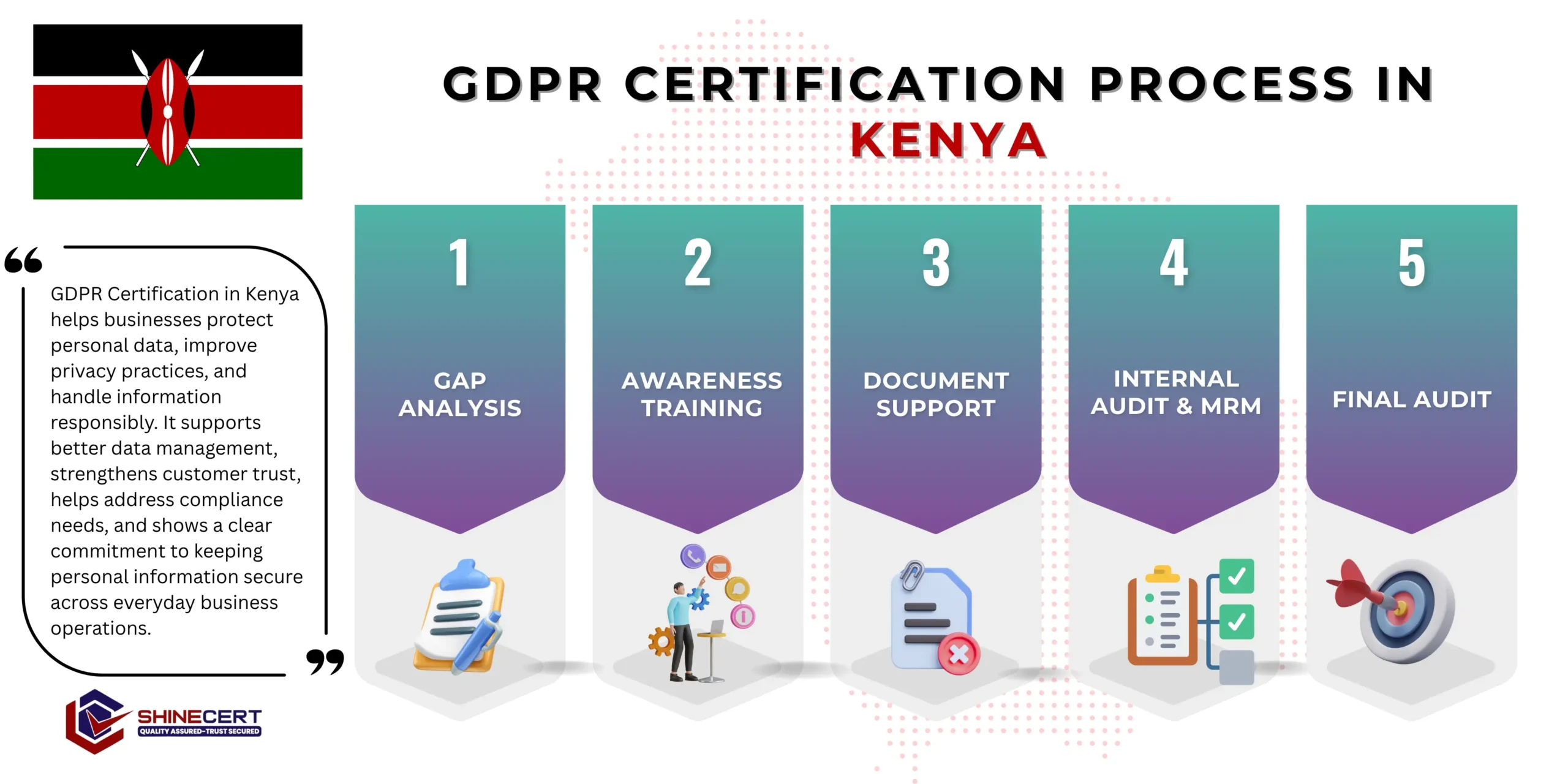
What are the steps to get GDPR Certification in Kenya?
our services
- ISO Certification Kenya
- ISO 9001 Certification Kenya
- ISO 14001 Certification Kenya
- ISO 27001 Certification Kenya
- ISO 22000 Certification Kenya
- ISO 27701 Certification Kenya
- ISO 45001 Certification Kenya
- ISO 20000-1 Certification Kenya
- ISO 13485 Certification Kenya
- ISO 17025 Certification Kenya
- ISO 31000 Certification Kenya
- ISO 42001 Certification Kenya
- ISO 37001 Certification Kenya
- ISO 22301 Certification Kenya
- ISO 50001 Certification Kenya
- CE Mark Certification Kenya
- GDPR Certification Kenya
- GMP Certification Kenya
- Halal Certification Kenya
GDPR Readiness Advisory Process for Kenyan Businesses
Applicability Assessment
We look at whether your business genuinely processes EU personal data or offers goods and services to EU-based individuals, and to what extent.
An applicability report clarifying your genuine GDPR exposure.
Gap Assessment
We review your current data protection practices against both GDPR and Kenya’s Data Protection Act, since building genuine alignment with both is considerably more efficient than treating them separately.
A gap report mapping your real practices against both frameworks side by side.
Documentation
We build records of processing, data subject rights procedures, and transfer mechanism documentation around your actual EU-facing data flows.
A complete GDPR-aligned documentation set.
Implementation
Data subject request handling, breach notification, and vendor due diligence processes move into genuine daily operational use.
Functioning data protection practice with real controls actively used and recorded.
Readiness Review
We assess your documentation and practice against the kind of due diligence EU clients and partners genuinely apply.
A readiness report you can confidently present to EU counterparts during contract negotiation.
Staying Compliant: Ongoing Requirements
GDPR alignment isn’t a certificate with a renewal cycle, it’s an ongoing legal and commercial responsibility. Given that Kenya’s adequacy decision remains pending, we recommend reviewing your cross-border transfer documentation whenever there’s meaningful movement in the adequacy process, and revisiting your broader data protection practice whenever the Data Protection Act is amended or ODPC issues significant new guidance.
GDPR Advisory Cost in Kenya
| Business Profile | Relative Investment Level | Why |
|---|---|---|
| Limited EU data processing | Lower | Narrower applicability and documentation scope |
| Moderate EU-facing operations, e.g. BPO or SaaS | Moderate | Broader records of processing and client due diligence support |
| Extensive EU data processing, e.g. fintech or healthtech | Higher | Extensive documentation given higher-risk processing categories |
There’s no flat price for GDPR advisory in Kenya. Cost genuinely comes down to six factors:
- Volume and sensitivity of EU personal data processed : Businesses handling large volumes or sensitive categories of EU data face genuinely broader documentation requirements.
- Number of EU client relationships and their specific due diligence demands : Each EU client relationship may bring its own contractual data processing requirements to address.
- Existing Data Protection Act compliance maturity : Businesses with mature ODPC compliance already have meaningful groundwork in place given the structural overlap between the two frameworks.
- Sector-specific risk category : Fintech and healthtech processing tend to involve higher-risk data categories requiring deeper documentation than general business services.
- Whether you’re pursuing ISO 27701 alongside GDPR readiness : Building GDPR alignment alongside ISO 27701 certification shares meaningful documentation infrastructure, reducing combined cost.
- Number of sub-processors and vendors in your data supply chain : Each additional sub-processor relationship requires its own due diligence assessment.
Benefits of GDPR-Aligned Practice for Kenyan Organizations
Kenyan organizations that build genuine GDPR-aligned practice gain considerably more than a document for contractual box-ticking. Here is what businesses genuinely gain:
Genuine GDPR alignment is frequently the deciding factor in whether an EU company will actually contract with a Kenyan BPO, fintech, or cloud services provider.
Businesses with genuinely mature data protection practice now are positioned to benefit immediately once Kenya’s adequacy status is formally granted, rather than scrambling afterward.
Even under current Standard Contractual Clause requirements, genuinely GDPR-aligned internal practice makes negotiating these clauses with EU partners considerably smoother.
Because Kenya’s Data Protection Act, 2019 shares substantial structural similarity with GDPR, building GDPR-aligned practice considerably strengthens your domestic ODPC compliance simultaneously.
Systematic data protection practice reduces genuine risk of the kind of data mishandling incidents that have driven ODPC’s escalating enforcement activity.
As Kenya’s BPO and tech sectors grow, demonstrable GDPR-aligned practice is a genuine way to stand out to EU clients evaluating multiple Kenyan vendors.
GDPR-aligned practice maps closely onto ISO 27701’s privacy information management requirements, useful for businesses pursuing accredited certification alongside GDPR readiness.
A Kenyan Business We’ve Worked With
- A Nairobi-based BPO company providing customer support services for a mid-sized European e-commerce client, approached us after the client’s legal team requested a data processing agreement and evidence of GDPR-aligned practice as part of a contract renewal.
- Our applicability assessment confirmed the company genuinely processed EU customer data extensively through its support operations, but records of processing were informal, and there was no documented data subject rights procedure specifically addressing EU requests.
- We built the records of processing, a proper data subject rights procedure, and supported the data processing agreement negotiation directly with the client’s legal team. The engagement took just under three months, and the company successfully renewed and expanded its contract with the client.
- This reflects a pattern we see often, genuinely capable service delivery that hadn’t yet been matched with the specific data protection documentation EU clients expect, rather than a single specific engagement.
Where GDPR Alignment Matters Most Across Kenya’s Economy?
Business Process Outsourcing Serving EU Clients
GDPR alignment is close to essential given direct handling of EU customer data on behalf of clients; pair with ISO 27701 for accredited privacy certification.
Read moreFintech and Digital Lending with EU-Linked Customers or Partners
GDPR addresses genuine sensitivity given financial data categories; pair with ISO 27001 for the underlying security foundation.
Read moreHealthtech and Telemedicine Platforms
GDPR addresses genuine health data sensitivity for any EU-linked patients or research data.
Read moreCloud Services and SaaS Providers with EU Customers
GDPR alignment is a genuine baseline expectation for any cloud provider processing EU customer data.
Read moreAI and Data Analytics Companies Processing EU-Sourced Data
GDPR’s requirements around automated decision-making and profiling are genuinely relevant for AI-driven data processing.
Read moreRealistic Timelines for Kenyan Businesses
| Business Profile | Typical Total Timeline | What Drives This |
|---|---|---|
| Limited EU data processing | 2–3 months | Narrower applicability scope and simpler documentation |
| Moderate EU-facing operations, e.g. BPO or SaaS | 3–4.5 months | Broader records of processing and vendor due diligence scope |
| Extensive EU data processing, e.g. fintech or healthtech | 4.5–7 months | Extensive documentation given higher-risk processing categories |
Beyond company size, the single biggest timeline driver is how directly and extensively your operations process EU personal data.
The Documentation Genuine GDPR Alignment Requires
A documented, actively maintained inventory of what EU personal data you process, the lawful basis, and retention periods.
Documented assessments for higher-risk processing activities involving EU personal data.
A documented, genuinely functioning process for handling EU data subjects’ access, correction, deletion, and portability requests within required timeframes.
Records showing your current legal basis for transferring EU personal data to Kenya, whether through Standard Contractual Clauses or, eventually, adequacy recognition.
Documented agreements with EU clients or partners clearly defining data processing roles and responsibilities.
A documented process for detecting, assessing, and notifying relevant authorities and affected individuals of personal data breaches within GDPR’s tight notification windows.
Documentation showing data protection considerations are genuinely built into new products, services, or systems from the outset.
Documentation showing any further sub-processors you use are genuinely assessed for GDPR alignment.
The Real Challenges Organizations Face With GDPR Alignment
- Assuming Kenya’s Data Protection Act compliance is automatically sufficient for GDPR : A common misunderstanding is assuming domestic ODPC compliance automatically satisfies GDPR, when the frameworks, while similar, have genuinely distinct specific requirements EU clients will check for directly.
- Underestimating breach notification timeframes : GDPR’s notification windows are genuinely tight, and businesses without a rehearsed breach response process often discover this only when an actual incident occurs.
- Cross-border transfer documentation that hasn’t kept pace with the adequacy process : As Kenya’s adequacy status evolves, businesses sometimes carry forward outdated Standard Contractual Clause documentation without genuinely tracking what changes once, or if, adequacy is granted.
- Sub-processor due diligence gaps : Businesses sometimes carefully manage their own data practices while giving considerably less scrutiny to further sub-processors handling the same EU data downstream.
Why Businesses Choose ShineCert in Kenya?
ShineCert brings 10 years of consulting experience to Kenya’s market, coordinated through our Riyadh and India offices with services delivered remotely or on-site depending on what your engagement genuinely needs. We’ve guided more than 10,000 organizations through certification and compliance worldwide, and we’re upfront that GDPR has no certification, only genuine compliance, this honest approach is why Kenyan businesses increasingly choose ShineCert as the best GDPR consultant in Kenya for informed, EU-client-ready guidance.
Choosing an Advisor in Kenya?
What to Check | Why It Matters |
Genuine transparency that GDPR has no certification, only compliance | An advisor offering a “GDPR certificate” is misrepresenting the regulation |
Real understanding of both GDPR and Kenya’s Data Protection Act together | Ensures efficient, non-duplicative compliance work across both frameworks |
Experience with your specific sector’s EU client due diligence expectations | BPO, fintech, and healthtech face genuinely different EU client scrutiny |
Awareness of Kenya’s evolving adequacy decision status | Ensures your transfer documentation approach reflects the current, genuine state of the process |
Ready to Get Started?
Whether you’re preparing for EU client due diligence or positioning ahead of Kenya’s pending adequacy decision, we’ll walk through your specific data processing activities and cost factors honestly, including exactly what GDPR compliance does and doesn’t involve, before proposing a fixed-scope plan, delivered remotely, on-site, or however genuinely fits your project. Book a free consultation or contact us directly to get started.
Frequently Asked Questions
Look for a consultant upfront that GDPR has no certification, with genuine understanding of both GDPR and Kenya’s Data Protection Act together, and sector-specific EU client due diligence experience. ShineCert scopes every Kenya engagement individually.
No, GDPR has no certification scheme. Compliance is an ongoing legal and operational responsibility, though ISO 27701 offers genuine, accredited certification for privacy information management that maps closely onto GDPR requirements.
Not necessarily, if you process EU personal data or serve EU-based individuals, GDPR applies to you directly regardless of your Data Protection Act compliance, though the two frameworks share substantial structural overlap that makes joint compliance considerably more efficient.
If granted, it would let personal data flow between Kenya and the EU without needing separate transfer mechanisms like Standard Contractual Clauses, genuinely reducing administrative burden, particularly relevant for BPO, fintech, healthcare, and cloud services businesses.
It genuinely depends on your volume of EU data processing, number of EU client relationships, and existing Data Protection Act compliance maturity, we scope every project individually.
Typically two to seven months depending on the extent and sensitivity of your EU data processing, see our detailed timeline breakdown above.
Documentation and advisory work runs effectively over remote sessions, with in-person engagement most valuable for staff training and process verification.
ShineCert doesn’t maintain a standalone Kenya office; we coordinate Kenya engagements from our Riyadh and India offices, with services delivered remotely or on-site as your project requires.