
GMP Certification in Kenya
Quick Answer
Good Manufacturing Practice, commonly known as GMP, sets out the quality controls required to consistently produce safe, effective health products and food. In Kenya, the Pharmacy and Poisons Board (PPB) has adopted GMP guidelines built directly on World Health Organization technical standards, with Kenya-specific adaptations addressing local regulatory circumstances. PPB conducts GMP inspections of manufacturing facilities as a core part of pharmaceutical supply chain oversight, and offers preferential fees and expedited evaluation timelines of three to six months specifically for locally manufactured products. GMP certification is close to essential for pharmaceutical manufacturers and genuinely valuable for food and health product manufacturers more broadly. Certification typically takes three to six months, and cost depends on real factors like your facility’s current quality infrastructure.
Understanding GMP
Good Manufacturing Practice is a quality assurance framework ensuring products are consistently produced and controlled according to quality standards appropriate to their intended use. It covers facility design and cleanliness, equipment qualification, raw material control, production process validation, quality control testing, documentation practices, and personnel training. In Kenya, PPB’s GMP guidelines are explicitly based on WHO technical guidance, meaning a Kenyan GMP certification carries genuine credibility aligned with globally recognized manufacturing quality expectations, while still reflecting Kenya-specific regulatory adaptations. GMP compliance is verified through facility inspection by PPB or another recognized body, distinct from a management-system-style certification audit, though many manufacturers pursue both GMP compliance and complementary ISO certifications together.
Why It’s Becoming Essential for Kenyan Businesses Right Now?
- PPB’s direct GMP inspection authority means non-compliance carries genuinely immediate regulatory consequences for manufacturers : With GMP inspections explicitly described by PPB as critical to safeguarding public health and maintaining pharmaceutical supply chain integrity, manufacturers face real, ongoing regulatory scrutiny rather than a one-time certification requirement that fades into the background.
- PPB’s WHO-aligned framework means Kenyan GMP compliance is genuinely recognized well beyond domestic borders : Because PPB’s guidelines are explicitly built on WHO technical guidance, Kenyan manufacturers achieving compliance are positioned for credibility with international regulators and buyers evaluating supply chain quality, not just domestic market access.
- PPB’s preferential fees and expedited evaluation timelines for local manufacturers create genuine incentive to formalize GMP compliance now : With expedited evaluation timelines of three to six months specifically offered to locally manufactured products, Kenyan manufacturers who achieve demonstrable GMP compliance are positioned to benefit from a genuinely faster regulatory pathway than manufacturers without it.
- Kenya’s strengthening regulatory collaboration with international partners, including India, signals rising cross-border scrutiny of manufacturing quality : As PPB continues building regulatory collaboration relationships internationally, Kenyan manufacturers with demonstrably robust GMP practices are better positioned as these relationships mature into more active mutual recognition or information-sharing arrangements.
What are the steps to get GMP Certification in Kenya?
our services
- ISO Certification Kenya
- ISO 9001 Certification Kenya
- ISO 14001 Certification Kenya
- ISO 27001 Certification Kenya
- ISO 22000 Certification Kenya
- ISO 27701 Certification Kenya
- ISO 45001 Certification Kenya
- ISO 20000-1 Certification Kenya
- ISO 13485 Certification Kenya
- ISO 17025 Certification Kenya
- ISO 31000 Certification Kenya
- ISO 42001 Certification Kenya
- ISO 37001 Certification Kenya
- ISO 22301 Certification Kenya
- ISO 50001 Certification Kenya
- CE Mark Certification Kenya
- GDPR Certification Kenya
- GMP Certification Kenya
- Halal Certification Kenya
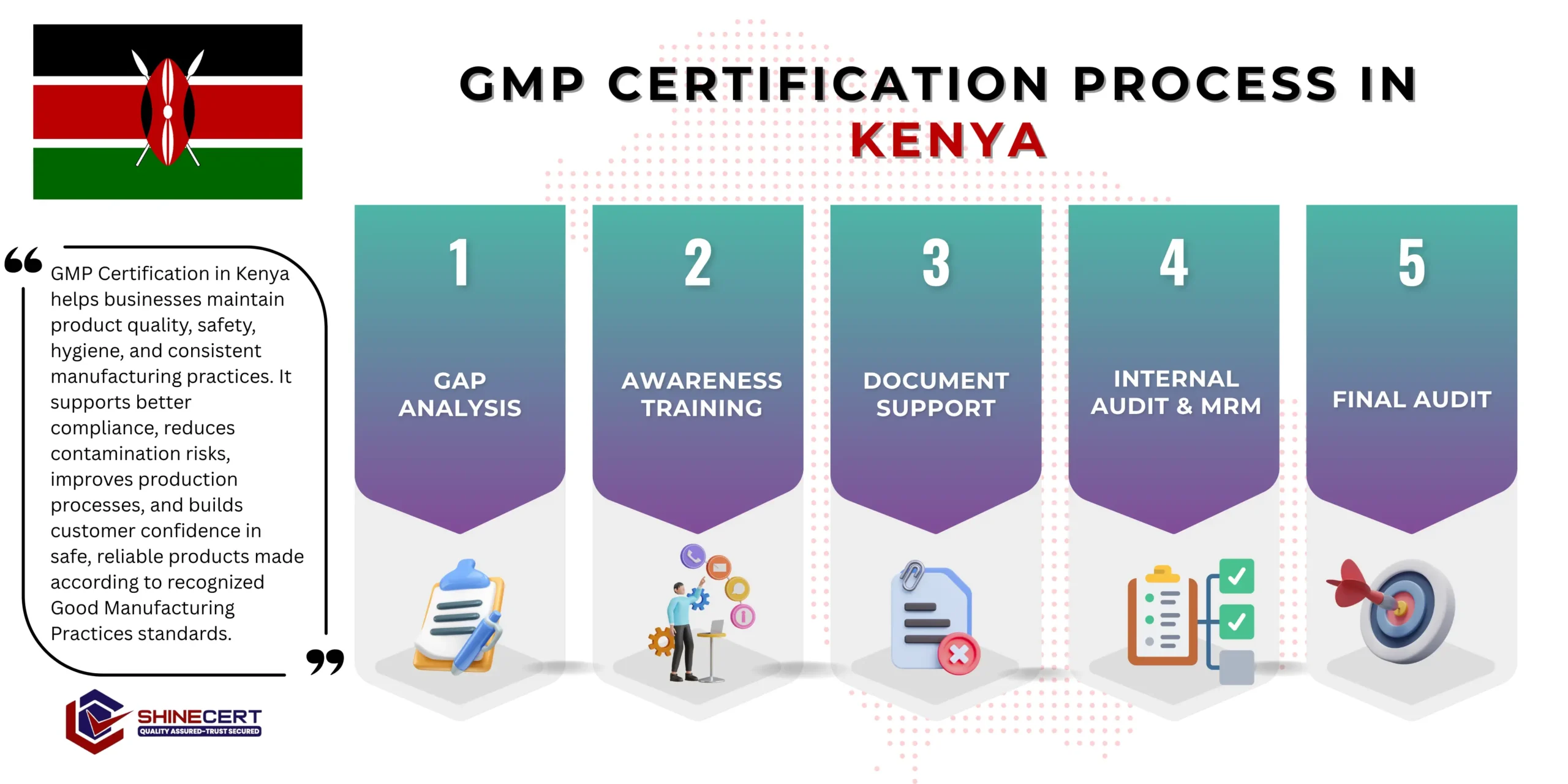
GMP Certification Process in Kenya
Gap Assessment
We walk your actual manufacturing facility and review current practices against PPB’s WHO-aligned GMP guidelines, identifying genuine gaps.
A gap report mapping your real manufacturing practices against GMP requirements.
Documentation
We build your quality manual, standard operating procedures, and batch record systems around your actual production processes.
A complete GMP documentation set, tied to your real manufacturing operations.
Implementation
Process controls, batch documentation, and deviation management move into genuine daily manufacturing use.
A functioning GMP system with real controls actively used and recorded.
Self-Inspection
We audit against every GMP requirement ourselves, surfacing gaps while stakes are low.
A self-inspection report and corrective actions closed out before the PPB inspection.
PPB Inspection
PPB, or another recognized inspecting body depending on your product category, visits your facility and reviews your actual batch and quality records. We stay engaged through the process.
GMP compliance recognition, positioning you for PPB’s expedited evaluation pathway where applicable.
Staying Certified: Surveillance and Renewal
GMP compliance requires ongoing adherence, verified through periodic PPB inspections rather than a fixed multi-year certificate cycle in the way ISO management system certifications work. Maintaining compliance means genuinely sustaining your documented processes, batch records, and self-inspection cycle between formal PPB visits. Given that PPB’s guidelines are explicitly WHO-based and continue to evolve, we recommend reviewing your GMP documentation whenever PPB issues updated guidance.
GMP Certification Cost in Kenya
| Business Profile | Relative Investment Level | Why |
|---|---|---|
| Small manufacturer, single product line | Lower | Narrower process validation and documentation scope |
| Medium manufacturer, multiple product lines | Moderate | Broader batch record systems across product lines |
| Larger pharmaceutical or health product manufacturer | Higher | Extensive facility qualification and process validation requirements |
| Bundled with ISO 22000 or ISO 13485 | Moderate-to-higher combined, lower than separate engagements | Shared quality infrastructure reduces combined cost |
There’s no flat price for GMP certification in Kenya. Cost genuinely comes down to six factors:
- Number of product lines manufactured : Each additional product line typically requires its own process validation and batch record documentation.
- Facility and equipment qualification needs : Facilities requiring formal equipment qualification from scratch face genuinely more work than those with existing qualification documentation.
- Existing quality documentation maturity : Manufacturers with well-established SOPs and batch records already in place aren’t starting from zero.
- Product risk category : Pharmaceutical products typically require more extensive validation than lower-risk food or general health products.
- PPB inspection and regulatory fees, tracked separately from our consulting fees : Inspection fees are invoiced directly by PPB or the relevant inspecting body.
- Whether you’re bundling with ISO 22000 or ISO 13485 : Building GMP alongside these standards shares meaningful quality infrastructure, reducing combined cost.
Benefits of GMP Certification for Kenyan Organizations
Kenyan manufacturers that achieve GMP compliance gain considerably more than a document proving quality processes exist. Here is what compliant businesses genuinely gain:
Demonstrable GMP compliance positions locally manufactured products for PPB’s preferential fees and faster, three-to-six-month evaluation timelines.
Systematic process validation and quality control testing catch manufacturing defects before products reach patients or consumers.
Because Kenya’s GMP framework is WHO-aligned, compliance carries genuine weight with international buyers and regulators evaluating Kenyan-manufactured products.
A genuinely mature, documented GMP system means routine PPB inspections proceed considerably more smoothly, with fewer findings requiring corrective action.
GMP compliance is frequently a genuine prerequisite for exporting pharmaceuticals, health products, or food products to international markets.
Documented process controls and quality testing provide genuine evidence of proactive quality management if a product issue is ever reviewed.
Public health procurement and larger private healthcare or food distribution buyers increasingly require demonstrable GMP compliance as a genuine condition of supply.
GMP compliance forms a core prerequisite program within both ISO 22000 for food businesses and ISO 13485 for medical device manufacturers, making it a genuinely efficient starting point.
A Kenyan Business We’ve Worked With
- A Nairobi-area nutraceutical manufacturer, producing vitamin and supplement products for domestic retail and a growing regional export line, approached us after PPB flagged documentation gaps during a routine facility visit, specifically around batch record completeness and raw material verification.
- Our gap assessment found the company’s actual production practices were genuinely careful, but batch records were incomplete in places, and there was no formal supplier verification process for raw material ingredients coming from multiple sources.
- We built a complete batch record system and a supplier verification procedure covering their actual ingredient sourcing, along with a self-inspection cycle to catch documentation gaps before future PPB visits. The process took just under four months, and the company’s subsequent PPB inspection proceeded with no significant findings.
- This reflects a pattern we see often, genuinely careful production practice that hadn’t yet been matched with equally careful documentation, rather than a single specific engagement.
Where Certification Matters Most Across Kenya’s Economy?
Pharmaceutical Manufacturing
GMP is close to essential given direct PPB regulatory obligations; pair with ISO 13485 if the business also manufactures medical devices.
Read moreNutraceutical and Supplement Manufacturing
GMP addresses genuine quality and safety expectations for products regulated similarly to pharmaceuticals in many markets.
Read moreFood and Beverage Manufacturing
GMP forms a core prerequisite program within ISO 22000, relevant for businesses formalizing broader food safety management.
Read moreCosmetics and Personal Care Manufacturing
GMP addresses genuine manufacturing quality expectations increasingly relevant as this sector grows in Kenya.
Read moreTraditional and Herbal Medicine Manufacturing
GMP supports genuine quality assurance as this sector faces increasing regulatory attention from PPB.
Read moreRealistic Timelines for Kenyan Businesses
| Business Profile | Typical Total Timeline | What Drives This |
|---|---|---|
| Small manufacturer, single product line | 2.5–3.5 months | Narrower process validation and documentation scope |
| Medium manufacturer, multiple product lines | 3.5–5.5 months | Broader batch record systems across product lines |
| Larger pharmaceutical or health product manufacturer | 5.5–8 months | Extensive process validation and facility qualification requirements |
| Bundled with ISO 22000 or ISO 13485 | Add roughly 3-5 weeks to the relevant tier above | Shared quality infrastructure meaningfully shortens the combined path |
Beyond company size, the single biggest timeline driver is how developed your existing quality and documentation practices already are before starting.
The Documentation PPB and Auditors Expect
A documented overview of your quality management approach, aligned with WHO-based GMP principles and PPB’s Kenya-specific requirements.
Documented, step-by-step procedures for every significant manufacturing process, from raw material receipt through finished product release.
Documentation showing each production batch was manufactured and tested according to defined specifications, with genuine traceability.
Documentation showing your facility and equipment have been formally qualified as suitable for their intended manufacturing purpose.
Documentation showing incoming materials are genuinely verified against specifications before use in production.
A documented, actively used process for capturing manufacturing deviations and the corrective actions taken in response.
Evidence that staff involved in manufacturing have genuinely received GMP-specific training appropriate to their role.
A planned internal self-inspection cycle and documented management review decisions on quality priorities.
The Real Challenges Organizations Face While Implementing GMP
- Assuming careful production alone is sufficient without matching documentation : Manufacturers with genuinely careful practices sometimes underestimate how much formal batch record and validation documentation GMP actually requires.
- Raw material verification gaps with multiple suppliers : A common gap is verifying primary suppliers carefully while giving less scrutiny to secondary or backup ingredient sources.
- Self-inspection becoming a formality rather than a genuine check : Auditors and PPB inspectors specifically probe whether self-inspection findings actually lead to corrective action, or whether the process has become a box-ticking exercise.
- Documentation discipline drifting after initial compliance : Documentation discipline tends to drift once the pressure of an initial PPB inspection passes, particularly across shift changes or staff turnover.
Why Businesses Choose ShineCert in Kenya?
ShineCert brings 10 years of ISO consulting and certification experience to Kenya’s market, coordinated through our Riyadh and India offices with services delivered remotely or on-site depending on what your engagement genuinely needs. We’ve guided more than 10,000 organizations through certification worldwide, and we build every Kenya GMP engagement around your actual manufacturing processes and PPB obligations, this is why Kenyan manufacturers increasingly choose ShineCert as the best GMP consultant in Kenya.
Choosing a Certification Body in Kenya?
What to Check | Why It Matters |
Genuine familiarity with PPB’s WHO-based GMP guidelines | Ensures your compliance program reflects actual Kenyan regulatory expectations |
Experience with your specific product category | Pharmaceuticals, nutraceuticals, and food products involve genuinely different GMP considerations |
Understanding of PPB’s expedited evaluation pathway requirements | Relevant if you’re pursuing GMP compliance specifically to access faster local-manufacturer evaluation timelines |
Willingness to build a genuinely sustainable self-inspection practice | The real value of GMP compliance comes from ongoing discipline, not a one-time inspection pass |
Ready to Get Started?
Whether you’re preparing for a PPB inspection or positioning your facility for expedited local-manufacturer evaluation, we’ll walk through your specific products and cost factors before proposing a fixed-scope plan, delivered remotely, on-site, or however genuinely fits your project. Book a free consultation or contact us directly to get started.
Frequently Asked Questions
Look for genuine familiarity with PPB’s WHO-based guidelines, sector-specific experience, and a willingness to build sustainable self-inspection practice. ShineCert scopes every Kenya engagement individually.
No, GMP is a manufacturing quality framework verified through facility inspection, typically by PPB, while ISO standards like ISO 9001 or ISO 22000 are management system certifications verified through accredited audit. Many manufacturers pursue both.
It genuinely depends on your number of product lines, facility qualification needs, and existing documentation maturity, we scope every project individually.
Typically two and a half to eight months depending on organization size and product risk category, see our detailed timeline breakdown above.
Demonstrable GMP compliance is a genuine factor supporting eligibility for PPB’s preferential fees and faster, three-to-six-month evaluation timelines for locally manufactured products.
It’s close to mandatory in practice for pharmaceutical manufacturers under PPB oversight, and genuinely valuable, though not always legally required, for food and other health product manufacturers.
Documentation work runs effectively over remote sessions, but facility qualification and process validation genuinely require in-person site visits.
ShineCert doesn’t maintain a standalone Kenya office; we coordinate Kenya engagements from our Riyadh and India offices, with services delivered remotely or on-site as your project requires.