
Halal Certification in Kenya
Quick Answer
Halal certification in Kenya is issued primarily through the Kenya Bureau of Halal Certification (KBHC), a private certification body recognized as a member of the World Halal Council, rather than through a government-run mandatory scheme. It’s important to be upfront about something genuinely relevant right now: a constitutional petition currently before the Kenya High Court is challenging the use of private Halal certification as a de facto mandatory requirement for market access in parts of the meat supply chain, with petitioners arguing this has occurred without a clear legal basis making it compulsory. What this means practically: Halal certification remains a genuinely valuable, market-driven credential for businesses serving Muslim consumers domestically and export markets across the Gulf and broader Muslim-majority world, but it is not currently established as a blanket legal requirement under Kenyan law. We help Kenyan food and meat businesses navigate certification honestly, understanding both its commercial value and its actual legal standing.
Understanding Halal Certification
Halal certification verifies that food products, and the processes used to produce them, comply with Islamic dietary law. For meat specifically, this includes requirements around slaughter method, handling, and processing. In Kenya, certification is issued by the Kenya Bureau of Halal Certification, which holds recognition from the World Halal Council, an international body that provides mutual recognition frameworks between national Halal certifiers so a certificate issued in one country carries genuine credibility elsewhere. This is distinct from Kenya Bureau of Standards (KEBS) certification, which addresses general product quality and safety standards rather than religious dietary compliance specifically. A business may hold KEBS certification, Halal certification, or both, depending on its market and product requirements.
Why It’s Becoming Relevant for Kenyan Businesses Right Now?
- Halal certification remains genuinely valuable for export to Gulf and Muslim-majority markets regardless of the current domestic legal debate : Businesses exporting meat, processed foods, or other consumables to Gulf Cooperation Council countries, Malaysia, Indonesia, and other Muslim-majority markets typically face Halal certification as a genuine, well-established requirement for market access, independent of Kenya’s own domestic legal framework.
- The ongoing High Court petition means businesses should understand the difference between commercial value and legal obligation : With petitioners specifically arguing that private Halal certification has become a de facto but not legally mandated requirement in parts of Kenya’s domestic meat supply chain, businesses benefit from clarity on where certification is a genuine commercial advantage versus where it may be being applied as an unofficial gatekeeping requirement without clear legal grounding.
- Kenya’s domestic Muslim consumer base and Halal-conscious food service sector continue to value the credential regardless of the legal question : Independent of the court petition’s outcome, a meaningful share of Kenyan consumers and food service operators genuinely prefer or seek out Halal-certified products, making certification commercially relevant on its own merits.
- Regulators have been asked to clarify certification’s legal status, which may bring genuinely useful clarity for businesses currently uncertain about their obligations : The court has directed regulators including KEBS to clarify the legal status of certification systems and improve transparency in labelling and pricing, a positive development for businesses wanting clearer footing either way.
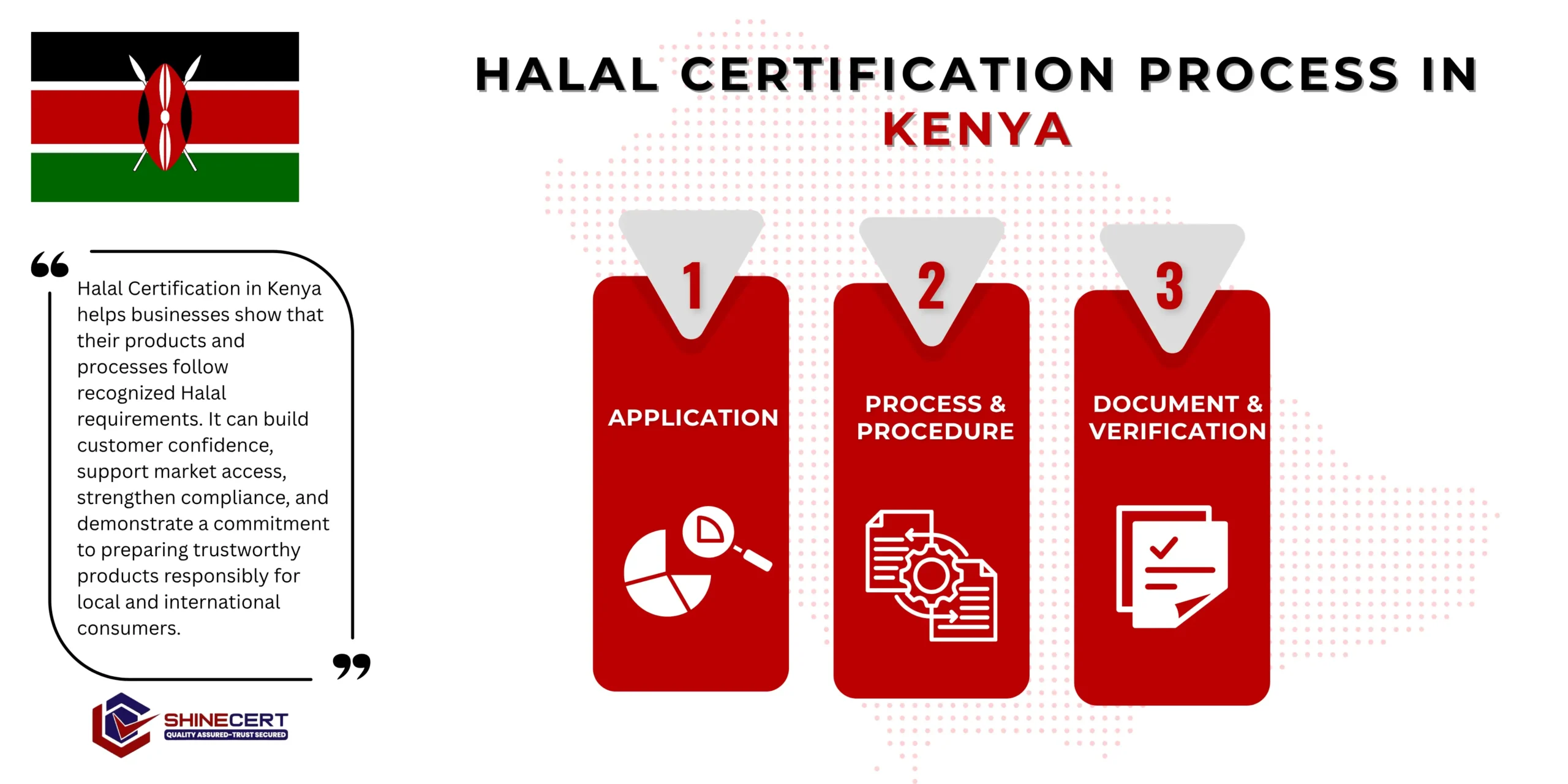
What are the steps to get Halal Certification in Kenya?
our services
- ISO Certification Kenya
- ISO 9001 Certification Kenya
- ISO 14001 Certification Kenya
- ISO 27001 Certification Kenya
- ISO 22000 Certification Kenya
- ISO 27701 Certification Kenya
- ISO 45001 Certification Kenya
- ISO 20000-1 Certification Kenya
- ISO 13485 Certification Kenya
- ISO 17025 Certification Kenya
- ISO 31000 Certification Kenya
- ISO 42001 Certification Kenya
- ISO 37001 Certification Kenya
- ISO 22301 Certification Kenya
- ISO 50001 Certification Kenya
- CE Mark Certification Kenya
- GDPR Certification Kenya
- GMP Certification Kenya
- Halal Certification Kenya
Halal Certification Process in Kenya
Eligibility Review
We look at your actual products, sourcing, and processing methods to genuinely assess Halal certification feasibility before committing resources.
An eligibility assessment identifying what changes, if any, your operation needs before certification.
Documentation
We build traceability records, supplier verification documentation, and process records around your actual supply chain and production methods.
A complete documentation package ready for certifier review.
Facility Preparation
Where segregation or process adjustments are needed, we help implement these changes and arrange relevant staff training.
A facility and process genuinely ready for certification audit.
Certifier Audit
KBHC or another World Halal Council-recognized body reviews your documentation and inspects your facility.
Audit findings and any corrective actions needed before certificate issuance.
Certificate Issuance
Upon successful audit, your Halal certificate is issued.
Your Halal certificate, with a defined validity period and renewal requirements set by the issuing body.
Staying Certified: Renewal and Ongoing Compliance
Halal certificate validity periods are set by the issuing certification body and typically require periodic renewal audits, alongside ongoing surveillance to confirm processes remain compliant between renewals. Because Kenya’s regulatory and legal environment around certification is genuinely evolving, including the pending High Court petition, we recommend staying informed of any regulatory clarifications that may affect labelling, marketing claims, or documentation requirements going forward.
Halal Certification Cost in Kenya
| Business Profile | Relative Investment Level | Why |
|---|---|---|
| Single-product processor, straightforward sourcing | Lower | Narrower documentation and audit scope |
| Meat processor requiring facility segregation | Moderate | Facility adjustments and training add cost |
| Larger exporter, multiple product lines | Higher | Extensive documentation across product lines and markets |
There’s no flat price for Halal certification in Kenya. Cost genuinely comes down to six factors:
- Whether facility segregation is required : Facilities already dedicated entirely to Halal production face lower costs than those needing physical or procedural segregation from non-Halal operations.
- Number of product lines requiring certification: Each additional product line typically needs its own traceability and sourcing verification.
- Existing supplier documentation maturity : Businesses already working with Halal-verified suppliers have less sourcing verification work to do.
- Export market requirements, if relevant : Some export markets have specific additional documentation or recognition requirements beyond baseline KBHC certification.
- Certification body fees, tracked separately from our consulting fees : The certification audit and certificate issuance itself is invoiced directly by the certifying body.
- Staff training scope : The number of personnel requiring Halal compliance training affects training program cost and duration.
Benefits of Halal Certification for Kenyan Organizations
Kenyan food and meat businesses that pursue certification gain considerably more than a document for supply chain gatekeeping. Here is what certified businesses genuinely gain:
Halal certification through KBHC’s World Halal Council recognition gives Kenyan exporters credibility that’s genuinely recognized in key international markets.
Certification lets you genuinely serve Muslim consumers and food service operators who specifically seek Halal-verified products.
As the legal debate around mandatory certification continues, businesses that pursue certification voluntarily and transparently position themselves clearly, regardless of how the broader legal question resolves.
KBHC’s recognition provides a level of mutual acceptance across markets that a purely domestic certification scheme wouldn’t offer.
For businesses supplying customers or distributors who specifically require Halal certification, having it removes a genuine point of friction in commercial negotiations.
Halal certification complements, rather than replaces, food safety certifications like ISO 22000, useful for businesses building comprehensive food quality and compliance credentials.
A Kenyan Business We’ve Worked With
- A Mombasa-based meat processor supplying both domestic retailers and a small but growing export line to Gulf markets approached us uncertain about whether pursuing Halal certification was genuinely necessary given the ongoing public debate about mandatory certification requirements.
- Our eligibility review found the company’s actual slaughter and processing practices were already substantively aligned with Halal requirements informally, but there was no documented traceability system or formal certification to support their export ambitions to Gulf markets, where the requirement is well-established regardless of Kenya’s domestic legal question.
- We helped the company pursue voluntary KBHC certification specifically to support export market access, while being transparent with them that domestic sales didn’t legally require it. The certification process took about ten weeks, and the company successfully used the certificate to open a new Gulf export relationship.
- This reflects a pattern we see often, businesses genuinely uncertain about a public debate that, in practice, doesn’t change the well-established export market value of certification, rather than a single specific engagement.
Where Certification Matters Most Across Kenya’s Economy?
Meat Processing and Slaughterhouses
Halal certification is directly central to product eligibility for Muslim consumers and export markets; pair with ISO 22000 for combined food safety and Halal compliance.
Read moreFood Export to Gulf and Muslim-Majority Markets
Halal certification is close to essential for market access regardless of Kenya’s domestic legal debate.
Read moreHospitality and Catering Serving Muslim Clientele
Halal certification supports genuine service to Muslim guests and broader inclusive hospitality positioning.
Read morePackaged and Processed Foods Targeting Domestic Halal-Conscious Consumers
Certification supports genuine market access to Kenya’s Muslim consumer base.
Read moreIngredient Suppliers to Halal-Certified Manufacturers
Upstream suppliers increasingly need their own Halal verification to support downstream customers’ certification requirements.
Read moreRealistic Timelines for Kenyan Businesses
| Business Profile | Typical Total Timeline | What Drives This |
|---|---|---|
| Single-product processor, straightforward sourcing | 6–9 weeks | Narrower traceability scope and simpler process documentation |
| Meat processor requiring facility segregation | 9–14 weeks | Facility adjustments and staff training add meaningful time |
| Larger exporter, multiple product lines | 12–18 weeks | Extensive traceability across product lines and export market-specific requirements |
Beyond company size, the single biggest timeline driver is whether your facility already has adequate segregation and trained personnel, or whether these need to be established as part of the certification process.
The Documentation Halal Certifiers Expect
For meat businesses, documented evidence that slaughter methods comply with Halal requirements, including trained personnel and appropriate facilities.
Documentation tracing ingredients and processing steps to confirm no cross-contamination with non-Halal materials occurs.
Records showing raw materials and ingredients sourced from Halal-compliant suppliers, with supporting documentation from upstream suppliers where relevant.
Documentation showing genuine physical or procedural segregation between Halal and non-Halal production where a facility handles both.
Evidence that relevant personnel, particularly those involved in slaughter or handling, have genuinely received appropriate Halal compliance training.
Documentation confirming Halal claims on packaging and marketing materials genuinely reflect certified status, particularly relevant given the current transparency concerns raised in the court petition.
The Real Challenges Organizations Face While Implementing Halal Certification
- Confusing domestic legal uncertainty with export market requirements : Businesses sometimes assume the ongoing legal debate about domestic mandatory status means certification isn’t worth pursuing, missing that export market requirements are genuinely separate and well-established.
- Underestimating traceability documentation for supply chains with multiple suppliers : A common gap is tracing your own processing carefully while not verifying Halal compliance further up the supply chain with ingredient or livestock suppliers.
- Facility segregation gaps in shared production environments : Facilities producing both Halal and non-Halal products sometimes have informal separation practices that don’t meet the documented segregation standard auditors expect.
- Labelling claims that outpace actual certification status : Given the transparency concerns raised in the current court petition, businesses should be genuinely careful that Halal claims on packaging accurately reflect verified certification status.
Why Businesses Choose ShineCert in Kenya?
ShineCert brings 10 years of ISO consulting and certification experience to Kenya’s market, coordinated through our Riyadh and India offices with services delivered remotely or on-site depending on what your engagement genuinely needs. We’ve guided more than 10,000 organizations through certification worldwide, and we’re upfront with Kenyan clients about Halal certification’s actual legal status alongside its genuine commercial value, this is why Kenyan food and meat businesses increasingly choose ShineCert as the best Halal certification consultant in Kenya for honest, informed guidance.
Choosing a Certification Body in Kenya?
What to Check | Why It Matters |
World Halal Council recognition | Confirms genuine international mutual recognition relevant to export markets |
Transparency about certification’s actual legal status in Kenya | Given the ongoing court petition, an honest certifier should be upfront that certification is currently market-driven, not a blanket legal mandate |
Experience with your specific product category | Meat processing and packaged foods involve genuinely different certification considerations |
Recognition by your target export markets | Some Gulf and Asian markets have specific certifier recognition requirements worth confirming upfront |
Ready to Get Started?
Whether you’re pursuing export market access or serving Kenya’s domestic Halal-conscious consumers, we’ll walk through your specific products and cost factors honestly, including certification’s actual legal standing, before proposing a fixed-scope plan, delivered remotely, on-site, or however genuinely fits your project. Book a free consultation or contact us directly to get started.
Frequently Asked Questions
Look for a consultant who is transparent about certification’s actual legal status in Kenya, has genuine World Halal Council-recognized certifier relationships, and understands your specific export markets. ShineCert scopes every Kenya engagement individually.
As of mid-2026, there is no blanket Kenyan legislation making Halal certification compulsory. A constitutional petition currently before the High Court is specifically challenging the use of private Halal certification as a de facto mandatory requirement in parts of the meat supply chain without clear legal basis. We recommend businesses stay informed as this matter proceeds through the courts.
Yes, typically, Gulf Cooperation Council countries and other Muslim-majority markets generally maintain well-established Halal certification requirements for meat and food imports, independent of Kenya’s domestic legal situation.
It genuinely depends on whether facility segregation is needed, your number of product lines, and existing supplier documentation maturity, we scope every project individually.
Typically six to eighteen weeks depending on your facility’s existing alignment with Halal requirements and product line complexity, see our detailed timeline breakdown above.
KEBS certification addresses general product quality and safety standards, while Halal certification specifically verifies compliance with Islamic dietary law. A business may need one, both, or neither depending on its products and markets.
Documentation and traceability work runs effectively over remote sessions, but facility audits and slaughter process verification genuinely require in-person site visits.
ShineCert doesn’t maintain a standalone Kenya office; we coordinate Kenya engagements from our Riyadh and India offices, with services delivered remotely or on-site as your project requires.