
ISO 45001 Certification in Kenya
Quick Answer
ISO 45001 is the international standard for occupational health and safety management systems, and Kenya’s regulatory environment around it is undergoing genuine, active transformation: the Directorate of Occupational Safety and Health Services (DOSHS), alongside the Kenya Bureau of Standards, is rolling out a 2026 manufacturing safety overhaul shifting from passive equipment use to data-driven, proactive safety systems, with fatal accidents now requiring DOSHS notification within 24 hours and non-compliance carrying fines up to Ksh1,000,000 or 12 months imprisonment. A certified safety management system gives your organization a structured, internationally recognized way to meet this genuinely tightening standard systematically. Certification typically takes three to five months, and cost depends on real factors like workforce size and hazard profile, never a flat number quoted upfront.
Understanding ISO 45001
ISO 45001 is an international standard, published by the International Organization for Standardization, that sets out requirements for an occupational health and safety management system, a structured way an organization identifies workplace hazards, manages risk to workers, and continually improves its safety performance. It applies to any organization regardless of sector or size, and requires genuine worker consultation and participation in hazard identification, not just top-down safety rules. Certification means an independent, accredited body has formally verified your safety management system meets the standard’s requirements, giving regulators, employees, and business partners genuine confidence your organization manages safety systematically, not just reactively after DOSHS’s 24-hour incident reporting requirement forces attention onto a problem.
Why It’s Becoming Essential for Kenyan Businesses Right Now?
- Kenya’s 2026 manufacturing safety overhaul explicitly demands proactive, data-driven safety management, exactly what ISO 45001 is built to deliver : With DOSHS and KEBS jointly driving a shift away from passive equipment compliance toward systematic, data-driven safety practice, businesses that already run a certified occupational health and safety management system are demonstrably ahead of where Kenyan regulation is explicitly heading, rather than scrambling to build proactive systems once new rules are gazetted.
- Reporting obligations are now genuinely fast and unforgiving : Fatal accidents require DOSHS notification within 24 hours, and non-fatal injuries or occupational diseases require written notice within 7 days, a genuinely tight window that’s considerably easier to meet when your organization already has documented incident response procedures, rather than building one under real pressure after an actual incident.
- Penalties for non-compliance carry genuine financial and personal consequences : Where non-compliance causes death or serious injury, occupiers and owners face fines up to Ksh1,000,000 or up to 12 months imprisonment, a real, personal-liability-level risk that makes demonstrable, documented safety management a genuine business priority, not just a compliance nicety.
- Proposed structural reform signals occupational safety regulation in Kenya is only getting more serious : With a bill proposing to transform DOSHS into the Occupational Safety and Health and Injury Compensation Authority (OSHICA) and amend both the OSH Act 2007 and the Workplace Injuries Benefit Act 2007, businesses have genuine reason to expect continued regulatory strengthening rather than a static compliance bar.
What are the steps to get ISO 45001 Certification in Kenya?
our services
- ISO Certification Kenya
- ISO 9001 Certification Kenya
- ISO 14001 Certification Kenya
- ISO 27001 Certification Kenya
- ISO 22000 Certification Kenya
- ISO 27701 Certification Kenya
- ISO 45001 Certification Kenya
- ISO 20000-1 Certification Kenya
- ISO 13485 Certification Kenya
- ISO 17025 Certification Kenya
- ISO 31000 Certification Kenya
- ISO 42001 Certification Kenya
- ISO 37001 Certification Kenya
- ISO 22301 Certification Kenya
- ISO 50001 Certification Kenya
- CE Mark Certification Kenya
- GDPR Certification Kenya
- GMP Certification Kenya
- Halal Certification Kenya
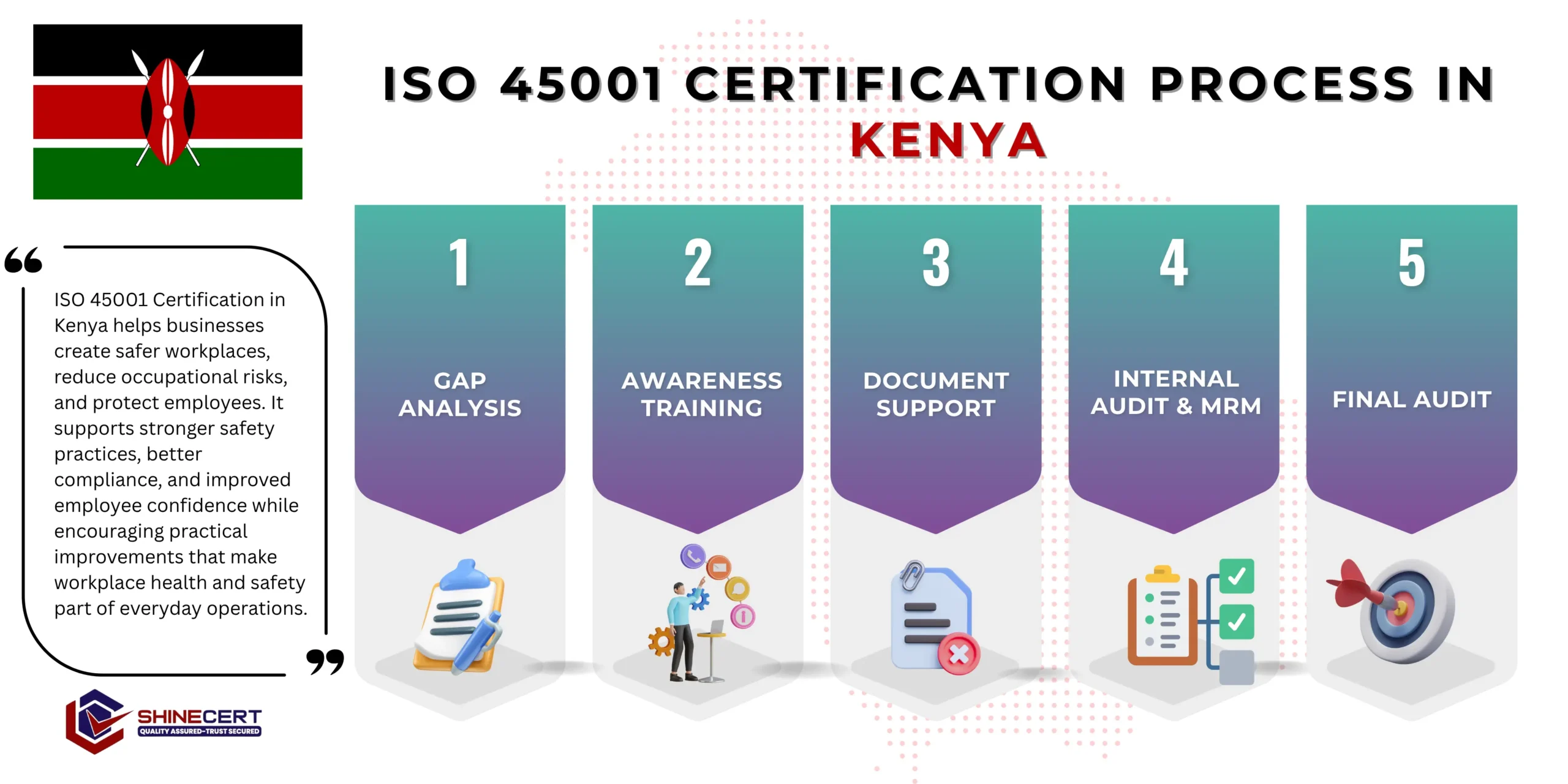
ISO 45001 Certification Process in Kenya
Gap Assessment
We walk your actual work sites and talk directly with workers, not just supervisors, about real hazards they encounter, mapping what we find against ISO 45001’s requirements and your genuine DOSHS obligations, including the new 2026 data-driven safety expectations.
A gap report identifying your real hazard profile and current DOSHS compliance status.
Documentation
We build your OH&S policy, hazard identification and risk assessment records, and legal register around your actual operations, with worker consultation genuinely built into the process.
A complete OH&S documentation set tailored to your real hazard profile.
Implementation
Operational controls for identified hazards move into real daily practice, permit systems get used, PPE requirements get enforced, workers get trained on hazards specific to their role.
A functioning OH&S system with real hazard controls in active use.
Internal Audit and Management Review
We audit against every ISO 45001 clause and DOSHS’s applicable requirements, surfacing gaps while stakes are low. Findings go to formal management review with documented decisions.
An internal audit report and corrective actions closed out before the certification audit.
Certification Audit
Stage 1 confirms your documentation is genuinely audit-ready; Stage 2 has the auditor observe safety controls in practice and interview workers directly. We stay engaged through both stages.
Your ISO 45001 certificate, valid for three years, plus a surveillance audit schedule.
Staying Certified: Surveillance and Renewal
An ISO 45001 certificate is valid for three years. During years one and two, your certification body conducts an annual surveillance audit, sampling part of your system. Before the three-year mark, a full recertification audit confirms your system has continued functioning throughout the cycle. Passing recertification issues a new three-year certificate.
ISO 45001 Certification Cost in Kenya
| Business Profile | Relative Investment Level | Why |
|---|---|---|
| Small, low-hazard operation | Lower | Narrower hazard register and fewer operational controls |
| Medium, manufacturing or moderate-hazard operation | Moderate | Broader hazard profile and more extensive controls |
| Larger, high-hazard operation | Higher | Extensive hazard identification and complex permit systems |
| Bundled with a second standard | Moderate-to-higher combined, lower than separate engagements | Shared implementation infrastructure reduces combined cost |
There’s no flat price for ISO 45001 certification in Kenya. Cost genuinely comes down to six factors:
- Nature and severity of your genuine hazard profile : Construction or heavy manufacturing with real fall, machinery, and chemical exposure hazards needs a considerably more extensive system than a lower-hazard office or light-assembly operation.
- Workforce size : More workers means more competence records, role-specific training, and genuine consultation on hazard identification.
- Number of sites : Each additional physical location typically has its own distinct hazard profile requiring separate assessment and control documentation.
- Existing safety practice maturity : Businesses with some documented safety procedures already in place, even under existing DOSHS compliance, aren’t starting from zero.
- Certification body fees, tracked separately from our consulting fees : The certification audit itself is conducted and invoiced directly by an independently accredited certification body.
- Whether you’re bundling standards : Building ISO 45001 alongside ISO 9001 or ISO 14001 shares meaningful implementation infrastructure, reducing combined cost.
Benefits of ISO 45001 Certification for Kenyan Organizations
Kenyan organizations that complete certification gain considerably more than a document proving safety compliance. Here is what certified businesses genuinely gain:
A certified system positions your organization ahead of DOSHS and KEBS’s explicit push toward proactive, data-driven safety management, rather than playing catch-up as new requirements are gazetted.
Systematic hazard identification and risk-based control catches dangerous conditions before they cause injury, reducing your real exposure to DOSHS’s stringent reporting and penalty framework.
ISO 45001 is understood and trusted by international partners and investors, giving Kenyan businesses a credential recognized well beyond domestic DOSHS compliance alone.
A documented, systematic safety management system provides genuine evidence of proactive risk management if an incident ever leads to a DOSHS investigation or a Workplace Injuries Benefit Act claim.
Construction, manufacturing, and industrial tenders increasingly weigh occupational safety credentials directly in evaluation criteria.
Beyond potential fines, workplace incidents carry real indirect costs, lost production time, equipment damage, reputational harm, that systematic prevention reduces meaningfully over time.
Workers who see genuine, systematic investment in their safety report higher trust in leadership, particularly in sectors where injury risk is a real, known concern.
ISO 45001 requires genuinely identifying hazards specific to your actual operations, equipment risks, chemical exposure, manual handling, and building real, documented controls, not generic safety posters.
ISO 45001’s Harmonized Structure makes pursuing ISO 9001 or ISO 14001 alongside or after it meaningfully more efficient.
A functioning system requires genuine root-cause investigation, meaning the organization actually learns from incidents and near-misses rather than treating each as isolated.
A Kenyan Business We’ve Worked With
- A mid-size garment manufacturer operating out of an export processing zone near Nairobi approached us following a DOSHS inspection that flagged inconsistent PPE enforcement and an absence of formal hazard identification documentation, despite the factory’s actual safety culture being reasonably strong among long-tenured staff.
- Our gap assessment found genuine safety awareness on the production floor, but no formal hazard register, no documented permit-to-work system for machine maintenance tasks, and no structured near-miss reporting process, meaning real safety knowledge lived informally with supervisors rather than in any auditable system.
- We built the hazard identification framework directly around the factory’s actual production lines, and established a near-miss reporting system workers were specifically consulted on and trained to use.
- Certification took just under four months, and the resulting documentation directly addressed the DOSHS inspection findings, considerably strengthening the factory’s regulatory standing.
- This reflects a pattern we see often, genuine safety awareness that had never been formalized into a documented, consistently enforced system, rather than a single specific engagement.
Where Certification Matters Most Across Kenya’s Economy?
Manufacturing (textiles, plastics, processed goods)
ISO 45001 is close to essential given real machinery and manual handling hazards, directly relevant to DOSHS’s 2026 manufacturing safety overhaul; pair with ISO 9001 for overall quality management.
Read moreConstruction and industrial park-based operations
ISO 45001 addresses genuinely elevated site hazard risk; pair with ISO 14001 for environmental management given construction’s environmental footprint.
Read moreAgro-processing
ISO 45001 addresses equipment and manual labor hazards in processing facilities; pair with ISO 22000 for food safety.
Read moreLogistics and warehousing
ISO 45001 addresses manual handling and vehicle movement hazards; pair with ISO 9001 for service consistency.
Read moreHorticulture and floriculture
ISO 45001 addresses genuine chemical exposure and manual labor hazards specific to this export-heavy sector; pair with ISO 22000 where cold-chain and handling requirements apply.
Read moreEnergy and utilities
ISO 45001 addresses electrical and equipment hazards; pair with ISO 50001 for energy management.
Read moreRealistic Timelines for Kenyan Businesses
| Business Profile | Typical Total Timeline | What Drives This |
|---|---|---|
| Small, office-based or low-hazard operation | 2.5–3.5 months | Fewer significant hazards, narrower operational control scope |
| Medium, manufacturing or moderate-hazard operation | 3.5–5.5 months | Broader hazard profile, more operational controls needed |
| Larger, high-hazard operation (heavy manufacturing, construction) | 5.5–8 months | Extensive hazard identification, complex permit systems |
| Bundled with a second standard | Add roughly 3-5 weeks to the relevant tier above | Shared implementation infrastructure meaningfully shortens the combined path |
Beyond company size, the single biggest timeline driver is how developed your existing safety culture already is, a workforce accustomed to reporting near-misses moves through implementation faster than one where safety has been treated as a supervisor’s problem alone.
The Documentation DOSHS and Auditors Expect
A documented statement defining which facilities, activities, and worker populations the system covers, including contractors where relevant.
A documented policy, approved by top management, expressing genuine commitment to safe working conditions and compliance with applicable requirements including DOSHS obligations.
A documented, actively maintained process for identifying workplace hazards specific to your operations and assessing genuine risk.
A documented list of applicable requirements, OSH Act 2007 provisions, Workplace Injuries Benefit Act obligations, DOSHS reporting timelines, along with evidence of how each is being met.
Evidence that workers are genuinely consulted on hazard identification and safety decisions, a specific and distinct requirement ISO 45001 places real weight on.
Evidence that workers, particularly in higher-risk roles, have received training relevant to their specific hazards.
Documented procedures controlling identified hazards, permit-to-work systems, PPE requirements, machine guarding, genuinely tailored to your operations.
Documentation showing your organization has planned for and tested emergency response through real drills.
Documentation showing incidents and near-misses are genuinely investigated for root cause, structured to support DOSHS’s 24-hour and 7-day reporting requirements.
A planned internal audit cycle and documented management review decisions on safety priorities and resourcing.
The Real Challenges Organizations Face While Implementing ISO 45001
- Inconsistent enforcement across shifts or supervisors : The most common obstacle is a safety rule enforced strictly by one supervisor and loosely by another, which undermines the whole system’s credibility with workers.
- Under-scoping the hazard register : Businesses sometimes capture obvious, visible risks while missing less obvious but genuinely significant ones, repetitive strain, chemical exposure from cleaning agents, or ergonomic issues that accumulate harm over time.
- Gaps between documented procedure and actual practice : Worker interviews during certification audits often reveal a permit-to-work system that exists on paper but gets skipped under production pressure, exactly what auditors are trained to surface.
- Safety performance drifting after initial certification : Near-miss reporting tends to slow down and PPE enforcement tends to loosen once the pressure of initial certification passes, creeping risk back up well before a surveillance audit catches it.
Why Businesses Choose ShineCert in Kenya?
ShineCert brings 10 years of ISO consulting and certification experience to Kenya’s market, coordinated through our Riyadh and India offices with services delivered remotely or on-site depending on what your engagement genuinely needs. We’ve guided more than 10,000 organizations through ISO certification worldwide, and we build every Kenya engagement around your actual hazard profile and workforce, not a generic template, this is why manufacturers navigating DOSHS’s 2026 safety overhaul increasingly choose ShineCert as the best ISO 45001 consultant in Kenya.
Choosing a Certification Body in Kenya?
What to Check | Why It Matters |
Accreditation under a recognized international accreditation framework | Confirms genuine, internationally recognized certification, whether through KEBS or another accredited body |
Genuine familiarity with DOSHS’s requirements and the 2026 safety overhaul | Ensures the auditor understands how your system connects to your actual regulatory obligations |
Experience with your specific sector’s hazard profile | Manufacturing, construction, and agro-processing carry genuinely different safety requirements |
A genuine worker-interview-based audit approach | Confirms the auditor checks real practice through direct worker conversation, not just documentation |
Ready to Get Started?
Whether you’re responding to a DOSHS inspection finding or building safety management proactively ahead of the 2026 overhaul, we’ll walk through your specific hazard profile and cost factors before proposing a fixed-scope plan, delivered remotely, on-site, or however genuinely fits your project. Book a free consultation or contact us directly to get started.
Frequently Asked Questions
Look for genuine familiarity with DOSHS’s requirements and the 2026 safety overhaul, sector-specific hazard experience, and transparent scoping rather than flat package pricing. ShineCert scopes every Kenya engagement individually.
No, ISO 45001 doesn’t replace your legal obligations under the OSH Act 2007 or DOSHS’s reporting requirements, but it gives you the structured system that makes preventing incidents systematic and meeting reporting timelines considerably easier.
It genuinely depends on your company size, number of departments and sites, and existing process documentation, we scope every project individually.
Typically two and a half to eight months depending on organization size and hazard complexity, see our detailed timeline breakdown above.
It shifts expectations from passive equipment compliance to proactive, data-driven safety management, exactly the systematic approach ISO 45001 certification builds.
Certification means your organization has a systematic process for investigating and reporting incidents within DOSHS’s required timelines, not that incidents never happen.
Documentation work runs effectively over remote sessions, but hazard identification and worker consultation genuinely require in-person site visits.
ShineCert doesn’t maintain a standalone Kenya office; we coordinate Kenya engagements from our Riyadh and India offices, with services delivered remotely or on-site as your project requires.