
ISO 20000-1 Certification in South Africa
Quick Answer
ISO 20000-1 is the world’s leading standard for IT service management. It proves a business has a documented system for delivering, supporting, and continually improving IT services, checked and confirmed by an independent auditor. In South Africa, it matters directly for the fast-growing business process outsourcing (BPO) and global business services sector, which has grown from around 65,000 jobs in 2019 to roughly 150,000 by 2024, with major international investment continuing in 2026. Certification usually takes three to six months. Cost depends on the number and complexity of IT services you deliver, and it’s increasingly requested by UK and US clients evaluating outsourcing partners.
What Is ISO 20000-1?
ISO 20000-1 is an international standard for IT service management. It sets out what a business needs in place to deliver IT services consistently, help desk support, incident resolution, change management, service availability, to a defined, reliable standard, rather than however happens to work on a given day.
Think of it as a structured way of proving that IT services aren’t run informally, on tribal knowledge held by a few key people, but through a documented, repeatable process anyone on the team can follow. A business becomes “ISO 20000-1 certified” once an independent, accredited auditor confirms this system genuinely operates.
In South Africa, this matters most directly for the country’s rapidly growing BPO and global business services sector, where international clients in the UK, US, and Europe are increasingly evaluating outsourcing partners specifically on formal service management maturity, not just cost and language skills.
Why ISO 20000-1 Matters in South Africa?
- The BPO sector is growing fast, and competition for international contracts is intensifying : South Africa’s BPO jobs grew from roughly 65,000 in 2019 to an estimated 150,000 by 2024, with continued major investment through 2026, including a R145 million pledge tied to thousands of new jobs. As more providers enter the market, formal service management certification becomes a genuine differentiator.
- International clients increasingly require it during procurement : UK and US companies evaluating South African outsourcing partners often treat ISO 20000-1 as a proxy for genuine operational maturity, alongside cost and language advantages.
- AI and automation are reshaping service delivery : As the sector shifts toward Business Process as a Service and AI-assisted support, having a documented, adaptable service management system makes it considerably easier to integrate new technology without breaking existing service commitments.
- It reduces the real cost of service failures : Missed service levels, unresolved incidents, and poor change management directly damage client relationships and contract renewals in a competitive outsourcing market.
What are the steps to get ISO 20000-1 Certification in South Africa?
our services
- ISO Certification South Africa
- ISO 9001 Certification South Africa
- ISO 14001 Certification South Africa
- ISO 27001 Certification South Africa
- ISO 22000 Certification South Africa
- ISO 27701 Certification South Africa
- ISO 45001 Certification South Africa
- ISO 20000-1 Certification South Africa
- ISO 13485 Certification South Africa
- ISO 17025 Certification South Africa
- ISO 31000 Certification South Africa
- ISO 42001 Certification South Africa
- ISO 37001 Certification South Africa
- ISO 22301 Certification South Africa
- ISO 50001 Certification South Africa
- CE Mark Certification South Africa
- GDPR Certification South Africa
- GMP Certification South Africa
- Halal Certification South Africa
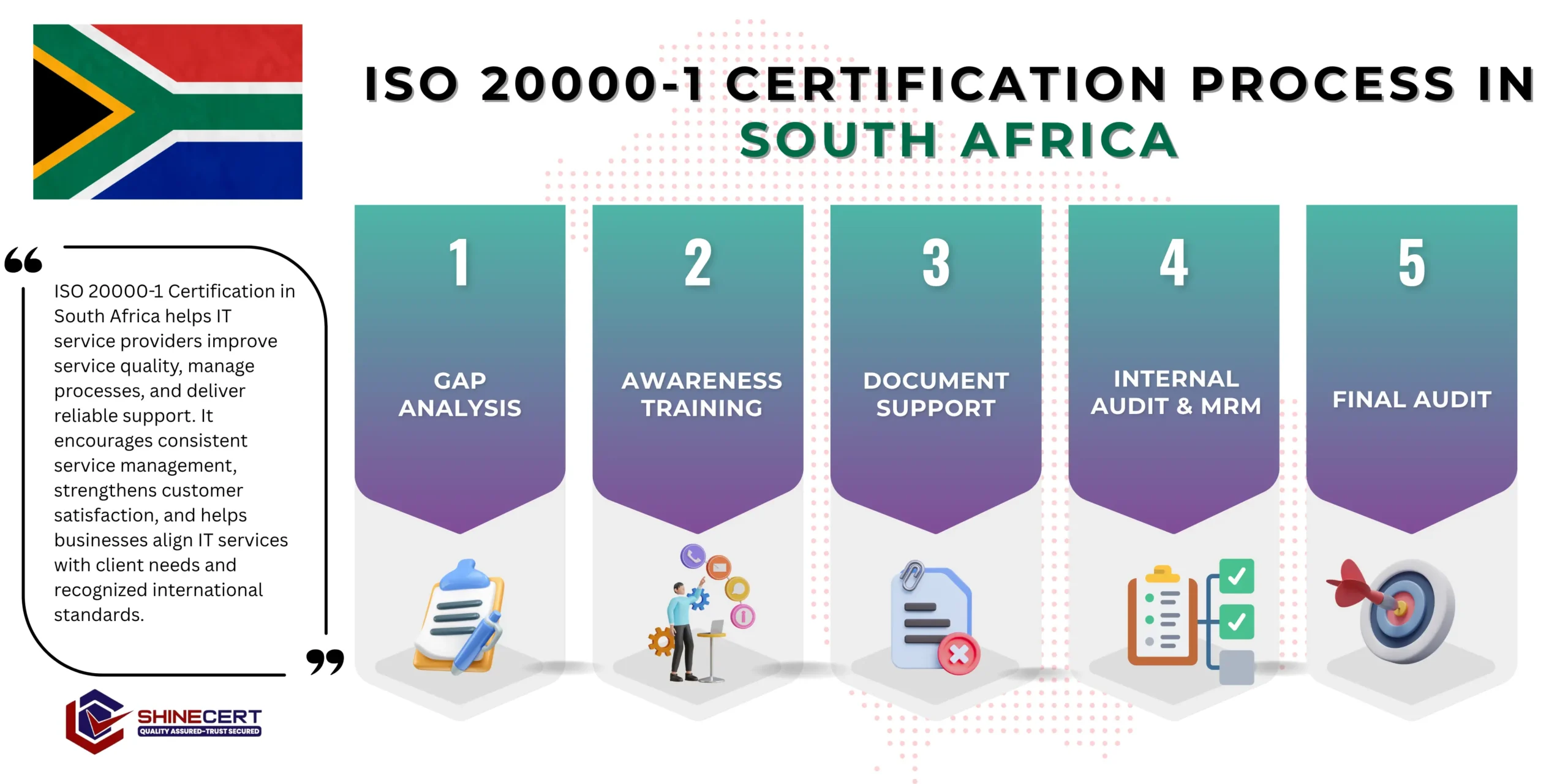
The ISO 20000-1 Certification Process in South Africa
Getting certified follows five steps. Here’s exactly what happens at each one.
Service Review
We map every IT service you actually deliver, from help desk support to infrastructure management, and compare current practice against ISO 20000-1’s requirements.
An honest picture of where your service delivery is genuinely mature and where it relies on informal habits.
A service review specific to your operations.
Documentation
We help build your service catalogue, service level agreements, and management procedures around the services you actually deliver.
Documentation your service desk and delivery teams can genuinely follow, not a generic ITIL template.
A complete ISO 20000-1 documentation set.
Implementation and Training
Controls go live, with staff trained on incident management, change control, and service level tracking specific to their role.
This phase takes real time, since consistent service delivery depends on habits changing across the whole team, not just a new tool being deployed.
Training records and evidence controls are genuinely operating.
Internal Audit and Management Review
We test whether the system genuinely works, with findings feeding into a management review before the external audit.
Gaps surface here, while there’s still time to close them before a client or auditor finds them.
An internal audit report and management review minutes.
Certification Audit
An accredited, independent auditor reviews your documentation and verifies real service delivery matches what’s documented.
Both your paperwork and your actual service performance get checked before certification.
Your ISO 20000-1 certificate and a surveillance audit schedule.
Benefits of ISO 20000-1 Certification
- Fewer service disruptions reaching clients : Structured incident and change management catches problems before they affect the client’s end customers.
- Stronger position in international procurement : Certification is a recognised signal of service maturity that UK, US, and European clients specifically look for when evaluating outsourcing partners.
- Clearer service level accountability : Everyone knows exactly what’s promised to the client and how performance against that promise is tracked.
- Easier integration of new technology : A documented service management system makes it easier to adopt AI-assisted tools without disrupting existing service commitments.
- Better internal visibility into service performance : Management gets accurate data on where service delivery is actually strong or weak, rather than relying on anecdotal client feedback.
- A foundation for ISO 27001 : Much of the documentation and audit structure overlaps, particularly relevant for BPO providers handling client data.
What Does ISO 20000-1 Certification Cost in South Africa?
- Number and complexity of services delivered : More services, systems, and client accounts mean more documentation and monitoring points.
- Current service management maturity : Businesses already using formal ticketing systems and SLAs aren’t starting from nothing, which shortens the work.
- Client base diversity : Businesses serving multiple international clients with different requirements typically need broader documentation than a single-client operation.
- Team size and structure : Larger service teams need more training and clearer role definition within the management system.
Case Study: A Cape Town BPO Provider
- A mid-sized BPO provider in Cape Town serving a UK retail client came to us after the client’s own procurement team flagged, during a contract renewal review, that competing outsourcing bids all had formal service management certification, and this provider did not.
- We ran a service review and found the company’s actual service delivery was genuinely reliable, built up through years of experienced staff, but almost none of it was documented, SLAs existed informally in staff knowledge rather than in a service catalogue, and incident handling varied by whoever was on shift.
- Over five months, we built a formal service catalogue, documented incident and change management procedures around the team’s existing (good) practices, and trained shift leads on consistent service level tracking. The company was certified within the expected timeline.
- The company retained its UK client contract at renewal and has since used the certification in two further new-business pitches to prospective UK and US clients evaluating outsourcing partners.
ISO 20000-1 Certification Across South Africa
ISO 20000-1 in Cape Town
ISO 20000 -1 in Johannesburg
ISO 20000-1 in Durban
ISO 20000-1 in Pretoria
ISO 20000-1 in Sandton
What Documents Do You Need for ISO 20000-1 in South Africa?
- Context and Scope : Document: Scope of the SMS Statement. Defines which services, clients, and locations the service management system covers.
- Leadership : Document: Service Management Policy. A signed top-management commitment to consistent, reliable service delivery.
- Planning : Document: Service Catalogue. A clear description of every service offered, including scope and service levels. Document: Risk Register. Identifies risks to service delivery, such as staff turnover, system outages, or capacity constraints.
- Support : Document: Training Records. Evidence staff understand the specific service management procedures relevant to their role. Document: Capacity and Availability Plan. How service capacity and uptime are planned and monitored.
- Operation : Document: Incident and Problem Management Procedure. How service disruptions are logged, prioritised, resolved, and prevented from recurring. Document: Change Management Procedure. How changes to services or systems are assessed, approved, and rolled out without breaking existing commitments.
- Performance Evaluation : Document: Service Level Performance Records. Actual measurements of service delivery against agreed levels. Document: Internal Audit Records. Proof an internal audit was carried out against every clause.
- Improvement : Document: Corrective Action Log. A functioning record tracking every service issue from discovery through to a verified fix.
Why Businesses Choose ShineCert in South Africa?
We’ve spent 10 years helping more than 10,000 businesses worldwide get certified, coordinated through our Riyadh and India offices with work delivered remotely or on-site as needed. As the best ISO 20000-1 consultant in South Africa, ShineCert quotes based on your real service portfolio, explains requirements in plain language, and builds a system your service desk and delivery teams can genuinely use.
How Long Does ISO 20000-1 Certification Take in South Africa?
| Business Size | Typical Timeline | Why |
|---|---|---|
| Small, single-client or simple service set | 3–4 months | Fewer services to document and monitor |
| Medium, several clients or service lines | 4–5 months | Broader service catalogue and SLA structure |
| Larger, multi-client, complex service delivery | 5–6 months | More complexity across services and teams |
Ready to Get Started?
Whether you’re responding to an international client requirement or strengthening your service delivery for its own sake, we’ll walk through your services and give you a clear, honest quote. Book a free consultation or contact us to get started.
Frequently Asked Questions
No, any business delivering IT services internally or to clients can benefit, though demand is currently strongest in the BPO and outsourcing sector.
It depends on your service complexity, client base, and current maturity. We quote every business individually.
Usually three to six months, depending on service complexity.
No, ISO 20000-1 doesn’t require formal ITIL certification, though many of the same concepts apply.
Most documentation and process work can happen remotely.
No certification guarantees new business, but it directly addresses a requirement increasingly present in international outsourcing procurement processes.