
ISO 14001 Certification in South Africa
Quick Answer
ISO 14001 is the world’s most used environmental management standard. It proves a business has a documented system for identifying, controlling, and reducing its environmental impact, checked and confirmed by an independent auditor. In South Africa, it’s not a legal requirement, but it directly reduces your exposure to NEMA enforcement action from the Green Scorpions, and it’s increasingly requested by mining, manufacturing, and government clients as proof of environmental due diligence. Certification usually takes three to seven months. Cost depends on your number of employees, sites, and how much environmental risk your operations already carry. Most businesses pair it with ISO 9001 or ISO 45001 since the documentation approach overlaps closely.
What Is ISO 14001?
ISO 14001 is an international standard published by the International Organization for Standardization. It sets out what a business needs to have in place to identify its environmental impacts, water use, waste, emissions, energy, and actively manage and reduce them over time.
Think of it as a structured way of answering three questions on an ongoing basis: what effect does our business have on the environment, what are we legally required to do about it, and how are we actually improving. A business becomes “ISO 14001 certified” once an independent, accredited auditor confirms it genuinely runs this system day to day, not just on paper.
In South Africa, environmental compliance itself is governed by the National Environmental Management Act (NEMA) and enforced by Environmental Management Inspectors, widely known as the Green Scorpions. ISO 14001 isn’t a legal substitute for NEMA compliance, it’s a voluntary international standard that sits on top of it, giving structure to how you manage environmental obligations you already have.
Why ISO 14001 Matters in South Africa?
- Green Scorpions enforcement is active and growing : Under the latest National Environmental Compliance and Enforcement Report, Green Scorpions inspectors arrested more than 500 suspects in a single financial year, registered 634 criminal dockets, and issued over 1,000 admission-of-guilt notices for environmental offences. A documented environmental management system is the clearest way to show inspectors your business takes its obligations seriously, well before any inspection happens.
- Mining and manufacturing clients increasingly require it : Large mining houses, manufacturers, and their supply chains routinely ask suppliers for ISO 14001 as a condition of doing business, particularly where waste, water use, or emissions are part of the relationship.
- It reduces the cost of environmental incidents : Spills, waste mismanagement, and permit breaches are expensive, in fines, cleanup costs, and reputational damage. A working environmental management system catches these risks before they become incidents.
- It strengthens your position on government and corporate tenders : Environmental management is increasingly scored in tender evaluations, alongside B-BBEE status and price, especially for contracts involving construction, mining, or manufacturing.
What are the steps to get ISO 14001 Certification in South Africa?
our services
- ISO Certification South Africa
- ISO 9001 Certification South Africa
- ISO 14001 Certification South Africa
- ISO 27001 Certification South Africa
- ISO 22000 Certification South Africa
- ISO 27701 Certification South Africa
- ISO 45001 Certification South Africa
- ISO 20000-1 Certification South Africa
- ISO 13485 Certification South Africa
- ISO 17025 Certification South Africa
- ISO 31000 Certification South Africa
- ISO 42001 Certification South Africa
- ISO 37001 Certification South Africa
- ISO 22301 Certification South Africa
- ISO 50001 Certification South Africa
- CE Mark Certification South Africa
- GDPR Certification South Africa
- GMP Certification South Africa
- Halal Certification South Africa
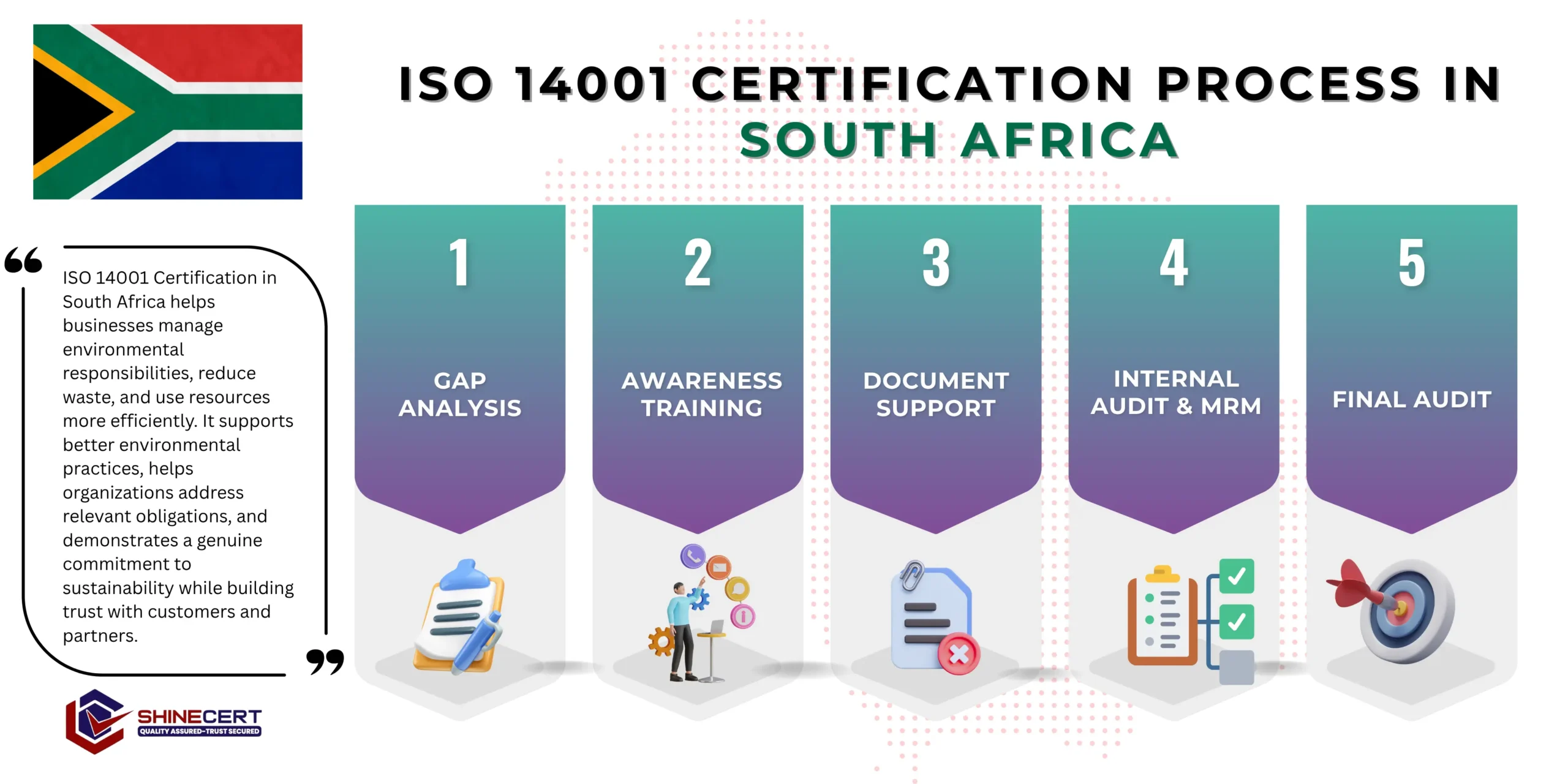
The ISO 14001 Certification Process in South Africa
Getting certified follows five steps. Here’s exactly what happens at each one.
Environmental Review
We identify every meaningful way your operations interact with the environment, water use, waste streams, emissions, chemical storage, energy use, and compare that against what ISO 14001 requires you to manage.
An honest picture of your real environmental footprint, not a generic industry checklist.
Environmental aspects and impacts register specific to your site.
Documentation
We help build your environmental policy, your register of legal requirements, and your operating procedures, written around how your site actually functions.
Documents your own operations team can follow, not a manual copied from a different industry.
A complete ISO 14001 documentation set.
Implementation and Training
The system goes live across your site, with staff trained on the specific controls relevant to their role.
This phase takes the longest because it involves real behaviour change on the floor, not just paperwork.
Training records and evidence the system is genuinely operating.
Internal Audit and Management Review
We test whether the system is actually working, and findings feed into a management review before the real audit.
Problems surface here, while there’s still time to fix them quietly, rather than in front of a certification auditor.
An internal audit report and management review minutes.
Certification Audit
An accredited, independent auditor reviews your documentation, then visits your site to confirm the system functions as described.
Both a documentation review and a real site visit are required before your certificate is issued.
Your ISO 14001 certificate and a surveillance audit schedule.
Benefits of ISO 14001 Certification
- Lower risk of environmental fines and enforcement action : A working system catches permit breaches and waste-handling problems internally, before a Green Scorpions inspection finds them first.
- Reduced waste and utility costs : Businesses that formally track water, energy, and waste often find real savings simply by measuring what they hadn’t measured before.
- Easier access to mining and manufacturing supply chains : Many larger buyers now require ISO 14001 as a baseline condition before they’ll even consider a new supplier.
- A foundation for other certifications : If you’re also pursuing ISO 9001 or ISO 45001, much of the document control, internal audit, and management review structure is shared, making the second and third certifications faster.
- Better standing with regulators and communities : Certification signals genuine environmental commitment to regulators, neighbouring communities, and environmental groups, reducing friction around permits and expansions.
- Clearer accountability internally : Staff know exactly who is responsible for which environmental control, instead of responsibility being assumed or unclear.
What Does ISO 14001 Certification Cost in South Africa?
- Nature of your business : A mining or manufacturing operation with real emissions, waste, and water-use risk needs more documentation and monitoring than an office-based services business. Businesses handling hazardous waste or chemicals sit at the higher end.
- Number of employees and sites : More staff means more training, and each additional site typically needs its own environmental review and share of the audit.
- Current environmental practices : If you already track waste and water use informally, you’re not starting from nothing, which shortens the documentation phase.
- Existing permits and legal exposure : Businesses already juggling multiple NEMA permits or water licences usually need more work building the legal register, but also get more value from having it properly organised.
- Certification body fees : Billed separately by the accredited body conducting your audit, never bundled into our quote.
Case Study: A Rustenburg Mining Supplier
- A mid-sized engineering supplier to the platinum mining sector near Rustenburg came to us after losing a supply contract renewal. The mine’s procurement team cited “environmental management” as a scoring requirement the supplier could not demonstrate.
- We ran an environmental review and found the company already handled its waste and chemical storage responsibly in practice, the problem was that none of it was documented, measured, or tied to a legal register. There was no formal environmental policy and no record of who was responsible for which control.
- Over five months, we built the company’s environmental management system around its existing (largely sound) practices, added a legal register mapping their NEMA and water-use obligations, and trained two staff members as internal environmental auditors. The company was certified within the expected timeline.
- At the next supply contract renewal, the company scored full marks on the environmental management line and retained the contract. It has since used the same certificate to qualify for two additional mining supply panels that required ISO 14001 as an entry condition.
ISO 14001 Certification Across South Africa
ISO 14001 in Johannesburg
ISO 14001 in Cape Town
ISO 14001 in Durban
ISO 14001 in Pretoria
ISO 14001 in Rustenburg
What Documents Do You Need for ISO 14001 in South Africa?
ISO 14001 is built around the same ten-clause structure as other modern ISO standards, but the working documents are specific to environmental management.
- Context and Scope : Document: Scope of the EMS Statement. States which sites, activities, and processes your environmental management system covers.
- Leadership : Document: Environmental Policy. A signed top-management commitment to legal compliance and continual environmental improvement.
- Planning : Document: Environmental Aspects and Impacts Register. A working list of every way your operations affect the environment, ranked by significance. Document: Legal and Compliance Register. A record of every environmental law, permit, and licence condition that applies to your business, including NEMA obligations.
- Support : Document: Environmental Training Records. Evidence staff understand their specific environmental responsibilities. Document: Document Control Procedure. How environmental documents are created, reviewed, and kept current.
- Operation : Document: Operational Control Procedures. Step-by-step instructions for managing waste, chemical storage, water discharge, or emissions specific to your processes. Document: Emergency Preparedness Plan. What happens in the event of a spill, fire, or other environmental incident.
- Performance Evaluation : Document: Environmental Monitoring Records. Actual measurements, water use, waste volumes, emissions, tracked against targets. Document: Internal Audit Records. Proof an internal audit against every clause was actually carried out.
- Improvement : Document: Corrective Action Log. A working record tracking every environmental nonconformity from discovery through to a verified fix.
Why Businesses Choose ShineCert in South Africa?
We’ve spent 10 years helping more than 10,000 businesses worldwide get certified, coordinated through our Riyadh and India offices with work delivered remotely or on-site depending on what you need. As the best ISO 14001 consultant in South Africa, ShineCert quotes based on your real operations, explains environmental requirements in plain language, and builds a system your own team can actually run, not paperwork that only makes sense to an auditor.
How Long Does ISO 14001 Certification Take in South Africa?
| Business Size | Typical Timeline | Why |
|---|---|---|
| Small, single site, low environmental risk | 3–4 months | Fewer aspects to document and monitor |
| Medium, moderate environmental risk | 4–6 months | More permits, processes, and monitoring points |
| Larger or higher-risk operations (mining, manufacturing) | 6–7 months | More sites, more legal obligations, more monitoring |
Ready to Get Started?
Whether you’re responding to a tender requirement or reducing your environmental risk exposure, we’ll walk through your operations and give you a clear, honest quote. Book a free consultation or contact us to get started.
Frequently Asked Questions
No. NEMA and its permits are the legal requirement. ISO 14001 is a voluntary standard that helps you manage those obligations more systematically.
It depends on your industry, number of sites, and current environmental risk. We quote every business individually.
Usually three to seven months, depending on the complexity of your environmental impacts.
Any business with meaningful water, waste, or energy use can benefit, but the pressure to certify is strongest in mining, manufacturing, and their supply chains.
Documentation work can happen remotely. The certification audit needs a site visit.
No certification prevents inspections, but a working environmental management system significantly reduces the chance an inspection finds a genuine violation.