
Halal Certification in South Africa
Quick Answer
Halal certification confirms that a food, cosmetic, or pharmaceutical product genuinely complies with Islamic dietary and production law, verified by a recognised certification body such as SANHA. In South Africa, this is a genuinely large market: the local Halal industry is estimated at R45 billion, and South Africa’s traders account for roughly half of Africa’s fast-moving consumer goods sector, over a third of which is Muslim-owned or Muslim-serving. Certification also opens export access to the Gulf, Southeast Asia, and neighbouring African markets. Certification usually takes two to four months. Cost depends on your product type and whether you’re pursuing local or export-scheme certification.
What Is Halal Certification?
Halal certification confirms that a product, food, cosmetics, pharmaceuticals, or ingredients, has been produced, handled, and processed in accordance with Islamic law. It covers everything from ingredient sourcing and slaughter methods for meat products, to preventing cross-contamination with non-Halal materials during processing and storage.
Think of it as an independent guarantee to Muslim consumers, wherever they are in the world, that a product genuinely meets Halal requirements, not just a claim on the packaging. A business becomes Halal certified once a recognised certification body, in South Africa, most commonly SANHA (the South African National Halaal Authority), audits and confirms the entire process meets the standard.
South Africa offers two main certification pathways: a Local Certification Scheme for businesses selling domestically, and a Global Certification Scheme specifically for companies exporting to the GCC region, which typically involves more rigorous documentation given the stricter import requirements of Gulf markets.
Why Halal Certification Matters in South Africa?
- The local Halal market is substantial : SANHA estimates South Africa’s Halal industry alone is worth R45 billion, with the broader African Halal market valued at more than R1 trillion.
- South African traders dominate the continent’s FMCG sector : South African traders account for around 50% of Africa’s fast-moving consumer goods sector, more than a third of which is Muslim, representing significant domestic demand alone.
- Export access depends directly on it : Certification opens doors to the Gulf Cooperation Council region, Southeast Asia, and neighbouring African markets, where Halal certification is often a non-negotiable entry requirement, not a preference.
- Certification volumes are rising quickly : SANHA reports strong, sustained growth in certification applications over recent years, reflecting both rising domestic demand and growing export ambition among South African producers.
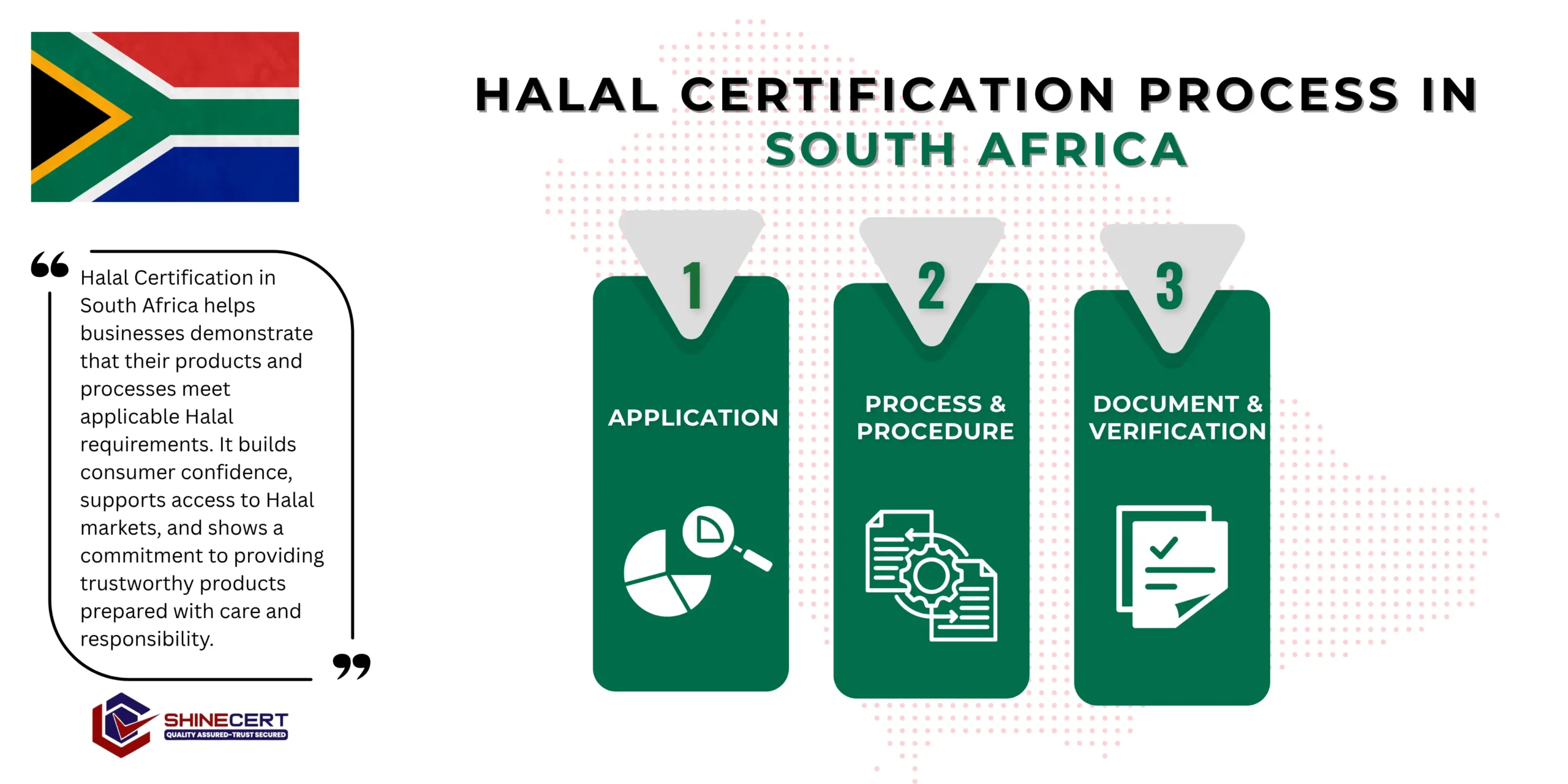
What are the steps to get Halal Certification in South Africa?
our services
- ISO Certification South Africa
- ISO 9001 Certification South Africa
- ISO 14001 Certification South Africa
- ISO 27001 Certification South Africa
- ISO 22000 Certification South Africa
- ISO 27701 Certification South Africa
- ISO 45001 Certification South Africa
- ISO 20000-1 Certification South Africa
- ISO 13485 Certification South Africa
- ISO 17025 Certification South Africa
- ISO 31000 Certification South Africa
- ISO 42001 Certification South Africa
- ISO 37001 Certification South Africa
- ISO 22301 Certification South Africa
- ISO 50001 Certification South Africa
- CE Mark Certification South Africa
- GDPR Certification South Africa
- GMP Certification South Africa
- Halal Certification South Africa
The Halal Certification Process in South Africa
Getting certified follows five steps. Here’s exactly what happens at each one.
Product and Ingredient Review
We review every ingredient, supplier, and processing step against Halal requirements, identifying any risk of cross-contamination or non-compliant sourcing.
A precise picture of your real compliance position before you commit to certification.
A product and ingredient review specific to your operation.
Documentation
We help build your Halal policy and traceability procedures around your actual production process.
Documentation your production team can genuinely follow, not a generic template.
A complete Halal certification documentation set.
Implementation and Training
Controls go live, with staff trained on Halal handling, storage separation, and cross-contamination prevention specific to your process.
This phase matters most where shared equipment or storage with non-Halal products creates real contamination risk.
Training records and evidence controls are genuinely operating.
Internal Review
We check whether controls are genuinely being followed before the real certification audit.
Any gaps surface here, while there’s still time to fix them quietly.
An internal review report.
Certification Audit
An accredited Halal certification body audits your ingredients, process, and facility, then issues your certificate if everything meets requirements.
Both your documentation and your actual production practice get verified before certification.
Your Halal certificate and a renewal schedule.
Benefits of Halal Certification
- Access to a R45 billion domestic market : Certification unlocks genuine purchasing power among South Africa’s Muslim consumer base and Muslim-owned retail and food service businesses.
- Direct access to Gulf and Southeast Asian export markets : SANHA’s Global Certification Scheme is specifically built for exporters targeting these regions, where certification is typically a condition of market entry.
- Credibility that travels internationally : A SANHA certificate carries recognised weight with international buyers, providing instant credibility that an unverified claim cannot.
- Stronger retail listings domestically : Many South African retailers actively seek Halal-certified suppliers to serve Muslim customers across their store networks.
- Clear production discipline : The certification process itself often improves general hygiene and traceability practices, benefiting overall product quality.
- A natural pairing with ISO 22000 : Much of the hygiene and traceability documentation overlaps directly with food safety management requirements.
What Does Halal Certification Cost in South Africa?
- Product type : Meat and poultry products, requiring specific slaughter method verification, typically involve more rigorous review than packaged or shelf-stable goods.
- Certification scheme : The Global Certification Scheme for GCC-region exports typically involves more thorough documentation than the Local Certification Scheme.
- Number of ingredients and suppliers : More ingredients mean more supplier verification and Halal status checks required.
- Current production practices : Businesses already maintaining clear ingredient records and separated storage aren’t starting from nothing, which shortens the work.
Case Study: A Durban Processed Foods Exporter
- A processed foods manufacturer in Durban came to us after securing initial interest from a Gulf-region distributor, who required SANHA Global Certification Scheme certification before finalising any purchase order.
- We reviewed the company’s ingredients and process and found most inputs were already Halal-compliant in practice, but several imported flavouring ingredients lacked verified Halal certificates from their suppliers, and there was no formal cross-contamination procedure separating these lines from other products in the same facility.
- Over three months, we verified and documented the Halal status of every ingredient, sourced updated supplier certificates where needed, and implemented a clear separation procedure for shared processing lines. The company was certified within the expected timeline.
- The company secured its first Gulf export order shortly after certification and has since used the certificate to open discussions with two additional regional distributors in Southeast Asia.
Halal Certification Across South Africa
Halal certification in Johannesburg
Halal certification in Cape Town
Halal certification in Durban
Halal certification in Pretoria
Halal certification in Gqeberha
What Documents Do You Need for Halal Certification in South Africa?
- Policy and Scope : Document: Halal Policy Statement. A signed commitment to maintaining Halal compliance across the certified product range.
- Ingredient and Supplier Documentation : Document: Ingredient Halal Status Register. A record confirming the Halal status and source of every ingredient used. Document: Supplier Halal Certificates. Copies of Halal certification for any pre-certified raw materials or ingredients sourced from third parties.
- Process Documentation : Document: Production Process Map. Shows exactly where potential Halal risk points occur in your process. Document: Cross-Contamination Prevention Procedure. How Halal and non-Halal materials are kept separate throughout storage and production.
- Training and Records : Document: Staff Training Records. Evidence staff understand Halal handling requirements relevant to their role. Document: Traceability Records. Evidence of a finished product can be traced back to its certified ingredients.
- Ongoing Compliance : Document: Internal Review Records. Evidence of regular internal checks that Halal compliance is being maintained between certification audits.
Why Businesses Choose ShineCert in South Africa?
We’ve spent 10 years helping more than 10,000 businesses worldwide get certified, coordinated through our Riyadh and India offices with work delivered remotely or on-site as needed. As the best Halal consultant in South Africa, ShineCert quotes based on your real product and supply chain, explains requirements in plain language, and builds documentation your production team can genuinely maintain.
How Long Does Halal Certification Take in South Africa?
| Business Size | Typical Timeline | Why |
|---|---|---|
| Small, single product, local market | 2–3 months | Fewer ingredients and suppliers to verify |
| Medium, several products or export ambitions | 3–4 months | Broader ingredient verification and Global Scheme requirements |
| Larger, multi-product export operation | 4 months | More products, suppliers, and cross-contamination controls |
Ready to Get Started?
Whether you’re pursuing new export markets or serving South Africa’s substantial domestic Halal market, we’ll walk through your products and give you a clear, honest quote. Book a free consultation or contact us to get started.
Frequently Asked Questions
SANHA (the South African National Halaal Authority) is the most widely recognised certification body, alongside the MJC.
It depends on your product type, target market, and current documentation. We quote every business individually.
Usually two to four months, depending on ingredient and supplier complexity.
No, the Local Certification Scheme is sufficient for domestic sales; Global Certification is specifically for GCC-region exports.
Documentation review can happen remotely; the certification audit requires a facility visit.
Yes, SANHA certifies a range of product categories requiring Halal endorsement, including cosmetics, nutritionals, and pharmaceuticals.