
GMP Certification in South Africa
Quick Answer
GMP (Good Manufacturing Practice) is the set of requirements ensuring pharmaceutical products, medical products, and related goods are consistently manufactured to a quality standard appropriate to their intended use. In South Africa, GMP is directly tied to SAHPRA licensing: SAHPRA’s Guidelines for Good Manufacturing Practice, now at Version 10, align the country’s framework with the internationally recognised Pharmaceutical Inspection Co-operation Scheme (PIC/S). A manufacturing licence from SAHPRA is not possible without demonstrating GMP compliance. Certification usually takes four to eight months. Cost depends on your facility complexity and product category.
What Is GMP?
GMP, or Good Manufacturing Practice, is a system of requirements ensuring products are consistently produced and controlled according to quality standards appropriate to their use, particularly for medicines, medical products, and related manufacturing. It covers facility design, equipment, staff training, documentation, and quality control testing across the entire production process.
Think of it as the manufacturing-specific discipline underneath any pharmaceutical or health product license, proof that a product isn’t just designed well on paper, but is actually produced consistently, batch after batch, without contamination or error. A facility becomes GMP compliant once it demonstrates this consistently through documentation and, typically, a regulatory inspection.
In South Africa, SAHPRA’s GMP guidelines, now at Version 10, specifically align the country’s framework with PIC/S, the Pharmaceutical Inspection Co-operation Scheme recognised internationally. A manufacturing licence from SAHPRA depends directly on demonstrating GMP compliance during inspection, it isn’t an optional add-on to licensing, it’s a core part of it.
Why GMP Matters in South Africa?
- It’s a precondition for SAHPRA manufacturing licensing : SAHPRA’s Pharma Licencing unit issues manufacturing, wholesale, and distribution licences specifically on condition of demonstrated GMP compliance, without it, a licence simply isn’t issued.
- South Africa’s regulatory alignment with PIC/S is deepening : The move toward PIC/S-aligned GMP guidelines signals stronger international regulatory cooperation, and facilities demonstrating this alignment are better positioned as the framework continues to mature.
- Local pharmaceutical manufacturing capacity is genuinely limited : With relatively few local manufacturing facilities meeting GMP standards and heavy reliance on imported medicines, GMP-compliant local manufacturers are positioned to meet growing demand for domestic production capacity.
- It directly reduces patient risk : A GMP-compliant facility catches contamination, mislabelling, and dosing errors before a product reaches a patient, which matters more here than in almost any other manufacturing category.
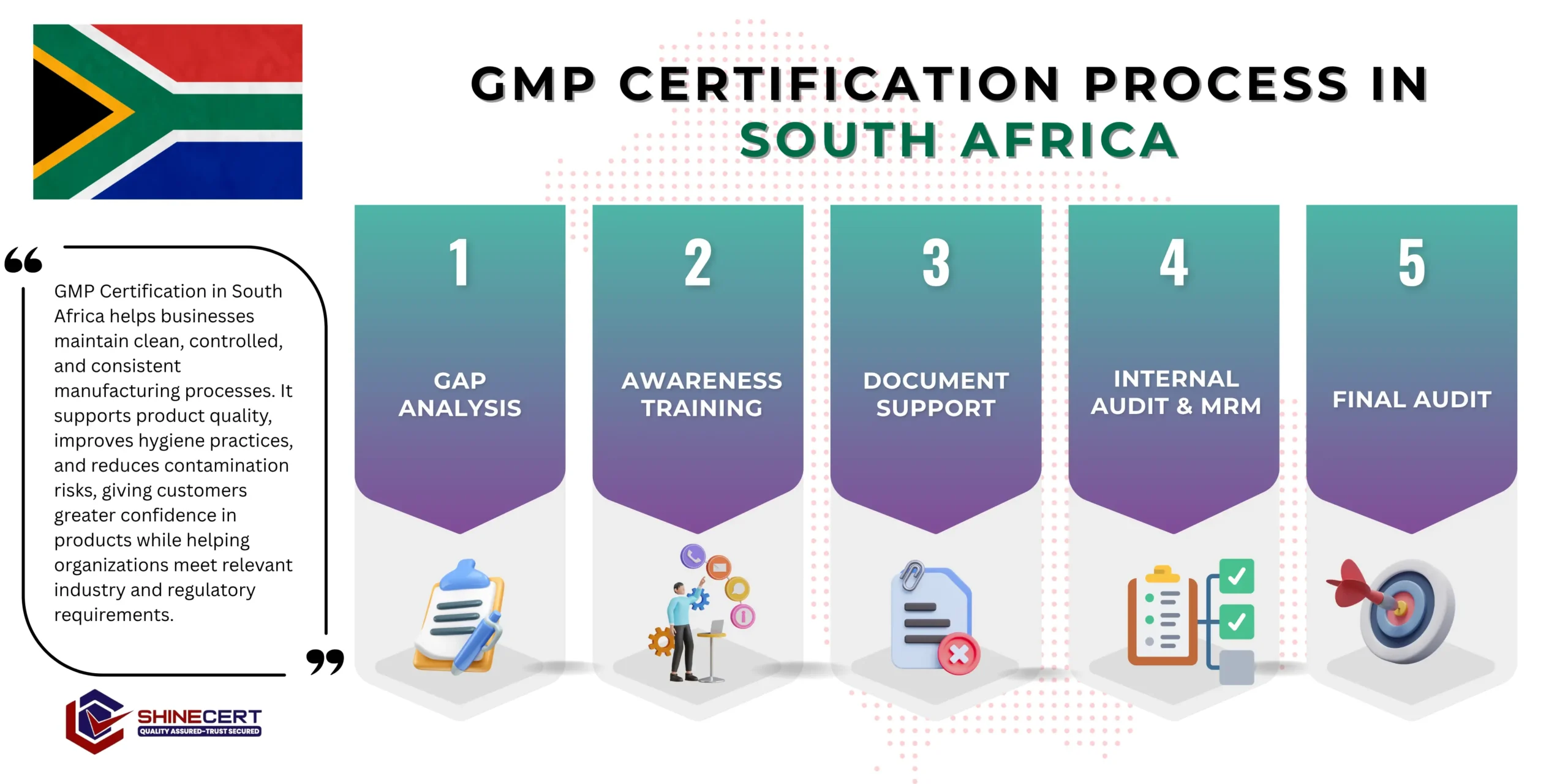
What are the steps to get GMP Certification in South Africa?
our services
- ISO Certification South Africa
- ISO 9001 Certification South Africa
- ISO 14001 Certification South Africa
- ISO 27001 Certification South Africa
- ISO 22000 Certification South Africa
- ISO 27701 Certification South Africa
- ISO 45001 Certification South Africa
- ISO 20000-1 Certification South Africa
- ISO 13485 Certification South Africa
- ISO 17025 Certification South Africa
- ISO 31000 Certification South Africa
- ISO 42001 Certification South Africa
- ISO 37001 Certification South Africa
- ISO 22301 Certification South Africa
- ISO 50001 Certification South Africa
- CE Mark Certification South Africa
- GDPR Certification South Africa
- GMP Certification South Africa
- Halal Certification South Africa
The GMP Certification Process in South Africa
Getting certified follows five steps. Here’s exactly what happens at each one.
Facility and Process Assessment
We assess your facility layout, equipment, and manufacturing processes against SAHPRA’s GMP guidelines and PIC/S alignment expectations.
A precise picture of the work ahead, specific to your facility and product category.
A facility and process assessment report.
Documentation
We help build your quality manual, batch manufacturing records, and standard operating procedures around your actual production process.
Documentation your production and quality control teams can genuinely follow, not a generic pharmaceutical template.
A complete GMP documentation set.
Implementation and Training
Controls go live across production, quality control, and warehousing, with staff trained on GMP-specific requirements for their role.
This is usually the longest phase, since pharmaceutical-grade discipline requires deeper technical rigour than general manufacturing.
Training records and evidence controls are genuinely operating.
Internal Audit and Management Review
We test whether the system genuinely works, with findings feeding into a management review before the real inspection.
Gaps surface here, while there’s still time to close them before SAHPRA sees them.
An internal audit report and management review minutes.
Regulatory Inspection
SAHPRA, or an accredited body under a reliance pathway, inspects your facility to confirm documentation and real practice alignment.
Both your paperwork and your actual manufacturing floor get inspected before a licence is granted.
GMP compliance status supporting your SAHPRA manufacturing licence.
Benefits of GMP Certification
- Directly enables SAHPRA licensing : GMP compliance isn’t a nice-to-have alongside a manufacturing licence, it’s a core requirement SAHPRA verifies before issuing one.
- Fewer product defects reaching patients : Structured quality controls catch contamination, mislabelling, and process errors during production, not after distribution.
- Positioning for growing local manufacturing demand : As South Africa works to reduce reliance on imported medicines, GMP-compliant local facilities are well placed to capture new manufacturing opportunities.
- Stronger position for international partnerships : PIC/S-aligned GMP compliance is recognised well beyond South Africa’s borders, supporting export and partnership opportunities.
- Reduced recall and liability risk : A functioning GMP system substantially lowers the chance of a defective batch reaching the market.
- A foundation for ISO 13485 : For businesses manufacturing both medicines and medical devices, much of the quality documentation structure overlaps.
What Does GMP Certification Cost in South Africa?
- Product category : Sterile injectables and biologics require more rigorous facility controls than solid-dose tablets or simpler formulations.
- Facility complexity : More production lines and equipment mean more validation and documentation work.
- Current quality maturity : Facilities already following informal good practice aren’t starting from nothing, which shortens the work.
- Key personnel experience requirements : SAHPRA’s licence categories set minimum experience requirements for key personnel, which may require additional recruitment or training investment.
Case Study: A Johannesburg Generic Medicines Manufacturer
- A small generic tablet manufacturer in Johannesburg came to us after SAHPRA flagged, during a licence renewal review, that its GMP documentation needed to be brought up to the newly updated Version 10 guideline requirements.
- We assessed the facility and found the actual manufacturing process was sound, but batch records were incomplete in places, several standard operating procedures hadn’t been updated in years, and key personnel experience records didn’t clearly demonstrate compliance with the updated requirements.
- Over six months, we rebuilt the company’s batch record system, updated its SOPs to reflect actual current practice, and documented key personnel qualifications against SAHPRA’s specific requirements. The company passed its SAHPRA inspection and retained its manufacturing licence without disruption.
- The company has since used its updated GMP documentation as a foundation for exploring a new product line, confident its quality system can support expansion without repeating the same documentation gaps.
GMP Certification Across South Africa
GMP certification in Cape Town
GMP certification in Johannesburg
GMP certification in Pretoria
GMP certification in Durban
GMP certification in Centurion
What Documents Do You Need for GMP in South Africa?
- Quality System : Document: Quality Manual. Describes your overall approach to quality management across manufacturing.
- Facility and Equipment : Document: Facility Qualification Records. Evidence your facility and equipment are validated as fit for pharmaceutical-grade manufacturing. Document: Cleaning and Maintenance Procedures. How equipment and facilities are kept free of contamination between batches.
- Personnel : Document: Training Records. Evidence staff have the specific GMP training their role requires, including key personnel experience requirements under SAHPRA’s licence categories.
- Production : Document: Batch Manufacturing Records. A complete record of every production run, including materials used and checks performed. Document: Standard Operating Procedures (SOPs). Step-by-step instructions for every manufacturing and quality control activity.
- Quality Control : Document: Testing and Release Records. Evidence each batch was tested and met specification before release. Document: Deviation and Investigation Records. How any departure from standard procedure is documented and investigated.
- Ongoing Compliance : Document: Internal Audit Records. Proof an internal audit was carried out against every relevant GMP requirement. Document: Corrective and Preventive Action (CAPA) Log. A functioning record tracking every quality issue from discovery through to a verified fix.
Why Businesses Choose ShineCert in South Africa?
We’ve spent 10 years helping more than 10,000 businesses worldwide get certified, coordinated through our Riyadh and India offices with work delivered remotely or on-site as needed. As the best GMP consultant in South Africa, ShineCert quotes based on your real facility and product complexity, explains requirements in plain language, and builds documentation your production and quality teams can genuinely maintain.
How Long Does GMP Certification Take in South Africa?
| Business Size | Typical Timeline | Why |
|---|---|---|
| Small, simple formulations (e.g. tablets) | 4–5 months | Fewer validation and control points |
| Medium, several product lines | 5–7 months | Broader validation across product types |
| Larger, complex products (sterile, biologics) | 7–8 months | Deeper validation and facility controls required |
Ready to Get Started?
Whether you’re renewing an existing SAHPRA licence or pursuing a new one, we’ll walk through your facility and process and give you a clear, honest quote. Book a free consultation or contact us to get started.
Frequently Asked Questions
Yes, GMP compliance is a core requirement SAHPRA verifies before issuing or renewing a manufacturing licence.
It depends on your product category, facility complexity, and current quality maturity. We quote every business individually.
Usually four to eight months, depending on product and facility complexity.
Yes, GMP principles apply broadly across pharmaceutical, biological, and related manufacturing categories.
Documentation work can happen remotely. The facility inspection requires an on-site visit.
No certification guarantees regulatory approval, but it is a core, non-negotiable requirement SAHPRA verifies directly.