
GDPR Certification in South Africa
Quick Answer
GDPR (the General Data Protection Regulation) is not South African law, it’s the EU’s data protection framework, and it applies to a South African business only when that business processes personal data of people in the EU, regardless of where the business itself is based. This matters increasingly for South Africa’s fast-growing BPO and global business services sector, which serves UK and EU clients whose customer data often flows through South African operations. There’s no GDPR “certification” as such; we provide advisory support to help businesses meet GDPR’s extraterritorial requirements alongside their existing POPIA compliance. Advisory engagements usually take two to four months.
What Is GDPR?
GDPR, the General Data Protection Regulation, is the European Union’s law governing how personal data of people in the EU is collected, used, and protected. It applies extraterritorially, meaning a South African business can fall under GDPR’s scope even without any physical presence in Europe, simply by processing personal data belonging to EU individuals.
This is the key distinction from POPIA, South Africa’s own data protection law. POPIA governs personal information processed within South Africa, regardless of the data subject’s location. GDPR governs personal data of EU individuals, regardless of where the processing business is located. A South African BPO handling a UK client’s customer database, for example, may need to comply with both laws simultaneously, for different reasons.
There’s no accredited “GDPR certification” the way there is for ISO standards. What ShineCert provides is advisory support: helping you understand whether GDPR applies to your operations, and if so, building the specific controls it requires alongside your existing POPIA compliance work.
Why GDPR Matters for South African Businesses?
- The BPO and global business services sector is the primary trigger : South Africa’s BPO sector, growing from roughly 65,000 jobs in 2019 to an estimated 150,000 by 2024, routinely handles UK and EU customer data on behalf of international clients, bringing many operations within GDPR’s scope even without a single EU office.
- Client contracts increasingly require it explicitly : UK and EU clients outsourcing customer service or data processing to South Africa often contractually require GDPR-aligned data handling as a condition of the engagement, regardless of POPIA compliance.
- General Data Protection Regulation (GDPR) and POPIA overlap substantially, but aren’t identical : Both require lawful processing, data subject rights, and breach notification, but specific details, timelines, penalty structures, extraterritorial scope, differ enough that POPIA compliance alone doesn’t guarantee General Data Protection Regulation (GDPR) compliance.
- Getting this wrong carries real client relationship risk : A South African supplier who mishandles EU client data risks not just direct regulatory exposure, but the loss of the client relationship itself, which in a competitive outsourcing market is often the bigger cost.
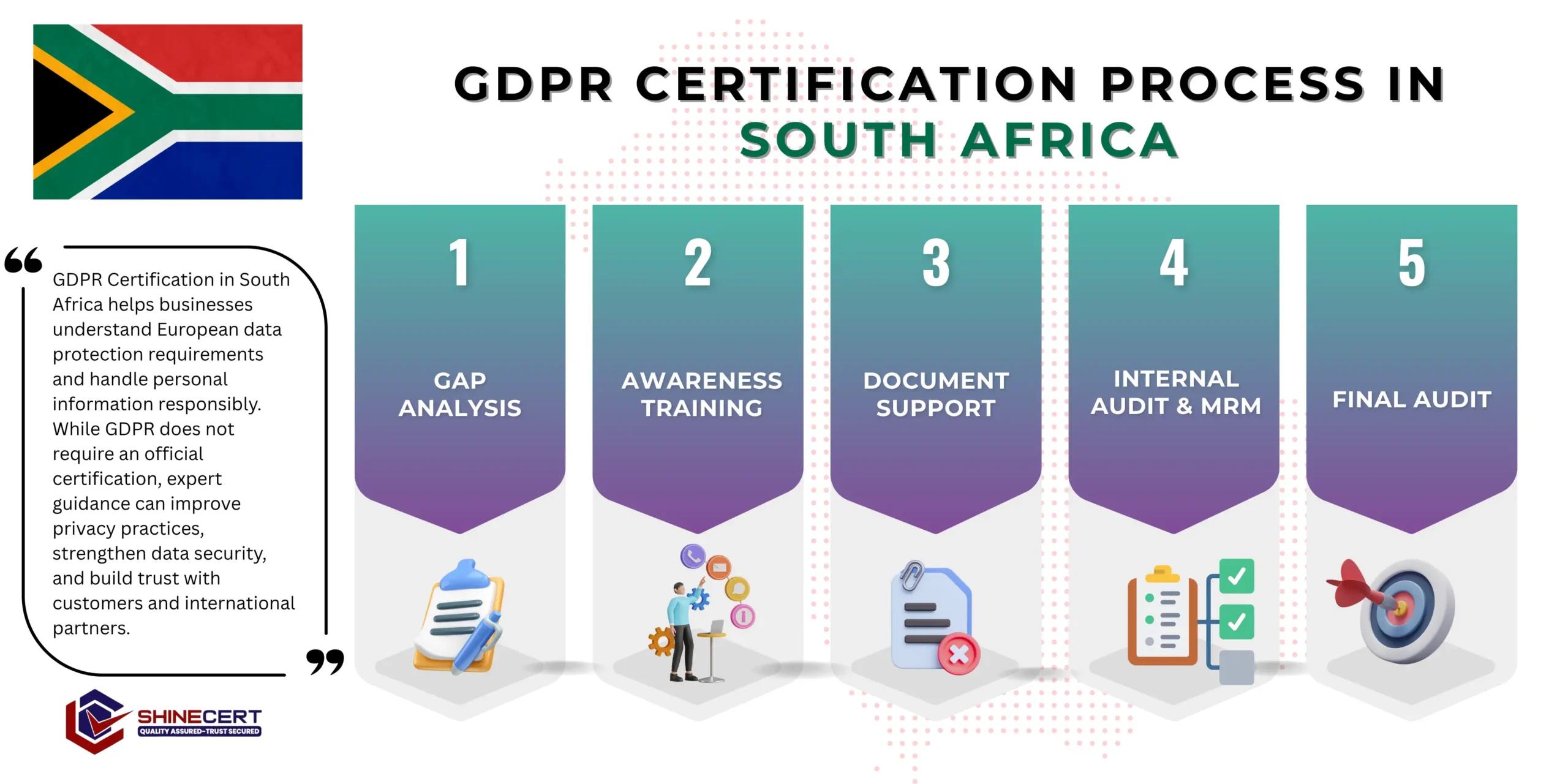
What are the steps to get GDPR Certification in South Africa?
our services
- ISO Certification South Africa
- ISO 9001 Certification South Africa
- ISO 14001 Certification South Africa
- ISO 27001 Certification South Africa
- ISO 22000 Certification South Africa
- ISO 27701 Certification South Africa
- ISO 45001 Certification South Africa
- ISO 20000-1 Certification South Africa
- ISO 13485 Certification South Africa
- ISO 17025 Certification South Africa
- ISO 31000 Certification South Africa
- ISO 42001 Certification South Africa
- ISO 37001 Certification South Africa
- ISO 22301 Certification South Africa
- ISO 50001 Certification South Africa
- CE Mark Certification South Africa
- GDPR Certification South Africa
- GMP Certification South Africa
- Halal Certification South Africa
The GDPR Advisory Process for South African Businesses
Our advisory engagement follows five steps. Here’s exactly what happens at each one.
Applicability Review
We determine precisely which of your data processing activities fall under GDPR’s scope, based on whose personal data you handle and under what client contracts.
Clarity on your actual GDPR exposure, rather than assuming it applies uniformly across your whole business.
A GDPR applicability review specific to your client contracts and data flows.
Documentation
We help build GDPR-aligned policies and a data mapping exercise showing exactly which EU personal data you process, on whose behalf, and why.
Documentation that satisfies specific client due-diligence requests, not a generic privacy policy.
A complete GDPR alignment documentation set.
Implementation and Training
Controls go live, with staff trained specifically on GDPR’s distinct requirements around data subject rights and breach notification timelines, alongside their existing POPIA training.
Staff who can correctly distinguish a GDPR-scoped request from a POPIA-scoped one, since the two carry different timelines and obligations.
Training records and evidence controls are genuinely operating.
Internal Review
We check whether GDPR-specific controls are genuinely being followed several weeks after go-live.
Early correction if something has started slipping, before a client audit or a real incident finds it first.
An internal review report.
Ongoing Alignment
As client contracts and GDPR guidance evolve, we help keep your controls current.
Your GDPR posture stays genuinely current, rather than becoming outdated the moment a client’s requirements change.
A recurring review cycle built into your compliance calendar.
Benefits of GDPR Advisory and Compliance Support
- Meets a common, explicit client contract requirement : Many UK and EU outsourcing contracts specifically require demonstrated GDPR alignment, not just general data protection assurances.
- Reduces the risk of losing international client relationships : Data handling failures involving EU customer data can end a client relationship outright, which is often costlier than any direct penalty.
- Clarifies genuine overlap with POPIA : Rather than treating GDPR and POPIA as entirely separate projects, we help you build controls that satisfy both efficiently, avoiding duplicated effort.
- Stronger positioning in new business pitches : Being able to speak confidently about GDPR alignment is a genuine differentiator when pitching new UK or EU clients considering South African outsourcing partners.
- Clearer internal accountability for EU data specifically : Staff understand exactly which data falls under GDPR’s stricter timelines and rights, rather than treating all personal data identically.
- A foundation that pairs naturally with ISO 27701 : Much of the privacy information management structure required for POPIA and ISO 27701 overlaps directly with what GDPR expects.
What Does GDPR Advisory Support Cost for South African Businesses?
- Volume of EU personal data processed : More EU client data and more contracts mean more mapping and documentation work.
- Number of EU client relationships : Each distinct client contract may carry its own specific data processing requirements to align with.
- Existing POPIA and ISO 27701 maturity : Businesses already compliant with POPIA or certified to ISO 27701 aren’t starting from nothing, which shortens the work significantly.
- Contractual complexity : More detailed client data processing agreements typically require more thorough internal alignment work.
Case Study: A Johannesburg Contact Centre Operator
- A contact centre operator in Johannesburg serving a UK insurance client came to us after the client’s own compliance team flagged, during an annual review, that the operator’s data handling documentation referenced POPIA but never explicitly addressed GDPR, despite processing UK customer data daily.
- We ran an applicability review and confirmed GDPR genuinely applied to this specific client relationship. We found the operator’s actual data handling practices were reasonably sound, but breach notification timelines followed POPIA’s requirements only, and no formal data processing agreement existed specifically addressing GDPR obligations.
- Over three months, we built a GDPR-aligned breach notification procedure meeting the EU’s 72-hour window, formalised a data processing agreement with the client, and trained staff to distinguish GDPR-scoped requests from POPIA-scoped ones. The operator passed its next client compliance review without issue.
The operator has since used its demonstrated GDPR alignment as a selling point in pitches to two additional prospective UK clients evaluating outsourcing partners.
Who We Support Across South Africa?
GDPR certification in Cape Town
GDPR certification in Johannesburg
GDPR certification in Durban
GDPR certification in Sandton
GDPR certification in Pretoria
What Documents Do You Need for GDPR Alignment?
- Scope and Mapping : Document: Data Processing Map. Shows exactly which EU personal data you process, its source, purpose, and retention period.
- Policy : Document: GDPR-Aligned Privacy Notice. A clear statement of how EU personal data is collected, used, and protected, distinct from your general POPIA-based privacy notice where the two diverge.
- Data Subject Rights : Document: Data Subject Request Procedure. How access, correction, deletion, and portability requests from EU individuals are handled within GDPR’s specific timelines.
- Contracts : Document: Data Processing Agreements. Formal agreements with EU clients defining each party’s data protection responsibilities.
- Breach Response : Document: Breach Notification Procedure. How a data breach involving EU personal data is identified, assessed, and reported within GDPR’s 72-hour notification window.
- Ongoing Compliance : Document: Training and Awareness Records. Evidence staff handling EU client data understand GDPR’s specific requirements alongside POPIA.
Why Businesses Choose ShineCert in South Africa?
We’ve spent 10 years helping more than 10,000 businesses worldwide navigate certification and data protection compliance, coordinated through our Riyadh and India offices with work delivered remotely or on-site as needed. As the best GDPR consultant in South Africa, ShineCert quotes based on your real EU client exposure, explains the overlap with POPIA in plain language, and builds controls your team can genuinely maintain.
How Long Does GDPR Advisory Support Take?
| Business Size | Typical Timeline | Why |
|---|---|---|
| Small, one or two EU client contracts | 2–3 months | Narrower scope of data flows to map |
| Medium, several EU client relationships | 3–4 months | Broader mapping and contract alignment |
| Larger, extensive EU client base | 4 months | More client-specific requirements to reconcile |
Ready to Get Started?
Whether you’re responding to a specific EU client requirement or proactively strengthening your international data handling, we’ll walk through your client relationships and give you a clear, honest quote. Book a free consultation or contact us to get started.
Frequently Asked Questions
Only if you process personal data of people in the EU, regardless of where your business is based; it doesn’t apply to purely domestic South African data processing.
No, there’s no accredited GDPR certification; we provide advisory support to help you meet its requirements.
It depends on your EU client base and existing data protection maturity. We quote every business individually.
Usually two to four months, depending on the number and complexity of EU client relationships.
POPIA governs data processed in South Africa regardless of the data subject’s location; GDPR governs EU individuals’ data regardless of where the processing business is located. They overlap substantially but aren’t identical.
Yes, most GDPR advisory and documentation work can be done remotely.