
ISO 45001 Certification in South Africa
Quick Answer
ISO 45001 is the world’s most used occupational health and safety management standard. It proves a business has a documented system for identifying workplace hazards, controlling risk, and preventing injuries, verified by an independent auditor. In South Africa, it’s not a legal substitute for the Occupational Health and Safety Act, but it gives structure to how you meet those legal duties, and it matters directly given the country’s construction fatality rate of 17.5 per 100,000 workers, roughly eight times the rate seen in comparable economies. Certification usually takes three to seven months. Cost depends on your number of employees, site risk level, and how much safety documentation already exists. It’s frequently certified alongside ISO 9001 and ISO 14001.
What Is ISO 45001?
ISO 45001 is an international standard for occupational health and safety management. It sets out what a business needs to have in place to identify workplace hazards, assess risk, and put real controls in place, before someone gets hurt rather than after.
Think of it as a structured way of running a workplace where safety is actively managed, not assumed. A business becomes “ISO 45001 certified” once an independent, accredited auditor confirms the system genuinely operates on the shop floor or site, not only in a policy document.
In South Africa, the Occupational Health and Safety Act (OHS Act) sets the legal minimum, enforced by the Department of Employment and Labour. Major 2026 amendments and new draft regulations are tightening enforcement across all industries. ISO 45001 doesn’t replace those legal duties, it gives you a proven international framework for meeting them consistently.
Why ISO 45001 Matters in South Africa?
- Construction and mining injury rates remain high : Construction sector data shows a fatality rate of 17.5 per 100,000 workers, against roughly 2 per 100,000 in comparable UK and Australian construction sectors, with an average of 36 injuries on South African construction sites every single day. Falls from height alone accounted for nearly 6,000 recorded injury cases over a recent multi-year period.
- Regulatory scrutiny is increasing : From 2026, sweeping OHS Act amendments and new draft regulations are moving South Africa from basic compliance toward structured, enforceable safety governance, with real financial and operational consequences for employers who fall short.
- It reduces the direct cost of incidents : Injuries mean lost time, compensation claims, potential prosecution, and reputational damage. A working safety management system catches hazards before they cause harm.
- It’s a condition of doing business in high-risk sectors : Mining houses, construction principals, and industrial clients increasingly require ISO 45001 from contractors and suppliers before awarding work.
What are the steps to get ISO 45001 Certification in South Africa?
our services
- ISO Certification South Africa
- ISO 9001 Certification South Africa
- ISO 14001 Certification South Africa
- ISO 27001 Certification South Africa
- ISO 22000 Certification South Africa
- ISO 27701 Certification South Africa
- ISO 45001 Certification South Africa
- ISO 20000-1 Certification South Africa
- ISO 13485 Certification South Africa
- ISO 17025 Certification South Africa
- ISO 31000 Certification South Africa
- ISO 42001 Certification South Africa
- ISO 37001 Certification South Africa
- ISO 22301 Certification South Africa
- ISO 50001 Certification South Africa
- CE Mark Certification South Africa
- GDPR Certification South Africa
- GMP Certification South Africa
- Halal Certification South Africa
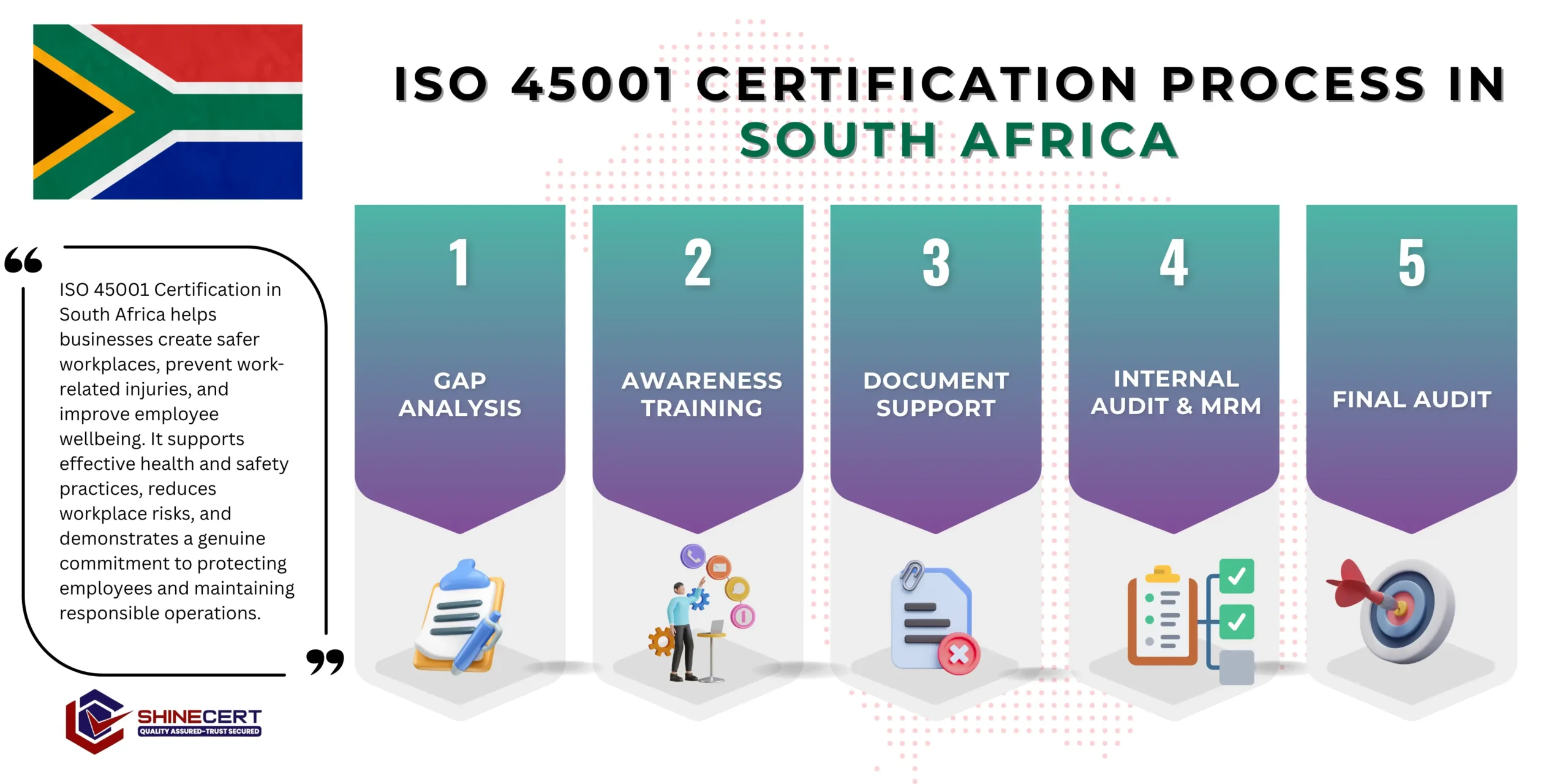
The ISO 45001 Certification Process in South Africa
Getting certified follows five steps. Here’s exactly what happens at each one.
Hazard and Risk Assessment
We walk your site, identify the hazards your workers actually face, and compare your current controls against what ISO 45001 requires.
An honest picture of where the real risk sits, not a generic safety checklist copied from a different industry.
A hazard identification and risk assessment report specific to your site.
Documentation
We help build your OHS policy, risk register, and safe operating procedures around your actual work processes.
Documents your supervisors and workers can genuinely follow, not paperwork that only makes sense to a consultant.
A complete ISO 45001 documentation set.
Implementation and Training
The system goes live, with workers and supervisors trained on the specific controls relevant to their tasks.
This phase usually takes the longest, because genuine safety culture change takes longer than writing a procedure.
Training records and evidence the system operates daily.
Internal Audit and Management Review
We test whether controls genuinely work on site, with findings feeding into a management review before the external audit.
Gaps surface here, while there’s still time to close them, rather than during the real audit.
An internal audit report and management review minutes.
Certification Audit
An accredited, independent auditor reviews your documentation and visits your site to observe real working conditions and talk to staff.
Both paperwork and practice are checked before your certificate is issued.
Your ISO 45001 certificate and a surveillance audit schedule.
Benefits of ISO 45001 Certification
- Fewer injuries and lost-time incidents : Hazards get identified and controlled before they cause harm, rather than being addressed only after an incident report is filed.
- Lower compensation and insurance costs over time : Insurers and compensation funds increasingly recognise certified businesses as lower risk.
- Easier access to construction and mining contracts : Many principal contractors and mines won’t onboard a new supplier without a functioning safety management system.
- Stronger legal defensibility : If an incident does occur, documented evidence of a genuine, functioning safety system matters significantly in any subsequent investigation or prosecution.
- Better workforce morale and retention : Workers who see safety taken seriously, with real training and real controls, tend to stay longer and report hazards more openly.
- A foundation for other certifications : Much of the audit and document control structure overlaps with ISO 9001 and ISO 14001, making a second or third certification faster.
What Does ISO 45001 Certification Cost in South Africa?
- Nature of your business : Construction, mining, and manufacturing carry inherently higher risk and need more documentation than office-based services.
- Number of employees and sites : More workers means more training and consultation records; each additional site typically needs its own hazard assessment.
- Current safety practices : Businesses already running toolbox talks, PPE programmes, or incident logging aren’t starting from nothing, which shortens the work.
- Industry risk profile : High-risk sectors typically require more detailed risk assessments and more frequent monitoring.
- Certification body fees : Billed separately by the accredited body, never bundled into our quote.
Case Study: A Gqeberha Automotive Component Manufacturer
- A component supplier to the automotive sector near Gqeberha came to us after a near-miss incident on their production line drew attention from a plant safety auditor working for their main customer. The audit flagged that the supplier had no formal safety management system, despite years of an actually reasonable safety record.
- We ran a hazard and risk assessment and found the real gaps weren’t in daily practice, supervisors already managed floor safety sensibly, but in documentation. There was no HIRA register, no formal incident log, and no structured worker consultation process.
- Over four months, we built the safety management system around the plant’s existing practices, added a proper incident and near-miss log, and trained two supervisors as internal safety auditors. The company was certified within the expected timeline.
- At its next plant safety audit, the company passed without a single major finding, and it has since retained its position on the customer’s approved supplier list, which now requires ISO 45001 as a standing condition.
ISO 45001 Certification Across South Africa
ISO 45001 in Johannesburg
ISO 45001 in Cape Town
ISO 45001 in Durban
ISO 45001 in Rustenburg
ISO 45001 in Gqeberha
What Documents Do You Need for ISO 45001 in South Africa?
- Context and Scope : Document: Scope of the OHS Management System Statement. States which sites and activities the system covers.
- Leadership : Document: OHS Policy. A signed top-management commitment to worker health and safety.
- Planning : Document: Hazard Identification and Risk Assessment (HIRA) Register. A working record of every significant hazard and its controls. Document: Legal and Other Requirements Register. A record of OHS Act obligations, permits, and industry-specific regulations that apply to your business.
- Support : Document: Competence and Training Records. Evidence workers have the specific safety training their role requires. Document: Consultation and Participation Records. Evidence workers are genuinely involved in identifying hazards, not just informed after the fact.
- Operation : Document: Safe Operating Procedures. Step-by-step instructions for higher-risk tasks specific to your operations. Document: Emergency Preparedness and Response Plan. What happens during a fire, chemical spill, or serious injury.
- Performance Evaluation : Document: Incident and Near-Miss Records. A working log of what actually happened on site, including near misses, not just reportable injuries. Document: Internal Audit Records. Proof an internal audit was carried out against every clause.
- Improvement : Document: Corrective Action Log. A functioning record tracking every safety issue from discovery through to a verified fix.
Why Businesses Choose ShineCert in South Africa?
We’ve spent 10 years helping more than 10,000 businesses worldwide get certified, coordinated through our Riyadh and India offices with work delivered remotely or on-site as needed. As the best ISO 45001 consultant in South Africa, ShineCert quotes based on your real risk profile, explains safety requirements in plain language, and builds a system your supervisors and workers can genuinely use.
How Long Does ISO 45001 Certification Take in South Africa?
| Business Size | Typical Timeline | Why |
|---|---|---|
| Small, low-risk site | 3–4 months | Fewer hazards to document |
| Medium, moderate risk | 4–6 months | More processes and training records |
| Larger or high-risk (construction, mining) | 6–7 months | More sites, more hazards, more monitoring |
Ready to Get Started?
Whether you’re responding to a client safety requirement or reducing your own incident risk, we’ll walk through your operations and give you a clear, honest quote. Book a free consultation or contact us to get started.
Frequently Asked Questions
No. The OHS Act is the legal requirement. ISO 45001 is a voluntary standard that helps structure how you meet it.
It depends on your industry, headcount, and site risk profile. We quote every business individually.
Usually three to seven months, depending on hazard complexity.
Lower-risk businesses can still benefit, but the strongest demand comes from construction, mining, and manufacturing supply chains.
Documentation can happen remotely. The certification audit needs a site visit to observe real conditions.
No system eliminates all risk, but a working ISO 45001 system meaningfully reduces the likelihood of preventable incidents.