
ISO 27001 Certification in South Africa
Quick Answer
ISO 27001 is the world’s most used information security management standard. It proves a business has a documented system for protecting the confidentiality, integrity, and availability of its information, checked and confirmed by an independent auditor. In South Africa, it’s not a legal requirement, but it directly supports compliance with POPIA (the Protection of Personal Information Act), which the Information Regulator is now actively enforcing, with fines of up to R10 million per violation and over 1,900 data breaches already reported in the current financial year. Certification usually takes three to seven months. Cost depends on your number of employees, systems, and how much of your security practice is already documented. It pairs naturally with ISO 27701 for organizations handling significant personal data.
What Is ISO 27001?
ISO 27001 is an international standard for information security management. It sets out what a business needs in place to protect data, customer records, financial information, intellectual property, from being lost, stolen, or exposed.
Think of it as a structured way of answering three questions continuously: what information do we hold that matters, what could go wrong with it, and what are we actually doing to prevent that. A business becomes “ISO 27001 certified” once an independent, accredited auditor confirms these controls genuinely operate, not just exist on paper.
In South Africa, POPIA is the legal framework governing personal information specifically, enforced by the Information Regulator. ISO 27001 is broader than POPIA, it covers all sensitive information, not only personal data, but a working ISO 27001 system makes POPIA compliance considerably more straightforward, since many of the same controls apply.
Why ISO 27001 Matters in South Africa?
- POPIA enforcement has become active, not theoretical : The Information Regulator has shifted from waiting for complaints to proactively investigating, and has already issued fines up to R5 million against organisations with weak security controls. In the current financial year alone, 1,947 security compromises have been reported, a 40% increase on the previous year.
- Data breaches carry real financial consequences : Administrative fines of up to R10 million per violation, alongside potential criminal liability of up to 10 years’ imprisonment for the most serious breaches, mean weak information security is no longer a background risk.
- Clients increasingly require it before sharing data : Financial services, insurance, and any business handling client or patient data increasingly ask suppliers and partners to prove their security posture with a recognised certification, not just a policy statement.
- It supports, but doesn’t replace, POPIA compliance : A working ISO 27001 system gives you most of the technical and organisational controls POPIA requires, though POPIA’s specific legal obligations, like the Information Officer role, still need separate attention.
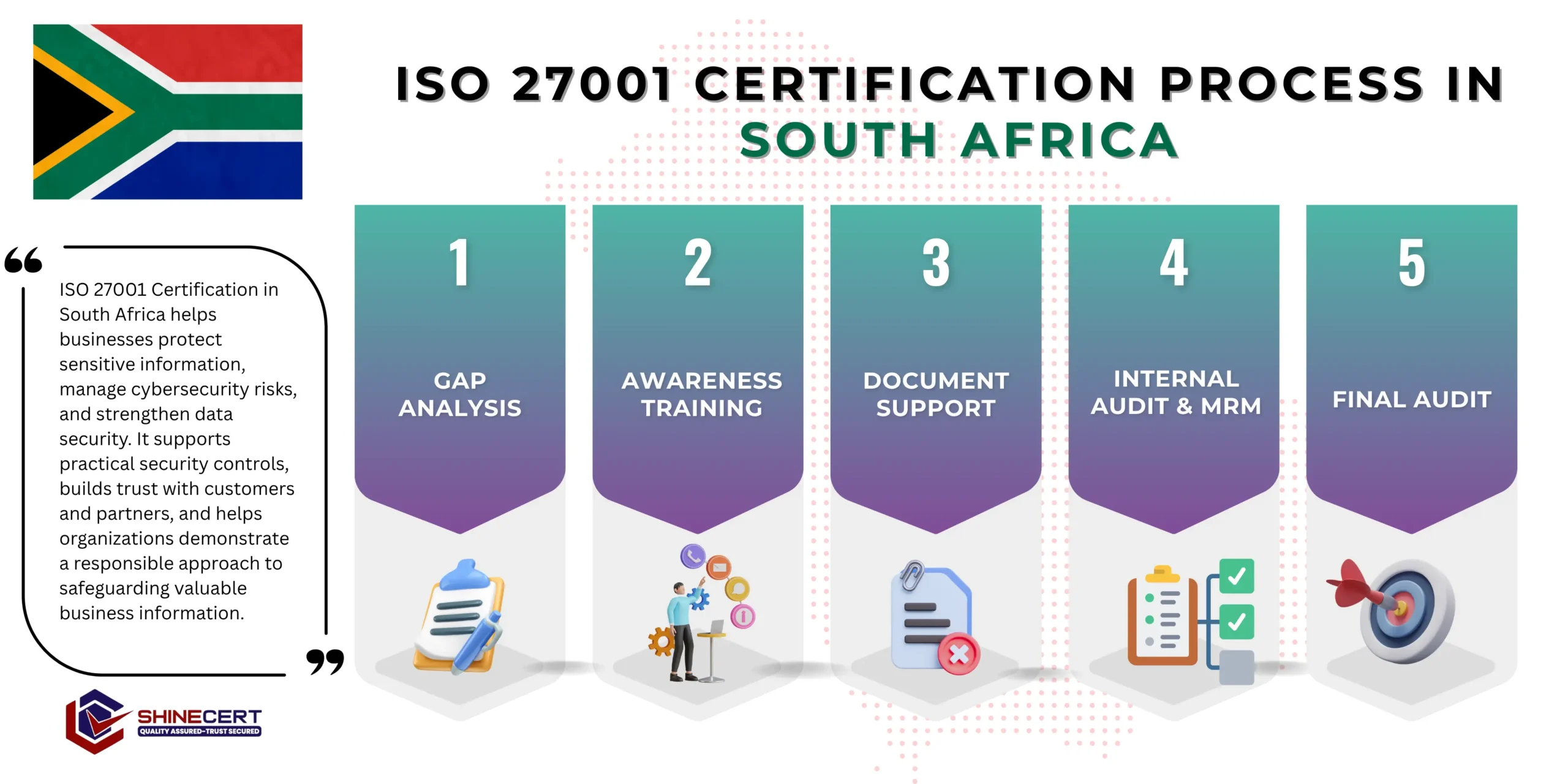
What are the steps to get ISO 27001 Certification in South Africa?
our services
- ISO Certification South Africa
- ISO 9001 Certification South Africa
- ISO 14001 Certification South Africa
- ISO 27001 Certification South Africa
- ISO 22000 Certification South Africa
- ISO 27701 Certification South Africa
- ISO 45001 Certification South Africa
- ISO 20000-1 Certification South Africa
- ISO 13485 Certification South Africa
- ISO 17025 Certification South Africa
- ISO 31000 Certification South Africa
- ISO 42001 Certification South Africa
- ISO 37001 Certification South Africa
- ISO 22301 Certification South Africa
- ISO 50001 Certification South Africa
- CE Mark Certification South Africa
- GDPR Certification South Africa
- GMP Certification South Africa
- Halal Certification South Africa
The ISO 27001 Certification Process in South Africa
Getting certified follows five steps. Here’s exactly what happens at each one.
Risk Assessment
We identify the information assets that actually matter to your business and assess realistic threats against them, rather than working from a generic security checklist.
A clear picture of where your real exposure sits, before you spend on controls that don’t address it.
An information security risk assessment specific to your systems.
Documentation
We help build your security policy, risk treatment plan, and Statement of Applicability, based on the controls your business genuinely needs.
A documentation set your IT and operations teams can actually follow, not a generic template.
A complete ISO 27001 documentation set.
Implementation and Training
Security controls go live, and staff are trained on their specific responsibilities, from password practices to incident reporting.
This is usually the longest phase, since real behaviour change (people not reusing passwords, reporting suspicious emails) takes longer than configuring a firewall.
Training records and evidence controls are genuinely operating.
Internal Audit and Management Review
We test whether controls genuinely work, with findings feeding into a management review before the external audit.
Weaknesses surface here, while there’s still time to fix them quietly.
An internal audit report and management review minutes.
Certification Audit
An accredited, independent auditor reviews your documentation and tests whether controls function as described.
Both your policies and your actual technical controls get checked before certification.
Your ISO 27001 certificate and a surveillance audit schedule.
Benefits of ISO 27001 Certification
- Fewer data breaches and security incidents : A working information security management system catches vulnerabilities and weak practices before they’re exploited, not after a breach notification is required.
- Stronger position with POPIA compliance : Much of what an ISO 27001 system requires, access control, incident response, risk assessment, directly overlaps with what POPIA expects.
- A competitive edge with data-sensitive clients : Financial services, healthcare, and insurance clients increasingly shortlist suppliers based on demonstrated security certification.
- Lower breach-related costs : Regulatory fines, breach notification costs, and reputational damage are all reduced when a genuine security system is already in place.
- Clearer internal accountability : Staff understand exactly what information they’re responsible for protecting and how, instead of security being treated as “IT’s problem.”
- A foundation for ISO 27701 : If personal data is central to your business, ISO 27001 is the base layer that ISO 27701 (privacy information management) builds directly on top of.
What Does ISO 27001 Certification Cost in South Africa?
- Nature of your business : Financial services, healthcare, and businesses processing significant personal data need more controls than a low-data-exposure services business.
- Number of employees and systems : More staff and more IT systems mean more access points to control and more people to train.
- Current security maturity : Businesses already running basic controls like firewalls, backups, and access management aren’t starting from zero, which shortens the work.
- Cloud and third-party dependencies : Businesses relying heavily on cloud providers or outsourced IT typically need more work mapping shared security responsibilities.
- Certification body fees : Billed separately by the accredited body, never bundled into our quote.
Case Study: A Sandton Financial Services Firm
- A mid-sized financial advisory firm in Sandton came to us after a client due-diligence questionnaire asked for proof of an information security certification before the client would proceed with onboarding. The firm had solid informal practices, decent passwords, a reasonably managed cloud setup, but nothing documented or independently verified.
- We ran a risk assessment and found the real exposure wasn’t in the firm’s day-to-day technical controls, which were reasonable, but in the absence of any formal risk assessment, incident response plan, or access review process. Client data access hadn’t been formally reviewed in years.
- Over five months, we documented the firm’s genuine practices, built a proper risk treatment plan and incident response process, and trained staff on security awareness and access hygiene. The firm was certified within the expected timeline.
- The firm passed its client’s due-diligence review on the first attempt and has since used the certification proactively in new business pitches, turning a compliance requirement into a genuine competitive advantage.
ISO 27001 Certification Across South Africa
ISO 27001 in Johannesburg
ISO 27001 in Cape Town
ISO 27001 in Durban
ISO 27001 in Pretoria
ISO 27001 in Sandton
What Documents Do You Need for ISO 27001 in South Africa?
- Context and Scope : Document: Scope of the ISMS Statement. Defines which systems, data, and locations the information security management system covers.
- Leadership : Document: Information Security Policy. A signed top-management commitment to protecting information assets.
- Planning : Document: Risk Assessment and Treatment Plan. Identifies threats to your information assets and the controls chosen to address each one. Document: Statement of Applicability. Explains which of ISO 27001’s Annex A controls apply to your business and why.
- Support : Document: Security Awareness Training Records. Evidence staff understand phishing, password, and data-handling risks relevant to their role. Document: Access Control Procedure. How access to systems and data is granted, reviewed, and revoked.
- Operation : Document: Incident Response Plan. What happens the moment a suspected breach or security event is identified. Document: Backup and Recovery Procedure. How data is protected against loss and how quickly it can be restored.
- Performance Evaluation : Document: Security Incident Log. A working record of every security event, however small, and how it was handled. Document: Internal Audit Records. Proof an internal audit was carried out against every clause.
- Improvement : Document: Corrective Action Log. A functioning record tracking every security weakness from discovery to a verified fix.
Why Businesses Choose ShineCert in South Africa?
We’ve spent 10 years helping more than 10,000 businesses worldwide get certified, coordinated through our Riyadh and India offices with work delivered remotely or on-site as needed. As the best ISO 27001 consultant in South Africa, ShineCert quotes based on your real systems and data exposure, explains security requirements in plain language, and builds controls your own IT team can genuinely maintain.
How Long Does ISO 27001 Certification Take in South Africa?
| Business Size | Typical Timeline | Why |
|---|---|---|
| Small, limited systems | 3–4 months | Fewer assets and controls to document |
| Medium, several systems and departments | 4–6 months | More access points and processes to secure |
| Larger, multiple systems or locations | 6–7 months | More complexity across infrastructure and staff |
Ready to Get Started?
Whether you’re responding to a client security requirement or reducing your own breach risk, we’ll walk through your systems and give you a clear, honest quote. Book a free consultation or contact us to get started.
Frequently Asked Questions
No. POPIA doesn’t mandate ISO 27001 specifically, but a working ISO 27001 system covers much of what POPIA’s security safeguard requirements expect.
It depends on your systems, data sensitivity, and current security maturity. We quote every business individually.
Usually three to seven months, depending on system complexity.
Any business handling meaningful customer or financial data can benefit, particularly if larger clients are starting to ask for proof of security controls.
Most documentation and technical review work can happen remotely.
No. POPIA specifically requires a registered Information Officer regardless of ISO 27001 certification; the two work together, not as substitutes.