
ISO 42001 Certification in South Africa
Quick Answer
ISO 42001 is the world’s first international standard for AI management systems. It proves a business has a documented, responsible way of developing or using artificial intelligence, covering risk, transparency, and human oversight, verified by an independent auditor. In South Africa, there’s no dedicated AI law yet; a draft National AI Policy was published and then withdrawn in 2026 after quality issues, with a revised version expected at Cabinet by November 2026. In that gap, ISO 42001 is the clearest way for a business to demonstrate responsible AI governance to clients, regulators, and partners right now. Certification usually takes three to seven months. Cost depends on how many AI systems you build or use and how mature your current governance already is.
What Is ISO 42001?
ISO 42001 is an international standard for artificial intelligence management systems. It sets out what a business needs in place to develop, deploy, or use AI responsibly, covering risk assessment, data governance, transparency to users, and human oversight of automated decisions.
Think of it as a structured way of answering questions regulators and clients are increasingly asking: what AI systems does your business use, what could go wrong, and how are you making sure a human stays accountable for the outcome. A business becomes “ISO 42001 certified” once an independent, accredited auditor confirms this governance genuinely operates, not just exists as a policy statement.
South Africa doesn’t yet have a dedicated AI law. A Draft National AI Policy was published for comment in April 2026, then withdrawn later that month after it emerged that some of its academic references were fabricated. A revised version is expected to reach Cabinet by November 2026, with public release targeted for January 2027. Until then, ISO 42001 gives businesses a credible, internationally recognised way to govern AI responsibly ahead of formal regulation.
Why ISO 42001 Matters in South Africa?
- Regulation is coming, and getting ahead of it is cheaper than catching up : The government has already signalled a sector-specific, multi-regulator approach to AI oversight built around skills, governance, ethics, and human-centred deployment. Businesses that already have structured AI governance in place will adapt faster once formal rules land.
- Client and partner due diligence increasingly includes AI questions : Financial services, healthcare, and public-sector clients are starting to ask suppliers how they govern the AI tools embedded in their products, well before any law requires it.
- It reduces real operational risk : Poorly governed AI systems can produce biased outcomes, fabricated information, or decisions nobody can explain, the same category of failure that sank South Africa’s own draft AI policy. A working management system catches this before it reaches a customer or regulator.
- It’s a genuine differentiator right now : Because ISO 42001 is new and few South African businesses have pursued it yet, early certification is a visible signal of maturity in an increasingly AI-conscious market.
What are the steps to get ISO 42001 Certification in South Africa?
our services
- ISO Certification South Africa
- ISO 9001 Certification South Africa
- ISO 14001 Certification South Africa
- ISO 27001 Certification South Africa
- ISO 22000 Certification South Africa
- ISO 27701 Certification South Africa
- ISO 45001 Certification South Africa
- ISO 20000-1 Certification South Africa
- ISO 13485 Certification South Africa
- ISO 17025 Certification South Africa
- ISO 31000 Certification South Africa
- ISO 42001 Certification South Africa
- ISO 37001 Certification South Africa
- ISO 22301 Certification South Africa
- ISO 50001 Certification South Africa
- CE Mark Certification South Africa
- GDPR Certification South Africa
- GMP Certification South Africa
- Halal Certification South Africa
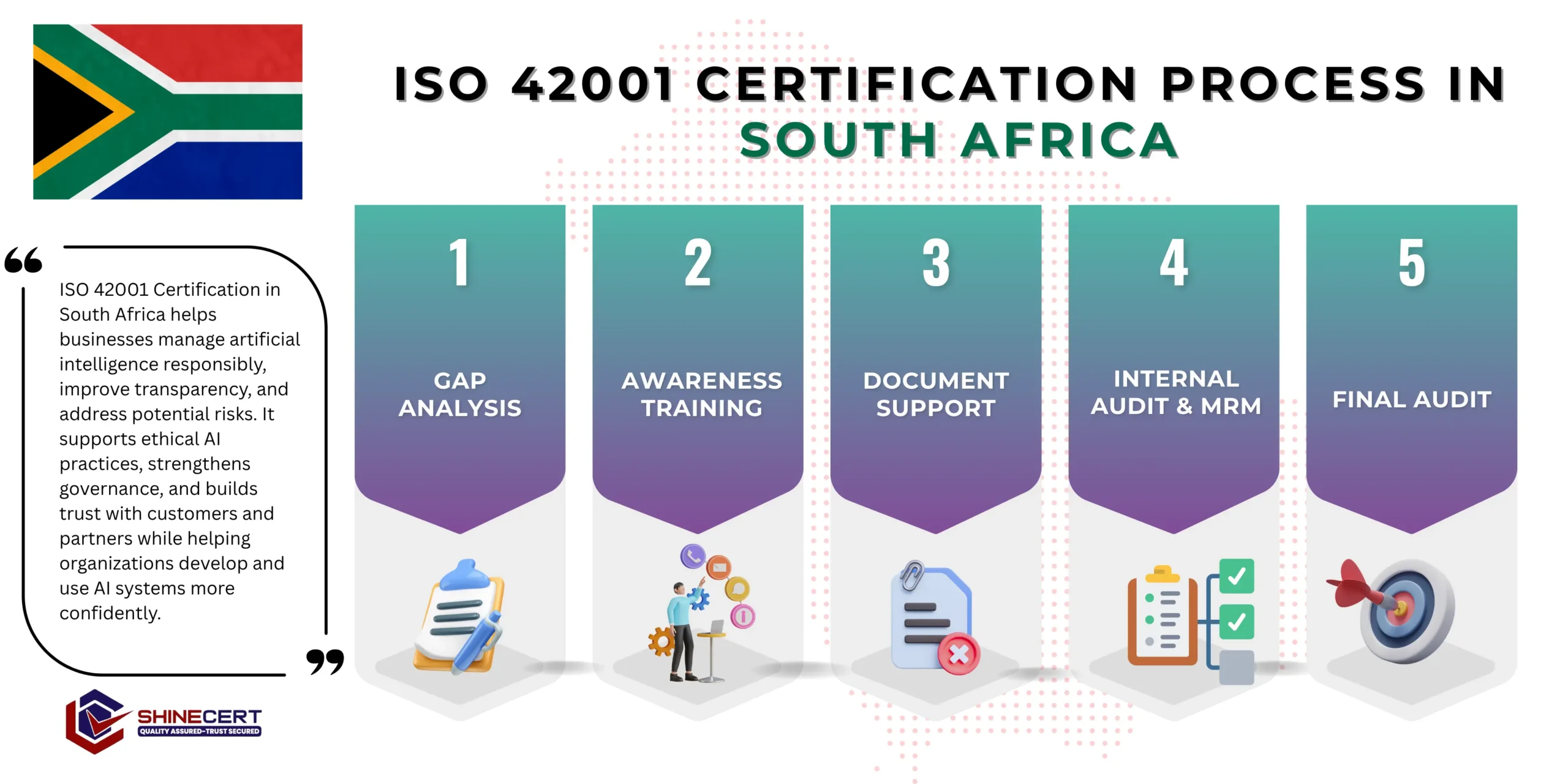
The ISO 42001 Certification Process in South Africa
Getting certified follows five steps. Here’s exactly what happens at each one.
AI System Inventory and Risk Review
We identify every AI system your business builds, buys, or uses, from customer chatbots to internal automation, and assess the realistic risks each one carries.
An honest inventory of AI risk across your business, most of which is usually invisible until someone actually looks.
An AI system inventory and risk assessment specific to your operations.
Documentation
We help build your AI policy, risk treatment plan, and governance procedures around the systems you actually run.
Documentation your product and technical teams can genuinely follow, not a generic AI ethics statement.
A complete ISO 42001 documentation set.
Implementation and Training
Governance controls go live, with staff trained on their specific responsibilities for reviewing and explaining AI-driven decisions.
This phase takes real time, because meaningful human oversight of AI systems is a genuine practice change, not a checkbox.
Training records and evidence governance controls are genuinely operating.
Internal Audit and Management Review
We test whether AI governance controls genuinely work, with findings feeding into a management review before the external audit.
Gaps surface here, while there’s still time to close them quietly.
An internal audit report and management review minutes.
Certification Audit
An accredited, independent auditor reviews your documentation and tests whether governance controls function as described.
Both your AI policy and your actual practice get checked before certification.
Your ISO 42001 certificate and a surveillance audit schedule.
Benefits of ISO 42001 Certification
- Fewer AI-related incidents reaching customers or the public : Structured risk assessment catches bias, fabrication, or accountability gaps before an AI system causes real harm.
- Stronger position with cautious, data-sensitive clients : Financial services and public-sector clients increasingly want proof of AI governance, not just a reassurance in a sales call.
- Reduced regulatory catch-up risk : When South Africa’s AI policy is finalised, certified businesses will already have most of the governance structure regulators are likely to expect.
- Clearer internal accountability for AI decisions : Someone is formally responsible for reviewing and explaining what an AI system does, rather than accountability being diffuse or assumed.
- A genuine market differentiator : Early ISO 42001 certification stands out in a market where very few competitors have pursued it yet.
- A natural pairing with ISO 27001 : Much of the risk assessment and documentation structure overlaps, since AI systems and information security risk are closely linked.
What Does ISO 42001 Certification Cost in South Africa?
- Nature of your business : A business building its own AI models needs more governance depth than one simply using third-party AI tools embedded in other software.
- Number of AI systems in use : More systems mean more risk assessments, more documentation, and more ongoing monitoring.
- Current governance maturity : Businesses already reviewing AI outputs and tracking data sources aren’t starting from nothing, which shortens the work.
- Data sensitivity : AI systems processing personal or financial data typically need deeper risk assessment and closer alignment with POPIA.
- Certification body fees : Billed separately by the accredited body, never bundled into our quote.
Case Study: A Johannesburg Fintech Lender
- A Johannesburg-based fintech offering AI-driven credit scoring came to us after an investor due-diligence process flagged the absence of any formal AI governance, despite the company’s model already being central to its lending decisions.
- We ran an AI system inventory and risk review and found the model itself was reasonably well built, but nobody could clearly explain how disputed credit decisions were reviewed, or how the training data was sourced and validated. There was no human oversight procedure and no AI incident log.
- Over five months, we built a governance structure around the company’s existing model, added a human review process for disputed decisions, and documented the data sourcing and validation process the data science team was already informally following. The company was certified within the expected timeline.
- The certification satisfied the investor’s due-diligence requirement and has since become a standing feature of the company’s pitch to new partners, who increasingly ask how AI-driven credit decisions are governed before signing on.
ISO 42001 Certification Across South Africa
ISO 42001 in Johannesburg
ISO 42001 in Cape Town
ISO 42001 in Pretoria
ISO 42001 in Durban
ISO 42001 in Sandton
What Documents Do You Need for ISO 42001 in South Africa?
- Context and Scope : Document: Scope of the AI Management System Statement. Defines which AI systems, products, and processes are covered.
- Leadership : Document: AI Policy. A signed top-management commitment to responsible AI development and use.
- Planning : Document: AI Risk Assessment and Treatment Plan. Identifies risks, bias, fabrication, security, misuse, for each AI system and the controls chosen to address them. Document: AI System Impact Assessment. Evaluates the effect of each significant AI system on individuals or groups it affects.
- Support : Document: AI Competence and Training Records. Evidence staff understand the specific AI risks relevant to their role. Document: Data Governance Procedure. How training and input data for AI systems is sourced, validated, and protected.
- Operation : Document: AI System Development and Deployment Procedure. Step-by-step controls for how new AI systems are built, tested, and released. Document: Human Oversight Procedure. How and when a human reviews or overrides an AI-driven decision.
- Performance Evaluation : Document: AI Incident Log. A working record of AI failures, biased outcomes, or fabricated outputs and how they were handled. Document: Internal Audit Records. Proof an internal audit was carried out against every clause.
- Improvement : Document: Corrective Action Log. A functioning record tracking every AI governance issue from discovery through to a verified fix.
Why Businesses Choose ShineCert in South Africa?
We’ve spent 10 years helping more than 10,000 businesses worldwide get certified, coordinated through our Riyadh and India offices with work delivered remotely or on-site as needed. As the best ISO 42001 consultant in South Africa, ShineCert quotes based on your real AI footprint, explains governance requirements in plain language, and builds a system your product and technical teams can genuinely maintain.
How Long Does ISO 42001 Certification Take in South Africa?
| Business Size | Typical Timeline | Why |
|---|---|---|
| Small, using a few third-party AI tools | 3–4 months | Fewer systems to assess and document |
| Medium, mix of built and bought AI systems | 4–6 months | More systems and more governance to build |
| Larger, developing proprietary AI models | 6–7 months | Deeper technical risk assessment required |
Ready to Get Started?
Whether you’re responding to investor or client due diligence, or simply getting ahead of AI regulation before it lands, we’ll walk through your AI systems and give you a clear, honest quote. Book a free consultation or contact us to get started.
Frequently Asked Questions
No. There’s no dedicated AI law in South Africa yet; ISO 42001 is a voluntary standard that gets you ahead of regulation that’s still being finalized.
It depends on how many AI systems you run and your current governance maturity. We quote every business individually.
Usually three to seven months, depending on the number and complexity of AI systems involved.
Yes, governance still matters, you’re still responsible for how those tools are used and what decisions they influence, even if you didn’t build the underlying model.
Most of the documentation and governance work can happen remotely.
It’s too early to say, since the policy itself is still being revised, but certified businesses will be well positioned regardless of the final requirements.