
Halal Certification in Tanzania
Quick Answer
Halal certification in Tanzania sits on two legs working together rather than one single authority. The Tanzania Bureau of Standards (TBS) has published a national standard, AFDC 1 (1867) Halal Food – General Requirements, setting out the technical specifications a food product or process must meet. The National Muslim Council of Tanzania, known as BAKWATA (Baraza Kuu la Waislamu Tanzania), provides the religious authority that actually issues Halal certification against those requirements, often working alongside affiliated certification bodies recognized for this purpose. For a food or meat business, this means certification isn’t a single government stamp, it’s technical compliance verified against a published national standard, combined with religious sign-off from a recognized Islamic authority. Certification typically takes six to eighteen weeks depending on your facility’s existing readiness.
Understanding Halal Certification: What It Actually Requires
Halal certification confirms that a food product, and the process used to make it, satisfies Islamic dietary law. For meat specifically, that covers the method of slaughter, how the animal is handled beforehand, and how the carcass is processed afterward. In Tanzania, TBS’s AFDC 1 (1867) standard gives this a concrete technical foundation: defined general requirements a Halal food product must meet, rather than leaving “Halal” as a purely informal claim. BAKWATA and its affiliated certifying bodies then apply religious verification on top of that technical standard, inspecting facilities, reviewing sourcing, and issuing the actual certificate.
This two-part structure matters practically because it means genuine Halal certification in Tanzania isn’t just a religious sign-off obtained informally, it’s meant to be checked against a published technical standard, the same way ISO or food safety certification would be. A business claiming Halal status without going through this combined process is making a claim that neither TBS’s technical standard nor BAKWATA’s religious authority has actually verified.
What are the steps to get Halal Certification in Tanzania?
our services
- ISO Certification Tanzania
- ISO 9001 Certification Tanzania
- ISO 14001 Certification Tanzania
- ISO 27001 Certification Tanzania
- ISO 22000 Certification Tanzania
- ISO 27701 Certification Tanzania
- ISO 45001 Certification Tanzania
- ISO 20000-1 Certification Tanzania
- ISO 13485 Certification Tanzania
- ISO 17025 Certification Tanzania
- ISO 31000 Certification Tanzania
- ISO 42001 Certification Tanzania
- ISO 37001 Certification Tanzania
- ISO 22301 Certification Tanzania
- ISO 50001 Certification Tanzania
- CE Mark Certification Tanzania
- GDPR Certification Tanzania
- GMP Certification Tanzania
- Halal Certification Tanzania
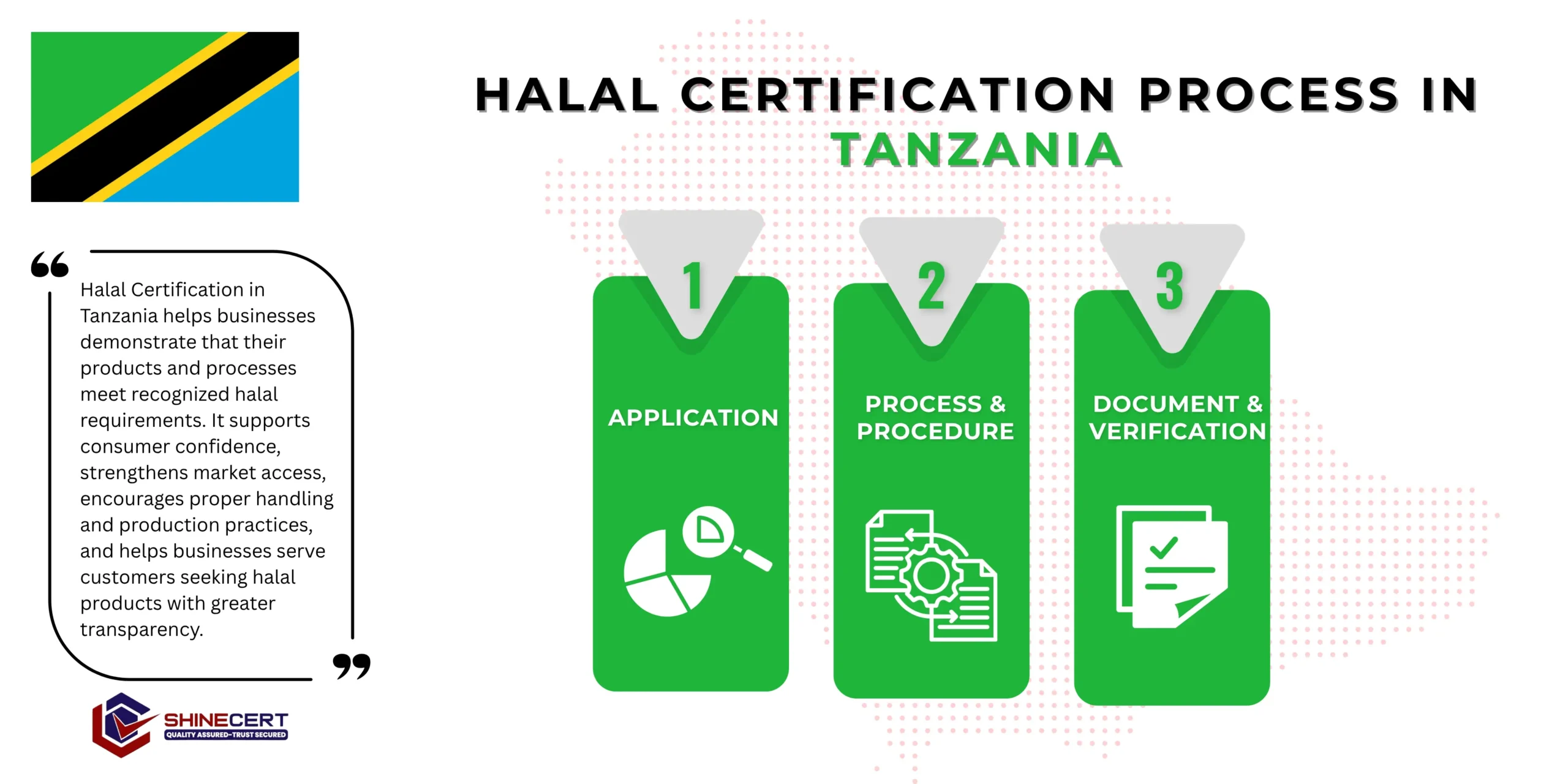
Halal Certification Process in Tanzania
Eligibility Review
We look at your actual products, sourcing, and processing methods against TBS's published requirements to genuinely assess feasibility before committing resources.
An eligibility assessment identifying what, if anything, needs to change before certification.
Documentation
We build traceability records, supplier verification, and process documentation around your real supply chain and production methods.
A complete documentation package ready for certifier review.
Facility Preparation
Where segregation or process changes are needed, we help implement them and arrange staff training specific to Halal requirements.
A facility genuinely ready for certification audit.
Certifier Audit
BAKWATA or an affiliated, recognized certifying body reviews your documentation and inspects your facility against both the technical standard and religious requirements.
Audit findings and any corrective actions needed before certificate issuance.
Certificate Issuance
Upon successful audit, your Halal certificate is issued.
Your Halal certificate, with validity and renewal terms set by the issuing body.
Staying Certified: Renewal and Ongoing Compliance
Halal certificate validity is set by the issuing body and typically requires periodic renewal audits alongside ongoing surveillance between renewals. Because Tanzania’s Halal certification landscape now involves both a published technical standard and religious authority working together, we recommend staying current on any updates to TBS’s Halal food requirements as well as any changes in which certifying bodies carry active recognition for your target markets.
Halal Certification Cost in Tanzania
A single price tag doesn’t really exist for this certification, and what a Tanzanian business ends up paying comes down to a specific set of factors:
01
Whether your facility needs physical or procedural separation between Halal and non-Halal production
A facility already dedicated entirely to Halal products spends considerably less than one that needs to build segregation from a mixed operation.
02
How many product lines you’re bringing into certification
Each additional line generally needs its own traceability and sourcing verification, adding to the overall scope.
03
How well-documented your supplier relationships already are
Businesses sourcing from suppliers who are themselves Halal-verified have meaningfully less sourcing verification work ahead of them.
04
Which export markets you’re actually targeting, if any
Some Gulf and Asian markets layer on their own recognition or documentation requirements beyond what TBS and BAKWATA require domestically.
05
The certifying body’s own audit and issuance fees
These are billed directly by whichever body conducts your audit and issues the certificate, separate from our consulting work.
06
How many staff need training specific to Halal handling
A larger workforce touching Halal-sensitive processes means a broader, longer training program.
Why It’s Becoming Essential for Tanzanian Businesses Right Now?
- TBS publishing a formal Halal standard gives the entire certification landscape a technical backbone that didn’t exist before : With AFDC 1 (1867) now setting out general requirements for Halal food, certification bodies and businesses alike have a defined reference point, moving the process away from informal religious assurance alone and toward something closer to a verifiable technical standard.
- Export markets across the Gulf and other Muslim-majority regions expect certification that can be traced back to a recognized authority, and Tanzania’s combined TBS-BAKWATA structure is built to answer that : Buyers in these markets routinely ask which body issued a Halal certificate and what standard it was checked against, and Tanzanian exporters with a clear answer tied to both TBS’s published standard and BAKWATA’s recognition move through buyer due diligence more smoothly.
- Tanzania’s own Muslim consumer base, concentrated heavily along the coast and in Zanzibar, represents a genuine and often underserved domestic market for verified Halal products : Businesses that treat Halal certification purely as an export requirement miss real commercial opportunities closer to home.
- A growing number of certification bodies now operate in the East African region specifically, which means Tanzanian businesses have more genuine options than a single national certifier : Businesses evaluating certification partners benefit from understanding which bodies carry recognition that will actually hold up with their specific target market.
Benefits of Halal Certification for Tanzanian Organizations
Tanzanian food and meat businesses that pursue certification gain considerably more than a label for the package. Here is what certification actually delivers:
Certification tied to TBS’s published standard and BAKWATA’s religious authority gives international buyers a verifiable reference point, not just an assurance to take on faith.
A Halal certificate recognized through established channels gives Tanzanian exporters the documentation these markets specifically require before goods can clear.
Certification lets you serve Muslim consumers, particularly in coastal regions and Zanzibar, who specifically look for verified Halal products.
A published technical standard removes ambiguity about what compliance requires, reducing disagreements with buyers or auditors down the line.
Distributors and buyers who specifically require Halal certification stop being a point of friction once you can produce a genuine certificate.
Halal certification pairs naturally with ISO 22000, addressing dietary compliance and food safety as two distinct but related concerns.
The Real Challenges Organizations Face While Implementing Halal Certification
- Treating an informal religious endorsement as equivalent to full certification : Some businesses rely on an imam’s verbal assurance or an informal community endorsement without realizing buyers, particularly export buyers, expect documentation tied to a recognized standard and certifying body.
- Underestimating traceability requirements once suppliers are involved : It’s common to document your own processing carefully while never verifying Halal compliance further up the chain with ingredient or livestock suppliers.
- Facility segregation that’s informal rather than documented : Facilities producing both Halal and non-Halal products sometimes rely on staff simply “knowing” which line is which, without the documented segregation an auditor actually needs to see.
- Labelling that gets ahead of actual certification status : Packaging sometimes carries Halal claims before certification is fully complete, which creates a genuine compliance gap once an auditor or buyer checks.
Where Certification Matters Most Across Tanzania’s Economy?
Meat processing and abattoirs
Halal certification is directly central to product eligibility for domestic Muslim consumers and export markets; pair with ISO 22000 for combined food safety and dietary compliance.
Read moreFood export to Gulf and Muslim-majority markets
Halal certification tied to a recognized authority is close to essential for clearing these markets.
Read moreHospitality and catering serving Muslim guests
Certification supports genuine, verifiable service to Muslim clientele, particularly relevant for coastal tourism operators.
Read morePackaged and processed foods for the domestic Muslim market
Certification supports real market access to Tanzania’s coastal and Zanzibar-based Muslim consumer base specifically.
Read moreIngredient suppliers to certified manufacturers
Upstream suppliers increasingly need their own Halal verification to support downstream customers pursuing certification.
Read moreA Tanzanian Business We’ve Worked With
- A Dar es Salaam-based meat processor supplying both domestic retailers and a growing export relationship with a Gulf buyer approached us uncertain about exactly what “properly certified” meant in Tanzania, having previously relied on an informal religious endorsement without documentation tied to any published standard.
- Our eligibility review found the company’s actual slaughter practices were substantively sound, but there was no traceability system linking their process to TBS’s published Halal food requirements, and no formal certificate a buyer could independently verify.
- We guided the company through documentation aligned with the TBS standard and supported their application through a BAKWATA-recognized certifying body. The process took about eleven weeks, and the resulting certificate gave their Gulf buyer the traceable, verifiable documentation they had specifically been requesting.
- This reflects a pattern we see often among Tanzanian food processors, genuinely sound practices that had simply never been tied to a formal, verifiable standard.
The Documentation Certifiers Expect
- Slaughter and Processing Procedure Records : For meat businesses, documented proof that slaughter methods meet both TBS’s technical requirements and Islamic dietary law, carried out by appropriately trained personnel.
- Supply Chain Traceability Records : Documentation tracing ingredients and processing steps to confirm nothing crosses paths with non-Halal materials at any stage.
- Ingredient and Supplier Verification : Records confirming raw materials come from Halal-compliant suppliers, with supporting paperwork from those suppliers where the chain extends further upstream.
- Facility and Equipment Segregation Evidence : Documentation showing genuine physical or procedural separation between Halal and non-Halal production in any facility handling both.
- Staff Training Records : Evidence that personnel involved in slaughter or handling have actually received training specific to Halal compliance, not general food handling training alone.
- Labelling and Marketing Compliance : Documentation confirming Halal claims on packaging genuinely match verified certification status, referencing both the TBS standard and the certifying authority.
Realistic Timelines for Tanzanian Businesses
| Business Profile | Typical Total Timeline | What Drives This |
|---|---|---|
| Single-product processor, straightforward sourcing | 6–9 weeks | Narrower traceability scope and simpler process documentation |
| Meat processor requiring facility segregation | 9–14 weeks | Facility adjustments and staff training add meaningful time |
| Larger exporter, multiple product lines | 12–18 weeks | Extensive traceability across product lines and export market-specific requirements |
What tends to stretch this timeline isn’t the paperwork itself, it’s whether your facility already has genuine segregation and trained staff in place, or whether both need to be built from the ground up as part of the process.
Halal Certification Across Tanzania’s Business Hubs
Dar es Salaam
As the country’s commercial and export hub, businesses here handle the widest volume of Halal-certified food processing and export activity.
Zanzibar
With an overwhelmingly Muslim population and a hospitality sector serving international Muslim travelers, Halal certification here carries particularly direct commercial weight.
Arusha
With a hospitality sector serving diverse international visitors, Halal-certified catering options support broader inclusive tourism positioning.
Mwanza
Serving the Lake Zone’s food processing and trade activity, certification here supports both regional distribution and export ambitions.
Why Businesses Choose ShineCert in Tanzania?
A decade of certification consulting across more than 10,000 organizations backs every Tanzania engagement we take on, coordinated from our Riyadh and India offices with people on-site whenever a project genuinely calls for it. We walk Tanzanian food and meat businesses through exactly how TBS’s technical standard and BAKWATA’s religious authority actually fit together, rather than leaving that structure vague, which is why Tanzanian businesses bring their Halal certification work to ShineCert, the best Halal consultant in Tanzania.
Choosing a Certification Body in Tanzania?
What to Check | Why It Matters |
Recognition by BAKWATA or an equivalent affiliated religious authority | Confirms the religious verification component actually carries weight domestically |
Alignment with TBS’s AFDC 1 (1867) Halal Food standard | Ensures the technical side of certification is genuinely being checked, not assumed |
Experience with your specific product category | Meat processing and packaged foods involve meaningfully different certification considerations |
Recognition by your target export markets | Gulf and Asian markets sometimes maintain specific certifier recognition requirements worth confirming upfront |
Ready to Get Started?
Whether you’re pursuing Gulf export access or serving Tanzania’s domestic Muslim consumer base, tell us about your products and we’ll walk through the actual TBS and BAKWATA requirements before proposing a fixed-scope plan, remote, on-site, or a mix of both. Book a free consultation or contact us directly to get started.
Frequently Asked Questions
Someone who understands how TBS’s published standard and BAKWATA’s religious authority actually work together, and who has real experience with your target export markets. ShineCert scopes every Tanzania project after understanding your specific products.
Not quite, TBS publishes the technical standard (AFDC 1, 1867) that defines what Halal food requirements actually mean, while BAKWATA and its affiliated bodies provide the religious verification and issue the certificate itself.
Yes, in almost all cases, Gulf and other Muslim-majority markets generally require Halal certification tied to a recognized authority before food or meat products can clear.
It depends heavily on whether your facility needs segregation work, how many product lines are involved, and your target export markets, we quote after understanding your specific situation.
Most Tanzanian businesses finish somewhere between six and eighteen weeks, depending mainly on how ready your facility already is.
TBS’s general quality marks address product safety and quality broadly, while Halal certification specifically verifies compliance with Islamic dietary law against the published Halal food standard.
Documentation and sourcing verification work well remotely, but facility audits and slaughter process checks genuinely require an in-person visit.
Not a standalone office, our Tanzania work is coordinated from Riyadh and India, with on-site visits arranged as needed.