
GMP Certification in Tanzania
Quick Answer
Good Manufacturing Practice, or GMP, is the set of quality controls that keep a factory from accidentally shipping a bad batch of medicine or food. Tanzania’s regulator for this, the Tanzania Medicines and Medical Devices Authority (TMDA), inspects manufacturing facilities against its own published GMP guidelines and against the East African GMP Compendium, a framework shared across the East African Community. TMDA itself carries genuine international standing here, the World Health Organization has recognized it as a Maturity Level 3 regulatory authority since 2019, and TMDA’s own laboratories hold WHO prequalification. For a Tanzanian manufacturer, that means the inspecting body’s own credibility is already established internationally, which is exactly why compliance with its GMP requirements travels well beyond Tanzania’s borders. Certification typically takes three to six months.
Understanding GMP: What It Actually Requires
Good Manufacturing Practice is a set of quality assurance requirements ensuring products are made and controlled consistently, to a standard appropriate for what they’re actually used for. It reaches into facility layout and cleanliness, equipment qualification, how raw materials get checked before use, validated production processes, quality control testing, documentation discipline, and staff training. In Tanzania, TMDA inspects against its own published guidelines for human and veterinary medicinal products, cross-referenced against the East African GMP Compendium that harmonizes expectations across the region. GMP compliance is confirmed through facility inspection, not an accredited management-system audit the way ISO certification works, though the two frequently get built alongside each other.
Here’s what makes this concrete for Tanzania specifically: TMDA isn’t simply applying WHO principles by reputation, the WHO has formally benchmarked TMDA itself at Maturity Level 3, meaning an international body has assessed the regulator’s own systems as sufficient to protect public health, and separately certified TMDA’s chemical analysis and microbiology laboratories as WHO-prequalified. A manufacturer passing TMDA’s GMP inspection is being checked by a regulator whose own competence has already cleared an international bar, which gives that compliance genuine weight with buyers and partners far beyond Tanzania.
What are the steps to get GMP Certification in Tanzania?
our services
- ISO Certification Tanzania
- ISO 9001 Certification Tanzania
- ISO 14001 Certification Tanzania
- ISO 27001 Certification Tanzania
- ISO 22000 Certification Tanzania
- ISO 27701 Certification Tanzania
- ISO 45001 Certification Tanzania
- ISO 20000-1 Certification Tanzania
- ISO 13485 Certification Tanzania
- ISO 17025 Certification Tanzania
- ISO 31000 Certification Tanzania
- ISO 42001 Certification Tanzania
- ISO 37001 Certification Tanzania
- ISO 22301 Certification Tanzania
- ISO 50001 Certification Tanzania
- CE Mark Certification Tanzania
- GDPR Certification Tanzania
- GMP Certification Tanzania
- Halal Certification Tanzania
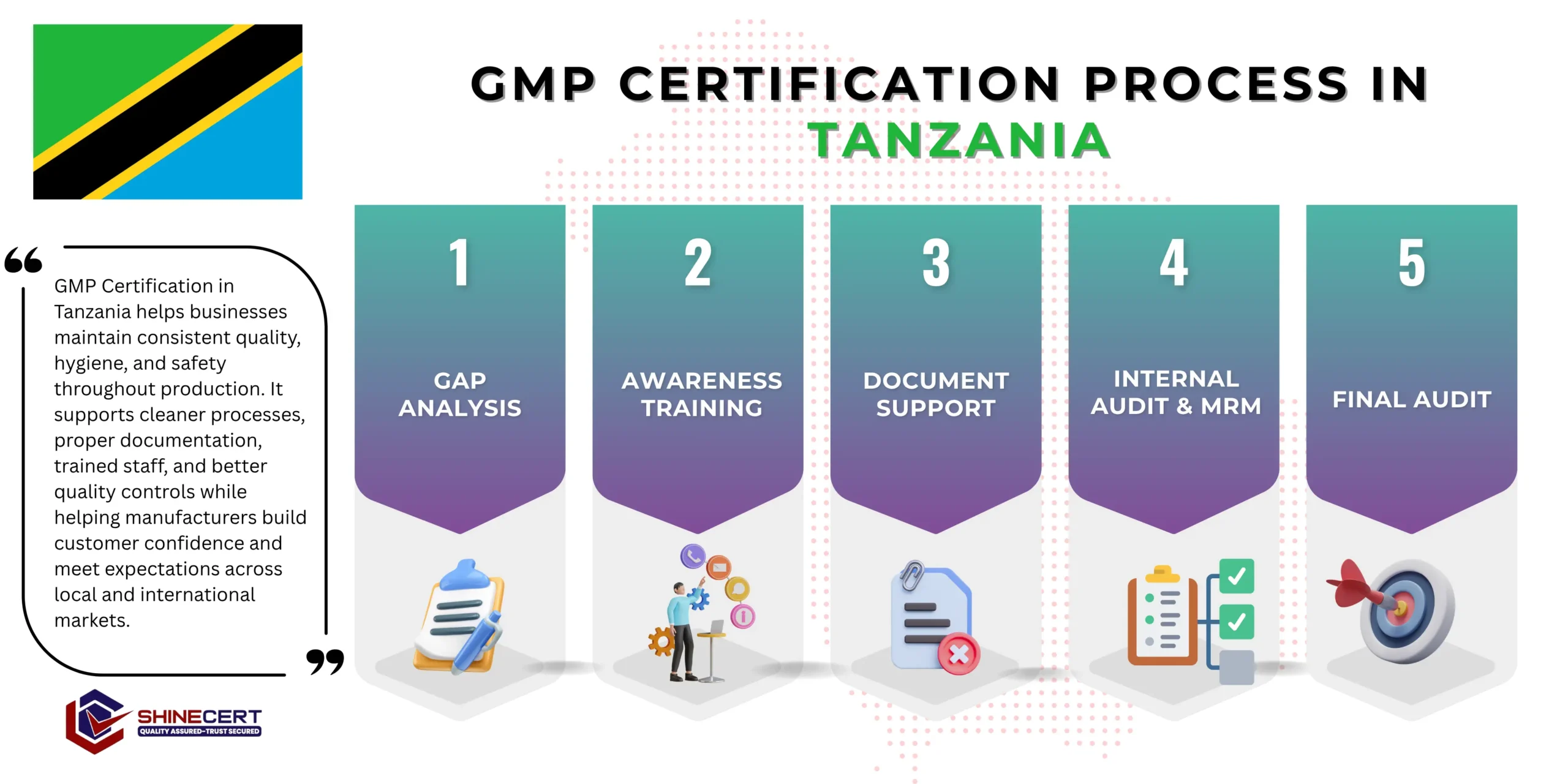
GMP Certification Process in Tanzania
The GMP certification journey in Tanzania: a five-step process from gap assessment through TMDA inspection, with typical durations for each stage
Gap Assessment
We walk your actual facility floor and compare current practice against TMDA's guidelines and the East African GMP Compendium, not a generic international template.
A gap report mapping your real manufacturing practices to what TMDA specifically expects.
Documentation
We build your quality manual, standard operating procedures, and batch record systems around your actual production lines.
A complete GMP documentation set tied to your genuine manufacturing operations.
Implementation
Process controls, batch documentation, and deviation handling move from procedure into daily manufacturing use.
A working GMP system with real controls being actively used and recorded.
Self-Inspection
We audit against every requirement ourselves first, catching gaps while the stakes are still low.
A self-inspection report with corrective actions already closed before TMDA arrives.
TMDA Inspection
TMDA visits your facility and reviews your actual batch and quality records directly. We stay engaged through the process.
GMP compliance recognition, positioning you for TMDA's domestic manufacturer support programs where applicable.
Staying Certified: Ongoing Compliance
GMP compliance is maintained through periodic TMDA inspections rather than a fixed multi-year certificate the way ISO management system certifications work. Staying compliant means genuinely sustaining your documented processes, batch records, and self-inspection cycle between formal TMDA visits, not just passing the initial inspection and letting discipline slip. We recommend reviewing your GMP documentation whenever TMDA updates its guidelines or the East African GMP Compendium is revised.
GMP Certification Cost in Tanzania
Six things genuinely shape what a Tanzanian GMP engagement costs:
01
How many product lines you’re running
Each additional line generally needs its own process validation work and batch record documentation.
02
How much facility and equipment qualification is still outstanding
A facility with existing qualification records has real groundwork already in place; one starting from nothing needs that built from scratch.
03
Where your current documentation actually stands
Manufacturers with established SOPs and batch records aren’t rebuilding a system, just formalizing and closing gaps in one that already exists.
04
What kind of product you’re making
Pharmaceutical products typically demand deeper validation work than lower-risk food or general health products.
05
TMDA’s own inspection fees, billed entirely separately from our work
Those charges go directly to TMDA, not through us.
06
Whether this runs alongside ISO 22000 or ISO 13485
Building GMP together with either standard shares real documentation groundwork, bringing the combined cost down.
Why It’s Becoming Essential for Tanzanian Businesses Right Now?
- TMDA’s own WHO Maturity Level 3 status changes what a Tanzanian GMP inspection actually signals to outside parties : Because an international body has separately assessed TMDA’s regulatory competence, passing its GMP inspection carries a kind of credibility that a less internationally recognized regulator’s approval wouldn’t.
- Tanzania’s active participation in the East African GMP Compendium means compliance opens doors across a wider regional market, not just at home : Manufacturers aligned with this shared regional framework are positioned to move products across East African Community member states with fewer duplicated regulatory hurdles.
- TMDA’s multi-year plan to promote domestic pharmaceutical manufacturing is creating real, structured incentives for local producers to formalize GMP practice now : With a dedicated action plan running through 2026/27 aimed at supporting domestic manufacturers, including facilitative inspections and technical training, Tanzanian producers who engage with this support early are positioned ahead of competitors who wait.
- Growing regional pharmaceutical and health product manufacturing investment across East Africa is raising the baseline expectation for manufacturing quality : As more producers enter the market chasing both domestic and regional demand, GMP compliance has become a genuine way to separate a serious manufacturer from one cutting corners.
Benefits of GMP Certification for Tanzanian Organizations
Tanzanian manufacturers achieving GMP compliance gain considerably more than paperwork proving quality controls exist. Here is what compliance actually delivers:
Demonstrable GMP readiness positions your facility to genuinely benefit from TMDA’s facilitative inspections and technical support for local producers.
Validated production processes and real quality control testing catch problems before products leave the facility, not after.
Because TMDA itself carries WHO Maturity Level 3 recognition, compliance verified by TMDA means something concrete to international buyers and regulators evaluating Tanzanian-made products.
Alignment with the East African GMP Compendium supports smoother regulatory engagement when selling into neighboring EAC states.
A genuinely mature, well-documented GMP system means routine inspections turn up fewer findings and less back-and-forth.
GMP compliance is frequently a hard prerequisite for exporting pharmaceuticals, health products, or food products beyond East Africa.
Public health supply chains and larger private buyers increasingly treat demonstrable GMP compliance as a genuine condition of doing business.
GMP forms a core prerequisite program inside both ISO 22000 for food producers and ISO 13485 for medical device manufacturers, making it an efficient place to start.
The Real Challenges Organizations Face While Implementing GMP
- Assuming careful hands-on production is proof enough on its own : Manufacturers doing genuinely good work on the factory floor sometimes underestimate how much formal batch record and validation documentation TMDA’s inspection actually expects.
- Verifying the primary supplier carefully while waving secondary sources through : It’s common to scrutinize a main ingredient supplier closely while giving considerably less attention to backup or secondary sources feeding the same production line.
- Self-inspection that’s become a formality instead of a real check : TMDA inspectors specifically look at whether self-inspection findings actually led to corrective action, or whether the exercise has quietly turned into box-ticking.
- Documentation habits that slip once the pressure is off : Record-keeping discipline tends to loosen after an initial inspection passes, especially across staff turnover or shift changes.
Where Certification Matters Most Across Tanzania’s Economy?
Pharmaceutical manufacturing
GMP is close to essential given direct TMDA regulatory obligations; pair with ISO 13485 if the business also manufactures medical devices.
Read moreNutraceutical and supplement manufacturing
GMP addresses quality and safety expectations for products regulated in ways similar to pharmaceuticals in many markets.
Read moreFood and beverage manufacturing
GMP forms a core prerequisite program within ISO 22000, relevant for producers formalizing broader food safety management.
Read moreCosmetics and personal care manufacturing
GMP addresses genuine manufacturing quality expectations for this growing sector.
Read moreTraditional and herbal medicine manufacturing
GMP supports quality assurance as this category faces increasing regulatory attention from TMDA.
Read moreA Tanzanian Business We’ve Worked With
- A Dar es Salaam-based nutraceutical manufacturer producing supplement products for domestic retail and a growing export line into neighboring EAC states approached us after a TMDA facility visit flagged gaps in batch record completeness and raw material verification.
- Our gap assessment found the company’s actual production practices were genuinely careful, but batch records had inconsistent detail from one production run to the next, and raw material verification for imported ingredients wasn’t formally documented in a way an inspector could easily check.
- We built a consistent batch record system and a supplier verification procedure covering their actual ingredient sourcing, along with a self-inspection routine to catch gaps before future TMDA visits. The process took just under four months, and the company’s next TMDA inspection passed with no significant findings.
- This reflects a pattern common among Tanzanian manufacturers we’ve worked with, genuinely sound production habits that simply hadn’t been matched by equally consistent documentation.
The Documentation TMDA Expects
- Quality Manual : A documented overview of your quality management approach, matched against TMDA’s published guidelines and the East African GMP Compendium.
- Standard Operating Procedures : Step-by-step procedures covering every significant manufacturing stage, from raw material receipt through to finished product release.
- Batch Manufacturing and Testing Records : Records showing each production batch was made and tested against defined specifications, with genuine traceability back to raw material sources.
- Facility and Equipment Qualification Records : Documentation confirming your facility and equipment have actually been qualified as fit for their intended manufacturing purpose.
- Raw Material and Supplier Control Records : Records showing incoming materials are genuinely checked against specification before entering production.
- Deviation and Corrective Action Records : A working, actually-used process for capturing manufacturing deviations and the corrective steps taken afterward.
- Personnel Training Records : Evidence that manufacturing staff have received training specific to GMP requirements, not general orientation alone.
- Self-Inspection and Management Review Records : A working internal self-inspection schedule and management review decisions showing quality priorities are genuinely tracked.
Realistic Timelines for Tanzanian Businesses
| Business Profile | Typical Total Timeline | What Drives This |
|---|---|---|
| Small manufacturer, single product line | 2.5–3.5 months | Narrower process validation and documentation scope |
| Medium manufacturer, multiple product lines | 3.5–5.5 months | Broader batch record systems across product lines |
| Larger pharmaceutical or health product manufacturer | 5.5–8 months | Extensive process validation and facility qualification requirements |
Company size matters less here than how far along your existing quality practices already are, a facility with informal but genuinely careful habits moves faster than one building documentation discipline from a standing start.
GMP Certification Across Tanzania’s Business Hubs
Dar es Salaam
As the country’s primary manufacturing base, businesses here carry the widest concentration of pharmaceutical, food, and health product production.
Arusha
With agro-processing and consumer goods manufacturing active locally, GMP-relevant production here spans a genuinely varied product mix.
Mwanza
Serving the Lake Zone’s growing food and consumer manufacturing sector, GMP compliance here supports both regional and export ambitions.
Dodoma
As the seat of government with expanding light manufacturing activity, quality compliance here increasingly ties into broader regional supply relationships.
Why Businesses Choose ShineCert in Tanzania?
A decade of certification consulting across more than 10,000 organizations backs every Tanzania engagement we run, coordinated from our Riyadh and India offices with people on-site whenever a project genuinely needs it. We build every GMP engagement around your actual production lines and TMDA’s specific requirements, not a generic international checklist, which is why Tanzanian manufacturers keep bringing their GMP work to ShineCert, the best GMP consultant in Tanzania.
Choosing a Certification Body in Tanzania?
What to Check | Why It Matters |
Genuine familiarity with TMDA’s GMP guidelines and the East African GMP Compendium | Ensures your compliance program reflects actual Tanzanian and regional regulatory expectations |
Experience with your specific product category | Pharmaceuticals, nutraceuticals, and food products involve meaningfully different GMP considerations |
Understanding of TMDA’s domestic manufacturer support programs | Relevant if you want to benefit from facilitative inspections or technical training as a local producer |
Willingness to build a genuinely sustainable self-inspection habit | The real value of GMP compliance is ongoing discipline, not a single passed inspection |
Ready to Get Started?
Whether you’re preparing for a TMDA inspection or positioning your facility to benefit from domestic manufacturer support programs, tell us about your products and we’ll come back with a scoped, fixed-price plan, remote, on-site, or a mix of both. Book a free consultation or contact us directly to get started.
Frequently Asked Questions
Someone with real familiarity with TMDA’s guidelines and the East African GMP Compendium, plus experience in your specific product category. ShineCert scopes every Tanzania project after seeing your actual facility.
No, GMP is verified through facility inspection by TMDA, while ISO standards like ISO 9001 or ISO 22000 are management system certifications verified through accredited audit. Many manufacturers pursue both together.
It depends on your number of product lines, facility qualification status, and how developed your existing documentation already is, we quote after understanding your specific operation.
Most Tanzanian manufacturers finish somewhere between two and a half and eight months, with product risk category as the biggest factor.
Yes, demonstrable GMP readiness is a genuine factor in benefiting from TMDA’s facilitative inspections and technical assistance under its domestic manufacturer promotion plan.
It’s close to mandatory in practice for pharmaceutical manufacturers under TMDA oversight, and genuinely valuable, though not always strictly required, for food and other health product manufacturers.
Documentation work runs well remotely, but facility qualification and process validation genuinely require an in-person visit.
Not a standalone office, our Tanzania work is coordinated from Riyadh and India, with on-site visits arranged as needed.