
CE Mark Certification in Tanzania
Quick Answer
Let’s clear something up first: nobody in Tanzania, and no consultant anywhere, “certifies” CE Marking, it isn’t that kind of credential. CE Marking is a European Union conformity marking manufacturers apply to their own products, based on genuine technical assessment against applicable EU directives, confirming the product meets EU health, safety, and environmental requirements. What makes this genuinely relevant for Tanzania right now is the country’s trade position: unlike Kenya, which signed its own bilateral Economic Partnership Agreement with the EU, Tanzania has never signed the EAC-EU EPA, and instead exports to the EU under the “Everything But Arms” scheme, a unilateral EU concession giving Tanzania, as a least developed country, duty-free and quota-free access without a negotiated reciprocal agreement. That access removes the tariff barrier entirely, which means product compliance, including CE Marking where applicable, is the genuine remaining question standing between a Tanzanian product and the EU shelf. Advisory engagement typically takes two to four months.
Understanding CE Marking: What It Actually Requires
CE Marking is a conformity marking used across the European Economic Area, confirming a product meets applicable EU health, safety, and environmental protection directives. It isn’t a quality certification the way ISO 9001 is, there’s no accredited body issuing a CE Marking certificate. Instead, the manufacturer, or an authorized representative, carries legal responsibility for assessing conformity, assembling technical documentation, and self-declaring compliance by affixing the mark, sometimes only after mandatory testing through an EU-recognized Notified Body depending on the product’s risk category. For a Tanzanian manufacturer, this means CE readiness comes down to building genuinely defensible technical documentation and test evidence, not obtaining approval from any Tanzanian authority.
Why this carries specific weight for Tanzania comes down to how the country actually trades with Europe. Because Tanzania trades under the Everything But Arms scheme rather than a negotiated EPA, there’s no bilateral framework layering in additional product requirements or phased compliance timelines the way a negotiated agreement sometimes does, the access is unconditional on the tariff side, which means CE Marking (and whatever other EU product-specific rules apply) stands entirely on its own as the actual gatekeeper for compliant products.
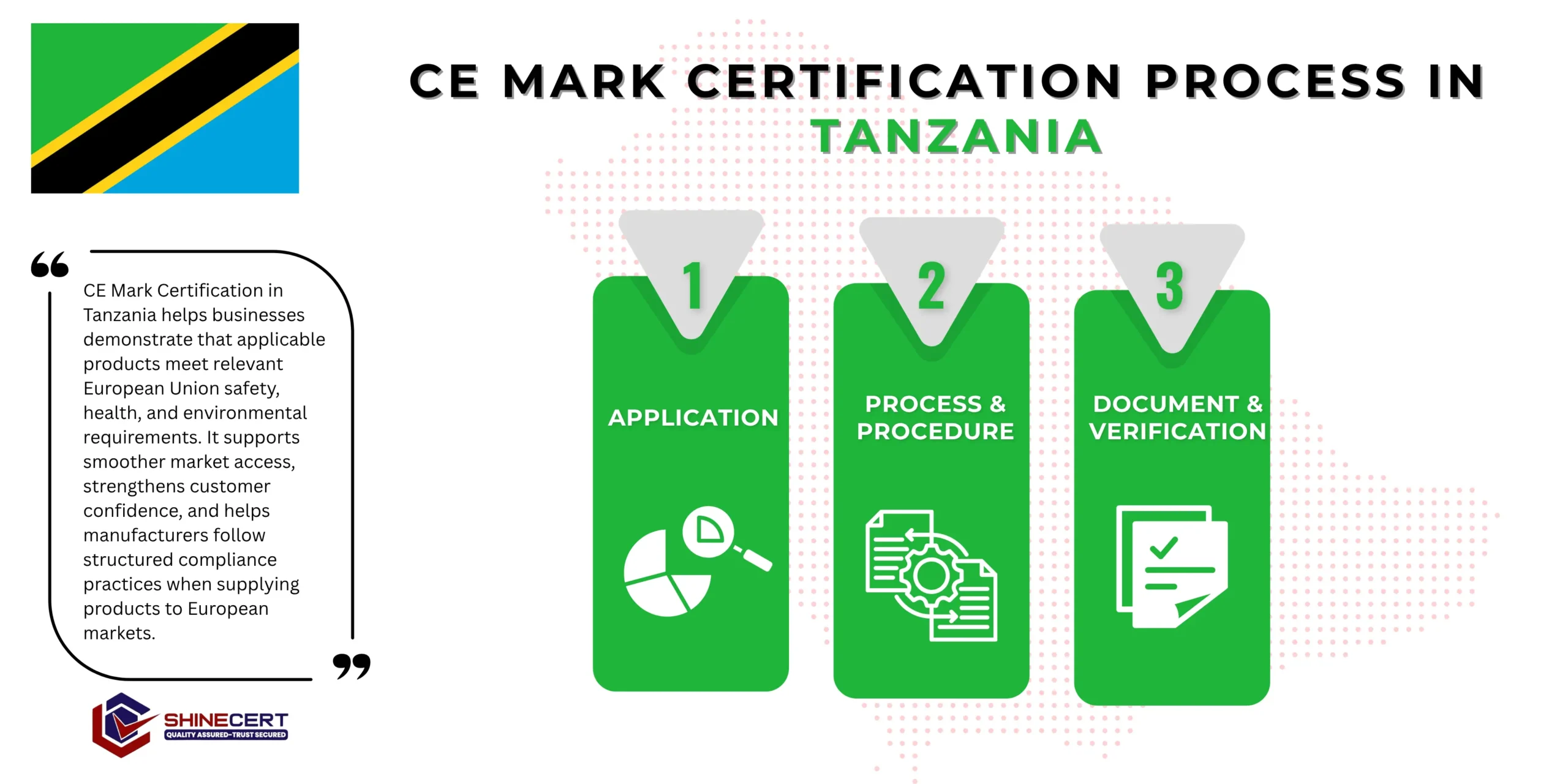
What are the steps to get CE Mark Certification in Tanzania?
our services
- ISO Certification Tanzania
- ISO 9001 Certification Tanzania
- ISO 14001 Certification Tanzania
- ISO 27001 Certification Tanzania
- ISO 22000 Certification Tanzania
- ISO 27701 Certification Tanzania
- ISO 45001 Certification Tanzania
- ISO 20000-1 Certification Tanzania
- ISO 13485 Certification Tanzania
- ISO 17025 Certification Tanzania
- ISO 31000 Certification Tanzania
- ISO 42001 Certification Tanzania
- ISO 37001 Certification Tanzania
- ISO 22301 Certification Tanzania
- ISO 50001 Certification Tanzania
- CE Mark Certification Tanzania
- GDPR Certification Tanzania
- GMP Certification Tanzania
- Halal Certification Tanzania
CE Marking Readiness Process for Tanzanian Exporters
Product Scoping
We check your actual product against the EU’s directive framework to genuinely confirm whether, and which, CE requirements apply before any other work starts.
A scoping report confirming applicable directives and the general compliance path ahead.
Gap Assessment
We review your existing documentation, any prior testing, and your manufacturing process against what CE Marking actually requires.
A gap report identifying exactly what still needs building.
Technical File Development
We build the risk assessment and technical documentation your specific product genuinely requires under its applicable directive category.
A complete technical file ready to support testing and declaration.
Testing and Verification
Depending on risk classification, testing may be self-conducted or require assessment through an EU-recognized Notified Body.
Test reports and verification evidence supporting your conformity declaration.
Declaration and Marking
We finalize your Declaration of Conformity and confirm the CE mark and any accompanying information are applied correctly.
A complete, defensible compliance package ready for EU market entry.
Staying Compliant: Ongoing Requirements
CE Marking carries no renewal cycle, it’s an ongoing manufacturer responsibility rather than a certificate with an expiry date. Compliance has to genuinely hold for every unit actually produced, not just the sample that got tested, which means manufacturing process controls need to keep matching what was originally assessed. If your product design, materials, or manufacturing process change meaningfully, the technical file and conformity assessment need a genuine second look. Because EU directives themselves get updated periodically, we recommend checking applicable requirements whenever your product category faces a regulatory revision.
CE Marking Advisory Cost in Tanzania
There’s no single price tag for CE Marking readiness, and what a Tanzanian manufacturer actually pays depends on:
01
Which EU directive category your product falls under
Electronics, machinery, construction products, and toys each carry meaningfully different documentation and testing demands.
02
Whether a Notified Body needs to get involved at all
Higher-risk product categories require third-party assessment, which adds real cost beyond what self-assessment categories face.
03
How much testing and documentation already exists
A manufacturer with prior testing or solid quality records isn’t starting the technical file from a blank page.
04
How many product variants you’re bringing into scope
Each distinct variant may need its own technical file and its own testing evidence.
05
Testing or Notified Body fees, which we never touch
Those charges are billed directly by whichever laboratory or Notified Body actually performs the assessment.
06
How much your manufacturing process still needs to change
A facility needing real adjustments to consistently hit tested specifications faces more implementation work than one already there.
Why It’s Becoming Essential for Tanzanian Businesses Right Now?
- Duty-free access under Everything But Arms already removes the tariff question, leaving product compliance as the genuine remaining hurdle : With no customs duty or quota standing in the way for almost all Tanzanian exports, a manufacturer’s actual barrier to the EU market is whether the specific product meets applicable directives, not whether trade terms allow it through.
- Tanzania’s manufacturing base is diversifying beyond its traditional agricultural export categories, into product types that actually fall under CE Marking scope : As Tanzanian producers explore electronics, machinery, and construction products for EU-facing markets, categories entirely outside the coffee, cashew, and cotton exports that built the country’s export base, they encounter CE requirements for the first time.
- Because Tanzania’s EU access runs on a unilateral scheme rather than a negotiated agreement, there’s less institutional infrastructure locally guiding exporters through EU-specific product compliance than in countries with a signed EPA : That gap means Tanzanian manufacturers exploring EU markets often need more hands-on technical guidance building genuine compliance capability from scratch.
- EU buyers and distributors treat CE Marking as an unquestioned baseline requirement, regardless of how favorable the underlying trade terms are : A distributor evaluating a Tanzanian product doesn’t care that access is duty-free if the product itself can’t legally carry the mark it needs to be sold in the EU.
Benefits of CE Marking Readiness for Tanzanian Organizations
Tanzanian manufacturers that build genuine CE Marking readiness gain considerably more than a symbol on a label. Here is what this actually delivers:
Combined with duty-free Everything But Arms access, genuine CE compliance is what actually lets applicable manufactured products reach EU customers at all.
The risk assessment and technical file built for CE purposes often supports compliance conversations in other markets applying similar product safety frameworks.
Genuine, well-documented conformity assessment reduces the risk of goods being turned back at an EU border or withdrawn from sale after entry.
EU-based buyers treat CE compliance as table stakes for applicable categories, not a nice-to-have differentiator.
Building real conformity assessment capability supports Tanzania’s wider push to grow manufactured exports beyond traditional raw agricultural commodities.
Because compliance readiness sits entirely separate from the Everything But Arms arrangement, a manufacturer’s CE capability remains valuable regardless of how Tanzania’s broader EU trade relationship evolves over time.
The Real Challenges Organizations Face With CE Marking
- Assuming duty-free access means the product itself is automatically ready : It’s an easy mistake to think that because Everything But Arms removes tariffs entirely, nothing else stands between a Tanzanian product and the EU shelf, but CE Marking and other product-specific rules are completely separate from trade terms.
- Assuming TBS certification carries over to EU requirements : A genuinely costly misunderstanding is treating domestic TBS standards compliance as automatically satisfying CE Marking, when the two frameworks don’t overlap in the way businesses sometimes expect.
- Guessing at Notified Body requirements rather than confirming them : Manufacturers sometimes assume self-assessment is enough without actually confirming their product’s specific risk classification under the relevant directive.
- Technical files built around a sample rather than actual production : A common gap is a technical file that matches a prototype but drifts from what’s genuinely being manufactured at scale.
Where CE Marking Matters Most Across Tanzania’s Economy?
Electronics and electrical goods manufacturing
CE Marking is close to essential for any electronics genuinely destined for EU markets; pair with ISO 9001 for underlying quality management.
Read moreConstruction and building products
CE Marking addresses EU-specific safety requirements for construction materials entering the European market.
Read moreMachinery and industrial equipment manufacturing
CE Marking is a real requirement for machinery categories under EU directives.
Read moreProcessed food and agro-processing with technical packaging components
Certain packaging or equipment used in processing may fall under separate CE-relevant directives depending on specific product characteristics.
Read moreToys and consumer products manufacturing
CE Marking addresses child safety and consumer product requirements central to EU market entry.
Read moreA Tanzanian Business We’ve Worked With
- A Dar es Salaam-based manufacturer of small electrical appliances, having built a solid domestic and regional East African customer base, approached us while exploring its first EU-bound export opportunity, having heard that Tanzania’s duty-free access under Everything But Arms made the EU market worth pursuing.
- Our product scoping found their appliances genuinely fell under CE Marking’s Low Voltage and Electromagnetic Compatibility directives, requirements the company had never navigated, having only worked previously with TBS domestic standards.
- We built their technical file, arranged the necessary testing, and guided them through Declaration of Conformity preparation. The process took just over four months given testing lead times, and the company shipped its first EU order using both the duty-free access and correctly applied CE Marking.
- This reflects a pattern we see often among Tanzanian manufacturers, genuine domestic quality practice meeting EU-specific requirements for the very first time.
The Documentation CE Marking Genuinely Requires
- Applicable Directive Identification : A documented assessment identifying which EU directives actually apply to your specific product, electronics, machinery, construction products, and other categories each carry distinct requirements.
- Risk Assessment : A documented analysis of hazards specific to your product, required under most applicable CE directives.
- Technical File : A comprehensive file including product design specifications, risk assessment, test reports, and manufacturing process descriptions.
- Test Reports : Documentation from testing, whether self-conducted or through an EU-recognized Notified Body, depending on your product’s risk classification.
- Declaration of Conformity : A formal declaration, signed by the manufacturer, stating the product meets every applicable EU requirement.
- Manufacturing Process Records : Documentation showing ongoing production genuinely matches the quality and specifications of the tested and assessed product, not just the sample that got tested.
- Labelling and Marking Compliance Records : Documentation confirming the CE mark and any required accompanying information are applied correctly.
Realistic Timelines for Tanzanian Businesses
| Business Profile | Typical Total Timeline | What Drives This |
|---|---|---|
| Lower-risk product, self-assessment eligible | 2–3 months | No Notified Body involvement required |
| Moderate-risk product, some testing required | 3–4.5 months | Testing lead times add to the process |
| Higher-risk product, Notified Body assessment required | 4.5–7 months | Notified Body scheduling and assessment adds meaningful time |
The real driver here isn’t how big your company is, it’s whether your specific product category needs third-party Notified Body sign-off or qualifies for manufacturer self-assessment, which can be a difference of months either way.
CE Marking Guidance Across Tanzania’s Business Hubs
Dar es Salaam
As the country’s manufacturing and export hub, businesses here handle the widest range of EU-bound product categories.
Arusha
With agro-processing and light manufacturing feeding both regional and international markets, EU compliance questions here increasingly extend beyond raw commodity exports.
Mwanza
Serving the Lake Zone’s growing manufacturing base, businesses here are beginning to explore EU market entry for processed and manufactured goods.
Zanzibar
With a growing light manufacturing and processed goods sector alongside its established trade activity, EU compliance questions are becoming more relevant here too.
Why Businesses Choose ShineCert in Tanzania?
A decade of consulting experience across more than 10,000 organizations backs every Tanzania engagement we take on, coordinated from our Riyadh and India offices with people on-site whenever a project genuinely calls for it. We’re upfront that CE Marking is manufacturer-declared, not something anyone certifies on your behalf, that honesty, paired with real understanding of Tanzania’s specific Everything But Arms trade position, is why Tanzanian manufacturers bring their EU export compliance work to ShineCert, the best CE Mark consultant in Tanzania.
Choosing an Advisor in Tanzania?
What to Check | Why It Matters |
Honesty that CE Marking is manufacturer self-declared, not issued by any Tanzanian body | An advisor claiming to “certify” CE Marking is misrepresenting how the framework actually works |
Real understanding of which EU directives apply to your product | Different product categories carry meaningfully different requirements |
Experience navigating Notified Body processes where relevant | Higher-risk categories require genuine familiarity with third-party assessment |
Awareness of Tanzania’s specific EU trade position | Understanding that Tanzania trades under Everything But Arms, not a negotiated EPA, shapes realistic expectations |
Ready to Get Started?
Whether you’re exploring your first EU-bound export under Tanzania’s duty-free access or expanding an existing product line, tell us about your product and we’ll come back with a scoped, fixed-price plan, remote, on-site, or a mix of both. Book a free consultation or contact us directly to get started.
Frequently Asked Questions
Someone upfront that CE Marking is self-declared, not certified by any Tanzanian or third-party body, with genuine directive-specific and Notified Body experience. ShineCert scopes every Tanzania project after understanding your specific product.
No, CE Marking is a manufacturer self-declaration based on real conformity assessment against EU directives, not something any Tanzanian body issues. We help build the technical documentation and testing evidence behind that declaration.
No, Everything But Arms removes tariffs and quotas, but product-specific requirements like CE Marking are entirely separate and still have to be met independently.
It depends on which EU directive applies to your product, whether Notified Body testing is required, and how much documentation already exists, we quote after understanding your specific product.
Most Tanzanian manufacturers finish somewhere between two and seven months, depending mainly on your product’s risk classification and whether third-party testing is needed.
No, they’re completely separate. TBS addresses Tanzanian domestic standards; CE Marking addresses EU market entry requirements specifically.
Documentation and directive scoping work well remotely, though testing typically happens through laboratories or Notified Bodies that may be located outside Tanzania depending on your product.
Not a standalone office, our Tanzania work is coordinated from Riyadh and India, with on-site visits arranged as needed.