
ISO 9001 Certification in Tanzania
Quick Answer
ISO 9001 is the internationally recognized standard for quality management systems, and in Tanzania it addresses something very concrete: the country’s manufacturing sector has held steady at roughly eight percent of GDP since the mid-1990s, a genuinely stubborn plateau that policymakers and industry analysts point to as one of the country’s clearest structural constraints. ISO 9001 won’t fix that plateau on its own, but it addresses one of the real factors behind it, many Tanzanian producers simply haven’t yet built the documented, repeatable quality systems that larger regional and international buyers expect before they’ll commit to a supply relationship. The Tanzania Bureau of Standards (TBS) is itself an accredited management systems certification body for ISO 9001, giving Tanzanian businesses a credible domestic certification pathway alongside international options. Certification typically runs three to six months, and cost is shaped by real, specific factors rather than a flat quoted number, which we break down in detail below.
Understanding ISO 9001: What It Actually Is, and Why It Matters in Tanzania
ISO 9001 is a standard published by the International Organization for Standardization that sets out requirements for a quality management system, a structured way of running your organization so that what you produce, or the service you deliver, is consistent every single time, and gets better over time rather than staying static. It’s built around a set of core ideas: leadership has to genuinely own quality rather than delegate it entirely, risks and opportunities need to be identified before they become problems or missed chances, processes need to be documented well enough that anyone following them gets the same result, and the whole system needs a built-in mechanism for continual improvement rather than being frozen once written. It is not industry-specific, a food processor, a construction contractor, and a logistics company can all be certified against the exact same standard, because it governs how you manage quality, not what you produce.
Certification itself is a formal, third-party confirmation: an independent, accredited body, TBS itself, or another internationally recognized certifier, audits your organization and confirms your quality management system genuinely meets ISO 9001’s requirements. That confirmation is what turns “we have good quality practices” from an internal claim into something a customer, regulator, or business partner can actually verify.
Why this matters specifically in Tanzania comes down to a mismatch: Tanzania’s economy is diversifying and attracting real international investment, but its manufacturing base has genuinely struggled to convert local production capability into export-ready, internationally credible supply relationships. ISO 9001 is one of the most widely recognized ways to close that credibility gap, because it’s the same standard an international buyer already trusts when evaluating suppliers anywhere else in the world, a Tanzanian business holding it isn’t asking a foreign partner to take a leap of faith on an unfamiliar local certification; it’s presenting a credential the buyer already understands.
What are the steps to get ISO 9001 Certification in Tanzania?
our services
- ISO Certification Tanzania
- ISO 9001 Certification Tanzania
- ISO 14001 Certification Tanzania
- ISO 27001 Certification Tanzania
- ISO 22000 Certification Tanzania
- ISO 27701 Certification Tanzania
- ISO 45001 Certification Tanzania
- ISO 20000-1 Certification Tanzania
- ISO 13485 Certification Tanzania
- ISO 17025 Certification Tanzania
- ISO 31000 Certification Tanzania
- ISO 42001 Certification Tanzania
- ISO 37001 Certification Tanzania
- ISO 22301 Certification Tanzania
- ISO 50001 Certification Tanzania
- CE Mark Certification Tanzania
- GDPR Certification Tanzania
- GMP Certification Tanzania
- Halal Certification Tanzania
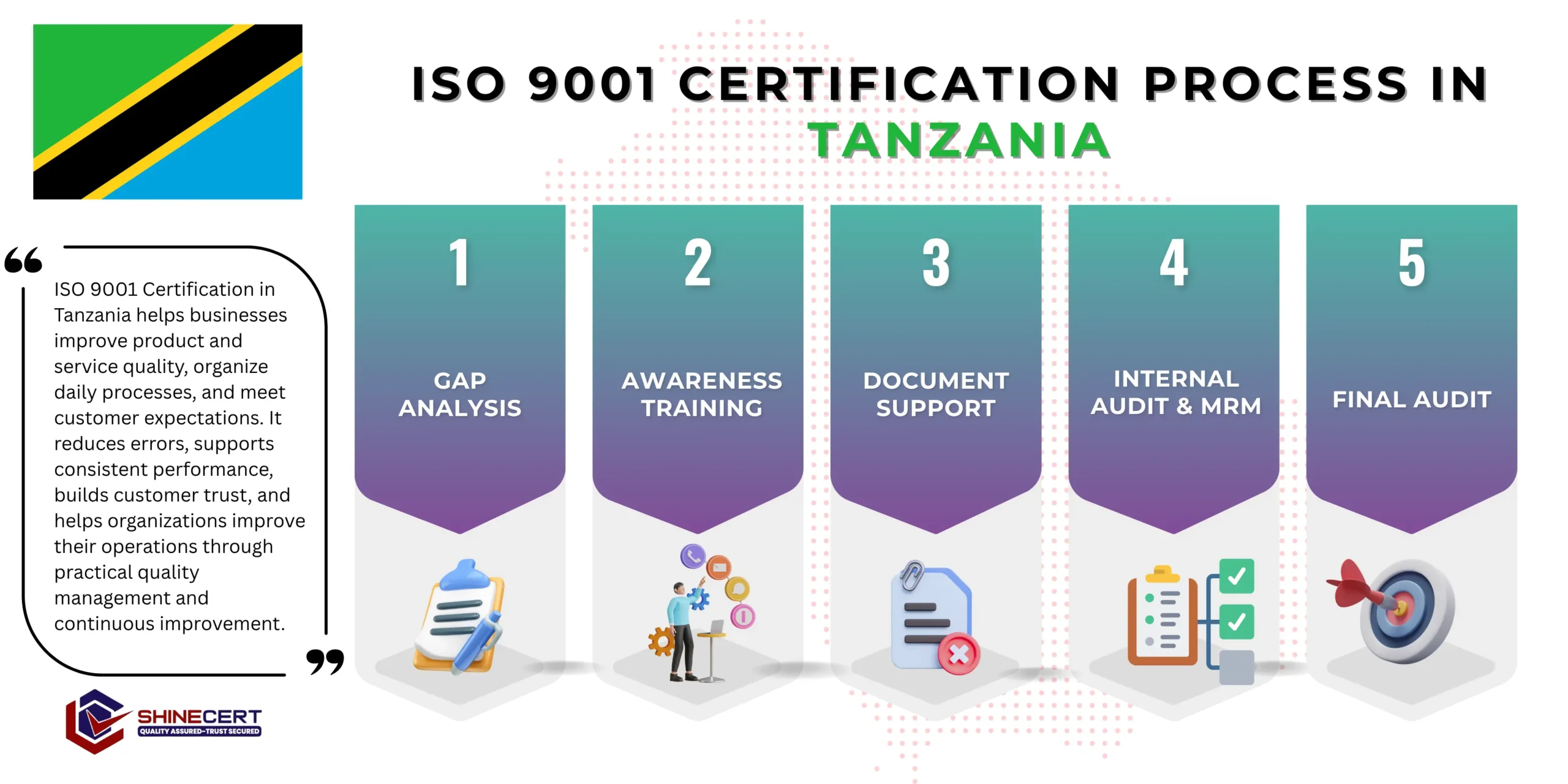
ISO 9001 Certification Process in Tanzania
The ISO 9001 certification journey in Tanzania: a five-step process from gap assessment through certification audit, with typical durations for each stage
Gap Assessment
We start by spending real time on your actual production floor or service delivery site, not just reviewing paperwork in an office, walking through how work genuinely gets done today. We map what we find against every clause of ISO 9001, so instead of a generic checklist you get a clear picture of exactly which requirements you already meet informally, which need to be formalized, and which don't exist at all yet. This stage also surfaces roughly how much documentation work lies ahead, which shapes the realistic timeline for the rest of the project.
A specific, prioritized gap report rather than a generic checklist, organized by clause so you can see exactly where the work is concentrated.
Documentation
Using the gap assessment as a blueprint, we write your quality manual, policy, objectives, and every required procedure around how your organization genuinely operates, not a generic template with your company name swapped in. This is typically the longest stage, because it involves real conversations with the people who actually do the work, to make sure the documented procedure matches what genuinely happens on the ground, rather than an idealized version that nobody follows.
A complete, usable QMS documentation set covering every clause, written in language your staff can actually follow day to day.
Implementation
This is where the system stops being a document sitting in a folder and starts being how people actually work. Process owners start using the new procedures for real, nonconformities start getting logged when something goes wrong instead of quietly fixed and forgotten, and the risk and opportunity register starts getting reviewed on a genuine schedule rather than existing only on paper. We stay engaged during this stage specifically because this is where systems either take root or quietly get abandoned under daily pressure.
A functioning quality management system with several weeks of genuine operational evidence, audit trails, records, logs, already building up before the certification audit ever happens.
Internal Audit and Management Review
Before the real certification audit, we run a full internal audit against every single clause, deliberately looking for exactly the kind of gaps an external auditor would flag. We then facilitate a genuine management review meeting, where leadership looks at audit findings, quality performance data, and any customer complaints, and makes real, documented decisions rather than a box-ticking formality.
An internal audit report and a set of corrective actions closed out before they have the chance to become certification audit findings.
Certification Audit
This happens in two parts. Stage 1 is a documentation review, the certification body confirms your QMS paperwork genuinely covers every clause and is ready for a real operational audit. Stage 2, usually a few weeks later, has the auditor physically on site, observing your actual operations, reviewing your real records, and interviewing staff directly to confirm the system works in practice, not just on paper. We stay engaged through both stages to help address any findings quickly.
Your ISO 9001 certificate, valid for three years, along with a clear surveillance audit schedule so you know exactly what's expected of you going forward.
Staying Certified: Surveillance and Renewal
Your ISO 9001 certificate holds for three years, but it isn’t a set-and-forget credential. Your certification body will conduct an annual surveillance audit in years one and two, checking whether the system is genuinely still functioning rather than having quietly lapsed back into old habits. Before the three-year mark, a full recertification audit determines whether you keep the certificate going forward. Organizations that treat the system as a living part of operations, rather than an annual scramble before the auditor arrives, tend to sail through these reviews with far less disruption.
ISO 9001 Certification Cost in Tanzania
01
How much of your practice is already documented
A business relying heavily on informal, undocumented know-how faces a genuinely bigger documentation task than one with existing procedures to build from. If quality control today happens because an experienced supervisor simply knows what to check, that knowledge has to be extracted, written down, and turned into something a new hire or an auditor can actually follow, and that extraction work takes real time regardless of how skilled your team already is. Businesses that have even informal written checklists, work instructions, or quality logs in place start from a meaningfully stronger position than those relying purely on institutional memory.
02
Number of sites and departments in scope
Each additional location or department typically adds its own process interactions that need mapping and coordination. A single-site business with one production line has a genuinely contained scope; a business with a head office in Dar es Salaam and a production facility elsewhere has to document how quality decisions, corrective actions, and audit findings flow between the two, which adds real coordination work on top of the documentation itself. The more departments involved in your actual quality-relevant processes, procurement, production, dispatch, customer service, the more process interactions need to be mapped and kept consistent.
03
Existing quality culture and staff buy-in
Organizations where staff are already quality-conscious implement new procedures with considerably less friction than those starting from a compliance-only mindset. When staff already care about consistency and take ownership of catching errors, the documentation exercise mostly formalizes habits that already exist, and adoption happens quickly. When quality has historically been someone else’s job, or has been treated as a box-ticking exercise, building genuine buy-in takes real change-management effort alongside the technical documentation work, and that effort has a real cost.
04
Industry complexity
A business with intricate, multi-stage production faces broader process documentation than a simpler service-based operation. A manufacturer with multiple production stages, each with its own quality checkpoints, raw material specifications, and in-process testing, requires considerably more detailed process documentation than, say, a logistics or professional services business with fewer, more linear processes. Industries with genuine technical complexity, like mineral processing or multi-ingredient food manufacturing, also tend to need more detailed risk assessments as part of the documentation.
05
Certification body fees, tracked separately from our consulting fees
The certification audit itself is invoiced directly by TBS or whichever accredited body conducts your audit, and this fee is set by the certifier based on your organization’s size, number of employees, and site count, not by us. It’s worth asking any certification body for a clear, itemized fee quote covering both the Stage 1 and Stage 2 audits, plus what future surveillance audits will cost, so you have the full three-year picture rather than just the initial certification number.
06
Whether you’re pursuing additional standards alongside ISO 9001
Bundling certifications that share management system architecture, like ISO 14001 or ISO 22000, reduces the combined cost versus pursuing them separately, because much of the underlying documentation structure, policy statements, internal audit processes, management review cycles, document control, is shared across standards. A business that knows it will eventually need both ISO 9001 and ISO 22000, for example, generally saves real time and cost by building both from the outset rather than adding the second standard as an entirely separate project later.
Why It’s Becoming Essential for Tanzanian Businesses Right Now
- A domestic manufacturing sector that has plateaued for three decades needs a genuine quality lever, and ISO 9001 is one of the few universally recognized ones available : With manufacturing’s share of GDP essentially unchanged since the 1990s, and export orientation contributing under a quarter of total exports, the constraint increasingly looks structural rather than cyclical, and documented quality management is a concrete, achievable piece of the fix that individual businesses can act on now, rather than waiting for broader policy shifts.
- Tanzania’s record 2024 foreign direct investment inflow means more international partners are actively evaluating local suppliers, often for the first time : With FDI reaching $1.72 billion in 2024, a 28.3 percent jump and the fastest growth rate in East Africa, a meaningful share of that capital is flowing into joint ventures and supply partnerships where the foreign partner will genuinely expect documented quality assurance from day one, not something retrofitted after the relationship starts.
- The district-based industrial development approach Tanzania is pursuing ties local resource-based production directly to export ambition, and that ambition runs straight into buyer quality expectations : As government strategy increasingly links each district’s specific resources, agricultural inputs, minerals, light manufacturing capacity, to value-added processing and export, businesses further up these value chains are the ones actually facing international buyer scrutiny, and they’re discovering that quality documentation isn’t optional at that stage.
- Newly updated national procurement regulations mean public-sector suppliers are operating under a genuinely refreshed compliance framework : With the Public Procurement Regulations updated under GN No. 261 of 2025 now governing how the Public Procurement Regulatory Authority (PPRA) applies its tendering rules, businesses supplying government contracts benefit from having their internal quality processes already aligned with a recognized international framework before procurement officers start asking harder questions.
Benefits of ISO 14001 Certification for Tanzanian Organizations
Certified Tanzanian organizations describe gains that go well beyond a certificate to display in the front office. Here’s what they actually report:
When a regional distributor or international buyer asks how you guarantee consistent output, a certified quality management system gives you a genuine, documented answer instead of a verbal assurance.
As joint ventures and foreign-backed projects multiply, certified businesses are simply easier for these new partners to plug into their own supply chains.
Process control and root-cause corrective action genuinely catch recurring defects that informal quality checks miss, reducing rework and material waste.
Certification gives your tender submissions a documented quality claim that stands up under scrutiny from procurement evaluators applying the current PPRA framework.
Documented procedures mean institutional knowledge about how things should be done doesn’t walk out the door when an experienced employee leaves.
For businesses in the district-based value chains government strategy is prioritizing, certification is frequently the missing credential standing between local production and export contracts.
A functioning system for capturing and resolving nonconformities means the same customer complaint doesn’t keep recurring quarter after quarter.
Organizations working with bodies like the Small Industries Development Organisation (SIDO) on formalization and growth programs find a certified quality system considerably strengthens that relationship.
Once ISO 9001’s process discipline is in place, adding standards like ISO 14001 or ISO 22000 becomes considerably faster since much of the underlying management system architecture is shared.
The Real Challenges Organizations Face While Implementing ISO 9001
- Assuming informal expertise is the same thing as a documented system : Businesses with genuinely skilled staff sometimes underestimate how much of that skill exists only in people’s heads, with nothing written down for an auditor, or a new hire, to reference.
- Treating documentation as a one-time writing exercise : A common gap is producing a polished manual during initial certification, then letting daily practice quietly drift away from what’s actually written.
- Underestimating cross-department coordination : ISO 9001 genuinely requires processes to interact coherently, and businesses sometimes document each department in isolation without mapping how they actually hand off to one another.
- Internal audits that become a formality : Auditors can tell quickly when internal audits have turned into a box-ticking exercise rather than a genuine search for gaps before the real certification audit.
Updating to ISO 9001:2026 in Your Organization
The revision of ISO 9001 is now in its final stages: the Final Draft International Standard was submitted for ballot in mid-April 2026, and formal publication is expected around September 2026, with a three-year transition window (subject to final IAF confirmation) likely running through September 2029. The confirmed direction of the revision centers on three things: a stronger emphasis on genuine quality culture and ethical behavior rather than paperwork compliance, clearer separation and documentation of risk versus opportunity rather than treating them as a single vague category, and formal integration of climate change considerations into how organizations understand their operating context. Here’s how to prepare, step by step:
- Step 1: Review your Clause 4 context analysis for climate-related gaps. ISO 9001:2026 is expected to require climate change to be explicitly considered as part of understanding your organization’s context. If your current context analysis doesn’t mention climate-related risks, supply disruption, resource availability, regulatory shifts, that’s the first document that will need updating.
- Step 2: Split your combined risk register into distinct risk and opportunity sections. Many organizations currently maintain a single, loosely structured risk log. The revision’s emphasis on clearer risk-versus-opportunity documentation means this is a good time to restructure that register into two genuinely distinct, actively maintained sections, each with its own review cadence.
- Step 3: Revisit your leadership and quality policy documentation for ethics and culture commitments. Where current documentation focuses mainly on process compliance, expect to add explicit leadership commitments around ethical behavior and building a genuine quality culture, not just following procedures, but visibly valuing quality as an organizational value. This will likely mean a new or expanded section within your existing Quality Policy and management review records.
- Step 4: Update your internal audit checklist to test for genuine culture, not just documentation. Once the revision is formally published, internal audits will need to probe whether quality culture is real, through staff interviews and behavioral evidence, rather than just confirming a policy document exists.
- Step 5: Plan your transition audit timing with your certification body. With a three-year transition window expected once ISO 9001:2026 is published, organizations don’t need to panic, but building the above changes into your next scheduled surveillance or recertification audit, rather than treating it as a separate emergency project, is the most efficient path.
Realistic Timelines for Tanzanian Businesses
| Business Profile | Typical Total Timeline | What Drives This |
|---|---|---|
| Small business, single site | 2.5–3.5 months | Narrower process scope and simpler documentation |
| Medium business, moderate complexity | 3.5–5.5 months | Broader process interactions and more departments involved |
| Larger or multi-site business | 5.5–8 months | Coordination across sites and more extensive documentation |
Beyond company size, the single biggest timeline driver is genuinely how much of your current practice is already documented versus how much exists only as informal know-how in people’s heads.
Where Certification Matters Most Across Tanzania’s Economy?
Agro-processing and Light Manufacturing
ISO 9001 is directly relevant to the district-based value chain government industrial strategy is actively prioritizing; pair with ISO 22000 where food products are involved.
Read moreMining and Mineral Processing Support Services
ISO 9001 supports the quality consistency international mining operators increasingly expect from local suppliers and contractors.
Read moreConstruction and Infrastructure Contractors
ISO 9001 gives public procurement submissions a documented quality claim that stands up under PPRA-aligned evaluation.
Read moreTextile and Apparel Manufacturing
ISO 9001 addresses the consistency international buyers expect as Tanzania’s manufacturing base looks to diversify beyond its current plateau.
Read moreTourism and Hospitality Services
ISO 9001 supports service consistency expectations as Tanzania’s tourism sector continues to be a genuine economic driver.
Read moreA Tanzanian Business We’ve Worked With
- An agro-processing operation based near Morogoro, producing packaged food staples for domestic retail with growing interest from a regional East African distributor, approached us after that distributor specifically asked for evidence of a formal quality management system before expanding the relationship.
- Our gap assessment found the company’s actual production discipline was genuinely solid, but almost nothing was written down, quality checks happened because experienced staff simply knew what to look for, with no documented procedure behind any of it.
- We built the documentation directly around how the team already worked, formalizing their existing informal checks rather than imposing an entirely new process. Certification took just under four months, and the company used the certificate directly to close the expanded distribution agreement.
- This reflects a pattern we see often, genuinely capable operations that had never translated real expertise into documented, auditable practice, rather than a single specific engagement.
The Documentation TBS and Auditors Expect, Clause by Clause
ISO 9001 is organized into numbered clauses, and auditors work through your documentation clause by clause during the certification audit. Here’s what’s genuinely expected at each stage, with the specific document each clause requires:
- Clause 4 — Context of the Organization : Document: Scope of the QMS Statement. A written statement defining exactly which products, sites, and processes your quality management system covers, along with a short analysis of internal and external issues (market conditions, regulatory requirements, stakeholder expectations) relevant to your business.
- Clause 5 — Leadership : Document: Quality Policy. A documented policy, signed off by top management, stating your organization’s genuine commitment to quality and customer satisfaction. Document: Roles and Responsibilities Matrix. A clear record of who owns which quality-related responsibility, so accountability doesn’t default to “whoever happens to notice a problem.”
- Clause 6 — Planning : Document: Risk and Opportunity Register. A living log identifying risks to product or service quality and genuine opportunities for improvement, each with an owner and a planned response. Document: Quality Objectives. Specific, measurable targets, not vague aspirations, tied to your quality policy, with a plan for how they’ll actually be achieved.
- Clause 7 — Support : Document: Competence and Training Records. Evidence that staff performing quality-relevant tasks have the training or experience the role genuinely requires. Document: Document Control Procedure. A defined process for how documents are created, approved, updated, and retired, so everyone is working from the current version.
- Clause 8 — Operation : Document: Operational Control Procedures. Specific, written procedures for your actual production or service delivery steps. Document: Supplier Evaluation Records. Evidence that suppliers are assessed for their ability to meet your quality requirements before and during the relationship. Document: Nonconforming Output Records. A record of how defective products or failed service deliveries are identified, contained, and dealt with.
- Clause 9 — Performance Evaluation. Document: Internal Audit Records. Evidence of a planned internal audit schedule that has actually been carried out against every clause, not just written into a manual. Document: Management Review Minutes. Documented records of leadership reviewing quality performance data, audit results, customer feedback, nonconformities, and making genuine decisions in response.
- Clause 10 — Improvement : Document: Corrective Action Records. A functioning system for logging nonconformities, investigating root cause, and tracking the corrective action taken. Document: Continual Improvement Log. A record showing quality performance is being tracked over time and genuinely improved, not just maintained at a static baseline.
ISO 9001 Certification Across Tanzania’s Business Hubs
Quality management needs look genuinely different depending on where in Tanzania your business operates, so here’s how ISO 9001 tends to show up city by city:
Dar es Salaam
As the country’s commercial and port capital, Dar es Salaam concentrates the manufacturers, logistics operators, and import-export businesses most directly exposed to international buyer due diligence, this is where we see the highest concentration of certification driven specifically by a named buyer or partner requirement.
Arusha
As Tanzania’s gateway to the East African Community and a hub for agricultural export and tourism services, Arusha-based businesses tend to pursue certification with regional cross-border trade and hospitality service consistency in mind.
Mwanza
Positioned in the Lake Zone with strong ties to mining-adjacent services and regional trade via Lake Victoria, Mwanza businesses frequently pair ISO 9001 with sector-specific safety or environmental considerations given the surrounding industrial activity.
Dodoma
As the seat of the national government, Dodoma-based contractors and suppliers face certification demand driven heavily by public procurement participation under the PPRA framework, where a documented quality system directly strengthens tender submissions.
Wherever you’re based, the certification process and requirements themselves don’t change, what changes is which benefits and buyer expectations are most immediately relevant to your specific market.
Why Businesses Choose ShineCert in Tanzania?
ShineCert brings 10 years of ISO consulting and certification experience to Tanzania’s market, coordinated through our Riyadh and India offices with services delivered remotely or on-site depending on what your engagement genuinely needs. We’ve guided more than 10,000 organizations through ISO certification worldwide, and we build every Tanzania engagement around your actual operations rather than a generic template, this is why Tanzanian businesses increasingly choose ShineCert as the best ISO 9001 consultant in Tanzania. Whether you’re responding to a buyer’s request for documented quality assurance or positioning for public procurement, we’ll walk through your specific operations and cost factors before proposing a fixed-scope plan, delivered remotely, on-site, or however genuinely fits your project.
Choosing a Certification Body in Tanzania?
What to Check | Why It Matters |
Accreditation under a recognized international framework | Confirms the certificate carries genuine international weight, whether through TBS or another accredited body |
Genuine sector experience relevant to your operations | Agro-processing, mining services, and construction each involve meaningfully different quality considerations |
Transparent, itemized cost scoping | Avoids surprises once the engagement is underway |
Willingness to genuinely test your system, not just review paperwork | The value of certification comes from a system that actually works, not documentation that looks good on paper |
Ready to Get Started?
Whether you’re responding to a buyer’s request for documented quality assurance or positioning for public procurement, we’ll walk through your specific operations and cost factors before proposing a fixed-scope plan, delivered remotely, on-site, or however genuinely fits your project.
How it works
Frequently Asked Questions
Look for genuine sector experience, transparent cost scoping, and a consultant who tests whether your system actually works rather than just reviewing paperwork. ShineCert scopes every Tanzania engagement individually.
TBS is itself an accredited certification body for ISO 9001, so it’s a genuinely credible domestic option alongside international certifiers, which one makes more sense depending on your specific export markets and buyer requirements.
It genuinely depends on how much of your practice is already documented, your number of sites, industry complexity, and whether you’re bundling additional standards, we scope every project individually rather than quoting a number upfront.
Typically two and a half to eight months depending on organization size and existing documentation maturity, see our detailed timeline breakdown above.
Yes, certification scope scales down to match a smaller operation’s actual complexity, and smaller exporters or suppliers often see the clearest commercial benefit since it’s precisely the credibility gap that stops them competing for larger contracts.
Yes, it gives your tender submission a documented quality claim that holds up under the evaluation framework the Public Procurement Regulatory Authority applies.
The certification requirements and process are identical nationwide, what differs is which benefits matter most locally, covered in our city-by-city breakdown above.
Formal publication is expected around September 2026, with a three-year transition window likely running through 2029, so there’s no need to panic, but building the expected changes into your next scheduled audit cycle is the efficient path, as covered in our transition guidance above.
Documentation work runs effectively over remote sessions, but the gap assessment and certification audit itself genuinely require in-person site visits.
ShineCert doesn’t maintain a standalone Tanzania office; we coordinate Tanzania engagements from our Riyadh and India offices, with services delivered remotely or on-site as your project requires.