
ISO 27701 Certification in Qatar
Quick Answer
ISO 27701 extends an existing ISO 27001 information security management system with a dedicated privacy information management layer, and it maps closely onto Qatar’s dual privacy regime, the Personal Data Privacy Protection Law (PDPPL), enforced by the NCSA’s Personal Data Privacy Protection Department, and the separate Qatar Financial Centre Data Protection Regulations 2021 for QFC-registered entities. Get certified through a body accredited by the Global Accreditation Bureau (GAB) or another body recognized under the new Global Accreditation Cooperation (GAC) framework. Budget QAR 20,000 to QAR 90,000 depending on whether ISO 27001 is already in place, and plan for three to six months.
What Is ISO 27701?
ISO 27701 is the international standard for privacy information management systems (PIMS), built as an extension to ISO 27001 rather than a standalone framework. It adds privacy-specific controls covering the roles of PII controllers and PII processors, consent management, data subject rights handling, cross-border data transfer safeguards, and privacy-by-design principles. An organization cannot become ISO 27701 certified without already holding, or simultaneously implementing, ISO 27001, the privacy controls sit on top of an existing information security management system rather than replacing it.
Why This Matters So Much in Qatar Specifically?
Qatar operates a genuinely dual data protection regime, which is one of the more distinctive features of doing privacy compliance work in the country. The Personal Data Privacy Protection Law, Law No. 13 of 2016, governs data processing across mainland Qatar and is enforced by the NCSA’s Personal Data Privacy Protection Department, with Executive Regulations that have progressively added more detailed requirements around consent, breach notification, data transfers, and technical and organizational controls. Separately, entities registered within the Qatar Financial Centre, a distinct legal and regulatory jurisdiction with its own independent judiciary, fall under the QFC Data Protection Regulations 2021 instead of the PDPPL, a framework more heavily influenced by GDPR and, in several respects, stricter than mainland requirements.
For organizations that process meaningful volumes of personal data, particularly in financial services, e-commerce, healthcare, and technology, ISO 27701 certification provides a single, internationally recognized management system that demonstrates genuine privacy governance regardless of which regime applies, and gives you a structured way to keep pace as NCSA’s enforcement activity, including public compliance orders issued against ICT and e-commerce operators, continues to intensify.
What are the steps to get ISO 27701 Certification in Qatar?
our services
- ISO Certification Qatar
- ISO 9001 Certification Qatar
- ISO 14001 Certification Qatar
- ISO 27001 Certification Qatar
- ISO 22000 Certification Qatar
- ISO 27701 Certification Qatar
- ISO 45001 Certification Qatar
- ISO 20000-1 Certification Qatar
- ISO 13485 Certification Qatar
- ISO 17025 Certification Qatar
- ISO 31000 Certification Qatar
- ISO 42001 Certification Qatar
- ISO 37001 Certification Qatar
- ISO 22301 Certification Qatar
- ISO 50001 Certification Qatar
- CE Mark Certification Qatar
- GDPR Certification Qatar
- GMP Certification Qatar
- Halal Certification Qatar
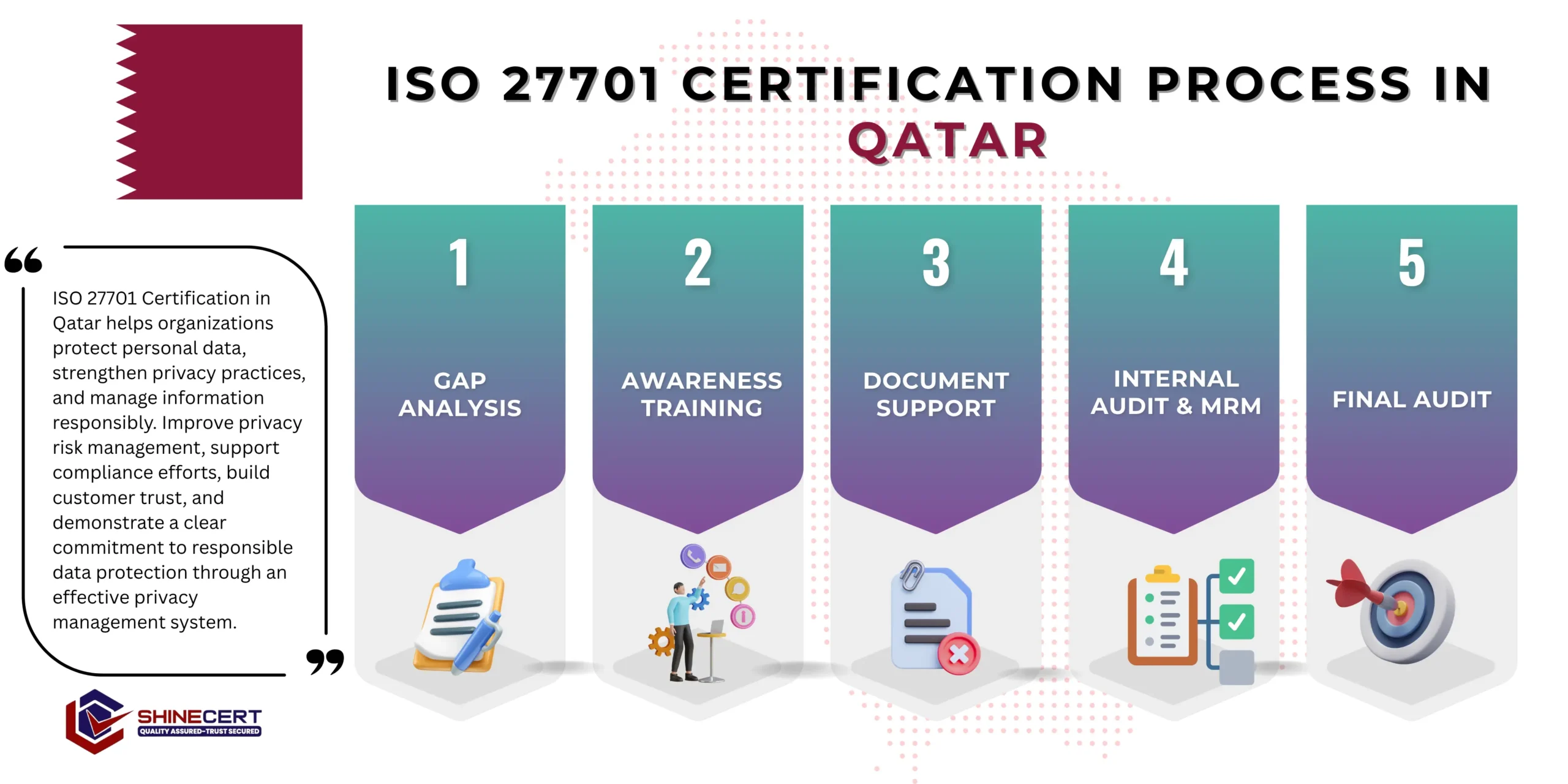
Our Five-Step ISO 27701 Certification Process
Privacy Gap Assessment and Role Determination
We assess your current privacy practices against ISO 27701, determine whether you are a PII controller, processor, or both, and confirm whether your existing ISO 27001 system is ready to be extended.
A gap assessment report and a clear roadmap identifying required privacy controls.
Privacy Risk Assessment and Documentation Development
We build a privacy-specific risk assessment and develop the required policies, consent mechanisms, and data subject rights procedures around your actual processing activities.
A complete PIMS documentation set extending your ISO 27001 system.
Implementation and Training
Privacy controls roll out across your organization, with staff trained on data subject rights handling, breach notification timelines, and role-specific privacy responsibilities.
Training records and evidence of functioning privacy controls in daily operations.
Internal Audit and Management Review
We test whether your privacy controls genuinely function, including simulated data subject rights requests, with findings feeding into a management review.
An internal audit report and management review minutes demonstrating genuine privacy governance.
Certification Audit
We coordinate Stage 1 and Stage 2 with a GAB-accredited or GAC-recognized certification body experienced in evaluating combined ISO 27001/27701 systems.
Your ISO 27701 certificate alongside your ISO 27001 certificate, with a clear surveillance audit schedule.
Privacy Gap Assessment and Role Determination
We assess your current privacy practices against ISO 27701, determine whether you are a PII controller, processor, or both, and confirm whether your existing ISO 27001 system is ready to be extended.
A gap assessment report and a clear roadmap identifying required privacy controls.
Privacy Risk Assessment and Documentation Development
We build a privacy-specific risk assessment and develop the required policies, consent mechanisms, and data subject rights procedures around your actual processing activities.
A complete PIMS documentation set extending your ISO 27001 system.
Implementation and Training
Privacy controls roll out across your organization, with staff trained on data subject rights handling, breach notification timelines, and role-specific privacy responsibilities.
Training records and evidence of functioning privacy controls in daily operations.
Internal Audit and Management Review
We test whether your privacy controls genuinely function, including simulated data subject rights requests, with findings feeding into a management review.
An internal audit report and management review minutes demonstrating genuine privacy governance.
Certification Audit
We coordinate Stage 1 and Stage 2 with a GAB-accredited or GAC-recognized certification body experienced in evaluating combined ISO 27001/27701 systems.
Your ISO 27701 certificate alongside your ISO 27001 certificate, with a clear surveillance audit schedule.
What It Costs: The Factors That Actually Drive ISO 27701 Price
- Whether ISO 27001 is already in place : Organizations extending an existing information security management system typically pay considerably less than those implementing ISO 27001 and ISO 27701 together from scratch.
- Number of data processing activities : Organizations with more distinct processing activities, especially across multiple business lines, need more extensive records of processing and risk assessment work.
- Regulatory scope : Organizations subject to both the PDPPL and the QFC Data Protection Regulations need broader documentation and control mapping than those operating under a single regime.
- Volume and sensitivity of personal data processed : Organizations processing larger volumes of personal data, or sensitive categories such as biometric or health data, need more thorough privacy risk assessment.
- Cross-border data transfer complexity : Organizations transferring personal data internationally need documented transfer safeguards, adding to implementation scope.
- Quick answer : Budget QAR 20,000 to QAR 90,000, with the low end reflecting an organization already ISO 27001 certified extending to ISO 27701, and the high end reflecting a QFC-regulated financial services group implementing both standards together across multiple processing activities.
A Genuine Qatar-Specific Complication: Two Regimes, One Organization
- This is worth walking through concretely, because it’s a distinction that catches organizations off guard more often than any single clause of either regime. A company incorporated in the QFC that also has mainland operations, a common structure for financial services groups with both a QFC-licensed entity and mainland subsidiaries, can genuinely find itself subject to the PDPPL for some processing activities and the QFC Data Protection Regulations 2021 for others, depending on which entity is doing the processing and where.
- The QFC regime is meaningfully stricter in places: it mandates Data Protection Officers for high-risk processors, defines sensitive data more broadly to include biometric and genetic data, and requires specific permits for processing sensitive categories, none of which the PDPPL expressly requires in the same form. We generally recommend that groups operating across both jurisdictions build their ISO 27701 PIMS around the stricter QFC requirements as a baseline, then confirm PDPPL-specific obligations, such as MCIT breach reporting for mainland entities, are layered on top, rather than trying to maintain two separate privacy programs that inevitably drift out of alignment with each other over time.
Benefits: What Certification Actually Changes
Rather than building separate ad hoc compliance programs, ISO 27701 gives you one internationally recognized management system that demonstrates genuine privacy governance under either regime.
A functioning PIMS reduces the likelihood of the kind of compliance gaps that have drawn NCSA enforcement action against other ICT and e-commerce operators.
With documented procedures already in place, the 72-hour breach notification window that NDPO’s executive guidelines require becomes considerably more achievable under real incident pressure.
Multinational partners and vendors increasingly require demonstrable privacy governance, and ISO 27701 is the most widely recognized way to provide that evidence.
Since the standard extends an existing information security management system, organizations already ISO 27001 certified typically implement ISO 27701 considerably faster than building privacy governance from nothing.
A structured PIMS gives you a genuine, repeatable process for responding to access, correction, and deletion requests, rather than improvising each time one arrives.
Mandatory Documents Required for Implementation
Documented, defining whether the organization acts as a PII controller, processor, or both, and for which processing activities.
Genuine leadership commitment addressing your specific data processing activities and applicable regime.
Documented, addressing risks to data subjects specifically, not only organizational information security risk.
A documented inventory of what personal data you process, why, and under what legal basis.
Documented process for handling access, correction, deletion, and portability requests within required timeframes.
Documented process addressing the 72-hour notification window required under NDPO’s executive guidelines.
Documented controls governing any cross-border transfer of personal data.
Applicable Standards by Industry
Financial Services and QFC-Regulated Entities
Banks, insurers, and asset managers typically need ISO 27701 alongside the QFC Data Protection Regulations’ stricter DPO and sensitive-data requirements.
Read moreE-commerce and Technology
Companies processing customer data at scale face direct exposure to NCSA’s active enforcement activity against ICT and e-commerce operators specifically.
Read moreHealthcare
Providers processing patient data need ISO 27701 addressing the sensitive-category requirements that apply under both the PDPPL and, for QFC-registered healthcare entities, the QFC regime.
Read moreTelecommunications
Operators handling large volumes of subscriber data face particular scrutiny given the scale and sensitivity of the personal data involved.
Read moreHuman Resources and Recruitment Services
Companies processing employee and candidate data across multiple jurisdictions need privacy controls addressing genuinely varied local requirements.
Read moreISO 27701 vs ISO 27001 Alone: What the Extension Actually Adds
- This distinction matters because organizations sometimes assume ISO 27001 already covers privacy adequately, and in a genuinely important sense, it doesn’t. ISO 27001 addresses information security broadly: confidentiality, integrity, and availability of information assets, regardless of whether that information is personal data or not. ISO 27701 adds a privacy-specific layer on top: PII controller and processor role distinctions, consent management, data subject rights handling, and privacy risk assessed specifically from the perspective of harm to data subjects, not just organizational risk.
- We’ve generally found that organizations already certified to ISO 27001 sometimes believe their existing controls satisfy PDPPL or QFC expectations, only to discover during a genuine compliance review that data subject rights procedures, consent mechanisms, and privacy-specific risk assessment were never actually built out. ISO 27701 closes exactly that gap, and because it extends rather than duplicates the ISO 27001 system, the additional implementation effort is considerably smaller than building privacy governance as a separate, unconnected program.
Privacy Information Management Requirements, Clause by Clause
- PIMS-specific requirements extending ISO 27001’s context clause : Determine your organization’s role as a PII controller, PII processor, or both, since the applicable controls genuinely differ by role.
- Leadership and privacy governance : Top management commitment to privacy as a genuine organizational priority, with clearly assigned responsibility for privacy decisions, not folded silently into general IT security ownership.
- Planning for privacy risk : A privacy-specific risk assessment addressing the rights and freedoms of data subjects, which is a genuinely different risk lens than the confidentiality-integrity-availability framing used in ISO 27001 alone.
- Support and competence : Privacy-specific training for staff handling personal data, including genuine understanding of data subject rights request handling and breach notification timelines.
- Operational controls for PII controllers : Consent management, purpose limitation, data minimization, and privacy notices genuinely reflecting your actual processing activities, not template language.
- Operational controls for PII processors : Controls governing processing on behalf of controllers, including contractual safeguards and constraints on further sub-processing.
- Performance evaluation : Monitoring of privacy control effectiveness, including internal audits testing whether data subject rights requests and breach procedures function as documented, not merely as written.
- Improvement : Structured response to privacy incidents and audit findings, feeding genuine improvements back into the privacy information management system.
A Scenario: How a QFC-Registered Fintech Might Approach ISO 27701
- Concrete examples clarify what this looks like in practice. Picture a QFC-licensed payments company already ISO 27001 certified, processing customer transaction data, biometric authentication data for a subset of premium accounts, and personal data shared with international banking partners. Under the QFC Data Protection Regulations, the biometric data processing likely triggers the requirement for a dedicated Data Protection Officer and a specific processing permit, obligations that wouldn’t automatically apply to an equivalent mainland PDPPL-only business.
- Extending the company’s existing ISO 27001 system to ISO 27701 gives it a structured way to build exactly these QFC-specific controls, role determination confirming its status as both controller and processor for different data flows, a privacy risk assessment specifically addressing the biometric data category, and documented cross-border transfer safeguards for the international banking data sharing. Rather than treating QFC compliance and information security as separate initiatives, the company ends up with one coherent, independently audited system covering both, which we’ve generally found produces a considerably cleaner audit experience than maintaining parallel, loosely connected compliance efforts.
Two Myths About ISO 27701 in Qatar
- We’re PDPPL compliant, so we don’t need ISO 27701 : PDPPL compliance is a legal obligation assessed by NCSA against Qatari law; ISO 27701 certification is an independent, internationally recognized verification of your privacy management system by an accredited third party. Many organizations that believe themselves PDPPL compliant have never had that belief independently tested, ISO 27701 certification is exactly that test, and it also demonstrates compliance to international partners in a way a self-assessed compliance claim cannot.
- ISO 27701 is only relevant for QFC-regulated companies : This significantly undersells the standard’s relevance. Mainland organizations subject only to the PDPPL benefit just as much from a structured privacy information management system, particularly given NCSA’s active enforcement activity against ICT and e-commerce operators regardless of QFC status. The standard’s value comes from structured privacy governance itself, not from which specific regulatory regime happens to apply.
Why ShineCert?
We coordinate Qatar engagements from ShineCert’s Riyadh and Lebanon offices, with direct familiarity with both the PDPPL and the QFC Data Protection Regulations, and genuine experience helping groups that operate across both jurisdictions build one coherent privacy information management system rather than two disconnected compliance efforts. As the best ISO 27701 consultant in Qatar, our team has guided more than 10,000 organizations through ISO certification globally.
Choosing a Certification Body in Qatar?
What to Check | Why It Matters |
GAB accreditation, or another GAC-recognized body | Confirms genuine, internationally recognized certification |
Genuine ISO 27001 and ISO 27701 combined-audit experience | Since 27701 extends 27001, auditors need competence across both, not privacy expertise alone |
Familiarity with both PDPPL and QFC Data Protection Regulations | Helps ensure your PIMS genuinely addresses whichever regime, or regimes, actually apply to your organization |
Experience with financial services or e-commerce privacy audits | Sector-specific processing patterns, like biometric authentication or large-scale customer data, need auditors who understand the practical risk profile |
Ready to Get Started?
ShineCert supports Qatar businesses building genuine privacy information management systems that work across both the PDPPL and QFC Data Protection Regulations, from gap assessment through certification audit. Book a free consultation or contact us directly, and we’ll review your data processing activities before proposing a fixed-scope plan.
Frequently Asked Questions
No, PDPPL compliance is a legal obligation self-assessed against Qatari law, while ISO 27701 certification is an independent, third-party-verified confirmation of your privacy management system.
It’s the international standard for privacy information management systems, extending an existing ISO 27001 information security management system with privacy-specific controls.
Yes, ISO 27701 extends ISO 27001 rather than functioning as a standalone standard, so you need to hold or simultaneously implement ISO 27001.
Typically QAR 20,000 to QAR 90,000, with organizations already ISO 27001 certified generally paying toward the lower end.
It’s not legally mandatory under either the PDPPL or the QFC Data Protection Regulations, but it’s an internationally recognized way to demonstrate compliance with both.
Typically three to six months, shorter for organizations already ISO 27001 certified.
The PDPPL governs mainland Qatar and is enforced by the NCSA, while the QFC Data Protection Regulations 2021 apply specifically to QFC-registered entities and are, in several respects, stricter, including mandatory DPOs for high-risk processors.
Not fully, ISO 27001 addresses information security broadly, while ISO 27701 adds privacy-specific controls like consent management and data subject rights handling.
NDPO’s executive guidelines require notification within 72 hours of the breach occurring or being detected, for organizations subject to the PDPPL.
We coordinate Qatar engagements from our Riyadh and Lebanon offices, with consultants traveling on-site as needed.