
ISO 42001 Certification in Qatar
Quick Answer
ISO 42001 is the international standard for AI management systems, and it arrives in Qatar at a genuinely active moment for AI governance, the Ministry of Communications and Information Technology (MCIT) is mid-rollout of a three-phase national AI regulatory framework running through 2027, with sector-specific implementation already underway in finance, healthcare, transport, and government services. Get certified through a body accredited by the Global Accreditation Bureau (GAB) or another body recognized under the new Global Accreditation Cooperation (GAC) framework. Budget QAR 22,000 to QAR 90,000 depending on the scope and risk level of your AI systems, and plan for three to six months from kickoff to certificate.
What Is ISO 42001?
ISO 42001 is the international standard for AI management systems, published in December 2023 as the first certifiable management system standard specifically addressing artificial intelligence. It requires organizations that develop, provide, or use AI systems to build a structured governance framework covering the AI lifecycle, from design and development through deployment and ongoing monitoring, with particular attention to risk assessment, transparency, and the potential impacts of AI systems on individuals and society. Unlike general-purpose IT security standards, ISO 42001 addresses AI-specific concerns directly: algorithmic bias, explainability, data provenance, and the genuine difficulty of maintaining oversight over systems that behave probabilistically rather than deterministically.
Why This Matters So Much in Qatar Specifically?
Qatar has been building AI governance infrastructure since its 2019 National AI Strategy, structured around six pillars including ethics, governance, and data management, coordinated centrally through the Artificial Intelligence Committee established in 2021 under MCIT. That groundwork is now translating into active implementation: Qatar’s regulatory rollout follows three phases, with foundational AI governance policies completed in 2024-2025, sectoral implementation running through 2025-2026 in priority sectors, and full cross-sector harmonization with Gulf-regional standard alignment targeted for 2026-2027.
The MCIT’s Principles and Guidelines for Ethical Development and Deployment of AI, published in 2025, categorize AI systems by potential impact and recommend more stringent controls, including Data Protection Impact Assessments and Discrimination Impact Assessments, for higher-impact systems. Qatar has also taken concrete regulatory action in specific domains: the Qatar International Court and Dispute Resolution Centre issued Procedural Directive No. 1 of 2026 governing AI use in legal proceedings, requiring clear identification of AI-generated content and mandatory disclosure of AI-generated evidence. For organizations deploying AI in Qatar, ISO 42001 certification gives you a structured, independently verified governance framework that maps directly onto exactly the kind of impact-based, sector-specific expectations Qatar’s regulatory framework is actively building toward.
What are the steps to get ISO 42001 Certification in Qatar?
our services
- ISO Certification Qatar
- ISO 9001 Certification Qatar
- ISO 14001 Certification Qatar
- ISO 27001 Certification Qatar
- ISO 22000 Certification Qatar
- ISO 27701 Certification Qatar
- ISO 45001 Certification Qatar
- ISO 20000-1 Certification Qatar
- ISO 13485 Certification Qatar
- ISO 17025 Certification Qatar
- ISO 31000 Certification Qatar
- ISO 42001 Certification Qatar
- ISO 37001 Certification Qatar
- ISO 22301 Certification Qatar
- ISO 50001 Certification Qatar
- CE Mark Certification Qatar
- GDPR Certification Qatar
- GMP Certification Qatar
- Halal Certification Qatar
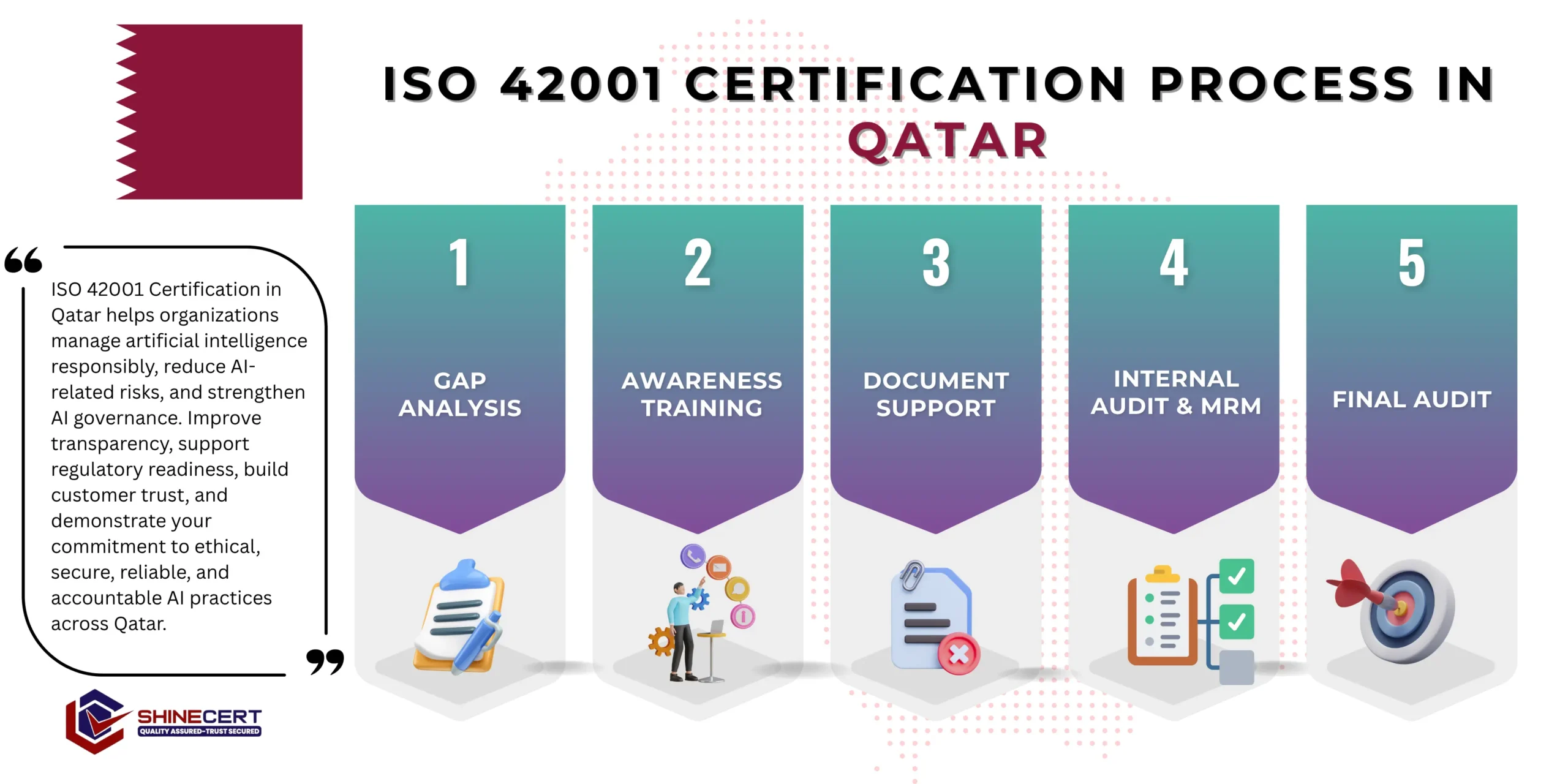
Our Five-Step ISO 42001 Certification Process
AI Inventory and Risk Assessment
We map your organization's genuine AI use cases and assess their risk and impact level, calibrated against the categorization approach used in Qatar's ethical AI guidelines.
An AI systems inventory and risk classification register, plus identification of applicable Qatar regulatory considerations.
Documentation Development
Your AI policy, risk assessment and impact assessment procedures, and lifecycle governance documentation get built around your actual AI use cases, not a generic template.
A complete ISO 42001 documentation set addressing your specific AI systems and Qatar regulatory context.
Implementation and Training
Governance controls roll out across your AI development and deployment processes, with staff trained by role on responsible AI practices relevant to their work.
Training records and evidence of functioning AI lifecycle governance controls.
Internal Audit and Management Review
A genuine internal audit tests whether your AI governance controls function under real conditions, with findings feeding into a management review where leadership commits to specific corrective actions.
An internal audit report with real findings and management review minutes demonstrating genuine leadership engagement with AI governance.
Certification Audit
We coordinate Stage 1 and Stage 2 with a GAB-accredited or GAC-recognized certification body experienced in AI management system assessment.
Your ISO 42001 certificate and a clear surveillance audit schedule.
AI Inventory and Risk Assessment
We map your organization's genuine AI use cases and assess their risk and impact level, calibrated against the categorization approach used in Qatar's ethical AI guidelines.
An AI systems inventory and risk classification register, plus identification of applicable Qatar regulatory considerations.
Documentation Development
Your AI policy, risk assessment and impact assessment procedures, and lifecycle governance documentation get built around your actual AI use cases, not a generic template.
A complete ISO 42001 documentation set addressing your specific AI systems and Qatar regulatory context.
Implementation and Training
Governance controls roll out across your AI development and deployment processes, with staff trained by role on responsible AI practices relevant to their work.
Training records and evidence of functioning AI lifecycle governance controls.
Internal Audit and Management Review
A genuine internal audit tests whether your AI governance controls function under real conditions, with findings feeding into a management review where leadership commits to specific corrective actions.
An internal audit report with real findings and management review minutes demonstrating genuine leadership engagement with AI governance.
Certification Audit
We coordinate Stage 1 and Stage 2 with a GAB-accredited or GAC-recognized certification body experienced in AI management system assessment.
Your ISO 42001 certificate and a clear surveillance audit schedule.
What It Costs: The Factors That Actually Drive ISO 42001 Price
- Number and complexity of AI use cases : Organizations with more AI systems, especially higher-impact ones requiring formal impact assessments, need more extensive governance documentation.
- Risk level of AI applications : Systems affecting individual rights, financial decisions, or health outcomes require considerably more extensive impact assessment and oversight controls than low-risk internal tools.
- Existing AI governance maturity : Organizations with informal but functioning AI oversight practices already in place need less foundational work than those building governance from scratch.
- Data governance complexity : Organizations with more complex data provenance chains for AI training need more extensive documentation to demonstrate genuine data governance.
- Bundling with ISO 27001 : Meaningful cost efficiency is available for companies pursuing both certifications together, given the shared risk-management and documentation infrastructure.
- Quick answer : Budget QAR 22,000 to QAR 90,000, with the low end reflecting a smaller organization with limited, lower-risk AI use and the high end reflecting a larger organization deploying higher-impact AI systems across multiple use cases.
A Scenario: How a Bank Might Approach ISO 42001 for a Credit-Scoring Model
- It helps to see this concretely rather than abstractly. Picture a Qatar-based bank using a machine learning model to help score loan applications. Under ISO 42001, the first genuine step isn’t writing a policy document, it’s classifying this specific use case honestly. A credit-scoring model directly affects individuals’ access to financial services, which places it squarely in the higher-impact category under both ISO 42001’s risk-based approach and the categorization logic in MCIT’s 2025 ethical AI guidelines. That classification triggers real obligations: a documented Discrimination Impact Assessment testing whether the model produces disparate outcomes across protected groups, clear documentation of what data trained the model and where it came from, and a genuine human review step before any adverse credit decision becomes final, not just a rubber-stamp approval workflow.
- The bank’s compliance team then needs ongoing monitoring, not a one-time assessment, model drift over time can quietly introduce bias that wasn’t present at launch, particularly as the underlying applicant population or economic conditions shift. A properly implemented ISO 42001 system builds this into the standard surveillance audit cycle, meaning the bank’s certification body checks not just that the assessment was done once, but that monitoring and review are genuinely ongoing. Banks that treat this as a one-time compliance exercise ahead of a single audit tend to find drift-related bias issues surface later regardless, at a point where the reputational and regulatory cost of discovery is considerably higher than it would have been during a routine surveillance check.
Benefits: What Certification Actually Changes
A certified AI management system produces exactly the impact assessments, governance documentation, and oversight evidence Qatar’s phased regulatory rollout is building toward.
Priority sectors under Qatar’s AI regulatory phases, finance, healthcare, transport, government services, increasingly expect demonstrable AI governance from vendors and partners.
A functioning AI management system reduces the likelihood of biased or harmful AI outputs reaching customers or the public, and provides documented evidence of due diligence if issues arise.
As AI adoption accelerates in Qatar, organizations that can demonstrate structured, certified AI governance stand out from those relying on informal oversight.
The risk assessment and impact evaluation process required by the standard genuinely improves how organizations decide which AI use cases are appropriate to pursue.
Companies already holding ISO 27001 find the shared risk-management and documentation structure makes ISO 42001 implementation considerably faster to build.
Mandatory Documents Required for Implementation
Genuine leadership commitment addressing your organization’s approach to responsible AI development and deployment.
Documented, specific to your actual use cases, not a generic industry list.
Documented processes for evaluating bias, discrimination, and broader impact risk, particularly for higher-impact systems.
Documentation covering data provenance and quality for AI training and operation.
Documented mechanisms ensuring appropriate human review of AI-driven decisions, especially high-impact ones.
Evidence of genuine, ongoing governance oversight.
Documented plans for responding to AI system failures, bias findings, or harmful outputs.
Applicable Standards by Industry
Financial Services
Beyond ISO 42001, Qatar financial institutions deploying AI for credit decisions, fraud detection, or trading typically face additional sector-specific AI governance expectations under the Phase 2 rollout, alongside existing QFC and Qatar Central Bank regulatory frameworks.
Read moreHealthcare
Organizations using AI for diagnostic support or clinical decision-making typically need ISO 42001 alongside Ministry of Public Health requirements specific to medical AI applications.
Read moreTechnology & Software Companies
Companies building AI products for Qatar clients increasingly need to demonstrate ISO 42001 governance directly during enterprise procurement, alongside ISO 27001 for the underlying data security.
Read moreGovernment-Adjacent Contractors
Vendors deploying AI in government service contexts face the most immediate exposure to Qatar’s Phase 2 sectoral AI governance expectations.
Read moreLegal & Professional Services
Firms using AI tools in legal work face specific obligations under the Qatar International Court’s Procedural Directive No. 1 of 2026, including AI-content identification and disclosure requirements.
Read moreISO 42001 vs Qatar’s Principles and Guidelines for Ethical AI
- These operate at different levels, and understanding the relationship helps you scope your compliance program correctly. MCIT’s 2025 Principles and Guidelines for Ethical Development and Deployment of AI set out Qatar’s own national expectations for responsible AI, using an impact-based categorization approach that recommends specific controls, including Data Protection Impact Assessments and Discrimination Impact Assessments, for higher-impact systems. ISO 42001 certifies your organization’s broader AI management system, the ongoing, internationally recognized discipline of governing AI across its full lifecycle, independently verified by a third-party certification body.
- We generally recommend Qatar organizations treat ISO 42001 as the structural backbone that makes genuine alignment with MCIT’s guidelines considerably more achievable, since a certified AI management system produces exactly the impact assessments, documentation, and oversight evidence the national guidelines describe, in a format that also carries international recognition. Organizations that try to build ad hoc compliance with the national guidelines alone, without an underlying certified management system, tend to find their documentation doesn’t hold together coherently as their AI use cases grow.
AI Management Requirements, Clause by Clause
- Context of the Organization : Understand your genuine AI use cases, the stakeholders affected by them, and applicable requirements, including MCIT’s ethical AI guidelines and any sector-specific rules relevant to your industry.
- Leadership : Top management commitment to responsible AI governance, with clear accountability for AI-related decisions, not distributed vaguely across a data science team without genuine oversight authority.
- Planning : A genuine AI risk assessment addressing bias, transparency, and impact on affected individuals, including Data Protection Impact Assessments and Discrimination Impact Assessments for higher-impact systems, consistent with the categorization approach in Qatar’s 2025 ethical AI guidelines.
- Support : Competence in AI ethics and technical AI risk management, calibrated by role, data scientists building models need meaningfully different training than business users deploying AI-powered tools.
- Operation : Operational controls across the AI lifecycle, data provenance documentation, model testing and validation, human oversight mechanisms for high-impact decisions, and clear escalation paths when AI systems produce unexpected or harmful outputs.
- Performance Evaluation : Monitoring and measurement of AI system performance and impact over time, including ongoing bias and drift monitoring, not a one-time assessment before deployment.
- Improvement : A structured response to AI-related incidents or nonconformities, including genuine root-cause investigation when a system produces biased, harmful, or unexpectedly inaccurate outputs.
Qatar’s AI Regulatory Rollout: What Phase Are We In, and Why It Matters for Certification Timing
- Understanding where Qatar sits in its regulatory timeline genuinely helps with certification planning. Phase 1, foundation building, ran 2024-2025 and delivered the core governance policies, including the 2025 ethical AI guidelines. Phase 2, sectoral implementation, is running through 2025-2026, with full rollout in the priority sectors of finance, healthcare, transport, and government services, meaning organizations in these sectors are the ones facing the most immediate, concrete regulatory expectations right now. Phase 3, targeted for 2026-2027, involves cross-sector harmonization and alignment with broader Gulf-regional AI standards.
- For organizations in the priority sectors, certifying to ISO 42001 now, while Phase 2 is actively underway, positions you ahead of the harmonization work coming in Phase 3 rather than scrambling to build governance documentation once cross-sector requirements solidify. Organizations outside the immediate priority sectors have a genuine window to build AI governance proactively before broader expectations arrive, rather than reactively once they do.
Why ShineCert?
We coordinate Qatar engagements from ShineCert’s Riyadh and Lebanon offices, with direct familiarity with MCIT’s AI governance framework and the practical realities of implementing AI oversight in fast-moving technology and financial organizations. As the best ISO 42001 consultant in Qatar, our team has guided more than 10,000 organizations through ISO certification globally.
Choosing a Certification Body for ISO 42001 in Qatar?
What to Check | Why It Matters |
GAB accreditation, or another GAC-recognized body | Confirms genuine, internationally recognized certification |
Genuine ISO 42001 audit experience, not just general ISMS experience | AI governance auditing requires understanding of AI-specific risk, distinct from general information security auditing |
Familiarity with MCIT’s ethical AI guidelines | Helps ensure certification genuinely supports alignment with Qatar’s own regulatory direction |
Sector-specific AI risk understanding | Financial and healthcare AI carries meaningfully different risk profiles than general business AI tools |
Ready to Get Started?
ShineCert supports Qatar businesses end to end, from AI risk assessment through certification audit, with direct experience navigating MCIT’s evolving, actively developing AI governance framework as it moves through its remaining rollout phases. Book a free consultation or contact us directly, and we’ll review your AI systems honestly before proposing a fixed-scope plan.
Frequently Asked Questions
It’s the international standard for AI management systems, requiring organizations to build structured governance across the AI lifecycle, addressing risk, bias, transparency, and oversight.
Typically QAR 22,000 to QAR 90,000, depending on the scope and risk level of your AI systems.
It’s not currently legally mandatory, but Qatar’s phased AI regulatory rollout is building toward expectations that a certified AI management system directly supports, particularly in finance, healthcare, transport, and government services.
Typically three to six months.
No, but the two are highly complementary, ISO 27001 addresses information security broadly, while ISO 42001 addresses AI-specific governance concerns like bias and algorithmic transparency, and organizations often pursue both together.
The guidelines set Qatar’s national expectations for responsible AI, while ISO 42001 certifies your organization’s broader AI management system against an internationally recognized standard, the two are complementary, not substitutes.
Finance, healthcare, transport, and government services, as these are the priority sectors under Phase 2 of Qatar’s AI regulatory rollout, running through 2025-2026.
It requires classifying the use case honestly by impact level, then applying proportionate controls, for credit scoring, this typically means a documented Discrimination Impact Assessment, data provenance documentation, human review before adverse decisions, and ongoing drift monitoring rather than a one-time check.
We coordinate Qatar engagements from our Riyadh and Lebanon offices, with consultants traveling on-site as needed.