
ISO 27001 Certification in Qatar
Quick Answer
ISO 27001 is the international standard for information security management systems, and in Qatar it operates alongside a genuinely active national cybersecurity regulator, the National Cyber Security Agency (NCSA), which enforces the Personal Data Privacy Protection Law (PDPPL) and the Cybercrimes Combating Law, and requires all data breaches to be reported directly to it. If your organization is still certified to the withdrawn ISO 27001:2013 edition, your certificate has not been valid since the transition deadline passed in October 2025. Get certified through a body accredited by the Global Accreditation Bureau (GAB) or another body recognized under the new Global Accreditation Cooperation (GAC) framework. Budget QAR 20,000 to QAR 85,000 depending on data scope and system complexity, and plan for three to six months from kickoff to certificate.
What Is ISO 27001?
ISO 27001 is the international standard for information security management systems (ISMS), currently in its 2022 edition. It requires organizations to identify their genuine information security risks, to data confidentiality, integrity, and availability, and build a structured, risk-based system of controls to manage them, rather than relying on ad hoc technical fixes applied reactively after incidents. The standard includes Annex A, a reference set of 93 security controls spanning organizational, people, physical, and technological categories, from which organizations select and justify the controls genuinely relevant to their actual risk profile.
Why This Matters So Much in Qatar Specifically?
Qatar’s National Cyber Security Strategy, developed under Qatar National Vision 2030’s digital pillar, treats cybersecurity as core national infrastructure, not a private-sector afterthought. The National Cyber Security Agency (NCSA) centralizes cybersecurity policy, threat monitoring, and incident response nationally, and its National Cyber Governance and Assurance Affairs division proposes legislative tools, assesses cyber risk, issues compliance certificates against national information security standards, and grants accreditation to service providers, a genuinely active regulatory posture, not a passive framework.
The Personal Data Privacy Protection Law (PDPPL), enforced by the NCSA alongside the Cybercrimes Combating Law, gives Qatari individuals explicit rights including the right to object to data processing and the right to erasure, and mandates that all data breaches be reported to the NCSA directly. In April 2026, the NCSA launched a Cloud Computing Privacy Assessment Tool specifically to help organizations strengthen privacy governance and demonstrate compliance, a clear signal that regulatory expectations here continue to sharpen, not stay static. For companies handling customer, financial, or government-adjacent data in Qatar, a certified ISMS gives you a structured, independently verified way to demonstrate genuine security governance against this actively evolving regulatory backdrop.
What are the steps to get ISO 27001 Certification in Qatar?
our services
- ISO Certification Qatar
- ISO 9001 Certification Qatar
- ISO 14001 Certification Qatar
- ISO 27001 Certification Qatar
- ISO 22000 Certification Qatar
- ISO 27701 Certification Qatar
- ISO 45001 Certification Qatar
- ISO 20000-1 Certification Qatar
- ISO 13485 Certification Qatar
- ISO 17025 Certification Qatar
- ISO 31000 Certification Qatar
- ISO 42001 Certification Qatar
- ISO 37001 Certification Qatar
- ISO 22301 Certification Qatar
- ISO 50001 Certification Qatar
- CE Mark Certification Qatar
- GDPR Certification Qatar
- GMP Certification Qatar
- Halal Certification Qatar
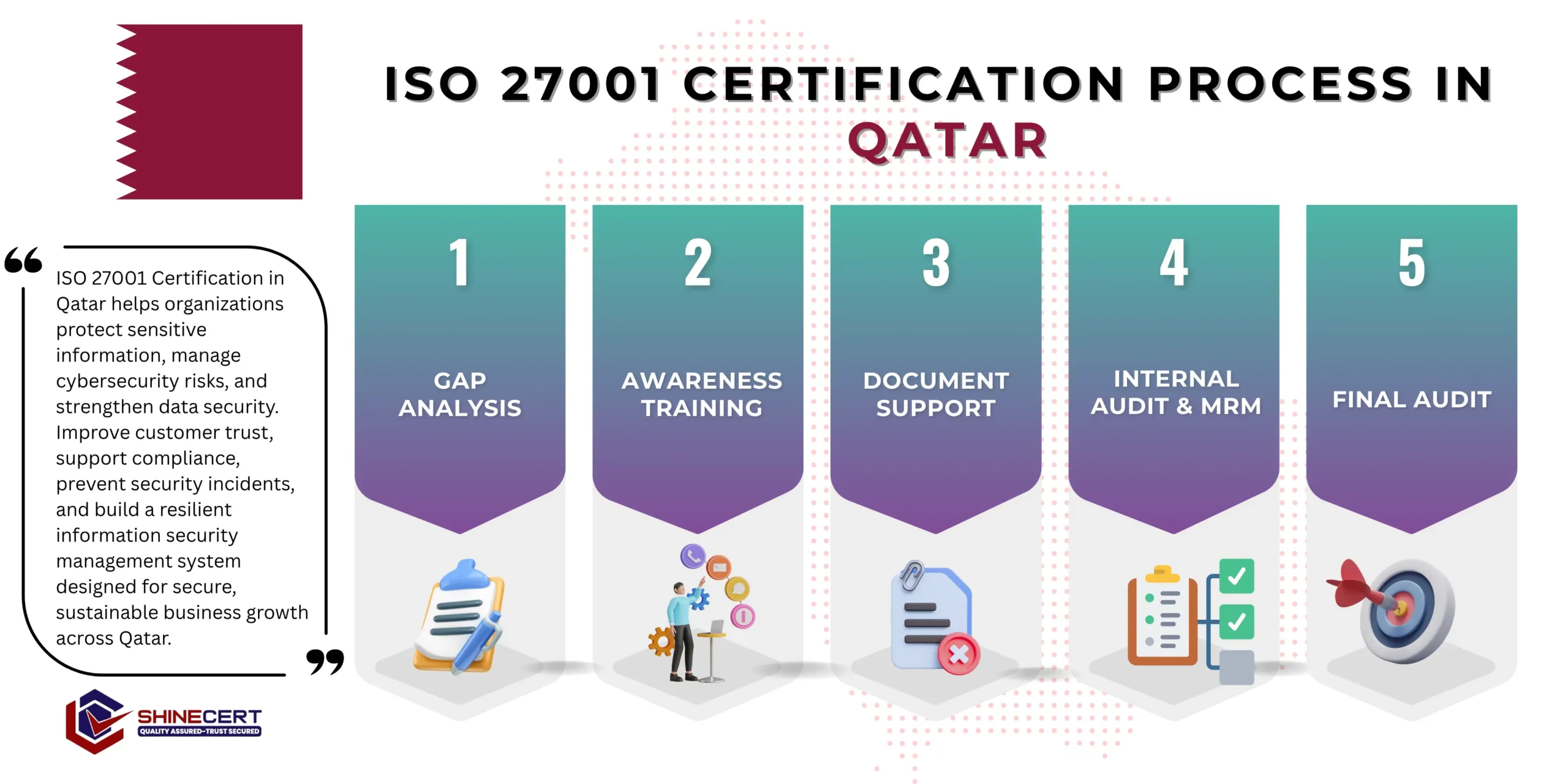
Our Five-Step ISO 27001 Certification Process
Risk Assessment and Gap Analysis
We identify your genuine information security risks and assess your current controls against Annex A, calibrated to your actual data scope and Qatar regulatory obligations under the PDPPL.
A risk assessment register and a gap analysis identifying where your current controls fall short of ISO 27001 requirements.
Documentation Development
Your information security policy, Statement of Applicability, and control-specific procedures get built around your actual risk profile and selected Annex A controls, not a generic template.
A complete ISO 27001 documentation set, including a Statement of Applicability tailored to your organization.
Implementation and Training
Selected controls roll out across your systems and processes, with staff trained by role on security responsibilities relevant to their access and data handling.
Training records and evidence of functioning technical and organizational controls.
Internal Audit and Management Review
A genuine internal audit tests whether your ISMS controls actually function under real conditions, with findings feeding into a management review where leadership commits to specific corrective actions.
An internal audit report with real findings and management review minutes demonstrating genuine leadership engagement with information security.
Certification Audit
We coordinate Stage 1 and Stage 2 with a GAB-accredited or GAC-recognized certification body experienced in Qatar's regulatory environment.
Your ISO 27001 certificate and a clear surveillance audit schedule.
Risk Assessment and Gap Analysis
We identify your genuine information security risks and assess your current controls against Annex A, calibrated to your actual data scope and Qatar regulatory obligations under the PDPPL.
A risk assessment register and a gap analysis identifying where your current controls fall short of ISO 27001 requirements.
Documentation Development
Your information security policy, Statement of Applicability, and control-specific procedures get built around your actual risk profile and selected Annex A controls, not a generic template.
A complete ISO 27001 documentation set, including a Statement of Applicability tailored to your organization.
Implementation and Training
Selected controls roll out across your systems and processes, with staff trained by role on security responsibilities relevant to their access and data handling.
Training records and evidence of functioning technical and organizational controls.
Internal Audit and Management Review
A genuine internal audit tests whether your ISMS controls actually function under real conditions, with findings feeding into a management review where leadership commits to specific corrective actions.
An internal audit report with real findings and management review minutes demonstrating genuine leadership engagement with information security.
Certification Audit
We coordinate Stage 1 and Stage 2 with a GAB-accredited or GAC-recognized certification body experienced in Qatar's regulatory environment.
Your ISO 27001 certificate and a clear surveillance audit schedule.
What It Costs: The Factors That Actually Drive ISO 27001 Price
- Data scope and system complexity : Organizations handling more sensitive data types across more systems need more extensive risk assessment and control documentation.
- Number of Annex A controls applicable : A broader Statement of Applicability, driven by your actual risk profile, means more implementation and audit work.
- Existing security maturity : Companies with informal but functioning security practices already in place need less foundational work than those building an ISMS from scratch.
- Regulatory complexity : Companies operating under Qatar Financial Centre regulations or handling PDPPL-regulated personal data at scale typically need more extensive compliance mapping.
- Bundling with ISO 9001 or ISO 42001 : Meaningful cost efficiency is available for companies pursuing multiple management system certifications together, given shared documentation infrastructure.
- Quick answer : Budget QAR 20,000 to QAR 85,000, with the low end reflecting a smaller organization with limited data scope and the high end reflecting a larger, multi-system organization handling sensitive financial or personal data.
Benefits: What Certification Actually Changes
A certified ISMS produces exactly the risk assessments, control documentation, and incident response evidence that PDPPL compliance and NCSA engagement typically require.
Banks, the Qatar Financial Centre ecosystem, and government-linked entities increasingly expect ISO 27001 certification from vendors handling sensitive data.
A functioning ISMS genuinely reduces both the likelihood of security incidents and the severity of their impact when they do occur.
Multinational partners increasingly treat ISO 27001 as a baseline expectation for any vendor handling their data, not a differentiator.
A certified ISMS gives you a documented, tested incident response process, directly relevant to the PDPPL’s mandatory NCSA breach reporting requirement.
Companies already pursuing ISO 9001 or considering ISO 42001 for AI governance find the shared management system structure makes ISO 27001 implementation meaningfully faster.
Mandatory Documents Required for Implementation
Genuine leadership commitment addressing your specific risk profile.
Documented justification for which Annex A controls apply, a document both certification bodies and Qatari regulators typically expect to see.
Documented, specific to your actual information assets and threats.
Documented plans aligned with PDPPL’s mandatory NCSA breach reporting requirement.
Evidence of genuine, ongoing control over who accesses what data.
Evidence of genuine, continuous oversight.
Documented plans for maintaining information availability during disruptions.
Applicable Standards by Industry
Financial Services and QFC Entities
Beyond ISO 27001, QFC-regulated firms typically face additional information security expectations from QFC authorities and, where applicable, Qatar Central Bank requirements.
Read moreTechnology and Software Companies
Companies handling customer data often need ISO 27001 alongside specific PDPPL compliance measures when meeting enterprise procurement requirements.
Read moreGovernment-Adjacent Contractors
Vendors working with government entities frequently face NCSA-specific compliance certificate requirements layered on top of ISO 27001.
Read moreHealthcare
Organizations handling patient data typically need ISO 27001 alongside Ministry of Public Health requirements for medical record data handling.
Read moreRetail and E-commerce
Companies processing customer payment and personal data increasingly pursue ISO 27001 alongside payment card industry compliance where applicable.
Read moreThe ISO 27001:2013 Withdrawal: A Genuine Urgency Issue, Not a Formality
- This deserves direct attention because we still encounter Qatar organizations operating under the mistaken belief their older certificate remains valid. ISO 27001:2013 certificates were formally withdrawn, with a transition deadline requiring all organizations to move to the 2022 edition no later than October 31, 2025. As of today, any organization still presenting a 2013-edition certificate to a client, tender committee, or regulator is presenting an expired credential, which can create genuine reputational and contractual exposure, particularly for financial services and government-adjacent vendors where certification currency gets actively checked during procurement.
- If your organization has not yet transitioned, the good news is that the 2022 edition’s core structural changes are manageable: a reorganized and expanded Annex A control set (93 controls replacing the previous 114, consolidated and restructured around themes), and new controls addressing areas like threat intelligence, cloud security, and data masking that reflect how information security risk has genuinely evolved since 2013. We generally recommend organizations still on the old edition treat this as an immediate priority rather than a routine renewal item, given how long the deadline has already passed.
Information Security Requirements, Clause by Clause
- Context of the Organization : Understand your genuine information assets, the threats and vulnerabilities relevant to them, and the interested parties, customers, regulators including the NCSA, business partners, who care about how you protect data.
- Leadership : Top management commitment to information security that goes beyond a signed policy, with resources genuinely allocated and clear accountability assigned, not distributed vaguely across IT.
- Planning : A genuine risk assessment identifying real threats to your information assets, plus a Statement of Applicability documenting which Annex A controls apply to your organization and why, this document is central to both certification and any regulatory compliance conversation.
- Support : Competence and security awareness training calibrated by role, a developer handling customer data needs meaningfully different training than general administrative staff, and social engineering awareness matters for everyone.
- Operation : Operational controls implementing your selected Annex A controls, access management, encryption, incident response procedures, documented and genuinely functioning, not just described in a policy nobody follows.
- Performance Evaluation : Monitoring and measurement of actual security performance, with internal audits testing whether controls function as designed, including genuine penetration testing or vulnerability assessment where relevant to your risk profile.
- Improvement : A structured response to security incidents and nonconformities, including genuine root-cause investigation, given the PDPPL’s mandatory breach reporting to the NCSA, a functioning incident response process isn’t optional operational hygiene, it’s a regulatory necessity.
What Happens If a Breach Occurs and NCSA Notification Fails to Happen in Time?
- This is worth spelling out concretely, because breach notification failure carries genuinely distinct consequences from the breach itself. Under the PDPPL, organizations experiencing a personal data breach are required to notify the NCSA, and failing to do so, or delaying notification beyond what the law expects, creates a separate compliance failure on top of whatever damage the breach itself caused. Regulators in most jurisdictions with mandatory breach reporting treat notification failures as an aggravating factor when assessing enforcement response, and Qatar’s framework, backed by the Cybercrimes Combating Law alongside the PDPPL, gives the NCSA real regulatory teeth here.
- A functioning ISO 27001 incident response process is specifically what prevents this scenario. Certification requires you to document and test an incident response procedure, which, done properly, includes a clear internal escalation path that gets a genuine data breach in front of the people responsible for regulatory notification quickly, not after days of internal confusion about who owns the decision. We’ve generally observed that organizations without this documented ahead of time tend to lose the most critical hours after a breach is discovered simply figuring out who is supposed to make the notification call, rather than actually making it. Building this escalation path before you need it, as ISO 27001 implementation requires, is genuinely one of the most practical, non-abstract benefits certification delivers in Qatar’s current regulatory environment.
Three Myths About ISO 27001 in Qatar
- We’re too small to need this : NCSA regulatory expectations and PDPPL obligations apply regardless of company size, smaller companies handling sensitive customer or financial data are not exempt from genuine security governance expectations.
- Having good IT security is basically the same as certification : Strong technical controls without documented risk assessment, a Statement of Applicability, and demonstrated management commitment don’t constitute an ISMS and won’t survive a certification audit.
- Our ISO 27001:2013 certificate is still fine : It isn’t, the transition deadline to ISO 27001:2022 passed in October 2025, and any organization still holding a 2013-edition certificate has an expired, invalid credential.
Why ShineCert?
We coordinate Qatar engagements from ShineCert’s Riyadh and Lebanon offices, with direct familiarity with NCSA’s regulatory framework and PDPPL compliance expectations. As the best ISO 27001 consultant in Qatar, our team has guided more than 10,000 organizations through ISO certification globally, including a substantial number of financial services and technology firms navigating exactly the kind of layered regulatory environment Qatar presents.
ISO 27001 vs. Qatar’s Personal Data Privacy Protection Law (PDPPL)
- These are complementary, not substitutes, and the distinction matters for how you scope your compliance program. The PDPPL is a national law setting specific legal obligations around how you collect, process, and protect personal data, including individual rights like the right to object and the right to erasure, enforced by the NCSA with mandatory breach reporting. ISO 27001 certifies your organization’s broader information security management system, the ongoing discipline of identifying, controlling, and improving information security across all your information assets, not limited to personal data specifically.
- We generally recommend Qatar organizations treat ISO 27001 as the operational backbone that makes genuine, sustained PDPPL compliance considerably more achievable, since a functioning ISMS produces exactly the risk assessments, access controls, and incident response processes that PDPPL compliance requires anyway. Organizations that try to address PDPPL requirements as a standalone legal exercise, disconnected from a broader security management system, tend to find compliance becomes a recurring scramble rather than a genuinely sustained state.
Ready to Get Started?
ShineCert supports Qatar businesses end to end, from risk assessment through certification audit, with direct experience navigating NCSA and PDPPL compliance expectations. Whether you’re pursuing certification for the first time or finally transitioning off an expired 2013-edition certificate, our team can scope the work honestly before you commit. Book a free consultation or contact us directly, and we’ll review your operations before proposing a fixed-scope plan.
Frequently Asked Questions
It’s the international standard for information security management systems, requiring organizations to identify information security risks and implement a structured, risk-based set of controls to manage them.
Typically QAR 20,000 to QAR 85,000, depending on data scope and system complexity.
It’s not universally legally mandatory, but it’s increasingly expected by financial institutions, government-adjacent entities, and international partners, and it directly supports PDPPL compliance.
Typically three to six months.
No, the transition deadline to the 2022 edition passed in October 2025, and any 2013-edition certificate is now expired.
No, PDPPL is a specific legal obligation around personal data, while ISO 27001 certifies your organization’s broader information security management system, the two are complementary.
The NCSA references compliance with national and international frameworks broadly rather than mandating ISO 27001 by name, but a certified ISMS directly supports the risk assessment and incident response evidence NCSA compliance activities typically expect.
Delayed or missing breach notification creates a separate compliance failure under the PDPPL, on top of the breach itself, and a documented ISO 27001 incident response process is specifically designed to prevent this by clarifying escalation and notification responsibility in advance.
We coordinate Qatar engagements from our Riyadh and Lebanon offices, with consultants traveling on-site as needed.