
GMP Certification in Lebanon
Quick Answer
Good Manufacturing Practice (GMP) certification verifies that pharmaceutical, food supplement, and cosmetic manufacturing facilities follow systematic quality controls covering hygiene, equipment, documentation, and process consistency. In Lebanon, the Ministry of Public Health’s drug registration process, handled through its Drug Import/Export Department, effectively assumes GMP-level manufacturing discipline is already in place, registration documentation and facility inspection expectations align closely with GMP principles, even where GMP certification itself isn’t separately mandated as a standalone legal requirement. For Lebanese pharmaceutical manufacturers and food supplement producers, particularly those seeking export markets, independently verified GMP certification substantially eases both domestic registration and international market entry. Budget three to four months for first-time certification. Cost depends on genuine factors, product category, facility complexity, and export market ambitions, not a flat figure we quote upfront.
GMP Certification, Explained Simply
Manufacturing a pharmaceutical product or food supplement correctly once isn’t the challenge GMP addresses, doing it correctly, consistently, batch after batch, with documentation proving it, is. GMP requires systematic controls at every stage: verified raw material sourcing, controlled production environments, equipment properly maintained and validated, and complete batch records that let you trace exactly what happened in production for any given batch. It’s the manufacturing discipline that separates a facility that happens to produce good products from one that’s structured to reliably produce good products every time.
Lebanon at a Glance: What Shapes GMP Demand Here
MoPH’s registration process assumes GMP-level discipline : The Ministry of Public Health’s Drug Import/Export Department evaluates manufacturing quality as part of drug registration, with expectations closely aligned to GMP principles even without a separate standalone GMP mandate.
A genuine pharmaceutical and supplement manufacturing base : Lebanon has real pharmaceutical and food supplement manufacturing activity, both for the domestic market and increasingly for regional export.
Export market requirements : Gulf and other regional markets frequently require GMP certification as an import condition for pharmaceutical and supplement products, making certification a genuine market access requirement beyond domestic registration.
Growing regional competition : As more manufacturers across the region pursue GMP certification, Lebanese producers without it risk losing ground in both domestic distribution partnerships and export opportunities.
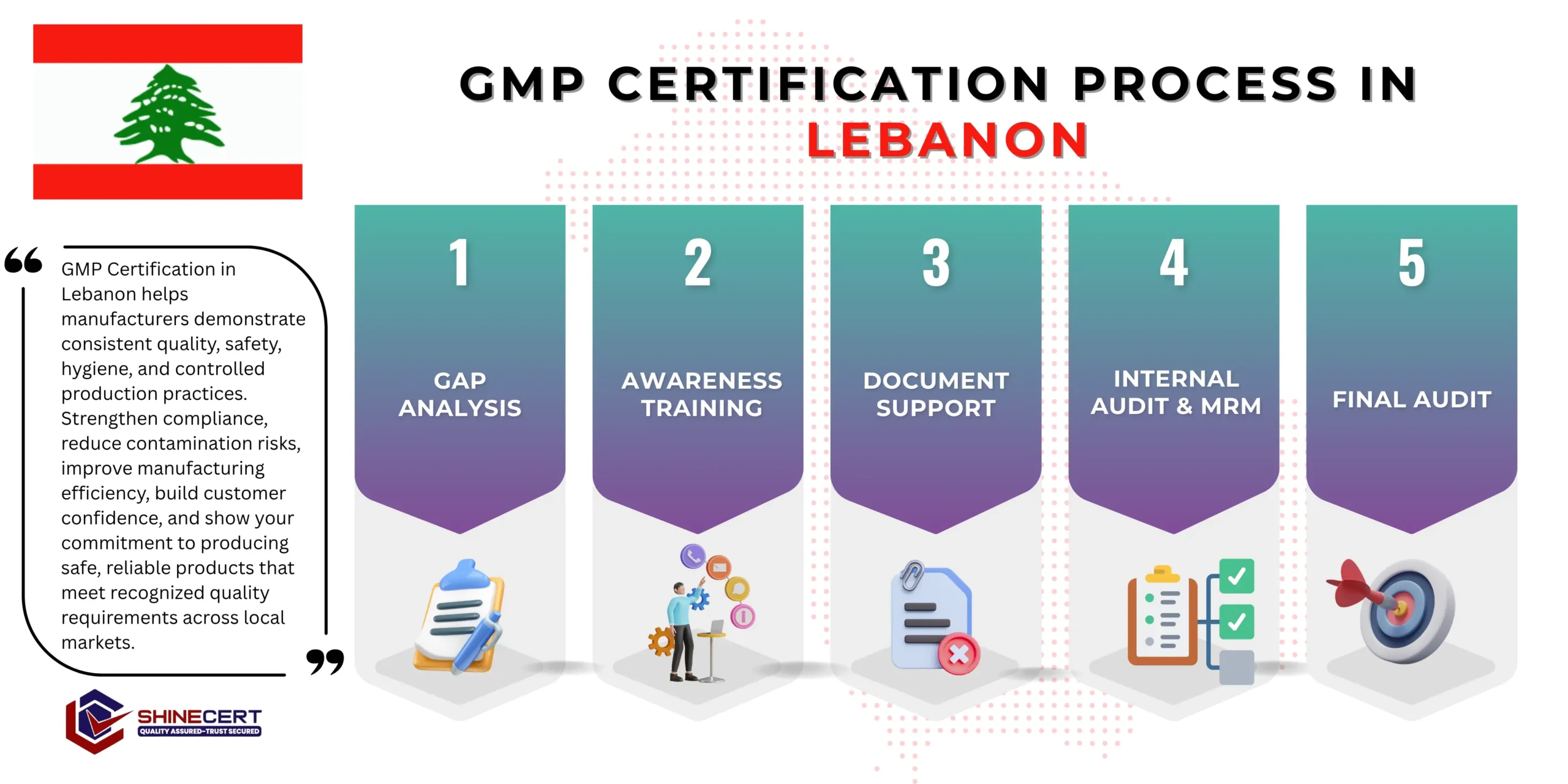
What are the steps to get GMP Certification in Lebanon?
our services
- ISO Certification Lebanon
- ISO 9001 Certification Lebanon
- ISO 14001 Certification Lebanon
- ISO 27001 Certification Lebanon
- ISO 22000 Certification Lebanon
- ISO 27701 Certification Lebanon
- ISO 45001 Certification Lebanon
- ISO 20000-1 Certification Lebanon
- ISO 13485 Certification Lebanon
- ISO 17025 Certification Lebanon
- ISO 31000 Certification Lebanon
- ISO 42001 Certification Lebanon
- ISO 37001 Certification Lebanon
- ISO 22301 Certification Lebanon
- ISO 50001 Certification Lebanon
- CE Mark Certification Lebanon
- GDPR Certification Lebanon
- GMP Certification Lebanon
- Halal Certification Lebanon
Our Process: What to Actually Expect
Gap Assessment
We walk your production facility, review existing quality documentation and any MoPH registration history, and conduct structured interviews across production and quality control staff. We map every GMP element against your actual manufacturing process, distinguishing requirements specific to your product category.
Documentation
We build your quality manual, standard operating procedures, and batch record templates around your actual production process, cross-referencing MoPH’s registration documentation requirements so the two efforts reinforce each other rather than duplicate.
Implementation
Controls roll out across production, quality control, and material handling, with role-specific training since production staff and quality control staff face genuinely different GMP responsibilities. Batch record systems get tested with real production runs.
Internal Audit and Management Review
We run a full internal audit against every GMP element, the way a certification auditor would, surfacing weaknesses while stakes are low. Findings go to formal management review where leadership makes documented decisions.
Certification Audit
Stage 1 confirms your documentation and quality manual are audit-ready; Stage 2 has the auditor observe actual production operations, review batch records, and verify quality control testing. We stay involved through both stages.
Gap Assessment
We walk your production facility, review existing quality documentation and any MoPH registration history, and conduct structured interviews across production and quality control staff. We map every GMP element against your actual manufacturing process, distinguishing requirements specific to your product category.
Documentation
We build your quality manual, standard operating procedures, and batch record templates around your actual production process, cross-referencing MoPH’s registration documentation requirements so the two efforts reinforce each other rather than duplicate.
Implementation
Controls roll out across production, quality control, and material handling, with role-specific training since production staff and quality control staff face genuinely different GMP responsibilities. Batch record systems get tested with real production runs.
Internal Audit and Management Review
We run a full internal audit against every GMP element, the way a certification auditor would, surfacing weaknesses while stakes are low. Findings go to formal management review where leadership makes documented decisions.
Certification Audit
Stage 1 confirms your documentation and quality manual are audit-ready; Stage 2 has the auditor observe actual production operations, review batch records, and verify quality control testing. We stay involved through both stages.
What Does GMP Certification Actually Help Your Organization Do?
- The core value GMP certification offers is proof, independently verified proof that your manufacturing process is systematically controlled, not just occasionally compliant. Without certification, a facility can genuinely produce good products while still lacking the documented, auditable system that MoPH registration reviewers, export market regulators, and business partners increasingly expect to see.
- Practically, this helps in concrete ways. It substantially eases MoPH drug registration, since much of what GMP certification generates, batch records, equipment validation, quality control documentation, overlaps directly with what the Drug Import/Export Department’s registration process evaluates. It opens export markets where GMP certification is a specific, non-negotiable import requirement. It gives distribution and business partners independently verified evidence of manufacturing quality, strengthening commercial relationships. And it creates genuine traceability, so if a quality issue is ever identified, you can trace it precisely through your production records rather than facing a broad, costly investigation.
- GMP principles apply distinctly across pharmaceutical, food supplement, and cosmetic manufacturing, with the specific control requirements varying by product category and risk level, a sterile injectable product faces meaningfully different requirements than an oral supplement, for instance.
Why This Matters So Much in Lebanon Specifically?
- Lebanon’s pharmaceutical and supplement manufacturing sector has real domestic and regional relevance, and MoPH’s registration process already expects manufacturing quality closely aligned with Good Manufacturing Practice (GMP) principles, meaning Lebanese manufacturers pursuing certification aren’t taking on an entirely separate compliance burden, they’re formalizing and independently verifying practices registration already assumes. This alignment makes GMP certification a genuinely efficient investment: the documentation work substantially serves both purposes simultaneously.
- For manufacturers with export ambitions, the calculation is more direct. Many Gulf and regional markets simply won’t accept pharmaceutical or supplement imports without GMP certification from a recognized body, making certification not a differentiator but a baseline requirement for market entry. We’ve seen Lebanese manufacturers with genuinely strong domestic manufacturing quality face real friction expanding into export markets purely because they lacked the independently verified GMP credential those markets require as a matter of course.
What Actually Drives Your Cost?
We don’t quote a flat number, because two Lebanese manufacturers’ actual product complexity and facility setup can look completely different. Here’s what genuinely drives cost.
Sterile or higher-risk pharmaceutical products require meaningfully deeper quality control documentation than lower-risk oral supplements.
Each additional production line or product category generally adds scope to the quality system.
Manufacturers with existing MoPH-aligned quality practices aren’t starting from zero, those with minimal formal documentation face more foundational work.
Certification aimed at specific export markets sometimes needs additional documentation alignment with that market’s regulatory expectations.
Pursuing ISO 9001 or ISO 13485 alongside GMP shares meaningful implementation and audit infrastructure.
A quality assurance team member who can own documentation and coordination reduces consultant hours needed.
GMP Benefits Businesses Don't Expect
Documentation generated for GMP certification directly serves registration requirements, reducing duplicated effort.
Many Gulf and regional markets won’t accept pharmaceutical or supplement imports without it, making certification a market entry prerequisite, not a differentiator.
If a quality issue arises, precise batch records let you respond quickly and narrowly rather than facing a broad, costly investigation.
Independently verified manufacturing quality strengthens commercial relationships with distributors and partners.
Systematic in-process controls catch quality issues before they reach finished product and distribution.
GMP’s sourcing verification requirements formalize supplier vetting, reducing risk introduced upstream.
Structural overlap with ISO 9001 and ISO 13485 (for medical device-adjacent products) makes pursuing complementary certifications meaningfully faster.
Quality control data and audit findings give management real visibility into where manufacturing risk actually concentrates.
Applicable Sectors for GMP Certification
Pharmaceutical manufacturing
Producers of prescription and over-the-counter medications use GMP to formalize manufacturing quality and support MoPH registration.
Read moreFood supplement and nutraceutical manufacturing
A genuinely active Lebanese sector, supplement producers use GMP to meet both domestic and export market requirements.
Read moreCosmetics manufacturing
Producers targeting export markets use certification to meet destination market import requirements.
Read moreContract manufacturing
Facilities producing pharmaceutical or supplement products on behalf of other brands use GMP certification to win and retain contract manufacturing relationships.
Read moreGMP and ISO 13485: Distinct Certifications That Frequently Overlap
- Manufacturers producing both pharmaceutical products and medical devices, or supplements alongside device-adjacent products, often ask whether GMP and ISO 13485 cover the same ground. They address related but distinct concerns. GMP focuses specifically on manufacturing process discipline, hygiene, equipment validation, batch consistency, largely independent of product category beyond risk-based control depth. ISO 13485 focuses on medical device quality management specifically, including device-specific design controls and regulatory traceability that GMP doesn’t directly address. A facility manufacturing both pharmaceutical products and medical devices may genuinely need both certifications, since MoPH’s device registration expectations and its drug registration expectations, while related, aren’t identical.
- For Lebanese manufacturers operating across both product categories, we generally recommend evaluating both certifications together rather than sequentially, since facility and personnel documentation frequently serves both efforts, meaningfully reducing the combined implementation timeline compared to treating them as fully separate projects.
GMP Requirements, Element by Element, With the Documents Each One Actually Needs
- Quality Management System : A documented quality management structure with clear accountability for manufacturing quality decisions across the organization. Documenting this element requires: a quality manual establishing your quality management structure and responsibilities.
- Personnel and Training : Qualified staff with role-specific training on GMP requirements relevant to their function, from production through quality control. Document this element requires: training records demonstrating GMP competence for all personnel involved in manufacturing.
- Premises and Equipment : Facility design prevents contamination and mix-ups, with equipment properly qualified, calibrated, and maintained. Documenting this element requires: equipment qualification and calibration records, and facility design documentation addressing contamination control.
- Documentation : Complete, controlled documentation covering every aspect of production, from raw material receipt through finished product release. Documenting this element requires: controlled standard operating procedures and complete batch manufacturing records for every product run.
- Production : Controlled production processes following validated methods, with in-process controls verifying quality at each production stage. Document this element requires: validated production process documentation and in-process control records.
- Quality Control : Independent testing and release procedures ensuring finished product meets specifications before distribution. Documenting this element requires: quality control testing records and product release documentation for every batch.
- Complaints and Recalls : A structured process for handling product complaints and, if necessary, executing a recall with genuine traceability back through the supply chain. Document this element requires: a documented complaint handling and recall procedure with batch traceability records.
What Happens When a Lebanon Business Operates Without Certification?
- MoPH registration obligations remain in force regardless of GMP certification status, and many Lebanese manufacturers do achieve registration without separate certification. What’s missing without it is the independently verified credential that substantially smooths registration documentation, and for export-focused manufacturers, the baseline requirement many regional markets simply won’t waive. Manufacturers relying entirely on informal quality practices tend to discover the gap either through friction in the MoPH registration process, or through being excluded from export markets that require GMP certification as a non-negotiable import condition.
- We generally recommend Lebanese pharmaceutical and supplement manufacturers with any export ambition treat GMP certification as foundational infrastructure, formalizing manufacturing discipline that registration already assumes, in a form that export markets will actually accept.
Common Pitfalls We See in Lebanon GMP Projects
- Assuming MoPH registration alone proves GMP-level quality : Registration evaluates manufacturing quality, but that’s not the same as holding independently verified GMP certification that export markets will actually accept.
- Weak batch record completeness : Businesses sometimes maintain partial batch records, missing the complete traceability GMP genuinely requires for every production run.
- Underestimating equipment qualification requirements : Having equipment that works isn’t the same as having documented qualification and calibration proving it consistently meets specification.
- No tested recall procedure : A documented recall process that’s never been exercised with a real scenario tends to reveal gaps exactly when they matter most.
Why ShineCert?
ShineCert brings 10 years of consulting and certification experience to Lebanon, backed by our own dedicated Lebanon office working alongside our Riyadh office. We deliver services remotely or on-site depending on what your project needs, facility walkthroughs and equipment qualification review genuinely benefit from an in-person visit, while documentation work can often run effectively over remote sessions. We’ve guided more than 10,000 organizations through certification globally, and as the best GMP consultant in Lebanon, we build every Lebanon GMP engagement around your actual products, facility, and export ambitions.
Choosing a Certification Body in Lebanon?
What to Check | Why It Matters |
Accreditation under the GAC framework | Confirms genuine, internationally recognized certification |
Experience with your specific product category | Pharmaceutical, supplement, and cosmetic manufacturing involve genuinely different GMP requirements |
Recognition in your target export markets | Confirm the certification body is recognized by your specific destination market’s regulators |
Experience with MoPH’s registration environment | Ensures the auditor understands how registration requirements connect to GMP certification |
Ready to Get Started?
Whether you’re formalizing manufacturing quality for MoPH registration or preparing for export market entry, we’ll walk through your specific products and cost factors before proposing a fixed-scope plan, delivered remotely, on-site, or however genuinely fits your project. Book a free consultation or contact us directly to get started.
Frequently Asked Questions
No, MoPH’s Drug Import/Export Department evaluates manufacturing quality as part of drug registration, but GMP certification itself comes from independent, accredited certification bodies.
Registration evaluates manufacturing quality closely aligned with GMP principles, but that’s not the same as holding independently verified GMP certification that export markets will accept.
It genuinely depends on your product category, facility complexity, and export market ambitions, we scope every project individually.
Typically three to four months for a first-time certification.
For pharmaceutical and supplement products, many Gulf and regional markets treat it as a non-negotiable import requirement, not a preference.
No, they’re complementary. MoPH registration is Lebanon’s legal market-entry requirement; GMP certification is the independently verified manufacturing quality credential supporting it.
Facility walkthroughs and equipment qualification review genuinely benefit from an in-person visit, but documentation can often run remotely, we scope this per project.
Export market requirements don’t scale with company size, even smaller manufacturers pursuing export markets often need certification to qualify.
Yes, sterile pharmaceutical products, oral supplements, and cosmetics each carry genuinely different risk profiles and control requirements.
Yes, ShineCert maintains its own dedicated Lebanon office, with services delivered remotely or on-site depending on your project.