
ISO 37001 Certification in Lebanon
Quick Answer
ISO 37001 is the international standard for anti-bribery management systems, and in Lebanon it operates within a genuinely evolving anti-corruption legal landscape: Law 44/2015 on Fighting Money Laundering and Terrorist Financing, Law 83/2018 establishing whistleblower protections and asset declaration requirements for public officials, and the National Anti-Corruption Commission (NACC), established in 2022 to implement Lebanon’s National Anti-Corruption Strategy. These laws primarily target public sector corruption and financial crime; ISO 37001 is what a private business builds internally to demonstrate it manages bribery risk in its own operations, contracts, and third-party relationships. For businesses bidding on public tenders, working with international partners, or operating in sectors where trust has been genuinely damaged by Lebanon’s broader governance challenges, independently verified anti-bribery management is a meaningful credibility signal. Budget three to four months for first-time certification. Cost depends on genuine factors, organizational complexity, number of third-party relationships, sector risk exposure, not a flat figure we quote upfront.
ISO 37001, Explained Simply
Most Lebanese businesses genuinely don’t pay bribes and don’t want to. The challenge ISO 37001 addresses is proving that, systematically, to a skeptical outside party, a public tender evaluator, an international partner, a lender conducting due diligence. Good intentions alone aren’t verifiable. ISO 37001 requires you to build actual controls: due diligence on business partners and agents, clear gift and hospitality policies, a way for employees to report concerns without fear, and documented decision trails showing bribery risk was genuinely assessed and managed, not just assumed away.
Lebanon at a Glance: What Shapes ISO 37001 Demand Here
Legal foundation : Law 44/2015 targets money laundering and terrorist financing with anti-corruption implications, Law 83/2018 establishes whistleblower protection and public official asset declaration, and the NACC (established 2022) implements Lebanon’s National Anti-Corruption Strategy 2020-2025.
Public tender credibility : Public Procurement Law 244/2021 (in force since July 2022) modernized Lebanon’s tender process, and businesses that can independently demonstrate anti-bribery management stand out in an environment where procurement integrity is under real public scrutiny.
International partner due diligence : International companies and lenders increasingly conduct heightened anti-corruption due diligence on Lebanese partners, given Lebanon’s broader governance and financial crisis context, making independently verified certification a genuine differentiator.
A private sector distinct from public sector challenges : Lebanon’s anti-corruption reform efforts have focused substantially on public institutions; ISO 37001 gives private businesses their own independent way to demonstrate integrity, separate from and unaffected by public sector reform pace.
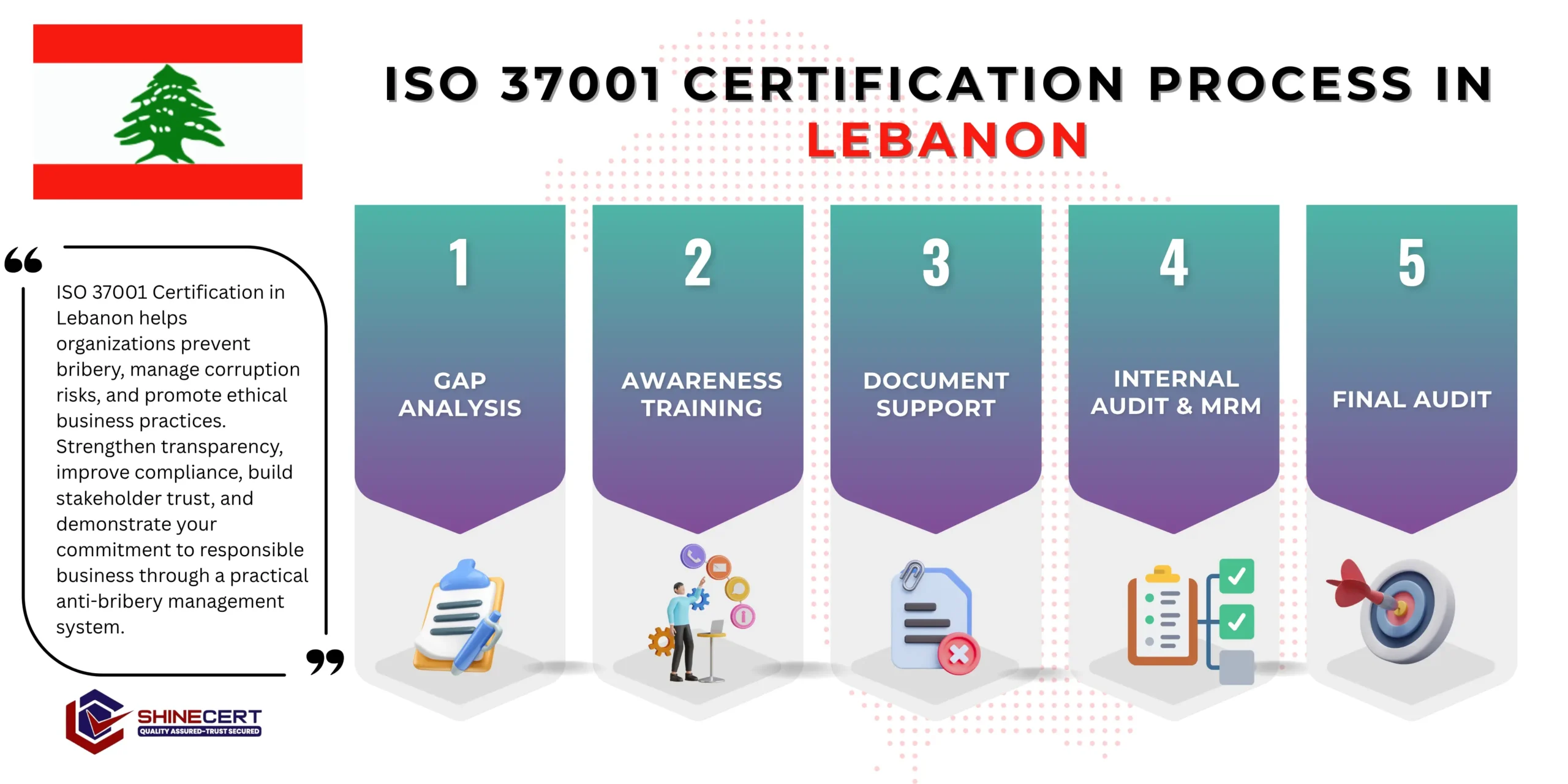
What are the steps to get ISO 37001 Certification in Lebanon?
our services
- ISO Certification Lebanon
- ISO 9001 Certification Lebanon
- ISO 14001 Certification Lebanon
- ISO 27001 Certification Lebanon
- ISO 22000 Certification Lebanon
- ISO 27701 Certification Lebanon
- ISO 45001 Certification Lebanon
- ISO 20000-1 Certification Lebanon
- ISO 13485 Certification Lebanon
- ISO 17025 Certification Lebanon
- ISO 31000 Certification Lebanon
- ISO 42001 Certification Lebanon
- ISO 37001 Certification Lebanon
- ISO 22301 Certification Lebanon
- ISO 50001 Certification Lebanon
- CE Mark Certification Lebanon
- GDPR Certification Lebanon
- GMP Certification Lebanon
- Halal Certification Lebanon
Our Five-Step Certification Process
Gap Assessment
We conduct structured, confidential interviews across leadership, sales, and procurement to understand your genuine bribery risk exposure, which contracts, relationships, or sectors carry elevated risk. We review existing policies and third-party relationships against every ISO 37001 clause.
A clause-by-clause gap assessment identifying your real bribery risk exposure and where current practices lack formal structure.
Documentation
We build your anti-bribery policy, risk assessment, and due diligence procedures around your actual business relationships and contracts, not a generic template. Whistleblowing procedures are designed to genuinely protect confidentiality, which matters enormously for employees to trust the system.
A complete, version-controlled anti-bribery documentation set including your risk assessment and due diligence procedures.
Implementation
Due diligence procedures roll out for agents and business partners, gift and hospitality controls get established, and staff receive role-specific training since sales and procurement teams face genuinely different bribery risk exposure than back-office staff.
A functioning anti-bribery system with real due diligence and reporting happening.
Internal Audit and Management Review
We run a full internal audit against every clause, surfacing weaknesses while stakes are low. Findings go to formal management review where leadership makes documented decisions on risk priorities.
An internal audit report, management review minutes with concrete decisions, and closed-out corrective actions.
Certification Audit
Stage 1 confirms your documentation and risk assessment are audit-ready; Stage 2 has the auditor verify controls are genuinely operating, reviewing due diligence records, interviewing staff, and testing the reporting mechanism’s confidentiality. We stay involved through both stages.
Your ISO 37001 certificate, valid for three years, plus a surveillance audit schedule.
Gap Assessment
We conduct structured, confidential interviews across leadership, sales, and procurement to understand your genuine bribery risk exposure, which contracts, relationships, or sectors carry elevated risk. We review existing policies and third-party relationships against every ISO 37001 clause.
A clause-by-clause gap assessment identifying your real bribery risk exposure and where current practices lack formal structure.
Documentation
We build your anti-bribery policy, risk assessment, and due diligence procedures around your actual business relationships and contracts, not a generic template. Whistleblowing procedures are designed to genuinely protect confidentiality, which matters enormously for employees to trust the system.
A complete, version-controlled anti-bribery documentation set including your risk assessment and due diligence procedures.
Implementation
Due diligence procedures roll out for agents and business partners, gift and hospitality controls get established, and staff receive role-specific training since sales and procurement teams face genuinely different bribery risk exposure than back-office staff.
A functioning anti-bribery system with real due diligence and reporting happening.
Internal Audit and Management Review
We run a full internal audit against every clause, surfacing weaknesses while stakes are low. Findings go to formal management review where leadership makes documented decisions on risk priorities.
An internal audit report, management review minutes with concrete decisions, and closed-out corrective actions.
Certification Audit
Stage 1 confirms your documentation and risk assessment are audit-ready; Stage 2 has the auditor verify controls are genuinely operating, reviewing due diligence records, interviewing staff, and testing the reporting mechanism’s confidentiality. We stay involved through both stages.
Your ISO 37001 certificate, valid for three years, plus a surveillance audit schedule.
What Is ISO 37001, and How Does It Actually Help Your Organization?
- The core problem ISO 37001 solves isn’t “our people might take bribes”, for most businesses, that’s not the genuine concern. It’s “we have no systematic way to prove our anti-bribery controls are real, not just a policy statement nobody follows.” Without structured due diligence, a business relationship with a problematic agent or a poorly vetted subcontractor can create bribery exposure the organization never intended and may not even know about until it’s already a problem.
- Practically, this helps in concrete ways. It gives you documented due diligence on agents, distributors, and business partners, closing exposure that often comes through third parties rather than direct employee action. It creates a genuine, protected channel for employees to report concerns, surfacing problems while they’re still manageable rather than after they’ve escalated. It gives international partners and lenders independently verified evidence of integrity controls during due diligence, which increasingly matters given the scrutiny Lebanese counterparts face. And for public tender bids, it’s a credibility signal that distinguishes your business in a genuinely competitive and integrity-conscious procurement environment.
- The standard shares the Harmonized Structure with ISO 9001 and ISO 27001, so organizations already holding either certification have real infrastructure, management review, internal audit, documented policy, to extend into anti-bribery management rather than building entirely from scratch.
Why This Matters So Much in Lebanon Specifically?
- Lebanon’s broader governance and financial crisis has understandably made international partners, lenders, and public tender evaluators more cautious, and that caution doesn’t distinguish between businesses with genuinely strong integrity practices and those without formal controls to prove it. A Lebanese company with real, well-intentioned anti-bribery practices but no documented system to demonstrate them faces the same skepticism as one with actual gaps, ISO 37001 closes that credibility gap regardless of your starting point.
- We’ve seen this pattern directly: Lebanese businesses bidding on public infrastructure tenders under Public Procurement Law 244/2021’s more modern evaluation framework, competing against companies that can point to independent anti-bribery certification. Without that same independent verification, genuinely well-run businesses can lose ground on a criterion that has nothing to do with their actual project capability.
What Actually Drives Your Cost?
We don’t quote a flat number, because two Lebanese businesses’ actual risk exposure and organizational complexity can look completely different. Here’s what genuinely drives cost.
A business with extensive agent, distributor, or subcontractor networks needs meaningfully more due diligence infrastructure than one with fewer third-party relationships.
Businesses in construction, public contracting, or import/export face genuinely higher bribery risk exposure than lower-risk service sectors.
Multiple business units or locations each add scope to the risk assessment and control implementation.
Businesses with existing codes of conduct or basic compliance policies aren’t starting from zero, those with minimal formal documentation face more foundational work.
Pursuing ISO 9001 or ISO 27001 alongside ISO 37001 shares meaningful implementation and audit infrastructure.
A compliance or legal lead who can own documentation and due diligence coordination reduces consultant hours needed.
ISO 37001 Benefits Businesses Don't Expect
Independent certification distinguishes your bid in an increasingly integrity-conscious procurement environment under Public Procurement Law 244/2021.
Verified anti-bribery controls meaningfully reduce the friction and scrutiny Lebanese businesses often face given the broader governance context.
Structured due diligence on agents and partners closes a risk category many businesses don’t realize they’re exposed to until it’s already a problem.
Employees who can report issues confidentially surface problems early, before they escalate into something far more damaging.
Documented controls provide a genuine defense if a bribery allegation ever arises, distinguishing systematic prevention from negligence.
Certification signals integrity beyond just anti-bribery specifically, often strengthening broader business relationships.
Shared Harmonized Structure makes pursuing ISO 9001 or ISO 27001 alongside ISO 37001 meaningfully faster.
Risk assessment data and audit findings give management real visibility into where bribery risk actually concentrates, rather than relying on assumption.
Applicable Standards by Industry
Construction and infrastructure
Companies bidding on public tenders under Public Procurement Law 244/2021 use certification to strengthen bid competitiveness and demonstrate integrity.
Read moreImport and export trading
Businesses managing cross-border relationships and customs processes use certification to formalize due diligence on agents and intermediaries.
Read moreFinancial services
Institutions already navigating Law 44/2015’s anti-money-laundering framework use ISO 37001 to extend integrity controls specifically to bribery risk.
Read moreProfessional services and consulting
Firms working with government or international clients use certification to build client trust in a sector where reputation matters enormously.
Read moreAnti-Bribery Management Requirements, Clause by Clause, With the Documents Each One Actually Needs
- Context of the Organization (Clause 4) : Understanding your genuine bribery risk exposure, public sector contracts, third-party relationships, sectors with elevated risk, and the interested parties whose anti-bribery expectations matter. Document this clause requires: a documented anti-bribery management system scope statement identifying which operations, contracts, and relationships are covered.
- Leadership (Clause 5) : Top management commitment to anti-bribery, with a documented policy and clear accountability, including a designated compliance function with genuine independence and authority. Document this clause requires: an anti-bribery policy signed by top management, and documentation establishing the compliance function’s independence and authority.
- Planning (Clause 6) : A genuine bribery risk assessment covering your specific operations, contracts, and third-party relationships, plus measurable anti-bribery objectives. Document this clause requires: a bribery risk assessment and documented anti-bribery objectives.
- Support (Clause 7) : Resources, competence, and anti-bribery training ensuring staff genuinely understand red flags relevant to their role, plus controlled policy documentation. Document this clause requires: anti-bribery training records and a controlled register of anti-bribery documentation.
- Operation (Clause 8) : The core of the standard, due diligence on business associates, gift and hospitality controls, financial and non-financial controls, and a confidential reporting mechanism. Document this clause requires: due diligence records for agents and business partners, a gift and hospitality register, and a documented whistleblowing procedure.
- Performance Evaluation (Clause 9) : Monitoring, internal audit, and management review testing whether anti-bribery controls are genuinely functioning, not just documented. Document this clause requires: an internal audit program and results, and management review minutes covering bribery risk trends.
- Improvement (Clause 10) : Structured investigation of reported concerns and nonconformities, driving continual improvement of the anti-bribery system. Document this clause requires: investigation records for reported concerns showing root-cause analysis and corrective actions.
What Happens When a Lebanon Business Operates Without Certification?
- Legal anti-corruption obligations under Laws 44/2015 and 83/2018 remain in force regardless of certification, these apply primarily to specific conduct and public officials, but the broader integrity expectation from partners and tender evaluators doesn’t depend on legal minimums. What’s missing without ISO 37001 is the independently verified proof that closes the credibility gap Lebanon’s broader governance context has created for even genuinely well-run businesses. Companies relying on informal integrity practices tend to discover the gap either through losing a public tender to a certified competitor, or through friction in an international partnership’s due diligence process.
- We generally recommend Lebanese businesses bidding on public contracts, pursuing international partnerships, or operating in higher-risk sectors treat ISO 37001 as protective credibility infrastructure, formalizing integrity practices the organization likely already has, in a form that skeptical outside parties can actually verify.
Common Pitfalls We See in Lebanon ISO 37001 Projects
- Treating a code of conduct as sufficient on its own : A policy statement without genuine due diligence, training, and a tested reporting mechanism doesn’t meet ISO 37001’s requirements.
- Weak or superficial third-party due diligence : Businesses often vet direct employees carefully while giving far less scrutiny to agents and intermediaries, where bribery risk frequently concentrates.
- A reporting mechanism employees don’t actually trust : A whistleblowing channel that exists on paper but where staff fear retaliation tends to go unused, defeating its purpose.
- No genuine risk differentiation across the business : Treating all contracts and relationships as equal risk misses where bribery exposure actually concentrates, typically higher-value public contracts and third-party relationships.
Why ShineCert?
ShineCert brings 10 years of ISO consulting and certification experience to Lebanon, backed by our own dedicated Lebanon office working alongside our Riyadh office. We deliver services remotely or on-site depending on what your project needs, confidential leadership interviews and risk assessment discussions often benefit from in-person facilitation, while documentation work can run effectively over remote sessions. We’ve guided more than 10,000 organizations through ISO certification globally, and as the best ISO 37001 consultant in Lebanon, we build every Lebanon anti-bribery engagement around your actual business relationships and sector risk, not a generic template.
Choosing a Certification Body in Lebanon?
What to Check | Why It Matters |
Accreditation under the GAC framework | Confirms genuine, internationally recognized certification |
Experience with Lebanon’s anti-corruption legal environment | Ensures the auditor understands how Laws 44/2015 and 83/2018 connect to the management system |
Genuine due diligence verification approach | Confirms the auditor checks that third-party vetting is real, not just documented |
Recognition by your target tender evaluators or partners | For public tender bids, confirm the certification body is recognized in your specific procurement context |
Ready to Get Started?
Whether you’re strengthening a public tender bid or responding to an international partner’s due diligence request, we’ll walk through your specific business relationships and cost factors before proposing a fixed-scope plan, delivered remotely, on-site, or however genuinely fits your project. Book a free consultation or contact us directly to get started.
Frequently Asked Questions
No, the NACC implements Lebanon’s national anti-corruption strategy at the public sector level; ISO 37001 certification comes from independent, GAC-accredited certification bodies for private organizations.
Those laws primarily address money laundering, terrorist financing, and public official conduct, they aren’t a substitute for the systematic bribery risk management ISO 37001 requires within your own operations.
It genuinely depends on your third-party relationships, sector risk, and organizational complexity, we scope every project individually.
Typically three to four months for a first-time certification.
Increasingly yes, under the modernized Public Procurement Law 244/2021 framework, independently verified integrity controls can meaningfully strengthen bid competitiveness.
No certification eliminates all risk, but ISO 37001 gives you documented, systematic controls and a genuine defense showing bribery risk was actively managed, not ignored.
Confidential interviews and risk discussions often benefit from in-person facilitation, but documentation can run remotely, we scope this per project.
Any business with meaningful third-party relationships or public tender ambitions benefits, regardless of size, bribery risk doesn’t scale predictably with company size.
Genuinely confidential, by design, the standard requires protections against retaliation, and a channel employees don’t trust simply won’t get used.
Yes, ShineCert maintains its own dedicated Lebanon office, with services delivered remotely or on-site depending on your project.