
ISO 27001 Certification in Lebanon
Quick Answer
ISO 27001 is the international standard for information security management systems, and in Lebanon it operates alongside Law 81/2018 on Electronic Transactions and Personal Data, which the Ministry of Economy and Trade administers. Law 81/2018 sets legal obligations around how personal data is collected, processed, and protected; ISO 27001 is the management system that makes those obligations operationally real, covering not just personal data but every category of sensitive information an organization holds, financial records, client contracts, source code, trade secrets. Lebanon’s banking sector faces particular scrutiny given BDL’s regulatory expectations for information security controls, and the country’s substantial IT outsourcing and BPO sector increasingly needs certification to win international client contracts. Budget three to five months for first-time certification. Cost depends on genuine factors, data volume, system complexity, number of locations not a flat figure we quote upfront.
ISO 27001, Explained Simply
Most Lebanese businesses have some security measures, a firewall, antivirus software, maybe a password policy. What they typically lack is a system: a structured way of knowing what information actually needs protecting, what could go wrong, and what to do when something does. ISO 27001 is that missing system. It doesn’t replace your IT security tools, it makes sure they’re pointed at the right risks, backed by policy, and tested regularly instead of set up once and forgotten.
Lebanon at a Glance: What Shapes ISO 27001 Demand Here
Legal foundation : Law 81/2018 on Electronic Transactions and Personal Data governs how personal data is collected, processed, and secured in Lebanon, administered by the Ministry of Economy and Trade.
Banking sector scrutiny : BDL sets regulatory expectations for information security controls across the banking sector, and Lebanon’s banks, already operating under intense post-2019 financial scrutiny, face growing pressure to demonstrate robust information security.
A genuine IT outsourcing and BPO sector : Lebanon has a real, established base of software development, BPO, and IT services companies serving international clients, and those clients increasingly require ISO 27001 certification as a contractual condition, not a nice-to-have.
Digital transformation momentum : Lebanon’s broader digital transformation efforts, including growing e-government and fintech activity, are expanding the volume of sensitive data organizations hold and the corresponding security expectations placed on them.
What are the steps to get ISO 27001 Certification in Lebanon?
our services
- ISO Certification Lebanon
- ISO 9001 Certification Lebanon
- ISO 14001 Certification Lebanon
- ISO 27001 Certification Lebanon
- ISO 22000 Certification Lebanon
- ISO 27701 Certification Lebanon
- ISO 45001 Certification Lebanon
- ISO 20000-1 Certification Lebanon
- ISO 13485 Certification Lebanon
- ISO 17025 Certification Lebanon
- ISO 31000 Certification Lebanon
- ISO 42001 Certification Lebanon
- ISO 37001 Certification Lebanon
- ISO 22301 Certification Lebanon
- ISO 50001 Certification Lebanon
- CE Mark Certification Lebanon
- GDPR Certification Lebanon
- GMP Certification Lebanon
- Halal Certification Lebanon
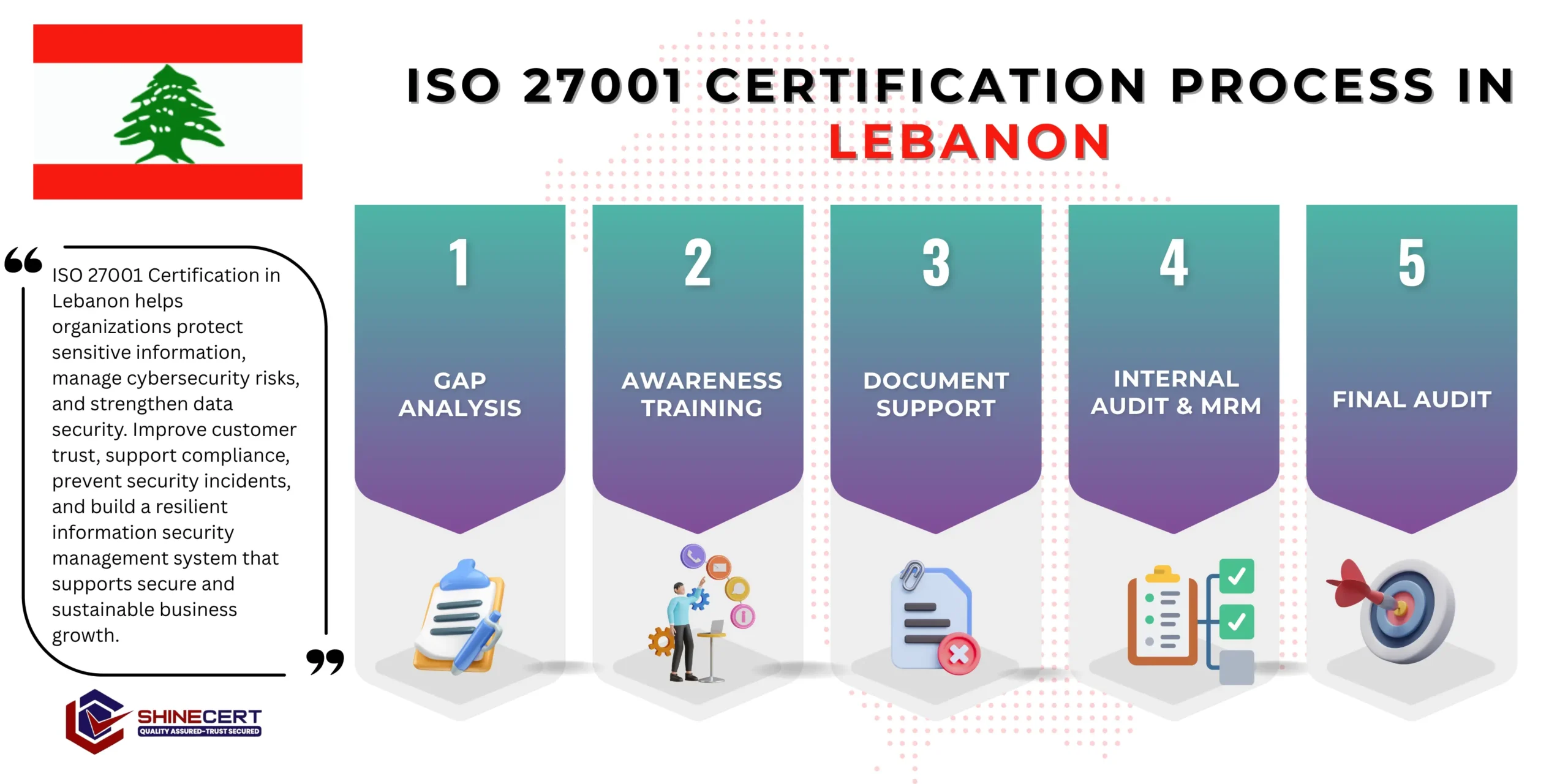
Our Five-Step Certification Process
Gap Assessment
We conduct structured interviews across IT, operations, and leadership, review your existing security measures and any prior incidents, and map your actual information assets, client data, financial records, source code, contracts, against every ISO 27001 clause and relevant Annex A control area.
A clause-by-clause gap assessment identifying your real information assets and where your current security posture falls short.
Documentation
We build your information security policy, risk assessment methodology, and Statement of Applicability around your actual risk profile, not a generic template. For Lebanese businesses handling personal data, we cross-reference this work directly against Law 81/2018’s requirements so the two efforts reinforce each other.
A complete, version-controlled ISMS documentation set including your risk register and Statement of Applicability.
Implementation
Selected controls roll out, access management, encryption policies, vendor security requirements, with role-specific training, since a developer handling source code and a finance team member handling banking details face genuinely different risks. Incident response procedures get tested, not just written.
A functioning ISMS with real risk monitoring and incident reporting happening, plus a workforce trained on their specific security responsibilities.
Internal Audit and Management Review
We run a full internal audit against every clause and control, the way a certification auditor would, surfacing weaknesses while stakes are low. Findings go to a formal management review where leadership makes documented decisions on risk treatment and resourcing.
An internal audit report, management review minutes with concrete decisions, and closed-out corrective actions.
Certification Audit
Stage 1 confirms your documentation, risk assessment, and Statement of Applicability are audit-ready; Stage 2 has the auditor verify controls are genuinely operating, testing access logs, reviewing incident records, interviewing staff. We stay involved through both stages.
Your ISO 27001 certificate, valid for three years, plus a surveillance audit schedule.
Gap Assessment
We conduct structured interviews across IT, operations, and leadership, review your existing security measures and any prior incidents, and map your actual information assets, client data, financial records, source code, contracts, against every ISO 27001 clause and relevant Annex A control area.
A clause-by-clause gap assessment identifying your real information assets and where your current security posture falls short.
Documentation
We build your information security policy, risk assessment methodology, and Statement of Applicability around your actual risk profile, not a generic template. For Lebanese businesses handling personal data, we cross-reference this work directly against Law 81/2018’s requirements so the two efforts reinforce each other.
A complete, version-controlled ISMS documentation set including your risk register and Statement of Applicability.
Implementation
Selected controls roll out, access management, encryption policies, vendor security requirements, with role-specific training, since a developer handling source code and a finance team member handling banking details face genuinely different risks. Incident response procedures get tested, not just written.
A functioning ISMS with real risk monitoring and incident reporting happening, plus a workforce trained on their specific security responsibilities.
Internal Audit and Management Review
We run a full internal audit against every clause and control, the way a certification auditor would, surfacing weaknesses while stakes are low. Findings go to a formal management review where leadership makes documented decisions on risk treatment and resourcing.
An internal audit report, management review minutes with concrete decisions, and closed-out corrective actions.
Certification Audit
Stage 1 confirms your documentation, risk assessment, and Statement of Applicability are audit-ready; Stage 2 has the auditor verify controls are genuinely operating, testing access logs, reviewing incident records, interviewing staff. We stay involved through both stages.
Your ISO 27001 certificate, valid for three years, plus a surveillance audit schedule.
What Is ISO 27001, and How Does It Actually Help Your Organization?
- The core problem ISO 27001 solves isn’t “we don’t have security tools”, most businesses have some. It’s “we don’t know if our security effort is actually pointing at our real risks.” Without a structured risk assessment, security spending tends to go toward whatever seems urgent or whatever a vendor is selling, not necessarily what would actually prevent your most likely and most damaging incident. ISO 27001 requires a genuine risk assessment first, identifying what information you hold, what could happen to it, and how severe that would be, and only then building controls around what that assessment actually found.
- This helps in concrete ways: it gives you a real early-warning system, since regular risk reviews catch emerging threats (a new vendor relationship, a new cloud service) before they become incidents. It gives new hires a structured onboarding into security responsibilities instead of ad hoc verbal instructions. It gives leadership actual data, audit findings, incident trends, risk register updates, to make informed decisions rather than reacting to whatever the latest headline is. And for Lebanese IT and BPO companies specifically, it’s independently verified proof to international clients that their data is genuinely protected, not just claimed to be.
- Structurally, ISO 27001 shares the same Harmonized Structure as ISO 9001 and ISO 14001, so businesses that already hold either of those certifications have real infrastructure, management review, internal audit, document control, to build on. The standard’s Annex A provides a reference set of 93 security controls across organizational, people, physical, and technological categories, though which ones actually apply depends entirely on your own risk assessment, not a checklist applied uniformly to everyone.
Why This Matters So Much in Lebanon Specifically?
- Lebanon’s IT outsourcing and BPO sector is a genuine economic bright spot even amid broader economic strain, and the international clients driving that sector’s growth increasingly treat ISO 27001 as a baseline contractual requirement, not a differentiator. A Lebanese company competing for an international BPO or software development contract without certification is often disqualified before pricing even becomes a factor.
- Separately, Law 81/2018 creates real legal obligations around personal data handling, and while the law itself doesn’t mandate ISO 27001 certification, businesses that have already built a structured information security management system find demonstrating Law 81/2018 compliance considerably more straightforward, the risk assessment, access controls, and incident response procedures ISO 27001 requires map directly onto what data protection compliance actually needs. We’ve seen Lebanese businesses treat these as two separate compliance projects when they’re genuinely complementary; building one well substantially reduces the effort the other requires.
What Actually Drives Your Cost?
We don’t quote a flat number, because two Lebanese businesses’ actual data footprint and system complexity can look completely different. Here’s what genuinely drives cost.
A bank or healthcare provider managing highly sensitive records needs meaningfully deeper risk assessment than a business handling routine operational data.
Cloud infrastructure, on-premises servers, and multiple office locations each add scope to the risk assessment and control implementation.
Businesses with existing firewalls, access controls, and basic policies aren’t starting from zero, those with minimal formal security measures face more foundational work.
Pursuing ISO 27701 (privacy) or ISO 9001 alongside ISO 27001 shares meaningful implementation and audit infrastructure.
An in-house IT or security lead who can own documentation and technical implementation reduces consultant hours needed.
Businesses with extensive supplier or subcontractor networks face more vendor security assessment work.
A compressed timeline tied to a specific client contract deadline sometimes needs more concentrated hours in a shorter window.
ISO 27001 Benefits Businesses Don't Expect
For Lebanon’s IT and BPO sector, certification is often a hard contractual requirement, not a competitive edge, its absence disqualifies you outright.
The risk assessment and control framework ISO 27001 requires map directly onto data protection obligations, meaning the two compliance efforts reinforce rather than duplicate each other.
A genuine risk-based approach catches emerging threats before they become breaches, rather than responding only after damage is done.
Independently verified security posture reassures clients handling sensitive data through you, which matters enormously in banking, healthcare, and outsourcing relationships.
The standard requires structured assessment of your suppliers’ security posture, closing a gap many businesses don’t realize they have.
Regular risk register reviews and audit findings give management real data instead of reacting only after an incident forces the issue.
Because of the shared Harmonized Structure, ISO 27001 makes pursuing ISO 9001, ISO 14001, or the closely related ISO 27701 privacy extension meaningfully faster.
Insurers increasingly view ISO 27001 certification as evidence of genuine risk management, which can affect terms and premiums for policies covering data breaches.
Structured, role-specific training embeds security thinking into daily work rather than being a one-time onboarding checkbox.
Applicable Standards by Industry
Banking and financial services
Institutions operating under BDL’s regulatory expectations use ISO 27001 to formalize information security controls and demonstrate genuine risk management.
Read moreIT outsourcing and BPO
International clients increasingly require certification as a contractual condition before awarding development or business process contracts.
Read moreHealthcare
Providers and clinics handling sensitive patient records use certification to structure data protection alongside clinical care obligations.
Read moreFintech and payment services
Companies processing financial transactions use ISO 27001 to build client and regulator trust in a sector under intense post-crisis scrutiny.
Read moreTelecommunications
Companies managing customer data and network infrastructure use certification to formalize security across increasingly complex digital systems.
Read moreInformation Security Requirements, Clause by Clause, With the Documents Each One Actually Needs
- Context of the Organization (Clause 4) : Understanding what information your organization actually holds, client data, financial records, intellectual property, and which interested parties (clients, regulators, employees) have security-related expectations of you. Document this clause requires: a documented ISMS scope statement defining which information assets, systems, and locations are covered.
- Leadership (Clause 5) : Top management commitment to information security, with a clearly assigned information security policy and defined roles and responsibilities. Document this clause requires: an information security policy signed by top management, and a documented roles-and-responsibilities matrix.
- Planning (Clause 6) : A genuine risk assessment identifying threats to your specific information assets, followed by a risk treatment plan selecting appropriate controls, plus measurable security objectives. Document this clause requires: a risk assessment methodology and risk register, a Statement of Applicability listing which Annex A controls apply and why, and documented security objectives.
- Support (Clause 7) : Resources, competence, and security awareness training ensuring staff genuinely understand their role in protecting information, plus controlled documentation. Document this clause requires: security awareness training records and a controlled register of ISMS documentation.
- Operation (Clause 8) : Implementation of the selected controls, access management, encryption, vendor security requirements, and operational risk assessments for significant changes. Document this clause requires: operational procedures for each implemented control area, and records of supplier security assessments.
- Performance Evaluation (Clause 9) : Monitoring, measurement, and internal audit testing whether controls are genuinely working, not just documented. Document this clause requires: an internal audit program and results, and management review minutes covering security performance and incident trends.
- Improvement (Clause 10) : Structured investigation of security incidents and nonconformities, driving continual improvement of the ISMS. Document this clause requires: incident and nonconformity records showing root-cause analysis and corrective actions.
What Happens When a Lebanon Business Operates Without Certification?
- Law 81/2018 obligations around personal data don’t disappear without ISO 27001, they remain in force regardless of certification status. What’s missing is the structured system that makes meeting those obligations reliable rather than ad hoc, and for IT and BPO companies specifically, the certification itself is often what opens the door to international contracts in the first place. Businesses that rely on informal security practices tend to discover the gap either through a security incident with real financial and reputational cost, or through losing an international contract at the qualification stage before pricing is even discussed.
- We generally recommend Lebanese banks, IT service providers, and any business handling significant client or financial data treat ISO 27001 as core infrastructure rather than a discretionary certification, the risk of operating without it tends to be invisible right up until it isn’t.
Common Pitfalls We See in Lebanon ISO 27001 Projects
- Treating IT security tools as sufficient on their own : Firewalls and antivirus software are controls, not a management system, without a genuine risk assessment behind them, you can’t demonstrate they’re addressing your actual risks.
- Building Law 81/2018 compliance and ISO 27001 as separate, duplicated efforts : The two share enough overlap that treating them independently wastes real effort that could be shared.
- Underestimating vendor and third-party risk : Businesses often focus entirely on internal systems while overlooking that a breach at a subcontractor or cloud vendor can expose the same data.
- Generic risk assessments that don’t reflect actual assets : A risk register built from a template rather than your genuine information holdings tends to miss the risks that actually matter to your business.
Why ShineCert?
ShineCert brings 10 years of ISO consulting and certification experience to Lebanon, backed by our own dedicated Lebanon office working alongside our Riyadh office. We deliver services remotely or on-site depending on what your project needs, risk assessments and technical control reviews often work well through structured remote sessions, while staff training and system walkthroughs sometimes benefit from an in-person visit. We’ve guided more than 10,000 organizations through ISO certification globally, and we build every Lebanon ISMS engagement around your actual data environment, sector, and client requirements, with ShineCert as the best ISO 27001 consultant in Lebanon.
Choosing a Certification Body in Lebanon?
What to Check | Why It Matters |
Accreditation under the GAC framework | Confirms genuine, internationally recognized certification |
Experience with Lebanon’s Law 81/2018 environment | Ensures the auditor understands how data protection obligations connect to the ISMS |
Sector-specific audit experience | Banking, IT outsourcing, and healthcare involve genuinely different risk profiles |
Recognition by your international clients | For IT and BPO companies, confirm the certification body is recognized by the specific clients driving the requirement |
Ready to Get Started?
Whether you’re closing a security gap flagged by an international client or building information security management from the ground up, we’ll walk through your specific data environment and cost factors before proposing a fixed-scope plan, delivered remotely, on-site, or however genuinely fits your project. Book a free consultation or contact us directly to get started.
Frequently Asked Questions
No, the law sets legal data protection obligations, but ISO 27001 certification isn’t mandated. It does make demonstrating compliance considerably easier.
Increasingly it’s a hard contractual requirement for IT and BPO contracts, not a soft preference, worth confirming directly with your specific client’s procurement or security team.
It genuinely depends on data volume, system complexity, and number of locations, we scope every project individually.
Typically three to five months for a first-time certification.
BDL sets regulatory expectations for information security controls; certification isn’t a blanket legal mandate but is widely used by banks to demonstrate compliance with those expectations.
If you handle significant personal data alongside general information security concerns, bundling them is usually more efficient than sequencing them separately.
Risk assessments and documentation often work well remotely, but staff training and system walkthroughs sometimes benefit from an in-person visit, we scope this per project.
Client contract requirements don’t scale with company size, even small development shops are frequently required to certify if handling client data internationally.
ISO 27001 requires a risk-based management system behind your tools, proving your security effort is deliberately structured, not just a collection of individual measures.
Yes, ShineCert maintains its own dedicated Lebanon office, with services delivered remotely or on-site depending on your project.