
ISO 14001 Certification in Lebanon
Quick Answer
ISO 14001 is the international standard for environmental management systems, and in Lebanon it intersects directly with a legal framework that’s been on the books since 2002 but is increasingly being enforced with real teeth: the Environment Protection Law No. 444, backed by the Environmental Impact Assessment Decree of 2012, which requires major industrial, infrastructure, and development projects to formally assess and mitigate their environmental impact before proceeding. Certification demonstrates that your environmental management goes beyond a one-time impact assessment into an ongoing, structured system. The current version, ISO 14001:2026, was published April 15, 2026, and is already in force, replacing the 2015 edition, this matters whether you’re certifying fresh or hold an existing certificate. Certification itself comes from a body accredited under the Global Accreditation Cooperation (GAC) framework; the Ministry of Environment doesn’t issue ISO certificates. Budget three to five months for a first-time certification. Cost isn’t a flat figure, it depends on your facility’s environmental footprint, site count, and existing documentation, not something we quote upfront.
ISO 14001, Explained Simply
Most Lebanese businesses that have gone through an Environmental Impact Assessment think of environmental compliance as something you do once, at the permitting stage, and then move past. ISO 14001 asks a different question: after the project is approved and running, is anyone actually managing its ongoing environmental impact, energy use, waste, emissions, resource consumption, in a structured way, or did the commitments made during the EIA quietly stop mattering once the ribbon was cut? ISO 14001 is the system that keeps those commitments alive for the life of the operation, not just its opening.
Lebanon at a Glance: What Shapes ISO 14001 Demand Here
Legal foundation : the Environment Protection Law No. 444 of 2002, together with the Environmental Impact Assessment Decree of 2012 (Decree 8633), requires major industrial, infrastructure, and development projects to undergo formal impact assessment before proceeding.
The Ministry of Environment’s role : it sets and enforces national environmental policy, but certification bodies, not the Ministry, issue ISO 14001 certificates.
A decentralized energy and resource reality : Lebanon’s post-2019 crisis pushed businesses and households toward self-generated power and, increasingly, private solar, an environmental and resource-management shift most companies never formally documented or optimized, which ISO 14001 is well suited to help structure.
SME financing available : Kafalat S.A.L. guarantees up to 75% of qualifying loans across five priority sectors, which can help offset the equipment and infrastructure investment that often accompanies genuine environmental management improvements.
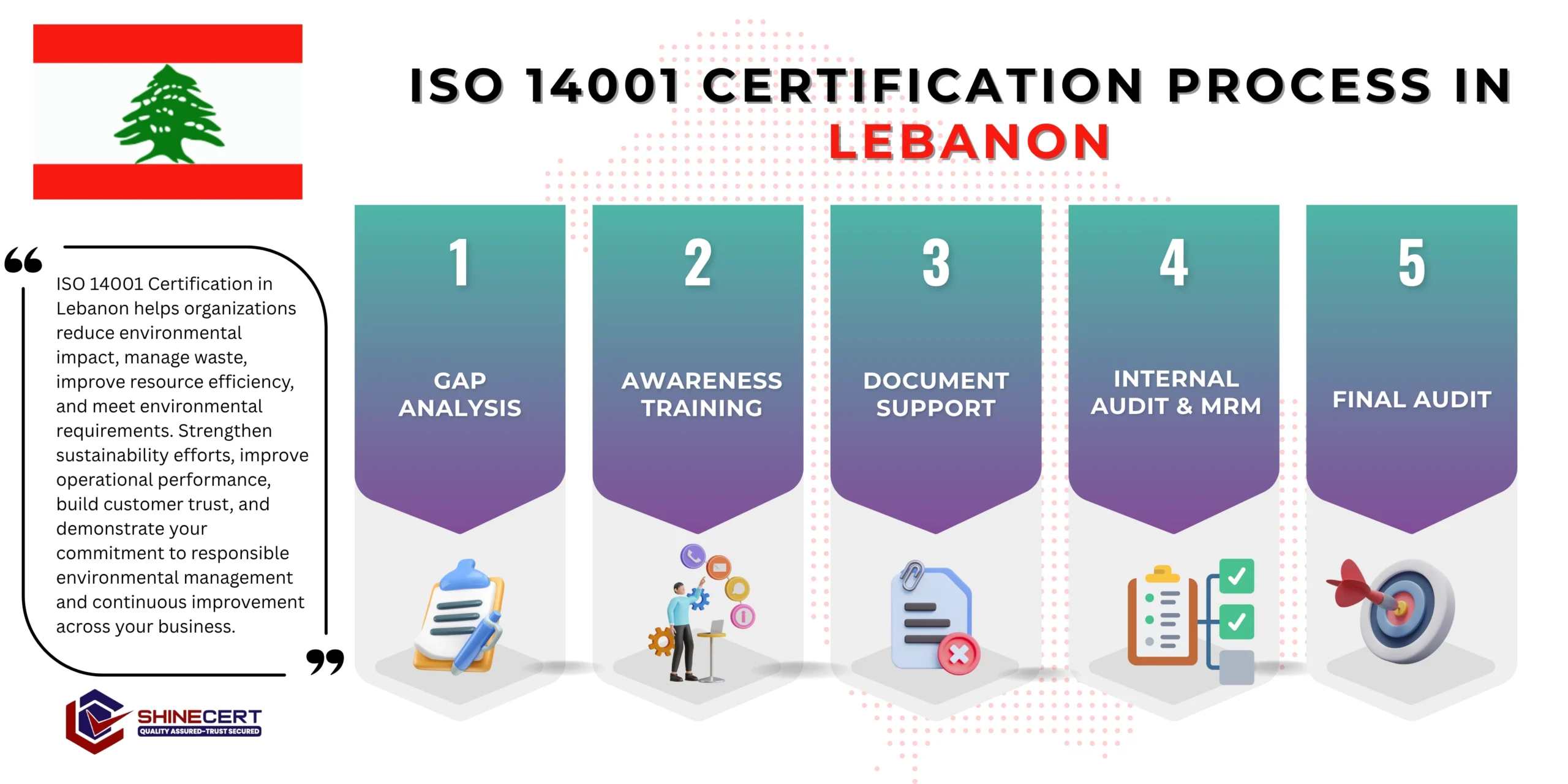
What are the steps to get ISO 14001 Certification in Lebanon?
our services
- ISO Certification Lebanon
- ISO 9001 Certification Lebanon
- ISO 14001 Certification Lebanon
- ISO 27001 Certification Lebanon
- ISO 22000 Certification Lebanon
- ISO 27701 Certification Lebanon
- ISO 45001 Certification Lebanon
- ISO 20000-1 Certification Lebanon
- ISO 13485 Certification Lebanon
- ISO 17025 Certification Lebanon
- ISO 31000 Certification Lebanon
- ISO 42001 Certification Lebanon
- ISO 37001 Certification Lebanon
- ISO 22301 Certification Lebanon
- ISO 50001 Certification Lebanon
- CE Mark Certification Lebanon
- GDPR Certification Lebanon
- GMP Certification Lebanon
- Halal Certification Lebanon
Our Five-Step Certification Process
Gap Assessment
We review your existing EIA documentation and any environmental permits alongside structured interviews with operations and facilities staff, then walk your site to see how energy, water, and waste are actually handled day to day versus how they’re described on paper. We map this against every ISO 14001 clause, not a generic checklist.
A clause-by-clause gap assessment report, plus an honest read on how much of your existing EIA work can be extended into a genuine ongoing system versus rebuilt.
Documentation
We draft your environmental policy, aspects and impacts register, and compliance obligations register around your real facility and processes, working directly with operations staff so the documentation reflects how work genuinely happens. Drafts circulate for review before anything is finalized.
A complete, version-controlled EMS documentation set built around your actual environmental footprint, not a generic industry template.
Implementation
Operational controls roll out for your significant environmental aspects, with role-specific training, a facilities manager and a production supervisor need genuinely different depth on different topics. We check in periodically to catch where controls aren’t sticking before they become habit gaps.
A functioning system generating real monitoring data and records, plus a trained team that understands its specific environmental responsibilities.
Internal Audit and Management Review
We run a full internal audit against every clause, the same way a certification auditor would, specifically to surface weaknesses while consequences are still low. Findings go to a formal management review where leadership makes and documents real decisions.
An internal audit report, management review minutes with concrete decisions, and closed-out corrective actions.
Certification Audit
Your certification body runs Stage 1 to confirm documentation readiness, then Stage 2, where the auditor observes actual site operations and verifies records against what’s documented. We stay involved through both stages.
Your ISO 14001 certificate, valid for three years, plus a surveillance audit schedule going forward.
Gap Assessment
We review your existing EIA documentation and any environmental permits alongside structured interviews with operations and facilities staff, then walk your site to see how energy, water, and waste are actually handled day to day versus how they’re described on paper. We map this against every ISO 14001 clause, not a generic checklist.
A clause-by-clause gap assessment report, plus an honest read on how much of your existing EIA work can be extended into a genuine ongoing system versus rebuilt.
Documentation
We draft your environmental policy, aspects and impacts register, and compliance obligations register around your real facility and processes, working directly with operations staff so the documentation reflects how work genuinely happens. Drafts circulate for review before anything is finalized.
A complete, version-controlled EMS documentation set built around your actual environmental footprint, not a generic industry template.
Implementation
Operational controls roll out for your significant environmental aspects, with role-specific training, a facilities manager and a production supervisor need genuinely different depth on different topics. We check in periodically to catch where controls aren’t sticking before they become habit gaps.
A functioning system generating real monitoring data and records, plus a trained team that understands its specific environmental responsibilities.
Internal Audit and Management Review
We run a full internal audit against every clause, the same way a certification auditor would, specifically to surface weaknesses while consequences are still low. Findings go to a formal management review where leadership makes and documents real decisions.
An internal audit report, management review minutes with concrete decisions, and closed-out corrective actions.
Certification Audit
Your certification body runs Stage 1 to confirm documentation readiness, then Stage 2, where the auditor observes actual site operations and verifies records against what’s documented. We stay involved through both stages.
Your ISO 14001 certificate, valid for three years, plus a surveillance audit schedule going forward.
What Is ISO 14001, and How Does It Actually Help Your Organization?
- Environmental compliance in Lebanon has historically meant clearing a one-time hurdle, the EIA process, and then operating with limited ongoing formal oversight of the environmental commitments made during that process. ISO 14001 changes that dynamic. It gives you a structured way to identify your genuine environmental impacts (energy, water, waste, emissions), set measurable targets for reducing them, and track progress over time, turning environmental management from a permitting exercise into an operational discipline.
- Concretely, it helps in ways that matter to the bottom line, not just compliance: it surfaces real cost-saving opportunities in energy and resource use that often go unnoticed without structured monitoring. It gives you documented evidence of environmental diligence that increasingly matters to international buyers, lenders, and insurers evaluating Lebanese counterparties. And it builds organizational muscle for managing regulatory and reputational risk, which matters considerably given how directly environmental incidents can affect a company’s standing with both regulators and communities.
- The standard follows the same Harmonized Structure as ISO 9001 and ISO 45001, meaning a business that has already implemented one of those standards has a genuine head start on environmental management, since the leadership, planning, and audit infrastructure largely transfers.
Why This Matters So Much in Lebanon Specifically?
- Lebanon’s environmental regulatory apparatus, anchored by Law 444 and the EIA process, has existed for over two decades, but genuine ongoing environmental management, beyond the initial assessment, has often lagged behind the letter of the law, a gap that’s becoming harder to sustain as international partners, lenders, and development-finance institutions apply more rigorous environmental due diligence to Lebanese counterparties.
- We’ve seen this pattern directly with Lebanese manufacturers and industrial operators: a company clears its EIA, gets its permit, and then genuinely does very little structured environmental monitoring afterward, not out of negligence, but because nothing forced a systematic ongoing process. ISO 14001 closes exactly that gap, and for companies pursuing international financing, partnerships, or export relationships, that documented ongoing management is increasingly expected as a baseline, not a differentiator.
Kafalat Financing: Does It Help With ISO 14001 Costs??
Kafalat’s loan guarantee program can support the broader operational and equipment investment that often accompanies genuine environmental management improvements, monitoring equipment, energy efficiency upgrades, waste handling infrastructure, for businesses in its five priority sectors. Worth a direct conversation with Kafalat and your bank alongside certification planning.
What Actually Drives Your Cost?
We don’t quote a flat number, because two Lebanese facilities’ actual environmental footprint and complexity can look completely different. Here’s what genuinely drives cost.
A facility with significant industrial processes, emissions, or waste streams needs meaningfully deeper environmental assessment than a low-impact office or service operation.
Each additional facility generally needs its own environmental aspects assessment and monitoring setup.
Businesses with EIA documentation and permits already in place, like the case study above, aren’t starting from zero, those without any formal environmental history face more foundational work.
Pursuing ISO 9001 or ISO 45001 alongside ISO 14001 shares meaningful implementation and audit infrastructure.
A facilities or EHS staff member who can own documentation and monitoring reduces consultant hours needed.
Where support is available, your real out-of-pocket cost can be meaningfully lower.
A compressed timeline tied to a lender’s due diligence deadline sometimes needs more concentrated hours in a shorter window.
ISO 14001 Benefits Businesses Don't Expect
Development finance institutions and international buyers increasingly apply environmental due diligence to Lebanese counterparties, and certification gives them documented evidence rather than assurances.
Structured monitoring of energy, water, and waste routinely surfaces genuine cost-saving opportunities that go unnoticed without systematic tracking, particularly relevant given how directly energy costs affect Lebanese operating budgets.
As Public Procurement Law 244/2021’s modernized framework matures, environmental credentials increasingly factor into evaluation for infrastructure and industrial contracts.
A structured EMS reduces the likelihood of environmental incidents escalating into regulatory action or community relations problems.
Companies that already went through the EIA process have real groundwork to build on, ISO 14001 extends that one-time assessment into an ongoing management system rather than starting from zero.
Because ISO 14001 shares the Harmonized Structure with ISO 9001 and ISO 45001, pursuing those standards is meaningfully faster once environmental management infrastructure exists.
Environmental efficiency investments, equipment upgrades, monitoring systems, often qualify for the broader operational financing Kafalat’s guarantee program supports.
Insurers increasingly view structured environmental management as a genuine risk-reduction signal when underwriting industrial and manufacturing operations.
Applicable Standards by Industry
Manufacturing and industrial
Facilities with genuine energy, waste, or emissions footprints have the clearest driver for structured environmental management.
Read moreConstruction and infrastructure
Contractors on projects that required an EIA use ISO 14001 to extend that assessment into ongoing management, often expected by lenders and government clients.
Read moreAgriculture and food processing
Operations with water use, waste, and land management considerations use certification to demonstrate environmental diligence to buyers and financiers.
Read moreHospitality and tourism
Operators use environmental management to control energy and water costs while supporting sustainability positioning to international guests and partners.
Read moreImport and export businesses
Companies seeking development-finance or international lender relationships increasingly need documented environmental management as part of due diligence.
Read moreWhat Happens When a Lebanon Business Skips Ongoing Environmental Management?
- Clearing an EIA and holding a permit doesn’t mean environmental risk disappears, it means the formal assessment happened once, at a single point in time. Without ongoing structured management, environmental performance tends to drift quietly, unnoticed until an incident, a community complaint, or a lender’s due diligence process surfaces. At that point, the company is reconstructing years of undocumented practice under real pressure, rather than having a continuous record to point to.
- We generally recommend Lebanese industrial and manufacturing businesses, particularly those that already went through an EIA, treat ISO 14001 as the natural continuation of that process rather than a separate, optional undertaking, the foundational work is already partly done.
Environmental Management Requirements, Clause by Clause With the Documents Each One Actually Needs
- Context of the Organization (Clause 4) : Understanding your genuine environmental context, internal factors like your processes and resource use, external factors like Law 444 requirements and community expectations, and the interested parties whose environmental concerns are relevant. Document this clause requires: a documented statement of the EMS scope, defining which facilities, processes, and activities are covered.
- Leadership (Clause 5) : Top management accountability for environmental performance, including genuine resourcing rather than delegating environmental responsibility entirely to a junior compliance role. Document this clause requires: an environmental policy signed by top management, addressing your genuine environmental commitments.
- Planning (Clause 6) : Identifying genuine environmental aspects and impacts, evaluating compliance obligations under Law 444 and related decrees, and setting measurable environmental objectives. Document this clause requires: an environmental aspects and impacts register, a compliance obligations register, and documented environmental objectives with targets and timelines.
- Support (Clause 7) : Resources, competence, and awareness ensuring staff genuinely understand their role in environmental performance, plus documented information supporting the system. Document this clause requires: environmental competence and training records, and a controlled register of EMS documentation.
- Operation (Clause 8) : Operational controls over significant environmental aspects, energy use, waste handling, emissions, plus emergency preparedness for environmental incidents. Document this clause requires: operational control procedures for significant aspects, and an emergency preparedness and response procedure.
- Performance Evaluation (Clause 9) : Monitoring, measurement, and internal audit testing whether genuine environmental performance improvement is happening, not just whether procedures exist. Document this clause requires: an internal audit program and results, plus management review minutes covering environmental performance.
- Improvement (Clause 10) : Structured handling of environmental nonconformities, with genuine continual improvement in environmental performance over time. Document this clause requires: nonconformity and corrective action records specific to environmental incidents or near-misses.
Case Study: A Lebanon Industrial Facility’s Environmental Management Buildout
- The following is an illustrative, composite example based on the kind of project ShineCert typically runs, not a specific named client. A Lebanon-based industrial manufacturer had cleared its EIA years earlier without issue and held a valid environmental permit, but genuine ongoing environmental monitoring had quietly lapsed once the facility was operational, waste and energy use weren’t formally tracked, and the environmental commitments made during permitting existed mostly on paper. The trigger was a development-finance institution’s due diligence process ahead of an expansion loan, which specifically flagged the absence of an ongoing environmental management system.
- The gap assessment found the facility’s actual environmental practices were reasonably sound in practice, no major violations, no community complaints, but almost none of it was being systematically monitored or documented in a way the lender’s due diligence team could verify. The bulk of the work went into building a genuine aspects and impacts register, establishing real energy and waste monitoring where none had existed, and reconnecting the facility’s day-to-day operations back to the commitments made during its original EIA. Certification was achieved in time to support the loan application, and the pattern that followed matched what we typically see: the monitoring data built for certification surfaced genuine energy-cost savings the facility hadn’t previously identified, paying back part of the implementation cost directly.
Migrating to ISO 14001:2026: What Actually Changed
This is relevant right now, not a future planning exercise, ISO 14001:2026 was published April 15, 2026, and is already in force, with a 36-month transition period running until roughly April 2029 for organizations still certified under the 2015 version.
Several genuine changes matter here.
- Climate risk is now central, not peripheral (Clause 4.1 and 6.1) : The climate change amendment previously issued separately is now fully integrated into the standard, requiring organizations to formally assess whether climate change is a relevant issue and factor climate-related requirements of interested parties into planning. What to update: your context analysis and risk assessment need an explicit climate change section, not just general environmental risk.
- Biodiversity and resource use are new formal considerations : Environmental conditions to weigh in your context analysis now explicitly include biodiversity and access to resources, alongside the existing climate factors. What to update: your aspects and impacts register should be reviewed for biodiversity and resource-access considerations that may not have been previously documented.
- Life-cycle and supply-chain thinking gets more weight : Environmental considerations now more explicitly extend to life-cycle and supply-chain impacts, not just on-site operations. What to update: consider whether your environmental aspects register should extend further upstream and downstream than it currently does.
- A new clause on change management (Clause 6.3) : Organizational changes affecting the EMS must now be planned and controlled in a systematic way to ensure intended outcomes are achieved. What to update: if you don’t already have a documented change management procedure, this is now a required addition.
For businesses certifying fresh now, building these considerations in from the start avoids a second documentation pass later. For businesses still on the 2015 version, this is a genuine planning conversation to have well ahead of the 2029 deadline.
Common Pitfalls We See in Lebanon ISO 14001 Projects
- Treating the EIA as the finish line. Many businesses assume clearing environmental permitting once means ongoing environmental management isn’t necessary, the EIA is a starting point, not a completed obligation.
- No systematic energy or waste monitoring. Facilities in Lebanon’s decentralized energy environment sometimes have real, meaningful resource costs that were never formally tracked, missing both compliance value and genuine cost-saving opportunities.
- Underestimating lender and partner expectations. Businesses seeking international financing are often surprised by how specifically development-finance due diligence now probes for structured environmental management, not just permit compliance.
- Ignoring the 2026 changes if already certified. Businesses holding a 2015-version certificate that don’t plan for the climate, biodiversity, and change-management additions risk a rushed transition close to the 2029 deadline.
Why ShineCert?
ShineCert brings 10 years of ISO consulting and certification experience to Lebanon, backed by our own dedicated Lebanon office working alongside our Riyadh office. We deliver services remotely or on-site depending on what your project genuinely needs, facility environmental assessments typically benefit from an on-site visit, while documentation and training can often run effectively over remote sessions. We’ve guided more than 10,000 organizations through ISO certification globally, and we build every Lebanon environmental management engagement around your actual facility, existing EIA history, and the best ISO 14001 consultant in Lebanon, ISO 14001:2026 requirements already in force.
Choosing a Certification Body in Lebanon?
What to Check | Why It Matters |
Accreditation under the GAC framework | Confirms genuine, internationally recognized certification |
Experience with Lebanon’s EIA and environmental permitting process | Ensures the auditor understands how your existing compliance obligations connect to the EMS |
Sector-specific environmental audit experience | Manufacturing, construction, and agriculture involve genuinely different environmental risk profiles |
Awareness of the ISO 14001:2026 requirements | Confirms your certification reflects the current, in-force version, not the superseded 2015 edition |
Ready to Get Started?
Whether you’re extending an existing EIA into genuine ongoing management or building environmental management from scratch, we’ll walk through your specific facility and cost factors before proposing a fixed-scope plan, delivered remotely, on-site, or however genuinely fits your project. Book a free consultation or contact us directly to get started.
Frequently Asked Questions
No, the Ministry sets and enforces environmental policy under Law 444, but ISO 14001 certification comes from independent, GAC-accredited certification bodies.
The EIA is a one-time assessment tied to project approval; ISO 14001 is an ongoing management system. Many businesses find their EIA work provides a genuine head start rather than being a substitute.
Yes, it was published April 15, 2026, and is in force now, with a 36-month transition period for existing 2015-certified organizations running to roughly April 2029.
It genuinely depends on your facility’s environmental footprint, number of sites, and existing documentation, we scope every project individually.
Typically three to five months for a first-time certification.
Potentially, particularly for equipment and infrastructure investment in Kafalat’s five priority sectors, worth a direct conversation with your bank.
No, we scope engagements as remote, on-site, or a mix, though facility environmental assessments often benefit from at least an initial on-site visit.
Yes, many businesses now have significant self-generated or solar power infrastructure that was never formally brought into a structured environmental or energy management system, which ISO 14001 and ISO 50001 both help address.
Yes, each site generally needs its own environmental aspects assessment and monitoring setup.
Yes, ShineCert maintains its own dedicated Lebanon office, with services delivered remotely or on-site depending on your project.