
ISO 50001 Certification in Nigeria
Quick Answer
ISO 50001 is the international standard for energy management systems, and in Nigeria it addresses a genuinely expensive, structurally complicated energy environment: the Nigerian Electricity Regulatory Commission’s Service-Based Tariff system charges premium rates to Band A customers in exchange for a target of 20 hours of daily supply, a target the grid frequently fails to meet, while the Federal Government spent roughly ₦358 billion on electricity subsidies in the first quarter of 2026 alone to keep tariffs below actual supply cost. ISO 50001 gives energy-intensive Nigerian businesses a structured, internationally recognized way to genuinely reduce energy consumption and cost, independent of how grid reliability or tariff policy evolves. Certification typically takes three to five months, and cost depends on genuine factors like energy consumption scale and facility complexity, never a flat figure quoted upfront.
What Is ISO 50001, Actually?
ISO 50001 is an international standard, published by the International Organization for Standardization, that sets out requirements for an energy management system, a structured way an organization systematically improves its energy performance, including energy efficiency, use, and consumption. It requires establishing an energy baseline, identifying significant energy uses, setting measurable energy performance improvement targets, and continually tracking progress against them, applying equally to organizations generating their own power through captive generation and those relying primarily on grid supply. Getting certified means an independent, accredited body has formally verified your energy management system meets the standard’s requirements, giving stakeholders genuine confidence your organization manages energy cost and consumption systematically, not just reactively responding to whatever the grid or tariff structure delivers that month.
Why ISO 50001 EnMS Matters So Much in Nigeria Right Now?
- NERC’s Service-Based Tariff structure directly ties electricity cost to a supply commitment that isn’t always met : Band A customers pay premium tariffs in exchange for an expected minimum of 20 hours of daily supply, but grid generation constraints have led NERC to issue formal compensation directives when that commitment isn’t honored, meaning businesses are paying premium rates for supply reliability that remains genuinely inconsistent, making internal energy efficiency and backup generation management directly relevant to controlling real operating cost.
- The federal government’s continued electricity subsidy spending signals structural tariff pressure that’s unlikely to disappear soon : With roughly ₦358 billion spent on electricity subsidies in the first quarter of 2026 alone to keep consumer tariffs below actual supply cost, businesses have genuine reason to expect continued tariff adjustment pressure over time, making energy efficiency a more durable cost-control strategy than assuming current pricing will hold indefinitely.
- Grid unreliability means most energy-intensive Nigerian businesses already run a hybrid grid-and-generator energy mix, which ISO 50001 is specifically built to optimize : Given the persistent gap between Nigeria’s installed generation capacity and what’s actually delivered to end users, most substantial businesses already blend grid power with diesel or gas generation, a genuinely complex energy mix that benefits considerably from systematic management rather than ad hoc, facility-by-facility decisions.
- Rising energy costs directly compress margins in energy-intensive manufacturing and industrial sectors : As both grid tariffs and the cost of diesel or gas for backup generation remain genuinely significant line items, systematic energy management translates directly into bottom-line cost control for manufacturing, cement, and other energy-intensive businesses.
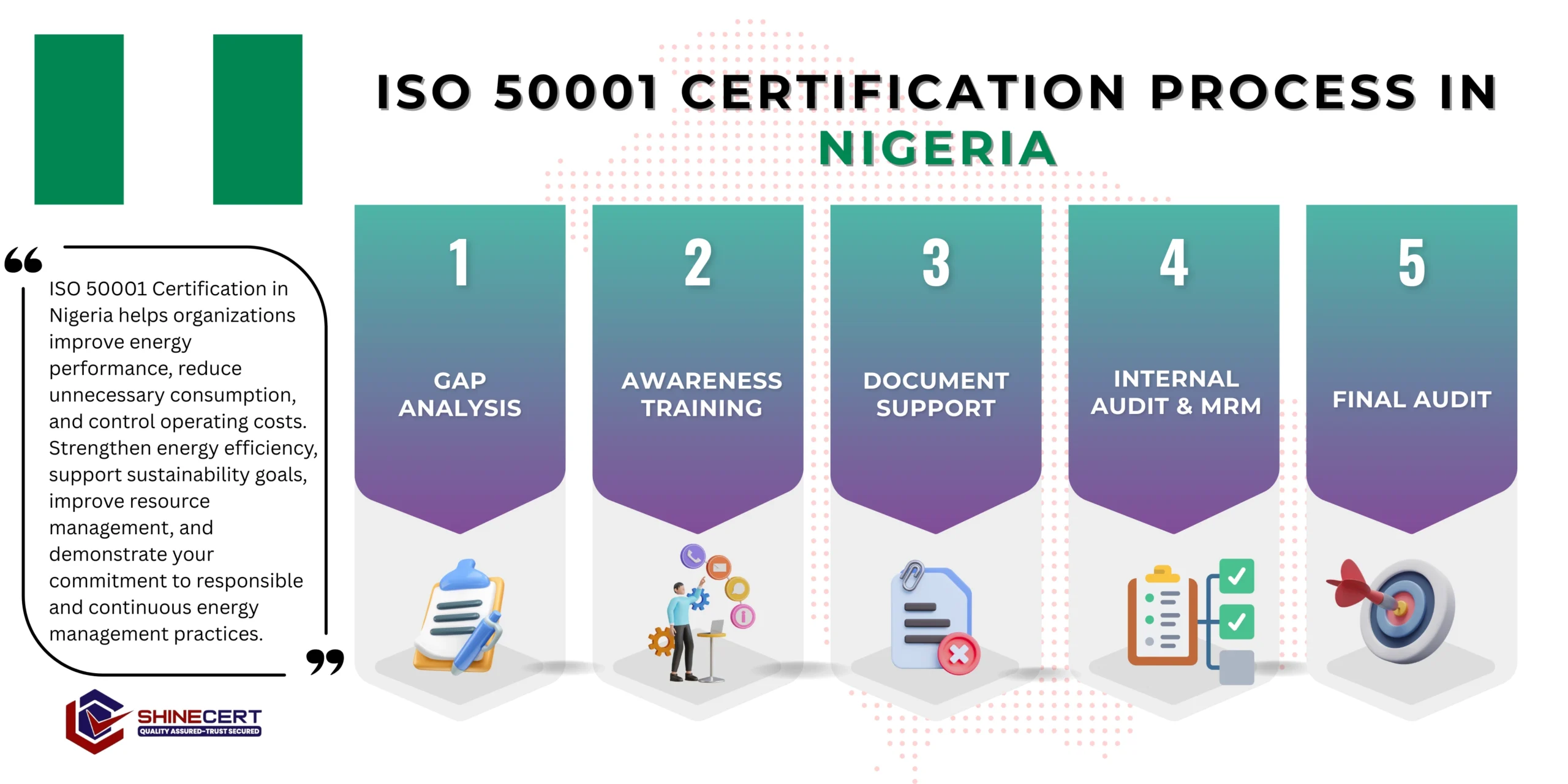
What are the steps to get ISO 50001 Certification in Nigeria?
our services
- ISO Certification Nigeria
- ISO 9001 Certification Nigeria
- ISO 14001 Certification Nigeria
- ISO 27001 Certification Nigeria
- ISO 22000 Certification Nigeria
- ISO 20000-1 Certification Nigeria
- ISO 45001 Certification Nigeria
- ISO 42001 Certification Nigeria
- ISO 13485 Certification Nigeria
- ISO 17025 Certification Nigeria
- ISO 31000 Certification Nigeria
- ISO 22301 Certification Nigeria
- ISO 27701 Certification Nigeria
- ISO 37001 Certification Nigeria
- ISO 50001 Certification Nigeria
- CE Mark Certification Nigeria
- GMP Certification Nigeria
- GDPR Certification Nigeria
- Halal Certification Nigeria
Our Five-Step Certification Process, in Depth
Gap Assessment
We review your actual energy consumption across grid supply and captive generation, your current NERC tariff band, and existing energy management practices, mapping what we find against ISO 50001's requirements.
A gap report identifying your real energy consumption patterns and exactly where formal ISO 50001 documentation and monitoring is missing.
Documentation
We build your energy review, baseline, and performance indicators around your organization's actual energy mix, a manufacturing facility running significant captive generation has a meaningfully different energy profile than an office-based business primarily on grid supply, and the documentation reflects that specifically.
A complete, version-controlled EnMS documentation set, with performance indicators genuinely tied to your real significant energy uses.
Implementation
Energy monitoring, operational controls, and improvement actions move into genuine daily practice, generator dispatch decisions, equipment scheduling, and consumption tracking actually happen systematically, not just on paper.
A functioning EnMS with real energy monitoring and improvement actions actively operating.
Internal Audit and Management Review
We audit against every ISO 50001 clause, surfacing gaps while stakes are low. Findings go to formal management review with documented decisions on energy priorities and resourcing.
An internal audit report, management review minutes, and corrective actions closed out before the certification audit.
Certification Audit
Stage 1 confirms your EnMS documentation is genuinely audit-ready; Stage 2 verifies energy monitoring and controls are actually operating as documented, through direct site review. We stay engaged through both stages.
Your ISO 50001 certificate, valid for three years, plus a surveillance audit schedule.
Gap Assessment
We review your actual energy consumption across grid supply and captive generation, your current NERC tariff band, and existing energy management practices, mapping what we find against ISO 50001's requirements.
A gap report identifying your real energy consumption patterns and exactly where formal ISO 50001 documentation and monitoring is missing.
Documentation
We build your energy review, baseline, and performance indicators around your organization's actual energy mix, a manufacturing facility running significant captive generation has a meaningfully different energy profile than an office-based business primarily on grid supply, and the documentation reflects that specifically.
A complete, version-controlled EnMS documentation set, with performance indicators genuinely tied to your real significant energy uses.
Implementation
Energy monitoring, operational controls, and improvement actions move into genuine daily practice, generator dispatch decisions, equipment scheduling, and consumption tracking actually happen systematically, not just on paper.
A functioning EnMS with real energy monitoring and improvement actions actively operating.
Internal Audit and Management Review
We audit against every ISO 50001 clause, surfacing gaps while stakes are low. Findings go to formal management review with documented decisions on energy priorities and resourcing.
An internal audit report, management review minutes, and corrective actions closed out before the certification audit.
Certification Audit
Stage 1 confirms your EnMS documentation is genuinely audit-ready; Stage 2 verifies energy monitoring and controls are actually operating as documented, through direct site review. We stay engaged through both stages.
Your ISO 50001 certificate, valid for three years, plus a surveillance audit schedule.
Certification Validity, Surveillance Audits, and Recertification
An ISO 50001 certificate is valid for three years from the date it’s issued. During years one and two, your certification body conducts an annual surveillance audit, narrower in scope, typically reviewing energy performance data against your baseline and confirming previously identified nonconformities were genuinely closed. Before the three-year mark, a full recertification audit, comparable in depth to your original Stage 2 audit, confirms your EnMS has continued functioning and genuinely improves energy performance throughout the cycle. Passing recertification issues a new three-year certificate.
Cost of ISO 50001 Certification in Nigeria, What Actually Drives It
| Organization Profile | Relative Investment Level | Why |
|---|---|---|
| Small, primarily grid-supplied operation | Lower | Narrower energy review and simpler monitoring requirements |
| Medium, mixed grid-generator energy profile | Moderate | Broader energy review across multiple sources |
| Larger, energy-intensive manufacturing operation | Higher | Extensive energy review, metering infrastructure, and operational control complexity |
| Bundled with ISO 14001 | Moderate-to-higher combined, lower than separate engagements | Shared environmental infrastructure reduces combined cost |
- Nature and scale of your energy consumption : An energy-intensive manufacturing operation faces a genuinely broader energy review and monitoring requirement than a lower-consumption office-based business.
- Complexity of your energy mix : Businesses managing grid supply alongside multiple generators or renewable installations face more extensive baseline and monitoring work than those on a single energy source.
- Existing metering and monitoring infrastructure : Businesses with reasonably good existing energy metering aren’t starting from zero, those relying on estimated or unmetered consumption face more foundational investment.
- Certification body fees, tracked separately from our consulting fees : The certification audit itself is conducted and invoiced directly by an independently accredited certification body, separate from ShineCert’s implementation work.
- Whether you’re bundling standards : Building ISO 50001 alongside ISO 14001 shares meaningful environmental and monitoring infrastructure, reducing combined cost.
- Internal capacity to contribute : A facilities or energy manager who can genuinely own monitoring, documentation, and internal audit coordination reduces the consulting hours required.
ISO 50001 Benefits Nigerian Businesses Actually Get
Systematic energy performance tracking identifies real inefficiencies, equipment running unnecessarily, poor load management, inefficient generator usage, that translate directly into lower energy bills over time.
ISO 50001 provides a structured framework for optimizing the balance between grid supply, captive generation, and any renewable investment, rather than managing each reactively and separately.
ISO 50001 is understood and trusted globally, giving Nigerian businesses a credential valuable for international partners and investors assessing operational efficiency and environmental performance together.
Businesses with a mature energy management system have better data to support Band A compensation claims when supply shortfalls occur, since ISO 50001 requires exactly the kind of energy consumption tracking NERC’s compensation framework depends on.
A business that has genuinely reduced its energy intensity is considerably better insulated from future tariff adjustments than one that hasn’t addressed underlying consumption patterns.
Energy-conscious clients and international partners increasingly weigh energy management credentials in supplier evaluation, particularly for manufacturing and industrial contracts.
ISO 50001 requires genuinely identifying your significant energy uses and the risks around them, generator fuel supply reliability, grid dependency, equipment inefficiency, and building real, documented improvement plans around each one.
Systematic energy data supports genuine environmental reporting and sustainability claims, increasingly relevant for businesses engaging with international buyers or investors on ESG criteria.
Energy management often surfaces equipment operating outside optimal parameters, and correcting this frequently improves equipment reliability and lifespan alongside energy savings.
Mandatory Documents Required for ISO 50001 Implementation
A documented statement defining which facilities, equipment, and energy sources, grid, captive generation, any renewable installation, the energy management system covers.
A documented policy, approved by top management, expressing genuine commitment to improving energy performance, appropriate to your actual energy mix and consumption profile.
A documented, actively maintained analysis of your actual energy consumption across grid and generator sources, identifying significant energy uses and establishing a genuine baseline to measure improvement against.
Documented, measurable indicators tracking energy performance over time, tailored to your specific significant energy uses rather than generic industry benchmarks.
Documented, measurable energy improvement objectives with specific action plans and assigned responsibility for achieving them.
A documented list of applicable requirements, NERC tariff band obligations, relevant environmental regulations tied to generator emissions, along with evidence of how each is being met.
Documented procedures for operating significant energy-using equipment and facilities efficiently, including generator dispatch and load management protocols where relevant.
Records showing energy consumption is genuinely and regularly measured against your baseline and performance indicators, not estimated or assumed.
Documentation showing energy performance is considered when designing new facilities or procuring new equipment, embedding efficiency into decisions before they’re made rather than retrofitting afterward.
A planned internal audit cycle, documented management review decisions on energy priorities and resourcing, and evidence relevant staff have received energy management training.
Challenges Organizations Face, Implementation, Risk Management, Audit, and Ongoing Certification
- Challenges during implementation : Businesses sometimes underestimate how much metering and monitoring infrastructure genuine energy performance tracking requires, particularly when existing metering only captures consumption at the facility level rather than by significant energy use.
- Challenges in risk management : A common gap is focusing energy risk assessment entirely on cost while overlooking genuine reliability risk, generator fuel supply disruption or maintenance failures that could halt production regardless of cost considerations.
- Challenges during internal and certification audits : Auditors specifically verify that energy performance indicators are genuinely being tracked against real consumption data, not estimated after the fact, gaps between documented monitoring frequency and actual practice are a common finding.
- Challenges maintaining certification after the initial audit : Energy performance improvements can quietly erode if equipment maintenance schedules slip or new equipment is added without being incorporated into the energy review, particularly when no one has clear, ongoing ownership of energy performance data.
Case Study
A textile manufacturer operating a production facility in Kaduna approached us after a NERC tariff band review moved their facility into a higher-cost band, prompting leadership to genuinely reassess energy costs that had previously been treated as a largely fixed, unmanaged expense alongside their captive generator running almost continuously to cover grid supply gaps.
Our energy review found the facility’s generator was frequently running under-loaded during off-peak production hours, a genuinely common but costly inefficiency, and there was no systematic tracking connecting energy consumption to specific production processes, making it difficult to identify where the real savings opportunities existed. Metering existed only at the facility level, not by production line.
We built an energy baseline and installed additional sub-metering to track consumption by production area, revealing that a specific dyeing process accounted for a disproportionate share of energy use relative to its production volume. Adjusting generator dispatch scheduling and addressing the dyeing process inefficiency together produced measurable energy cost reduction within the first few months of implementation, well before certification was complete.
This reflects a pattern we see often, energy treated as an unavoidable fixed cost until systematic measurement reveals genuine, addressable inefficiency, rather than a single specific engagement.
Industries and Sectors We Certify in Nigeria and Which Standards Each Actually Needs
Cement and heavy manufacturing
ISO 50001 is close to essential given genuinely significant energy consumption and cost exposure; pair with ISO 14001 for environmental management given related emissions considerations.
Read moreSteel and metal processing
ISO 50001 addresses substantial energy-intensive production processes; pair with ISO 9001 for quality management.
Read moreTextile and garment manufacturing
ISO 50001 addresses genuine energy cost pressure in production processes; pair with ISO 9001 for quality consistency.
Read moreHospitality and large-scale facilities
ISO 50001 addresses genuine energy cost exposure from continuous cooling, lighting, and backup power needs; pair with ISO 14001 for broader environmental management.
Read moreData centers and IT infrastructure
ISO 50001 addresses substantial, continuous energy consumption central to this sector’s cost structure; pair with ISO 27001 for information security.
Read moreReal estate and commercial property management
ISO 50001 addresses energy efficiency across managed properties; pair with ISO 14001 for broader environmental management.
Read moreWhy Choose ShineCert for ISO 50001 Certification Nigeria?
ShineCert brings 10 years of ISO consulting and certification experience to Nigeria’s market, coordinated through our Riyadh and India offices with services delivered remotely or on-site depending on what your engagement genuinely needs. We’ve guided more than 10,000 organizations through ISO certification worldwide, and we build every Nigeria energy management engagement around your actual energy mix and consumption profile, not a generic template lifted from a different regulatory environment. ShineCert is the best ISO consultant in Nigeria.
Choosing a Certification Body in Nigeria?
What to Check | Why It Matters |
Accreditation under a recognized international accreditation framework | Confirms genuine, internationally recognized certification |
Genuine familiarity with Nigeria’s NERC tariff structure and grid reliability challenges | Ensures the auditor understands how your EnMS connects to your actual operating environment |
Experience with your specific sector’s energy consumption profile | Manufacturing, hospitality, and data centers involve genuinely different energy management priorities |
A genuine metering-and-monitoring-verification audit approach | Confirms the auditor checks real consumption data, not just documentation review |
Ready to Get Started?
Whether you’re managing rising tariff costs or a genuinely complex grid-generator energy mix, we’ll walk through your specific energy consumption and cost factors before proposing a fixed-scope plan, delivered remotely, on-site, or however genuinely fits your project. Book a free consultation or contact us directly to get started.
Frequently Asked Questions
Look for demonstrated experience with your specific sector’s energy consumption profile, genuine familiarity with NERC’s tariff structure, and transparent scoping rather than flat package pricing. ShineCert scopes every Nigeria engagement individually.
Indirectly, yes, the systematic energy consumption tracking ISO 50001 requires gives you better data to support Band A compensation claims when NERC directs DisCos to compensate for supply shortfalls.
It genuinely depends on your energy consumption scale, energy mix complexity, and existing metering infrastructure, we scope every project individually.
Typically two and a half to eight months depending on organization size and energy mix complexity, see our detailed timeline breakdown above.
Yes, ISO 50001 covers your total energy consumption regardless of source, and businesses with significant captive generation often see some of the largest efficiency gains given how energy-intensive generator operation typically is.
Certification doesn’t control tariff policy, but a mature energy management system means your organization is genuinely better positioned to absorb or offset tariff increases through demonstrated efficiency gains rather than starting from an unmanaged baseline.
Documentation and data analysis work runs effectively over remote sessions, but energy review and metering assessment genuinely require in-person site visits, we scope the right mix per project.
ShineCert doesn’t maintain a standalone Nigeria office; we coordinate Nigeria engagements from our Riyadh and India offices, with services delivered remotely or on-site as your project requires.