
ISO 13485 Certification in Bahrain
Quick Answer
ISO 13485 is the international standard for medical device quality management systems, and in Bahrain it is not optional for anyone bringing a medical device to market, the National Health Regulatory Authority (NHRA) recognizes ISO 13485:2016 as mandatory QMS evidence for medical device registration, regardless of device risk classification (Class I, IIa, IIb, III, and IVD A-D). Every device, at every risk level, must be registered before market entry, and ISO 13485 certification is a required part of that registration package alongside other quality documents like CE marking or FDA certificates of free sale. Get certified through a body accredited under the Global Accreditation Cooperation (GAC) framework. Plan for three to five months from kickoff to certificate, and note that NHRA’s own review adds a further 6 to 8 weeks on top. Cost depends on genuine factors, device classification, manufacturing versus distribution role, product range, not a flat number.
What Is ISO 13485, Technically Speaking?
ISO 13485 is the internationally recognized quality management system standard specifically for medical devices, and it deliberately diverges from the generic Harmonized Structure that ISO 9001, ISO 14001, and ISO 27001 share. This is a genuinely important technical distinction: ISO 13485 retains an older-style, more prescriptive structure because medical device regulation worldwide, including the EU Medical Device Regulation, the US FDA’s Quality System Regulation, and Bahrain’s NHRA framework, expects a specific, harmonized structure that regulators can map directly against their own regulatory clauses. Where ISO 9001 emphasizes customer satisfaction and continual improvement broadly, ISO 13485’s overriding principle is maintaining the effectiveness of the quality management system specifically to consistently meet both customer requirements and applicable regulatory requirements, regulatory conformity is built into the standard’s core purpose, not treated as an external add-on.
The standard’s technical backbone is risk management integrated throughout the device lifecycle, formally referencing ISO 14971 (the dedicated medical device risk management standard) rather than building its own separate risk framework. This means a genuinely compliant ISO 13485 system doesn’t just document risks once during design, it requires risk management activity at every lifecycle stage: design and development, production, post-market surveillance, and complaint handling. Clause 7.3 (Design and Development) is particularly technical, requiring design inputs, outputs, verification, validation, and a formal design history file, documentation regulators like NHRA and its international counterparts specifically expect to see referenced in registration submissions.
A distinguishing technical feature compared to ISO 9001 is the depth of traceability and Unique Device Identification requirements. ISO 13485 requires organizations to maintain device history records enabling traceability from raw materials and components through to the specific finished device and, where applicable, to the specific patient or customer who received it, a level of granularity most quality management standards don’t require, but which is essential for medical device recalls where patient safety is directly at stake.
Post-market surveillance is another area where ISO 13485 goes beyond generic quality management: Clause 8.2.1 requires a systematic process for gathering and reviewing information about the device once it’s in use, feeding genuine field performance data back into risk management and, where necessary, triggering corrective action or recall procedures. For Bahrain-based manufacturers and authorized representatives, this technical requirement maps directly onto NHRA’s own post-market obligations, meaning a properly built ISO 13485 system does double duty: satisfying the international standard and Bahrain’s regulatory post-market expectations simultaneously.
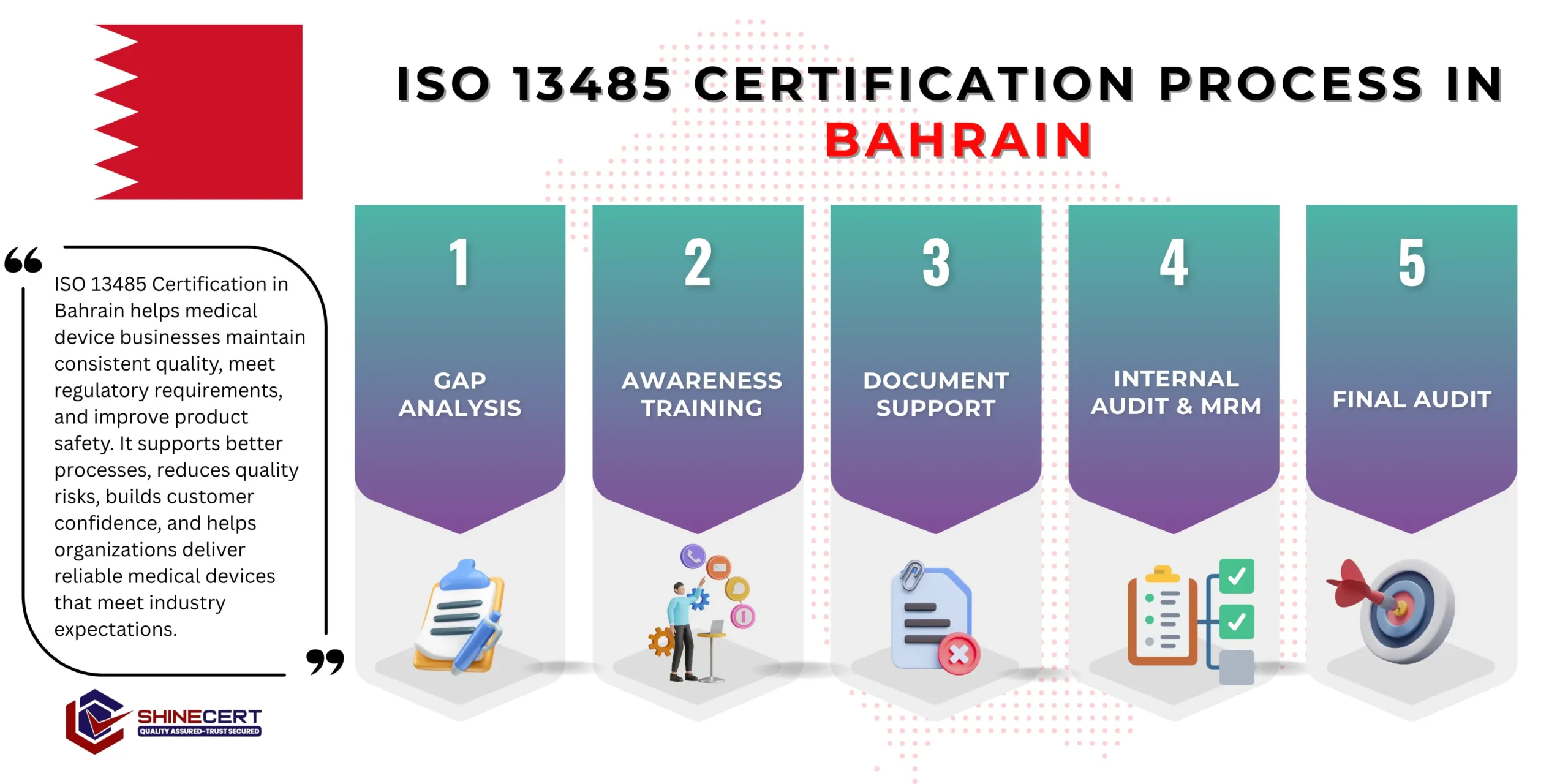
What are the steps to get ISO 13485 Certification in Bahrain?
our services
- ISO Certification Bahrain
- ISO 9001 Certification Bahrain
- ISO 14001 Certification Bahrain
- ISO 27001 Certification Bahrain
- ISO 22000 Certification Bahrain
- ISO 27701 Certification Bahrain
- ISO 45001 Certification Bahrain
- ISO 20000-1 Certification Bahrain
- ISO 13485 Certification Bahrain
- ISO 17025 Certification Bahrain
- ISO 31000 Certification Bahrain
- ISO 42001 Certification Bahrain
- ISO 37001 Certification Bahrain
- ISO 22301 Certification Bahrain
- ISO 50001 Certification Bahrain
- CE Mark Certification Bahrain
- GDPR Certification Bahrain
- GMP Certification Bahrain
- Halal Certification Bahrain
Our Five-Step Certification Process: What to Actually Expect
Gap Assessment
We evaluate your current quality practices, design documentation, and risk management against ISO 13485’s requirements. What this means for you: a clear picture of exactly what NHRA’s registration reviewers will expect to see, before you submit anything.
A gap assessment report specific to your device range and role (manufacturer, distributor, or authorized representative).
Documentation Development
Your quality manual, device history records, design history files, and risk management documentation get built around your actual device portfolio. What this means for you: documentation structured the way NHRA and international regulators actually expect to review it.
A complete ISO 13485 documentation set.
Implementation and Training
Controls roll out across design, production, and post-market surveillance processes, with staff trained on traceability and complaint-handling procedures. What this means for you: your team builds genuine habits around device traceability, not a compliance exercise that falls apart under real recall pressure.
Training records and evidence of controls functioning across your device lifecycle.
Internal Audit and Management Review
We test the system internally, surfacing weaknesses before the real audit. What this means for you: documentation gaps get caught and fixed before they can delay your NHRA registration.
Internal audit report and management review minutes.
Certification Audit
Stage 1 and Stage 2 audits with a GAC-accredited certification body. What this means for you: Stage 1 checks documentation readiness; Stage 2 verifies the system genuinely functions, positioning you for a smooth NHRA registration submission immediately after.
Your ISO 13485 certificate, ready to support NHRA registration.
Why This Matters So Much in Bahrain Specifically?
- Unlike most standards on this page, ISO 13485 isn’t a competitive differentiator in Bahrain’s medical device sector, it’s a genuine, mandatory market entry requirement. NHRA’s registration process explicitly requires ISO 13485 certification as QMS evidence for every device, at every risk classification, before that device can legally reach the Bahrain market. This makes the standard’s role fundamentally different from something like ISO 9001, where certification is a strong commercial and compliance advantage but not a legal gate.
- The authorized representative requirement adds a genuinely Bahrain-specific dimension: foreign manufacturers can’t submit registration applications directly, and NHRA’s guidance specifically references a “Bahrain quality records and Authorised Representative QMS interface” requirement, meaning the local representative’s own quality system needs to interface properly with the manufacturer’s ISO 13485 system, not just pass paperwork through. Companies acting as authorized representatives for multiple foreign manufacturers need particular attention to how their own QMS genuinely manages this interface across different manufacturer relationships.
Bahrain at a Glance: What Shapes ISO 13485 Demand Here
01
Mandatory registration authority
the National Health Regulatory Authority (NHRA) requires all medical devices, regardless of classification, to be registered before market entry.
02
Mandatory QMS requirement
ISO 13485 certification is required as part of the manufacturer’s registration documentation; NHRA explicitly recognizes ISO 13485:2016 as QMS evidence, with a Bahrain-specific overlay requiring Bahrain quality records and an authorized representative QMS interface.
03
Authorized representative requirement
only a locally appointed authorized representative can submit registration applications on a foreign manufacturer’s behalf, adding a genuine local-presence dimension to Bahrain’s registration process.
04
Registration timeline
NHRA typically reviews applications and supporting documents over 6 to 8 weeks (40 to 80 working days), with certificates valid for 1 to 5 years depending on the underlying quality certificate’s validity.
What Actually Drives Your Cost?
We don’t quote a flat number, because a flat number would misrepresent how different two Bahrain medical device companies’ actual scope can be. Here’s what genuinely drives cost :
A manufacturer designing and producing devices faces meaningfully deeper documentation requirements, design history files, full risk management files, than a distributor or authorized representative handling already-manufactured devices.
Higher-risk device classes (IIb, III) generally need deeper risk management documentation than lower-risk classes (I, IIa), reflecting the genuinely higher stakes of a failure.
Each device generally needs its own design history file and risk management file, so a company registering a handful of devices is a genuinely smaller project than one registering dozens.
Each manufacturing or storage site generally needs its own assessment and audit time.
Companies with established design control and traceability aren’t starting from zero. Companies with informal practices need more foundational work.
Companies already holding a valid ISO 13485 certificate or CE marking often need meaningfully less work to add the Bahrain-specific authorized representative interface documentation.
Companies pursuing GMP alongside ISO 13485, common for combination product manufacturers, share meaningful implementation and audit infrastructure.
An internal regulatory affairs or quality lead who can own documentation reduces consultant hours needed.
Where your project qualifies for co-funding, your genuine out-of-pocket cost can be meaningfully lower.
A compressed timeline driven by a market-entry deadline sometimes needs more concentrated consultant hours in a shorter window.
Common Pitfalls We See in Bahrain ISO 13485 Projects
- Assuming a foreign manufacturer’s existing certificate is sufficient on its own : NHRA’s guidance specifically expects Bahrain-specific quality records and authorized representative QMS interface, a valid international certificate alone doesn’t automatically satisfy this local overlay.
- Underestimating design history file depth for higher-risk devices : Companies sometimes apply the same documentation depth across their entire device portfolio regardless of risk classification, either over-documenting low-risk devices or under-documenting high-risk ones.
- Treating post-market surveillance as passive record-keeping : NHRA and the standard both expect an active feedback loop from field data back into risk management, a system that only stores complaints without analyzing them misses the point.
- Starting registration planning too late in the market-entry timeline : Given NHRA’s 6-to-8-week review on top of the certification process itself, companies that leave registration to the last minute before a planned launch often face costly delays.
Benefits at a Glance
01
Mandatory prerequisite for NHRA medical device registration
02
Faster registration processing with complete, properly structured documentation
03
Reduced risk of device recalls and regulatory penalties
04
Access to potential Tamkeen funding support
05
A foundation that supports parallel registration in other GCC markets
Benefits: What Certification Actually Changes
- Market access, full stop : Without ISO 13485 certification, NHRA registration and therefore legal market entry, simply isn’t possible for a medical device manufacturer or its authorized representative in Bahrain.
- Faster, smoother NHRA review : Complete, properly structured ISO 13485 documentation submitted alongside your registration application tends to move through NHRA’s 6-to-8-week review with fewer follow-up queries than incomplete or poorly organized submissions.
- Reduced recall and liability risk : Genuine, lifecycle-wide risk management and post-market surveillance reduce both the likelihood of a device safety issue and the severity of its consequences if one occurs.
- Regional registration leverage : A properly built ISO 13485 system supports registration processes across other GCC markets with similar QMS evidence requirements, reducing duplicate work for companies expanding regionally.
- Access to Tamkeen-supported funding : Depending on eligibility, certification-related training and consulting costs may be partially offset through Tamkeen’s programs.
What Happens When a Bahrain Company Tries to Sell Devices Without Proper Registration?
- This is worth understanding concretely, because the consequence here isn’t a competitive disadvantage, it’s a genuine legal barrier. Without NHRA registration, supported by ISO 13485 certification, a medical device simply cannot be legally sold or distributed in Bahrain, regardless of how well the device itself performs or how strong the company’s informal quality practices might be. Companies that attempt to move devices to market without completing registration face regulatory enforcement action, and companies that discover mid-process that their QMS documentation doesn’t meet NHRA’s specific evidence requirements face registration delays that can push back market entry by months.
- We generally recommend companies planning to bring medical devices to Bahrain build ISO 13485 certification and NHRA registration into their market-entry timeline from the earliest planning stage, rather than treating it as a late-stage formality, the standard’s design and documentation requirements are substantial enough that starting late genuinely delays revenue.
Medical Device Quality Requirements, Clause by Clause
- Quality Management System (Clause 4) : Documentation control and record-keeping requirements are notably more rigorous than generic quality standards, reflecting the regulatory-submission function this documentation ultimately serves.
- Management Responsibility (Clause 5) : Leadership accountability specifically for regulatory compliance, not just general quality objectives.
- Resource Management (Clause 6) : Competence requirements for personnel involved in activities affecting product quality, including specific infrastructure and work environment controls relevant to device manufacturing.
- Product Realization (Clause 7) : The largest and most technical clause, covering design and development, purchasing controls, production and service provision, and the control of monitoring and measuring equipment, this is where device-specific risk management under ISO 14971 lives.
- Measurement, Analysis, and Improvement (Clause 8) : Post-market surveillance, complaint handling, and corrective/preventive action, the ongoing feedback loop connecting real-world device performance back into the quality system.
Tamkeen Funding: Does Your ISO 13485 Project Qualify for Subsidy?
Tamkeen’s training and business development programs can apply to medical device quality management system implementation, depending on your company’s size, sector, and program eligibility. Given the mandatory nature of this certification for market access, checking Tamkeen eligibility early is worthwhile to manage the genuine cost of a mandatory regulatory requirement.
Applicable Standards by Industry
Medical Device Manufacturing
Manufacturers use ISO 13485 as the mandatory foundation for both international operations and Bahrain-specific NHRA registration.
Read moreMedical Device Distribution and Import
Distributors and importers need ISO 13485-aligned quality systems to support the registration process, even where they don’t manufacture devices themselves.
Read moreDiagnostic and Laboratory Equipment
IVD manufacturers and distributors face registration requirements across the IVD A-D classification spectrum.
Read moreDental and Surgical Instruments
Manufacturers and distributors of dental and surgical devices need device-specific risk management documentation reflecting their particular use cases.
Read moreHealthcare Technology and Combination Products
Companies at the intersection of medical devices and pharmaceuticals often need ISO 13485 alongside GMP.
Read moreCase Study: A Bahrain Medical Device Distributor’s Registration Journey
- The following is an illustrative, composite example based on the kind of project ShineCert typically runs, not a specific named client. A Bahrain-based company acting as the authorized representative for a European diagnostic device manufacturer needed to register several new devices with NHRA, but the manufacturer’s own ISO 13485 certification, while valid, didn’t clearly document the Bahrain-specific quality records interface NHRA’s guidance requires from the authorized representative relationship.
- The gap assessment found the manufacturer’s core quality system was genuinely strong, but the local representative’s own QMS hadn’t formally documented how it interfaced with the manufacturer’s system, complaint handling, for instance, had an informal email-based process between the two parties rather than a documented, auditable procedure. The bulk of implementation work went into formalizing this interface: building a documented complaint-handling and traceability procedure connecting the representative’s local operations to the manufacturer’s global quality system, and preparing a complete, well-organized registration package for each device. Registration was achieved within NHRA’s typical 6-to-8-week review window without significant follow-up queries, and the pattern we typically see afterward held: subsequent device registrations for the same manufacturer moved noticeably faster once the interface documentation template was established.
Mandatory Documents Required for Certification
Genuine leadership commitment specific to your device portfolio.
Documented, defining exactly which devices, processes, and sites are covered.
Documenting design inputs, outputs, verification, and validation for each device.
Aligned with ISO 14971, covering the full device lifecycle.
Supporting genuine, fast traceability for potential recalls.
Evidence of a genuine feedback loop from field performance back into the quality system.
Why ShineCert?
We coordinate Bahrain engagements from ShineCert’s Riyadh and Lebanon offices, with direct familiarity with NHRA’s medical device registration process, the authorized representative QMS interface requirement, and Tamkeen’s funding programs. Our team has guided more than 10,000 organizations through ISO certification globally, with the best ISO 13485 consultant in Bahrain, and we build every Bahrain medical device engagement around your specific device portfolio, market role, and registration timeline, not a one-size-fits-all package.
Choosing a Certification Body in Bahrain?
What to Check | Why It Matters |
Accreditation under the GAC framework | Confirms genuine, internationally recognized certification NHRA will accept |
Genuine medical device sector experience | ISO 13485 auditing requires understanding of design controls and risk management specific to devices |
Familiarity with NHRA’s registration evidence requirements | Ensures your certificate and documentation package are structured the way NHRA reviewers expect |
Experience with authorized representative QMS interfaces | Particularly relevant for companies representing foreign manufacturers |
Ready to Get Certified?
ShineCert supports Bahrain medical device companies from initial gap assessment through certification audit and NHRA registration support, including checking whether your project qualifies for Tamkeen funding support. Book a free consultation or contact us directly, and we’ll walk through your specific device portfolio and cost factors before proposing a fixed-scope plan.
Frequently Asked Questions
It’s the international standard for medical device quality management systems, required for regulatory registration in most markets worldwide, including Bahrain.
It genuinely depends on factors like your supply chain role, device risk classification, and number of devices, we scope every project individually.
Yes, NHRA requires ISO 13485:2016 as QMS evidence for medical device registration, regardless of risk classification, before any device can legally reach the Bahrain market.
ISO 13485 certification typically takes three to five months, with NHRA’s own registration review adding a further 6 to 8 weeks on top.
Potentially, Tamkeen’s training and development programs can apply to certification-related costs depending on eligibility.
Yes, foreign manufacturers cannot submit NHRA registration applications directly and must work through a locally appointed authorized representative.
It provides a strong foundation, but NHRA’s guidance expects Bahrain-specific quality records and authorized representative interface documented alongside it.
ISO 13485 replaces continual improvement emphasis with strict regulatory conformity focus, adds mandatory risk management under ISO 14971, and requires deeper traceability and design control documentation.
Yes, higher-risk classes (IIb, III) need meaningfully deeper risk management and design documentation than lower-risk classes.
We coordinate Bahrain engagements from our Riyadh and Lebanon offices, with consultants traveling on-site as needed.