
ISO 45001 Certification in Bahrain
Quick Answer
ISO 45001 is the international standard for occupational health and safety management systems, and in Bahrain it operates alongside, not instead of genuine statutory obligations. Labour Law No. 36 of 2012, enforced by the Ministry of Labour and Social Development (MLSD), sets employer OHS duties, worker rights, work injury compensation, and the summer outdoor-work heat ban under Ministerial Order 8/2013. Certification is increasingly required by major employers like BAPCO and Alba as part of contractor pre-qualification. Get certified through a body accredited under the Global Accreditation Cooperation (GAC) framework. Plan for three to five months from kickoff to certificate. Cost depends on genuine factors, workforce size, site risk profile, number of locations, not a flat number, and Tamkeen funding may reduce your net cost.
What Is ISO 45001, Technically Speaking?
ISO 45001 replaced OHSAS 18001 in 2018 as the internationally recognized occupational health and safety management system standard, and the shift was more than a rebrand, OHSAS 18001 was a British Standards Institution specification, while ISO 45001 is a genuine ISO management system standard built on the Harmonized Structure shared with ISO 9001, ISO 14001, and ISO 27001. This means an organization already running ISO 9001 or ISO 14001 can integrate ISO 45001 into the same management review, internal audit, and document control infrastructure rather than building a parallel system from scratch.
The standard’s most technically significant feature is its treatment of “worker participation and consultation” (Clause 5.4), which goes well beyond a suggestion box. ISO 45001 requires genuine, documented mechanisms for workers, including non-managerial staff, to participate in hazard identification, incident investigation, and the development of OHS policy and objectives. This reflects a deliberate philosophical position embedded in the standard: workers doing the actual work often have the clearest visibility into genuine hazards, and a system that doesn’t structurally involve them is treated as incomplete, not just suboptimal.
Structurally, the standard follows the same PDCA cycle as its Harmonized Structure siblings, but its Clause 6 planning requirements carry a specific technical distinction between “hazard identification” and “risk assessment”, a hazard is a potential source of harm (a forklift operating in a warehouse aisle), while the risk assessment evaluates the likelihood and severity of that hazard causing actual harm given existing controls. Clause 8.1.2 then requires organizations to apply a defined “hierarchy of controls” when addressing identified risks: elimination first, then substitution, then engineering controls, then administrative controls, and personal protective equipment last, a sequencing that reflects genuine occupational safety science rather than an arbitrary checklist, and auditors specifically test whether an organization actually worked down this hierarchy rather than jumping straight to handing out PPE.
Another technically important element is Clause 10.2’s approach to incident investigation, which requires organizations to distinguish root causes from immediate causes, for example, an immediate cause might be a worker not wearing a harness, while the root cause might be inadequate harness availability, insufficient training, or unrealistic production pressure discouraging proper PPE use. A system that only documents immediate causes without genuinely investigating root causes tends to see the same incident type recur, which is exactly the pattern ISO 45001 audits are designed to catch.
For Bahrain specifically, ISO 45001’s legal compliance clause (6.1.3) requires organizations to map applicable legal requirements, meaning your OHS management system needs to explicitly incorporate Labour Law No. 36/2012, Ministerial Order 8/2013, and the seasonal heat-stress ban as genuine, tracked legal obligations, not treat ISO 45001 as a separate international overlay disconnected from Bahrain’s actual statutory framework.
What are the steps to get ISO 45001 Certification in Bahrain?
our services
- ISO Certification Bahrain
- ISO 9001 Certification Bahrain
- ISO 14001 Certification Bahrain
- ISO 27001 Certification Bahrain
- ISO 22000 Certification Bahrain
- ISO 27701 Certification Bahrain
- ISO 45001 Certification Bahrain
- ISO 20000-1 Certification Bahrain
- ISO 13485 Certification Bahrain
- ISO 17025 Certification Bahrain
- ISO 31000 Certification Bahrain
- ISO 42001 Certification Bahrain
- ISO 37001 Certification Bahrain
- ISO 22301 Certification Bahrain
- ISO 50001 Certification Bahrain
- CE Mark Certification Bahrain
- GDPR Certification Bahrain
- GMP Certification Bahrain
- Halal Certification Bahrain
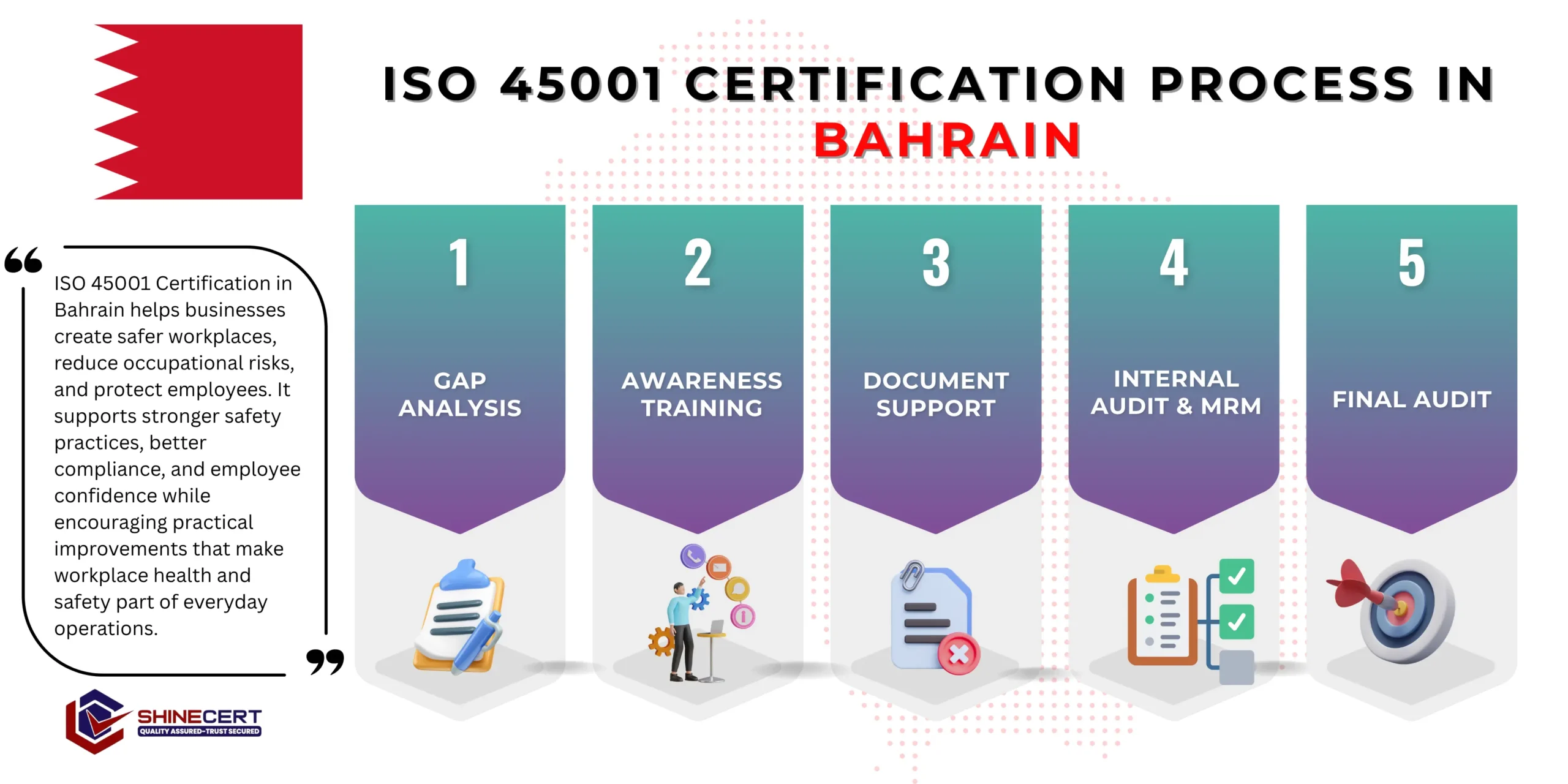
Our Five-Step Certification Process: What to Actually Expect
Gap Assessment
We evaluate your current OHS practices and Labour Law compliance status against ISO 45001’s requirements. What this means for you: an honest picture of the real gap, including any statutory compliance issues worth fixing regardless of certification.
A gap assessment report specific to your operations and site risks.
Documentation Development
Your OHS policy, hazard and risk register, and legal compliance register get built around your actual site conditions. What this means for you: documentation your own safety staff can genuinely use to run daily operations, not a generic binder.
A complete ISO 45001 documentation set.
Implementation and Training
Controls roll out with staff trained on hazard awareness and, critically, genuine worker participation mechanisms established. What this means for you: this phase typically runs longest, since building real trust in worker consultation processes takes longer than writing a procedure.
Training records and evidence of worker participation functioning.
Internal Audit and Management Review
We test the system internally, surfacing weaknesses before the real audit. What this means for you: gaps get caught and fixed in a low-stakes setting.
Internal audit report and management review minutes.
Certification Audit
Stage 1 and Stage 2 audits with a GAC-accredited certification body. What this means for you: Stage 1 checks documentation readiness; Stage 2 verifies the system genuinely functions on-site, including worker interviews.
Your ISO 45001 certificate and a surveillance audit schedule.
Why This Matters So Much in Bahrain Specifically?
- Bahrain’s industrial economy carries genuine occupational risk, construction, oil and gas services, and heavy manufacturing anchored by BAPCO and Alba all involve activities where safety failures have serious human consequences, not just compliance implications.
- The statutory heat-stress ban under Ministerial Order 8/2013 is a direct regulatory acknowledgment of Bahrain’s climate-driven occupational risk, and companies operating outdoor manual labor need OHS systems that genuinely account for this seasonal reality, not a generic international template that ignores it.
- The supply chain effect mirrors what we see with ISO 14001: BAPCO Golden Rules and ISO 45001 supplement but do not replace statutory Labour Law obligations, meaning certified companies aren’t exempted from Bahrain’s legal requirements, but certification does become the practical baseline for contractor pre-qualification across major industrial and construction projects, where lenders and insurers increasingly expect internationally recognized safety management as a condition of financing or coverage.
Bahrain at a Glance: What Shapes ISO 45001 Demand Here
01
Primary legislation
Labour Law No. 36 of 2012 (Legislative Decree) and Ministerial Order 8/2013 on occupational safety and health in workplaces, enforced by the Ministry of Labour and Social Development.
02
Heat stress regulation
a statutory ban on outdoor manual labor during peak summer heat hours, reflecting Bahrain’s genuine climate-driven occupational risk.
03
Anchor-employer pressure
BAPCO and Alba, alongside major construction and project-finance stakeholders, routinely expect ISO 45001 as part of contractor and supplier pre-qualification, supplementing rather than replacing statutory Labour Law obligations.
04
SME funding available
Tamkeen offers training and business development grants that can offset certification-related costs for eligible companies.
What Actually Drives Your Cost?
We don’t quote a flat number, because a flat number would misrepresent how different two Bahrain companies’ actual OHS risk profiles can be. Here’s what genuinely drives cost.
A low-risk office environment needs meaningfully less documentation and control depth than a construction site or industrial facility with genuine physical hazards.
Each additional site generally needs its own hazard identification and risk assessment, since site conditions vary meaningfully even within the same company.
More workers means more training to deliver and a larger pool for auditors to interview, and critically for ISO 45001, a larger worker participation mechanism to structure and evidence.
Every function with distinct hazard exposure, site operations, warehousing, transport, administration, needs its own documented controls.
Companies with functioning toolbox talks, PPE discipline, and some incident tracking aren’t starting from zero. Companies where safety knowledge lives entirely with one supervisor need more foundational work.
Businesses with significant outdoor manual labor need a documented heat-stress protocol mapped to Ministerial Order 8/2013, adding a genuine, Bahrain-specific documentation requirement.
Pursuing ISO 14001 or ISO 9001 alongside ISO 45001 shares meaningful implementation and audit infrastructure.
An internal safety officer who can own documentation and coordinate training reduces consultant hours needed.
Where your project qualifies for co-funding, your genuine out-of-pocket cost can be meaningfully lower.
A compressed timeline driven by a bid deadline sometimes needs more concentrated consultant hours in a shorter window.
Common Pitfalls We See in Bahrain ISO 45001 Projects
Stopping incident investigation at the immediate cause : Companies that document “worker error” without digging into the underlying systemic cause tend to see the same incident type recur, which auditors specifically look for.
Treating worker participation as a checkbox : A token suggestion box doesn’t satisfy Clause 5.4’s genuine participation requirements, auditors test for real, evidenced worker involvement in hazard identification and decision-making.
Building a generic heat-stress protocol instead of one mapped to Ministerial Order 8/2013 : A copy-pasted heat policy from another country’s standard misses Bahrain’s specific statutory ban timing and requirements.
Assuming BAPCO Golden Rules compliance automatically satisfies ISO 45001 : The two frameworks overlap substantially but aren’t identical, companies need to verify genuine ISO 45001 conformity independently rather than assuming equivalence.
Benefits at a Glance
01
Documented alignment with Labour Law No. 36/2012 and heat-ban compliance
02
Stronger position in BAPCO/Alba and major contractor pre-qualification
03
Fewer workplace incidents and reduced associated cost
04
Access to potential Tamkeen funding support
05
A foundation that transfers cleanly into ISO 14001 or ISO 9001 later
Benefits: What Certification Actually Changes
- Reduced workplace incidents and associated cost : A genuinely functioning hazard identification and control system reduces injuries, and with them, the direct and indirect costs of workplace incidents, medical costs, lost time, investigation time, and reputational impact.
- Stronger footing in industrial and construction pre-qualification : Certification is frequently the practical baseline for contractor pre-qualification across BAPCO, Alba, and major construction and project-finance-backed developments.
- Clearer legal compliance tracking : Formally mapping Labour Law No. 36/2012 and Ministerial Order 8/2013 obligations into your management system reduces the risk of inadvertent non-compliance and the penalties that follow.
- Genuine worker engagement : The structured worker participation requirements tend to surface real hazards that management alone would miss, and improve morale by giving workers a genuine voice in safety decisions.
- Access to Tamkeen-supported funding : Depending on eligibility, certification-related training and consulting costs may be partially offset through Tamkeen’s programs.
What Happens When a Bahrain Company Bids Without Certification on a Safety-Scored Project?
- This is worth understanding concretely. When a major contractor, lender, or insurer expects ISO 45001 as part of pre-qualification, an uncertified Bahrain company isn’t always disqualified outright, but it often faces additional safety audits, higher insurance premiums, or exclusion from shortlists that certified competitors bypass. On project-finance-backed developments specifically, IFC Performance Standards compliance frequently references internationally recognized OHS management systems, and a company without ISO 45001 may need to demonstrate equivalent controls through a slower, more manual due-diligence process.
- Companies that discover this only after losing a bid or being excluded from a shortlist often start certification under real time pressure. We generally recommend Bahrain contractors and industrial employers expecting to bid on major projects treat ISO 45001 as standing infrastructure to have ready before the opportunity appears, not something to pursue only once a specific bid requires it.
Occupational Health & Safety Requirements, Clause by Clause
- Context of the Organization (Clause 4) : Mapping your genuine workplace hazards and interested parties, for a Bahrain employer, this explicitly includes the MLSD and the statutory heat-ban requirement as part of your operating context.
- Leadership and Worker Participation (Clause 5) : Beyond leadership commitment, this clause specifically requires documented mechanisms for worker involvement in hazard identification and OHS decision-making, not a token consultation, but a genuine, evidenced process.
- Planning (Clause 6) : Hazard identification, risk assessment, and legal compliance obligations. This is where Bahrain-specific risks, heat stress, industrial equipment, construction site hazards, get formally identified and where Labour Law No. 36/2012 and Ministerial Order 8/2013 get mapped as legal obligations.
- Support (Clause 7) : Competence, training, and communication requirements ensure workers genuinely understand hazards and controls relevant to their role, tested through worker interviews during audits.
- Operation (Clause 8) : Operational controls following the hierarchy of controls, plus emergency preparedness specific to your actual site risks, a construction site’s emergency plan looks nothing like an office environment’s.
- Performance Evaluation (Clause 9) : Monitoring, measurement, and internal audit test whether the system is genuinely reducing incidents, not just generating paperwork.
- Improvement (Clause 10) : Root-cause incident investigation and structured nonconformity handling, distinguishing immediate causes from underlying systemic causes.
Tamkeen Funding: Does Your ISO 45001 Project Qualify for Subsidy?
Tamkeen’s training and business development programs can apply to occupational health and safety management system implementation, depending on your company’s size, sector, and program eligibility. We generally recommend checking your Tamkeen eligibility before finalizing your certification budget, since co-funded training support can meaningfully reduce your effective cost. Eligibility criteria shift over time, so confirm current terms directly with Tamkeen or a consultant familiar with the current program cycle.
Applicable Standards by Industry
Construction
Contractors bidding on major developments regularly find ISO 45001 either explicitly required or heavily favored in pre-qualification.
Read moreOil, Gas, and Industrial Services
Contractors serving BAPCO, Alba, and related industrial operations routinely need ISO 45001 alongside ISO 14001 for major-project eligibility.
Read moreManufacturing
Facilities with genuine physical production risk use ISO 45001 as baseline evidence of systematic hazard control.
Read moreLogistics and Warehousing
Operations involving heavy equipment, forklifts, and material handling use ISO 45001 to demonstrate structured safety management to insurers and partners.
Read moreHospitality and Facilities Management
Operators managing large sites and outdoor-facing staff use ISO 45001 to formalize heat-stress and general safety protocols.
Read moreCase Study: A Bahrain Construction Contractor’s Safety System Buildout
- The following is an illustrative, composite example based on the kind of project ShineCert typically runs, not a specific named client. A Bahraini construction contractor with around 150 workers across two active sites had a functioning but informal safety culture: toolbox talks happened, PPE was generally worn, but incident investigation rarely went beyond “worker error” as the stated cause, and outdoor summer scheduling was managed on an ad hoc basis rather than a documented heat-stress protocol tied to Ministerial Order 8/2013. The trigger was a pre-qualification requirement from a project-finance-backed development that explicitly listed ISO 45001 as a bidding prerequisite.
- The gap assessment found the company’s day-to-day safety practices were reasonably sound, but its incident investigation process stopped at the immediate cause almost every time, meaning the same equipment-related near-misses kept recurring without the underlying issue, inadequate equipment maintenance scheduling, ever being addressed. The bulk of implementation work went into building genuine root-cause investigation habits, formalizing the heat-stress protocol into a documented, legally mapped procedure, and establishing a structured worker participation mechanism through site safety committees with real decision-making input. Certification was achieved in time for the bid deadline, and the pattern we typically see afterward held: incident rates dropped measurably in the following year, driven less by new equipment than by the equipment-maintenance root cause finally being addressed.
Mandatory Documents Required for Certification
Genuine leadership commitment specific to your operations.
Documented, defining exactly which sites and activities are covered.
Reflecting your actual site conditions, including heat-stress and seasonal risk where applicable.
Mapped to Labour Law No. 36/2012, Ministerial Order 8/2013, and other applicable Bahrain regulations.
Measurable, tied to genuine risk reduction priorities.
Evidence of genuine, ongoing oversight and root-cause analysis.
Why ShineCert?
We coordinate Bahrain engagements from ShineCert’s Riyadh and Lebanon offices, with direct familiarity with Labour Law No. 36/2012, Ministerial Order 8/2013, Tamkeen’s funding programs, and the safety expectations running through BAPCO and Alba supply chains. Our team has guided more than 10,000 organizations through ISO certification globally, with ShineCert as the best ISO 45001 consultant in Bahrain, building every Bahrain OHS engagement around your actual site risks, workforce size, and funding eligibility, not a one-size-fits-all package.
Choosing a Certification Body in Bahrain?
What to Check | Why It Matters |
Accreditation under the GAC framework | Confirms genuine, internationally recognized certification |
Experience with Bahrain Labour Law and MLSD requirements | Ensures the auditor understands actual statutory obligations, not just the ISO standard in isolation |
Experience with BAPCO/Alba contractor pre-qualification timelines | Helps ensure your certificate lands before a bid or vendor deadline |
Sector-specific safety audit experience | Construction, industrial, and logistics each involve meaningfully different hazard profiles |
Ready to Get Certified?
ShineCert supports Bahrain businesses from initial gap assessment through certification audit, including checking whether your project qualifies for Tamkeen funding support. Book a free consultation or contact us directly, and we’ll walk through your specific safety risk profile and cost factors before proposing a fixed-scope plan.
Frequently Asked Questions
It’s the international standard for occupational health and safety management systems, setting requirements for identifying, controlling, and continually reducing workplace risk.
It genuinely depends on factors like your operational risk level, number of sites, workforce size, and existing safety maturity, we scope every project individually.
Potentially, Tamkeen’s training and development programs can apply to certification-related costs depending on eligibility.
No, it supplements statutory requirements under Labour Law No. 36/2012, it doesn’t replace them; both need to be genuinely satisfied.
Typically three to five months.
Not always contractually mandatory, but it’s frequently the practical baseline for contractor pre-qualification.
It supports it, a properly built ISO 45001 system explicitly maps Ministerial Order 8/2013’s heat-ban requirements as a legal obligation within your OHS system.
ISO 45001 replaced OHSAS 18001 in 2018 and is a full ISO management system standard built on the Harmonized Structure, with stronger requirements around worker participation and leadership accountability.
Yes, each site generally needs its own hazard identification and risk assessment given genuinely different conditions.
We coordinate Bahrain engagements from our Riyadh and Lebanon offices, with consultants traveling on-site as needed.