
ISO 14001 Certification in Nigeria
Quick Answer
ISO 14001 is the international standard for environmental management systems, and in Nigeria it arrives at a genuinely useful moment: NESREA, the National Environmental Standards and Regulations Enforcement Agency, has been actively tightening enforcement across manufacturing, construction, food processing, waste management, and any industry generating effluents, emissions, or waste, most visibly through the National Environmental (Plastic Waste Control) Regulations 2026, which NESREA has defended and enforced despite pushback from the Manufacturers Association of Nigeria. ISO 14001 doesn’t replace your legal NESREA obligations, but it gives you the structured management system that makes meeting them consistent and demonstrable, rather than reactive. Certification typically takes three to five months, and cost depends on genuine factors — facility complexity, environmental impact scope, existing compliance maturity, never a flat figure quoted upfront.
What Is ISO 14001, Actually?
ISO 14001 is an international standard, published by the International Organization for Standardization, that sets out requirements for an environmental management system, a structured way an organization identifies, controls, and continually improves its environmental impact, covering everything from waste and emissions to resource use and regulatory compliance. It doesn’t set specific pollution limits itself; those come from your actual legal requirements, in Nigeria’s case primarily NESREA’s regulations. What ISO 14001 provides is the management framework that makes sure you know what your environmental obligations actually are, have real controls in place to meet them, and can prove it to a regulator, customer, or business partner through an independently verified certificate.
Why ISO 14001 EMS Matters So Much in Nigeria Right Now?
NESREA’s enforcement posture has genuinely hardened : A NESREA inspection revealing non-compliance can result in fines, operational shutdowns, and in serious cases, criminal liability for individual directors and officers, this isn’t a theoretical risk sitting in legislation nobody enforces. The agency’s public, sustained defense of the 2026 Plastic Waste Control Regulations against direct pushback from the Manufacturers Association of Nigeria signals an agency willing to hold its position under real industry pressure, not one that backs down when compliance gets inconvenient for business.
The Environmental Impact Assessment requirement already assumes structured environmental management : Nigeria’s EIA Act requires an Environmental Impact Assessment for a wide range of project categories before they’re approved and commenced, including manufacturing, agriculture, mining, petroleum, and construction projects. NESREA holds sole jurisdiction over certifying these assessments, and businesses that already run a structured environmental management system find the EIA process considerably more straightforward, since much of the baseline environmental data and control documentation an EIA requires already exists inside a functioning ISO 14001 system.
Regulatory scope is broad and growing, not narrowing : NESREA’s regulations span ambient air quality, water quality standards for industrial effluents, soil contamination limits, noise pollution limits, and chemical and hazardous waste handling, meaning environmental compliance touches far more of a typical Nigerian business’s operations than just an obvious “polluting industry” label would suggest. Manufacturing, construction, food processing, hospitality, and waste management businesses all fall within NESREA’s active jurisdiction.
International buyers and partners increasingly ask the same question NESREA does, just from a different angle : As Nigerian exporters pursue AfCFTA-driven growth and international partnerships, buyers and investors increasingly treat environmental management maturity as part of standard due diligence, independent of whether a specific NESREA inspection has ever flagged an issue. A certified system gives you an answer to both audiences at once.
What are the steps to get ISO 14001 Certification in Nigeria?
our services
- ISO Certification Nigeria
- ISO 9001 Certification Nigeria
- ISO 14001 Certification Nigeria
- ISO 27001 Certification Nigeria
- ISO 22000 Certification Nigeria
- ISO 20000-1 Certification Nigeria
- ISO 45001 Certification Nigeria
- ISO 13485 Certification Nigeria
- ISO 17025 Certification Nigeria
- ISO 31000 Certification Nigeria
- ISO 22301 Certification Nigeria
- ISO 27701 Certification Nigeria
- ISO 37001 Certification Nigeria
- ISO 50001 Certification Nigeria
- CE Mark Certification Nigeria
- GMP Certification Nigeria
- GDPR Certification Nigeria
- Halal Certification Nigeria
- SOC Certification Nigeria
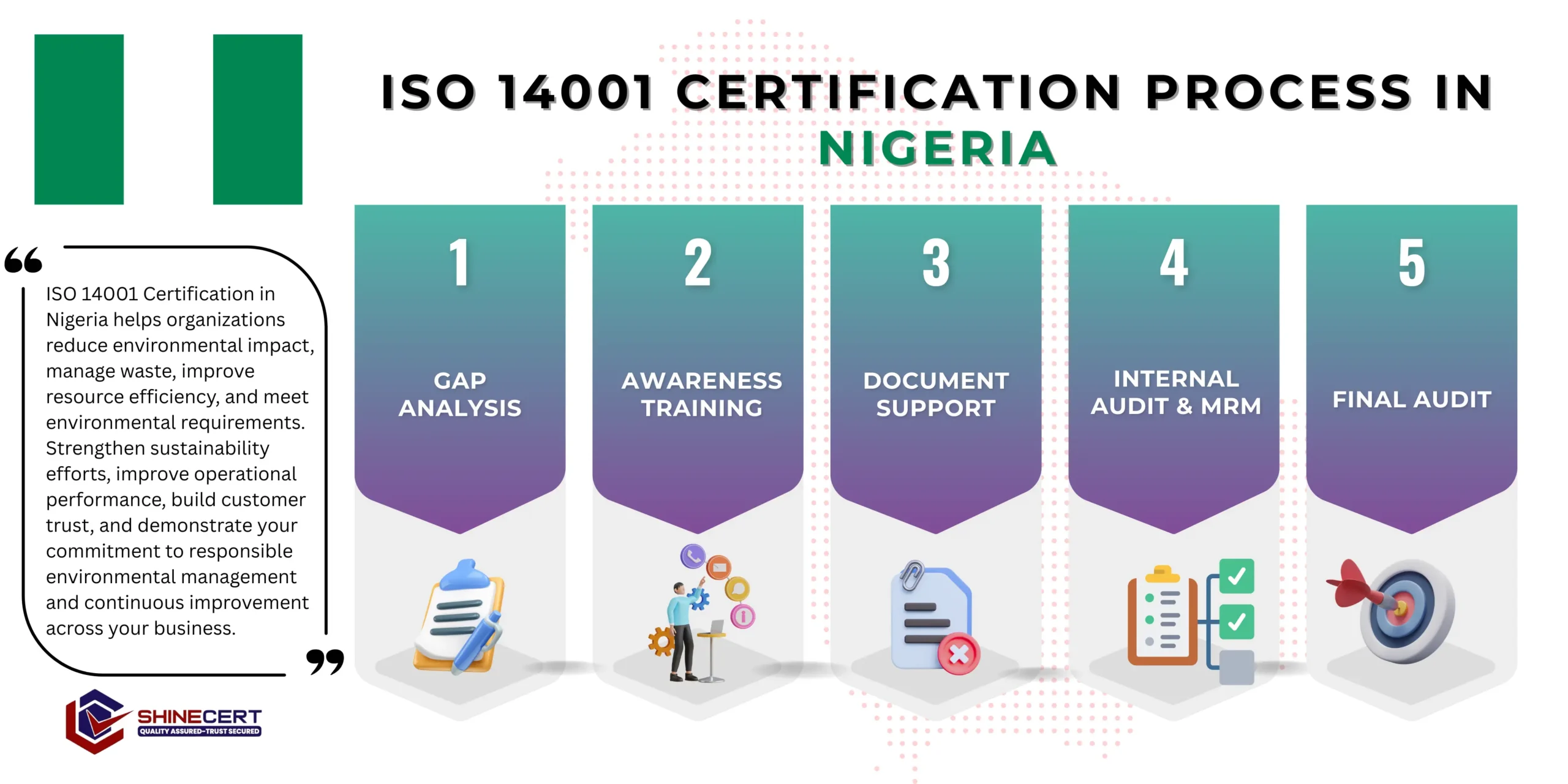
Our Five-Step Certification Process, in Depth
Gap Assessment
We walk your facility, review your existing environmental practices and any NESREA correspondence or EIA history, and identify every significant environmental aspect your operations actually generate, not a generic industry checklist, but a real accounting of your specific waste streams, emissions, and resource use. We map this against both ISO 14001's requirements and your genuine NESREA legal obligations side by side, since these two frameworks need to work together, not be treated as separate projects.
A gap report identifying your real environmental aspects, your current compliance status against NESREA's specific requirements, and exactly where ISO 14001 documentation is missing.
Documentation
We build your environmental policy, aspects and impacts register, legal requirements register, and objectives around your actual operations, a plastics manufacturer's environmental aspects register looks nothing like a logistics company's, and the documentation needs to reflect that genuinely, not generically.
A complete, version-controlled EMS documentation set, including your legal register cross-referenced directly against NESREA's applicable regulations.
Implementation
Operational controls for your significant environmental aspects go into real daily practice, waste segregation procedures actually get followed, effluent monitoring actually happens on schedule, staff handling hazardous materials get trained on the specific controls relevant to their role. This is where the system moves from documented intention to measurable practice.
A functioning EMS with real monitoring data being generated and operational controls genuinely in use across the facility.
Internal Audit and Management Review
We audit against every ISO 14001 clause and every applicable NESREA requirement, surfacing gaps while the stakes are still low. Findings go to a formal management review where leadership makes documented decisions on environmental priorities and resourcing.
An internal audit report, management review minutes with concrete decisions, and corrective actions closed out before the certification audit.
Certification Audit
Stage 1 confirms your EMS documentation is genuinely audit-ready; Stage 2 has the auditor visit your facility, observe operational controls in practice, and verify your environmental monitoring data is real and consistent. We stay engaged through both stages.
Your ISO 14001 certificate, valid for three years, plus a surveillance audit schedule.
Gap Assessment
We walk your facility, review your existing environmental practices and any NESREA correspondence or EIA history, and identify every significant environmental aspect your operations actually generate, not a generic industry checklist, but a real accounting of your specific waste streams, emissions, and resource use. We map this against both ISO 14001's requirements and your genuine NESREA legal obligations side by side, since these two frameworks need to work together, not be treated as separate projects.
A gap report identifying your real environmental aspects, your current compliance status against NESREA's specific requirements, and exactly where ISO 14001 documentation is missing.
Documentation
We build your environmental policy, aspects and impacts register, legal requirements register, and objectives around your actual operations, a plastics manufacturer's environmental aspects register looks nothing like a logistics company's, and the documentation needs to reflect that genuinely, not generically.
A complete, version-controlled EMS documentation set, including your legal register cross-referenced directly against NESREA's applicable regulations.
Implementation
Operational controls for your significant environmental aspects go into real daily practice, waste segregation procedures actually get followed, effluent monitoring actually happens on schedule, staff handling hazardous materials get trained on the specific controls relevant to their role. This is where the system moves from documented intention to measurable practice.
A functioning EMS with real monitoring data being generated and operational controls genuinely in use across the facility.
Internal Audit and Management Review
We audit against every ISO 14001 clause and every applicable NESREA requirement, surfacing gaps while the stakes are still low. Findings go to a formal management review where leadership makes documented decisions on environmental priorities and resourcing.
An internal audit report, management review minutes with concrete decisions, and corrective actions closed out before the certification audit.
Certification Audit
Stage 1 confirms your EMS documentation is genuinely audit-ready; Stage 2 has the auditor visit your facility, observe operational controls in practice, and verify your environmental monitoring data is real and consistent. We stay engaged through both stages.
Your ISO 14001 certificate, valid for three years, plus a surveillance audit schedule.
Certification Validity, Surveillance Audits, and Recertification
An ISO 14001 certificate is valid for three years from the date it’s issued. During years one and two, your certification body conducts an annual surveillance audit, narrower in scope than the original certification audit, typically checking previously identified nonconformities were genuinely closed and sampling a portion of your operational controls and monitoring records. Before the three-year mark, a full recertification audit, comparable in depth to your original Stage 2 audit, confirms your system has continued functioning throughout the cycle. Passing recertification issues a new three-year certificate. Given NESREA’s active enforcement posture, we recommend using surveillance audits as a genuine opportunity to confirm your legal register stays current against any new NESREA regulations issued since your last audit, rather than treating them as a formality.
Cost of ISO 14001 Certification in Nigeria, What Actually Drives It
| Organization Profile | Relative Investment Level | Why |
|---|---|---|
| Small, limited environmental aspects | Lower | Narrower aspects register, fewer operational controls to document and implement |
| Medium, multi-department manufacturing | Moderate | Broader environmental aspects, more extensive monitoring and training requirements |
| Larger, high-impact industrial operation | Higher | Extensive aspects register, complex monitoring systems, potentially significant emergency preparedness documentation |
| Bundled with ISO 9001 or ISO 45001 | Moderate-to-higher combined, lower than separate engagements | Shared implementation infrastructure reduces combined cost |
- Nature and scale of your environmental impact : A chemical manufacturer with genuine emissions, effluent, and hazardous waste streams needs a meaningfully more extensive environmental aspects register and set of operational controls than a business with a lighter environmental footprint, such as a professional services firm.
- Number of facilities and locations : Each additional site typically has its own environmental aspects, monitoring requirements, and NESREA-related obligations that need separate assessment and documentation.
- Existing environmental monitoring maturity : Businesses that already track emissions, effluent quality, or waste volumes aren’t starting from zero on baseline data, those with no existing monitoring face more foundational measurement work before objectives can be meaningfully set.
- Certification body fees, tracked separately from our consulting fees : The certification audit itself is conducted and invoiced by an independently accredited certification body, separate from ShineCert’s implementation work, we lay out both figures clearly before you commit.
- NESREA-related complexity, including EIA history : Businesses navigating an active or recent Environmental Impact Assessment process, or operating in sectors with more detailed NESREA-specific regulations like the 2026 Plastic Waste Control Regulations, often need more detailed legal register documentation and operational control alignment.
- Whether you’re bundling standards : Building ISO 14001 alongside ISO 9001 or ISO 45001 shares meaningful implementation infrastructure, reducing combined cost versus pursuing each separately.
- Internal capacity to contribute : An environmental, health and safety, or operations lead who can own documentation and monitoring coordination internally reduces the consulting hours the engagement requires.
ISO 14001 Benefits Nigerian Businesses Actually Get
A functioning environmental management system builds in the structured monitoring and documentation that makes it far less likely a NESREA inspection finds a genuine, costly gap, and if one does surface, demonstrable systematic management is a meaningfully stronger position than having no structure to point to at all.
ISO 14001 is understood and respected globally, giving international buyers, lenders, and partners a credential they can trust without needing to independently verify your environmental practices or understand Nigeria’s specific regulatory landscape.
Structured environmental management routinely surfaces real efficiency opportunities, reduced material waste, lower energy and water consumption, more efficient waste handling, that translate directly into operational cost savings, not just compliance value.
Businesses with a documented, functioning EMS move through EIA reviews and inspections more smoothly, since much of the baseline data and control evidence regulators ask for already exists in an organized, auditable form.
Both public tenders and private sector procurement increasingly weigh environmental management credentials, particularly for construction, manufacturing, and infrastructure contracts where environmental impact is a genuine evaluation criterion.
ISO 14001 requires identifying environmental risks specific to your actual operations, effluent discharge, hazardous material handling, emissions, and building real, documented responses, rather than discovering gaps only after a regulator does.
Certification signals genuine environmental responsibility to increasingly climate-conscious customers, investors, and partners, strengthening relationships that extend well beyond simple regulatory compliance.
ISO 14001’s Harmonized Structure makes pursuing ISO 9001 or ISO 45001 alongside or after it meaningfully more efficient, since the core management review and internal audit infrastructure carries directly across all three.
A genuine EMS gives staff a structured way to identify and raise environmental concerns, building a culture where environmental responsibility is everyone’s job, not just a compliance officer’s.
Businesses navigating the National Environmental (Plastic Waste Control) Regulations 2026 specifically benefit from ISO 14001’s structured approach to waste identification, reduction, and disposal management.
Rather than environmental management being a one-time compliance push, ISO 14001 builds ongoing monitoring and improvement into how the organization runs day to day.
Mandatory Documents Required for ISO 14001 Implementation
A documented statement defining which facilities, activities, products, and services the EMS actually covers, including which environmental aspects (emissions, effluents, waste streams) fall within that scope. Auditors and NESREA reviewers alike use this as the reference point for everything else in the system.
A documented policy, formally approved by top management, expressing genuine commitment to environmental protection, compliance with legal requirements including NESREA regulations, and continual improvement, not generic language, but a policy that connects to your organization’s actual environmental impact.
A documented record identifying the specific environmental aspects of your operations, water use, emissions, waste generation, chemical handling, and evaluating which have significant actual or potential environmental impact, forming the basis for what the rest of the system needs to control.
A documented, actively maintained list of the environmental legal requirements applicable to your operations, NESREA regulations, the EIA Act where applicable, and any sector-specific environmental rules, along with evidence of how you’re meeting each one.
Measurable environmental objectives set at relevant functions and levels, with documented plans for how they’ll actually be achieved, tracked, and reported.
Evidence that personnel whose work has genuine environmental impact, production staff handling hazardous materials, facilities managers overseeing waste disposal, have the necessary training and awareness for their specific role.
Documented procedures for controlling significant environmental aspects identified in your register, covering how waste gets handled, how effluent gets treated before discharge, how hazardous materials get stored.
Documentation of how your organization identifies and prepares for potential environmental emergencies, a chemical spill, an effluent treatment failure, including evidence that response plans have actually been tested, not just written.
Records showing you’re actually measuring your environmental performance against your objectives and legal requirements, emissions readings, effluent quality tests, waste volume tracking, not just asserting compliance without evidence.
Evidence of a planned internal audit cycle covering the whole EMS, plus documented leadership review of overall environmental performance, compliance status, and resourcing needs.
Challenges Organizations Face, Implementation, Risk Management, Audit, and Ongoing Certification
- Challenges during implementation : The most common obstacle is treating environmental management as the environmental officer’s sole responsibility rather than an organization-wide discipline, production staff who handle materials daily often have the most relevant knowledge about actual waste generation and spill risk, and systems built without their genuine input tend to miss real operational detail.
- Challenges in risk management : Businesses sometimes build an environmental aspects register that lists obvious categories (emissions, waste) without genuinely quantifying which specific aspects carry significant impact versus which are minor, this dilutes focus away from the environmental risks that actually matter most for your specific operations and NESREA’s specific regulatory attention.
- Challenges during internal and certification audits : Monitoring records that exist but aren’t consistently maintained, a gap in effluent testing during a busy production period, for instance, are one of the most common findings, since auditors specifically check for consistency over time, not just a snapshot of current practice.
- Challenges maintaining certification after the initial audit : Legal registers go stale as NESREA issues new regulations, the 2026 Plastic Waste Control Regulations are a direct example of a new requirement businesses need to actively incorporate, not something that updates itself. Organizations that treat their legal register as a one-time document rather than an actively maintained one risk falling out of alignment between their EMS and their actual legal obligations.
Case Study
- A mid-size cement and building materials manufacturer operating a production facility outside Lagos came to us after a NESREA inspection flagged inconsistent effluent monitoring records and an incomplete legal requirements register, findings that didn’t result in a shutdown, but did trigger a formal compliance timeline the business needed to satisfy within a defined window. The business had genuine environmental controls in practice (effluent treatment equipment was installed and operating), but the documentation proving consistent monitoring and legal compliance simply didn’t exist in a form NESREA’s inspectors could verify.
- Our gap assessment found the underlying environmental management was reasonably sound, the treatment equipment worked, staff generally followed reasonable waste handling practices, but nothing was systematically documented, measured against objectives, or reviewed by leadership on a genuine schedule. We built the environmental aspects register, formalized the legal requirements register directly against the specific NESREA regulations applicable to cement manufacturing, and established a real monitoring and internal audit cycle.
- The certification project ran alongside the business’s NESREA compliance timeline, and the formal EMS documentation directly supported closing out NESREA’s findings within the required window. Certification audit findings were minor, and the business has since used the certified system as a standing answer to any future NESREA inquiry, rather than scrambling to reconstruct records under regulatory pressure each time a question arises.
- This reflects a pattern we see often, genuine environmental controls in practice, but no systematic way to prove it, rather than a single specific engagement.
Industries and Sectors We Certify in Nigeria, and Which Standards Each Actually Needs
Manufacturing (plastics, chemicals, cement, processed goods)
ISO 14001 is directly relevant given NESREA's active enforcement across this sector, particularly the 2026 Plastic Waste Control Regulations for plastics manufacturers specifically; pair with ISO 9001 for quality management and ISO 45001 for workplace safety.
Read moreConstruction and civil engineering
ISO 14001 addresses the genuine environmental impact assessment and site management obligations construction projects face under the EIA Act; pair with ISO 9001 and ISO 45001 given elevated workplace injury risk on construction sites.
Read moreOil and gas services
ISO 14001 is close to essential given the sector's environmental regulatory scrutiny and EIA obligations; pair with ISO 45001 for occupational safety and ISO 9001 for quality management.
Read moreFood processing
ISO 14001 addresses effluent and waste management obligations; pair with ISO 22000 for food safety management, since environmental compliance and food safety are evaluated separately by different regulators.
Read moreWaste management and recycling
ISO 14001 is directly central to this sector's core business, particularly relevant given the emerging circular economy opportunities NESREA has specifically flagged around the 2026 plastic waste regulations.
Read moreHospitality and hotels
ISO 14001 increasingly matters for larger hospitality operations given water, waste, and energy management scrutiny; pair with ISO 9001 for service quality management.
Read moreMining and extractive industries
ISO 14001 is close to mandatory in practice given the EIA Act's explicit coverage of mining projects and the genuinely elevated environmental impact these operations carry.
Read moreWhy Choose ShineCert for ISO 9001 Certification Nigeria?
ShineCert brings 10 years of ISO consulting and certification experience to Nigeria’s market, coordinated through our Riyadh and India offices with services delivered remotely or on-site depending on what your engagement genuinely needs. We’ve guided more than 10,000 organizations through ISO certification worldwide, and we build every Nigeria environmental management engagement around your actual environmental aspects and NESREA obligations, not a generic template lifted from a different regulatory environment. ShineCert is the best ISO consultant in Nigeria.
Choosing a Certification Body in Nigeria?
|
What to Check |
Why It Matters |
|
Accreditation under a recognized international accreditation framework |
Confirms genuine, internationally recognized certification |
|
Genuine familiarity with NESREA’s regulatory framework |
Ensures the auditor understands how your legal register connects to actual Nigerian environmental law, not just generic ISO requirements |
|
Experience with your specific sector’s environmental profile |
Manufacturing, construction, and waste management carry genuinely different environmental aspects |
|
Realistic, business-specific scoping rather than a flat package price |
A credible partner scopes based on your actual environmental complexity |
Ready to Get Started?
Whether you’re responding to a NESREA compliance timeline or building environmental management proactively ahead of one, we’ll walk through your specific facility and cost factors before proposing a fixed-scope plan, delivered remotely, on-site, or however genuinely fits your project. Book a free consultation or contact us directly to get started.
Frequently Asked Questions
Look for demonstrated experience with NESREA’s specific regulatory framework, genuine familiarity with your sector’s environmental aspects, and transparent scoping rather than flat package pricing. ShineCert scopes every Nigeria engagement individually.
No, ISO 14001 doesn’t replace your legal requirement to comply with NESREA regulations, but it gives you the structured management system that makes meeting those obligations consistent and demonstrable, and the two work together directly in your legal requirements register.
It genuinely depends on the nature and scale of your environmental impact, number of facilities, and existing monitoring maturity, we scope every project individually.
Typically three to eight months depending on organizational size and environmental complexity, see our detailed timeline breakdown above.
If your business generates plastic waste, this regulation becomes part of your legal requirements register and your operational controls need to genuinely address it, we build this directly into your EMS documentation.
Any business with genuine environmental aspects, waste generation, effluent discharge, emissions, benefits from certification, and NESREA’s regulations apply regardless of company size within covered sectors.
We build your EMS documentation to directly support closing out any NESREA findings, since the legal requirements register and operational controls ISO 14001 requires map closely onto what NESREA inspectors actually check.
Documentation work runs effectively over remote sessions, though facility walkthroughs to identify genuine environmental aspects and operational control verification benefit significantly from in-person visits, we scope the right mix per project.
ShineCert doesn’t maintain a standalone Nigeria office; we coordinate Nigeria engagements from our Riyadh and India offices, with services delivered remotely or on-site as your project requires.