
ISO 50001 Certification in Oman
Quick Answer
ISO 50001 is the international standard for energy management systems, and in Oman it aligns directly with the Authority for Public Services Regulation’s (APSR) national efficiency agenda. APSR regulates electricity, water, sewage, and gas stations, and runs a Government ESCO program conducting building energy audits alongside the “Kafaa wa Atta” initiative replacing inefficient air conditioning units for underprivileged families, reflecting a genuinely active regulatory push toward efficiency, with RO 8.8 billion in regulated-sector investment projected between 2026 and 2030. Get certified through a body accredited under the Global Accreditation Cooperation (GAC) framework. Plan for three to five months from kickoff to certificate. Cost depends on genuine factors, energy consumption profile, number of facilities, existing metering infrastructure, not a flat number, and the energy savings a properly implemented system produces often meaningfully offset the certification investment over time.
ISO 50001, Explained Simply
Strip away the technical language, and ISO 50001 is a structured way of actually reducing how much energy your business wastes, not just documenting how much it uses. You establish a genuine, measured baseline of your energy consumption, identify exactly which equipment or processes drive the bulk of it, and then track real, ongoing improvement against that baseline, turning vague energy awareness into a system that produces measurable cost savings.
For a client trying to decide whether it’s worth pursuing: unlike many compliance-oriented certifications, this one tends to pay for itself. The same structured measurement that satisfies an auditor also identifies genuine, quantifiable waste you can eliminate, often at zero or low capital cost.
Oman Market Snapshot: Key Facts for ISO 50001
- National regulator: the Authority for Public Services Regulation (APSR) regulates electricity, water, sewage, and gas stations across Oman.
- Government ESCO program: APSR runs a program conducting building energy audits, identifying genuine efficiency opportunities in government and commercial facilities.
- Kafaa wa Atta initiative: a national program replacing inefficient air conditioning units for underprivileged families, reflecting a genuinely broad national efficiency push beyond just commercial and industrial sectors.
- Regulated-sector investment: APSR projects RO 8.8 billion in regulated-sector investment between 2026 and 2030, alongside new EV charging station regulations signaling continued infrastructure evolution.
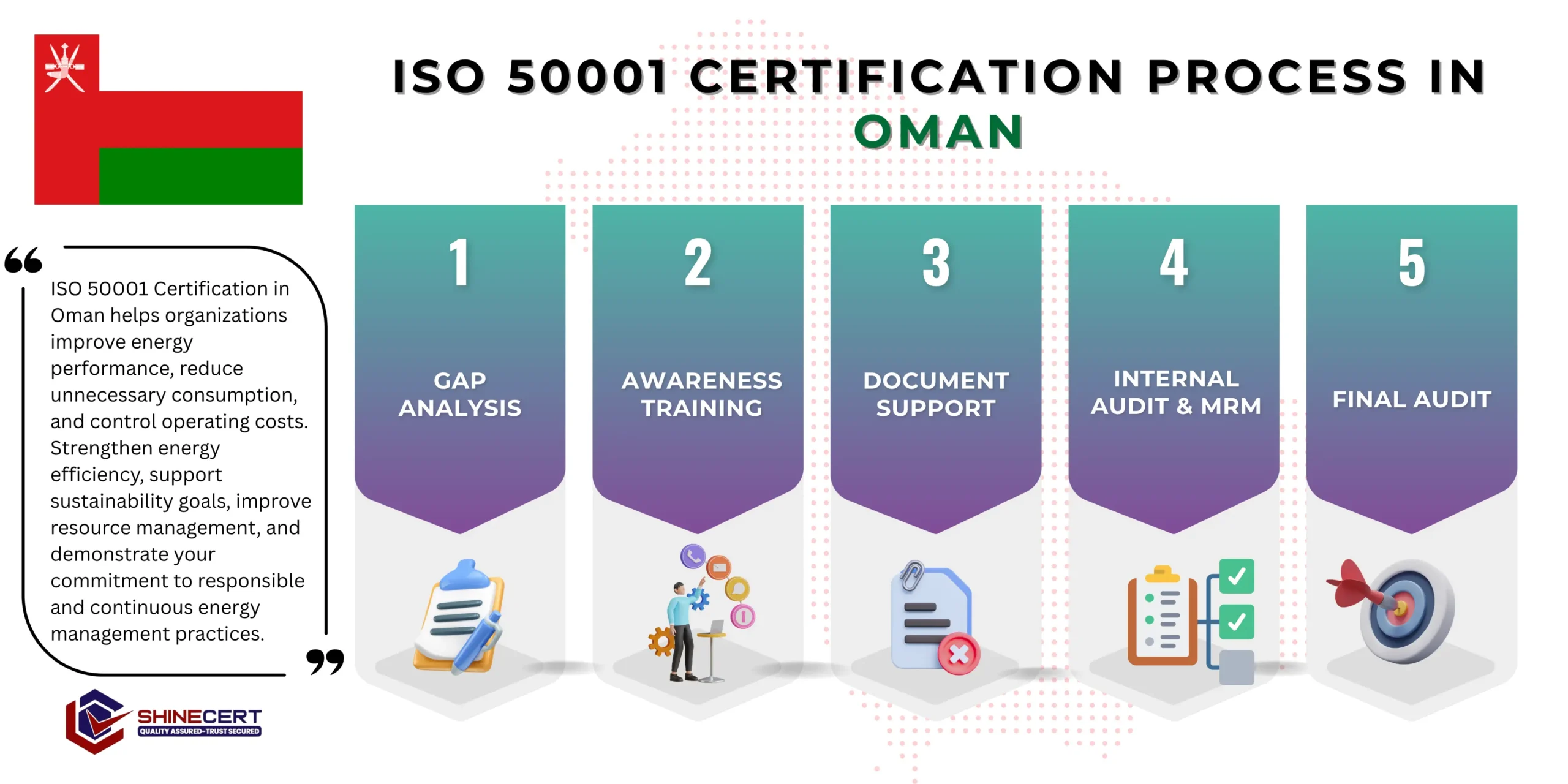
What are the steps to get ISO 50001 Certification in Oman?
our services
- ISO Certification Oman
- ISO 9001 Certification Oman
- ISO 14001 Certification Oman
- ISO 27001 Certification Oman
- ISO 22000 Certification Oman
- ISO 45001 Certification Oman
- ISO 13485 Certification Oman
- ISO 17025 Certification Oman
- ISO 31000 Certification Oman
- ISO 22301 Certification Oman
- ISO 27701 Certification Oman
- ISO 37001 Certification Oman
- ISO 50001 Certification Oman
- CE Mark Certification Oman
- GMP Certification Oman
- Halal Certification Oman
- SOC Certification Oman
major citys
Our Five-Step Certification Process: What to Actually Expect
Gap Assessment and Energy Review
We evaluate your current energy management practices and conduct an initial review identifying significant energy uses and improvement opportunities.
A clear, data-driven picture of where your genuine energy savings potential actually lies, before committing to a broader implementation budget.
A gap assessment and initial energy review report specific to your facilities.
Documentation Development
Your energy policy, baseline, Energy Performance Indicators, and management plans get built around your actual consumption data.
EnPIs that genuinely reflect your operations, normalized for relevant variables like production volume or weather, not distorted metrics that mask real performance.
A complete ISO 50001 documentation set.
Implementation and Training
Controls roll out across significant energy uses, with facilities and operations staff trained on their specific role in maintaining and improving energy performance.
Your team develops genuine habits around monitoring and responding to energy performance data, not a one-time efficiency push that fades.
Training records and evidence of controls functioning across significant energy uses.
Internal Audit and Management Review
We test whether the system is genuinely producing measurable improvement against your baseline before the real audit.
Gaps between documented intent and genuine energy performance improvement get caught and closed.
Internal audit report, management review minutes, and interim energy performance data.
Certification Audit
Stage 1 and Stage 2 audits with a GAC-accredited certification body.
Stage 1 checks documentation readiness; Stage 2 verifies the system genuinely demonstrates energy performance improvement against your baseline.
Your ISO 50001 certificate and a surveillance audit schedule.
Gap Assessment and Energy Review
We evaluate your current energy management practices and conduct an initial review identifying significant energy uses and improvement opportunities.
A clear, data-driven picture of where your genuine energy savings potential actually lies, before committing to a broader implementation budget.
A gap assessment and initial energy review report specific to your facilities.
Documentation Development
Your energy policy, baseline, Energy Performance Indicators, and management plans get built around your actual consumption data.
EnPIs that genuinely reflect your operations, normalized for relevant variables like production volume or weather, not distorted metrics that mask real performance.
A complete ISO 50001 documentation set.
Implementation and Training
Controls roll out across significant energy uses, with facilities and operations staff trained on their specific role in maintaining and improving energy performance.
Your team develops genuine habits around monitoring and responding to energy performance data, not a one-time efficiency push that fades.
Training records and evidence of controls functioning across significant energy uses.
Internal Audit and Management Review
We test whether the system is genuinely producing measurable improvement against your baseline before the real audit.
Gaps between documented intent and genuine energy performance improvement get caught and closed.
Internal audit report, management review minutes, and interim energy performance data.
Certification Audit
Stage 1 and Stage 2 audits with a GAC-accredited certification body.
Stage 1 checks documentation readiness; Stage 2 verifies the system genuinely demonstrates energy performance improvement against your baseline.
Your ISO 50001 certificate and a surveillance audit schedule.
What Is ISO 50001, Technically Speaking?
- Built around measurable performance, not just documentation : ISO 50001 follows the Harmonized Structure shared with ISO 9001 and ISO 14001, but its technical core is built around a concept genuinely distinct from other management system standards: Energy Performance Indicators (EnPIs) measured against an Energy Baseline (EnB). The standard is fundamentally about measurable, ongoing energy performance improvement, not just energy-related documentation.
- The energy review : The technical process begins with an energy review (Clause 6.3), which requires organizations to analyze energy use and consumption based on measurement and other data, identify areas of significant energy use, and identify opportunities for improving energy performance. This isn’t a one-time audit, the standard expects the energy review to be updated at defined intervals and when significant changes occur.
- Significant energy uses and normalization : A technically important feature is the standard’s treatment of “significant energy uses” (SEUs), the specific equipment, systems, or processes accounting for substantial energy consumption or offering substantial potential for improvement. Organizations identify relevant variables affecting these SEUs, production rate, weather, occupancy, and establish appropriate energy baselines normalized for these variables, so a genuine efficiency improvement isn’t masked by, say, a hotter summer increasing cooling load.
- Energy consideration built into design and procurement : ISO 50001 also formally requires organizations to consider energy performance in the design of new, modified, and renovated facilities, equipment, systems, and processes (Clause 8.2), pushing energy efficiency consideration upstream into capital planning, not just operational management of existing infrastructure.
- Procurement gets explicit attention too : Procurement (Clause 8.3) requires organizations to inform suppliers that procurement is partly evaluated on energy performance, and to establish criteria for assessing energy use, consumption, and efficiency over the planned operating lifetime when procuring energy-using products, equipment, and services, directly relevant to Oman’s broader efficiency push, including initiatives like Kafaa wa Atta’s focus on equipment replacement.
Why This Matters So Much in Oman Specifically?
- Oman’s energy landscape is genuinely evolving as the country diversifies away from oil dependence, and APSR’s regulatory activity, the Government ESCO program’s building energy audits, the Kafaa wa Atta initiative, new EV charging station regulations, and RO 8.8 billion in projected regulated-sector investment through 2030, reflects a national efficiency agenda that touches government, commercial, and even residential sectors. This is a genuinely active, evolving regulatory environment, not a static compliance checklist.
- For commercial building operators and manufacturers, this creates a genuine alignment between regulatory direction and direct cost savings: a properly implemented ISO 50001 system doesn’t just demonstrate compliance-oriented good practice, it produces measurable energy cost reductions that matter as Oman’s energy market continues evolving. One pattern we frequently see in Oman: organizations treat energy management as a facilities-department concern disconnected from broader business strategy, missing the genuine cost-reduction opportunity a properly measured system actually delivers.
What Actually Drives Your Cost?
We don’t quote a flat number, because a flat number would misrepresent how different two Oman organizations’ actual energy profile can be. Here’s what genuinely drives cost.
- Nature and energy intensity of your operations : A manufacturing facility with substantial equipment-driven consumption needs meaningfully more analysis depth than a low-intensity office environment.
- Number of facilities : Each additional site generally needs its own energy review and baseline, since consumption patterns and equipment differ meaningfully between locations, including across Duqm, Sohar, and Salalah.
- Existing metering and monitoring infrastructure : Facilities with sub-metering already in place need less investment in measurement infrastructure than those relying solely on a single utility meter for an entire operation.
- Number and complexity of significant energy uses : A facility with one or two dominant energy-consuming systems is a genuinely smaller project than one with many distinct significant energy uses each needing separate analysis.
- How mature your existing energy practices already are : Organizations with some existing monitoring or efficiency initiatives aren’t starting from zero. Organizations with no structured tracking need more foundational work.
- Whether you’re bundling with other standards : Pursuing ISO 14001 alongside ISO 50001 shares meaningful implementation and audit infrastructure.
- Your internal capacity to lead parts of the work : An internal facilities or engineering lead who can own energy data analysis reduces consultant hours needed.
- Riyada funding eligibility : Where your project qualifies for co-funding, your genuine out-of-pocket cost can be meaningfully lower.
- Timeline urgency : A compressed timeline driven by a customer sustainability questionnaire deadline sometimes needs more concentrated consultant hours in a shorter window.
Because these factors genuinely interact, we scope every project individually after a short conversation about your specific facilities and energy consumption profile.
Riyada Funding: Does Your ISO 50001 Project Qualify for Subsidy?
Riyada’s training and business development programs can apply to energy management system implementation, depending on your company’s size, sector, and program eligibility. We generally recommend checking your Riyada eligibility before finalizing your certification budget, particularly since the direct energy cost savings ISO 50001 tends to further improve the overall project economics.
Mandatory Documents Required for Certification
- Energy policy. Genuine leadership commitment specific to your organization’s energy profile : What it should contain: a clear statement of your commitment to energy performance improvement, compliance with applicable requirements, and a framework for setting and reviewing energy objectives.
- Scope of the energy management system : Documented, defining exactly which facilities and significant energy uses are covered. What it should contain: the specific facilities, equipment, and processes included, with justification for any exclusions.
- Energy review and baseline : Reflecting your actual consumption data, updated at defined intervals. What it should contain: identified significant energy uses, current consumption levels, and the baseline period used for comparison.
- Energy Performance Indicators : Appropriate to your operations and normalized for relevant variables. What it should contain: the specific metric used for each significant energy use, and the normalization variables applied.
- Energy objectives, targets, and action plans : Measurable, tied to genuine improvement opportunities identified in the energy review. What it should contain: specific numeric targets, timelines, and the actions planned to achieve them.
- Records of monitoring, internal audits, and management reviews : Evidence of genuine, ongoing performance tracking. What it should contain: monitoring data, audit findings, and management review decisions with follow-up actions.
What Happens When an Oman Business Operates Without Structured Energy Management?
- This is worth understanding concretely. Without a structured energy management system, most organizations don’t lack energy awareness entirely, utility bills get paid and occasionally scrutinized, but they typically lack the ability to distinguish genuine efficiency improvement or decline from other factors like production volume, occupancy, or weather, making it genuinely difficult to identify real savings opportunities or demonstrate real progress to customers and regulators. In a diversifying energy economy like Oman’s, this isn’t just a missed compliance opportunity, it’s an ongoing, quantifiable cost left on the table.
- Businesses that discover meaningful inefficiencies only through a one-off energy audit, rather than ongoing structured monitoring, often find the same inefficiencies have been quietly costing money for years by the time they’re identified. We generally recommend Oman manufacturers and large commercial building operators treat ISO 50001 as standing infrastructure for continuous improvement, not a one-time efficiency project.
Energy Management Requirements, Clause by Clause
- Context of the Organization (Clause 4) : Mapping your genuine energy use context, which facilities, equipment, and processes consume meaningful energy, and which interested parties (APSR, tenants, customers) have a stake in your energy performance.
- Leadership (Clause 5) : Top management accountability for energy performance, including genuine commitment to providing resources needed for measurable improvement, not just a signed energy policy.
- Planning (Clause 6) : The energy review, baseline establishment, and Energy Performance Indicator selection, the technical heart of the entire system.
- Support (Clause 7) : Competence and awareness requirements ensuring staff genuinely understand their role in energy performance, particularly facilities and operations personnel managing significant energy uses.
- Operation (Clause 8) : Operational controls over significant energy uses, plus the specific design and procurement requirements pushing energy consideration into capital planning.
- Performance Evaluation (Clause 9) : Monitoring, measurement, and analysis of energy performance against the baseline, testing whether the system is genuinely producing measurable improvement, not just documentation.
- Improvement (Clause 10) : Structured handling of energy performance nonconformities, feeding lessons back into the energy review cycle.
Case Study: An Oman Manufacturing Facility’s Energy Performance Buildout
The following is an illustrative, composite example based on the kind of project ShineCert typically runs, not a specific named client. An Omani light manufacturing facility had reasonably modern equipment but no structured energy monitoring, utility bills were paid and filed, but nobody had systematically analyzed which specific equipment or processes drove the bulk of consumption, or whether consumption patterns reflected genuine efficiency or simply reflected production volume changes. The trigger was rising energy costs combined with a multinational customer’s sustainability questionnaire asking specifically about energy management practices.
The energy review found that a small number of aging compressed-air units accounted for a disproportionate share of the facility’s electricity consumption relative to their actual production contribution, a genuine, previously unidentified significant energy use. The bulk of implementation work went into establishing a proper energy baseline normalized for production volume, replacing the identified inefficient equipment, and building ongoing monitoring that could distinguish genuine efficiency change from production-volume-driven consumption change. Certification was achieved alongside a measurable reduction in energy cost per unit produced, and the pattern we typically see afterward held: the normalized EnPI approach let the facility confidently demonstrate genuine efficiency gains to its multinational customer, rather than an ambiguous total consumption figure that could be explained away by production changes in either direction.
Benefits at a Glance
- Direct alignment with APSR’s Government ESCO program and national efficiency agenda
- Measurable energy cost savings, not just compliance documentation
- Government tender eligibility and stronger positioning with efficiency-conscious clients
- Increased partner and lender trust in your operational efficiency
- Access to potential Riyada funding support
- A foundation that transfers cleanly into ISO 14001 or ISO 9001
Benefits: What Certification Actually Changes
Unlike many compliance-oriented certifications, ISO 50001’s core requirement for demonstrable energy performance improvement translates directly into reduced energy spend over time, a genuine financial return alongside the compliance benefit.
Certification gives organizations a credible, internationally recognized framework that directly supports Government ESCO program goals and broader efficiency initiatives.
Pushing energy consideration into design and procurement decisions reduces the risk of building or buying inefficient infrastructure that becomes an expensive, hard-to-fix mistake for years afterward.
Certification is increasingly a genuine differentiator for organizations serving multinational clients or seeking project finance with sustainability requirements.
Depending on eligibility, certification-related training and consulting costs may be partially offset through Riyada’s programs.
Applicable Standards by Industry
Manufacturing
Facilities with substantial equipment-driven energy consumption, particularly in Sohar's industrial corridor, find ISO 50001 delivers genuine, measurable cost reduction alongside compliance benefits.
Read moreCommercial real estate and building management
Operators of large commercial buildings use ISO 50001 to structure efficiency compliance and demonstrate performance to tenants.
Read moreHospitality
Hotels and resorts, with genuinely significant HVAC and equipment-driven consumption, use ISO 50001 to control operating costs and support sustainability positioning.
Read moreRenewable energy manufacturing
Companies in Duqm's wind and solar component manufacturing sector use ISO 50001 to demonstrate energy efficiency credibility consistent with their own industry.
Read moreRetail and logistics
Operators of large retail or warehouse facilities, including those in Salalah's logistics hub, use ISO 50001 to manage HVAC and refrigeration-driven consumption.
Read moreWhy Choose ShineCert for ISO 50001 Certification Oman?
ShineCert brings 10 years of ISO consulting and certification experience to every Oman engagement, coordinated from our Riyadh and Lebanon offices with direct familiarity with APSR’s Government ESCO program, national efficiency initiatives, and Riyada’s funding programs. Our team has guided more than 10,000 organizations through ISO certification globally, and we build every Oman energy management engagement around your actual facilities, consumption profile, and funding eligibility, with genuine focus on measurable savings alongside compliance.
Choosing a Certification Body in Oman?
What to Check | Why It Matters |
Accreditation under the GAC framework | Confirms genuine, internationally recognized certification |
Genuine technical energy engineering expertise | Ensures the auditor can meaningfully assess whether EnPIs and baselines are properly normalized |
Familiarity with APSR’s Government ESCO program and efficiency initiatives | Ensures your system genuinely aligns with Oman’s national efficiency framework |
Sector-specific energy audit experience | Manufacturing, hospitality, and commercial real estate each involve meaningfully different energy profiles |
Common Pitfalls We See in Oman ISO 50001 Projects
- Using unnormalized consumption data as an EnPI : Comparing raw total consumption year over year without normalizing for production volume, occupancy, or weather produces misleading conclusions about genuine efficiency performance.
- Treating the energy review as a one-time exercise : The standard expects periodic review updates and updates after significant operational changes, a static review from the certification’s first year quickly becomes disconnected from current reality.
- Underestimating design and procurement integration : Companies that build strong operational energy controls but never extend consideration into new equipment purchasing or facility design decisions miss a substantial, genuinely durable source of improvement.
- Focusing exclusively on compliance rather than genuine savings : Organizations that treat ISO 50001 as a checkbox exercise miss the standard’s real commercial value, genuine energy cost reduction that matters as much as regulatory alignment.
Ready to Get Started?
ShineCert, the best ISO consultant in Oman, supports Oman businesses from initial gap assessment through certification audit, including checking whether your project qualifies for Riyada funding support. Book a free consultation or contact us directly, and we’ll walk through your specific energy profile and cost factors before proposing a fixed-scope plan.
Frequently Asked Questions
It’s the international standard for energy management systems, requiring organizations to establish a measured baseline and demonstrate genuine, ongoing energy performance improvement against it.
It genuinely depends on factors like energy intensity, number of facilities, and existing metering infrastructure, we scope every project individually.
Both, the standard’s core requirement for measurable energy performance improvement typically produces genuine, ongoing energy cost reduction alongside compliance and reputational benefits.
Not as a blanket mandate, but it directly supports and structures alignment with the Government ESCO program and broader national efficiency initiatives.
Typically three to five months.
Potentially, Riyada’s training and development programs can apply to certification-related costs depending on eligibility.
A metric measuring your organization’s energy performance, normalized for relevant variables like production volume or weather, so genuine efficiency change isn’t masked by unrelated factors.
Equipment, systems, or processes accounting for substantial energy consumption or offering substantial potential for improvement, identified through a structured energy review, not assumed.
Yes, each facility generally needs its own energy review and baseline given different equipment and consumption patterns.
We coordinate Oman engagements from our Riyadh and Lebanon offices, with consultants traveling on-site as needed.