
ISO 45001 Certification in Oman
Quick Answer
ISO 45001 is the international standard for occupational health and safety management systems, and in Oman it operates alongside, not instead of , genuine statutory obligations. Royal Decree 35/2003, supplemented by Ministerial Decision 286/2008 and the newer Royal Decree 53/2023 Labour Law, sets employer OHS duties, enforced by the Ministry of Labour. Reporting deadlines are unusually specific: fatalities within 24 hours, serious injuries within 48 hours, occupational diseases within 7 days, with investigation reports due within 30 days, failure to report carries fines from OMR 20,000 to OMR 100,000. Get certified through a body accredited under the Global Accreditation Cooperation (GAC) framework. Plan for three to five months from kickoff to certificate. Cost depends on genuine factors, workforce size, site risk profile, number of locations — not a flat number, and Riyada funding may reduce your net cost.
ISO 45001, Explained Simply
Strip away the technical language, and ISO 45001 is a structured way of keeping your workers safe, identifying what could realistically hurt someone on the job, putting real controls in place, and making sure everyone actually knows what to do if something goes wrong. Instead of relying on one supervisor’s judgment or ad hoc safety talks, you build a documented system that gets independently checked by an auditor to confirm it actually works, not just that a policy exists somewhere.
For a client weighing whether it’s worth pursuing, the simplest way to think about it: it’s proof, verified by an outside party, that your business takes worker safety seriously and manages it systematically, proof that matters enormously the moment a real incident happens, a client audits your site, or a major contractor asks you to demonstrate it before awarding work.
Oman Market Snapshot: Key Facts for ISO 45001
- Primary legislation: Royal Decree 35/2003, supplemented by Ministerial Decision 286/2008 on OSH in industrial workplaces and the newer Royal Decree 53/2023 Labour Law, enforced by the Ministry of Labour’s Department of Occupational Safety and Health.
- Strict reporting clock: fatalities must be reported within 24 hours, serious injuries within 48 hours, occupational diseases within 7 days, with full investigation reports due within 30 days, failure to report carries fines from OMR 20,000 to OMR 100,000.
- Zone-driven risk profiles: OPAZ’s major economic zones, Duqm, Sohar, and Salalah, carry genuinely different occupational hazard profiles, from heavy-lift construction to industrial process risk to logistics operations.
- SME funding available: Riyada offers financing and training support that can offset certification-related costs for eligible companies.
What are the steps to get ISO 45001 Certification in Oman?
our services
- ISO Certification Oman
- ISO 9001 Certification Oman
- ISO 14001 Certification Oman
- ISO 27001 Certification Oman
- ISO 22000 Certification Oman
- ISO 45001 Certification Oman
- ISO 13485 Certification Oman
- ISO 17025 Certification Oman
- ISO 31000 Certification Oman
- ISO 22301 Certification Oman
- CE Mark Certification Oman
- GMP Certification Oman
- Halal Certification Oman
- SOC Certification Oman
major citys
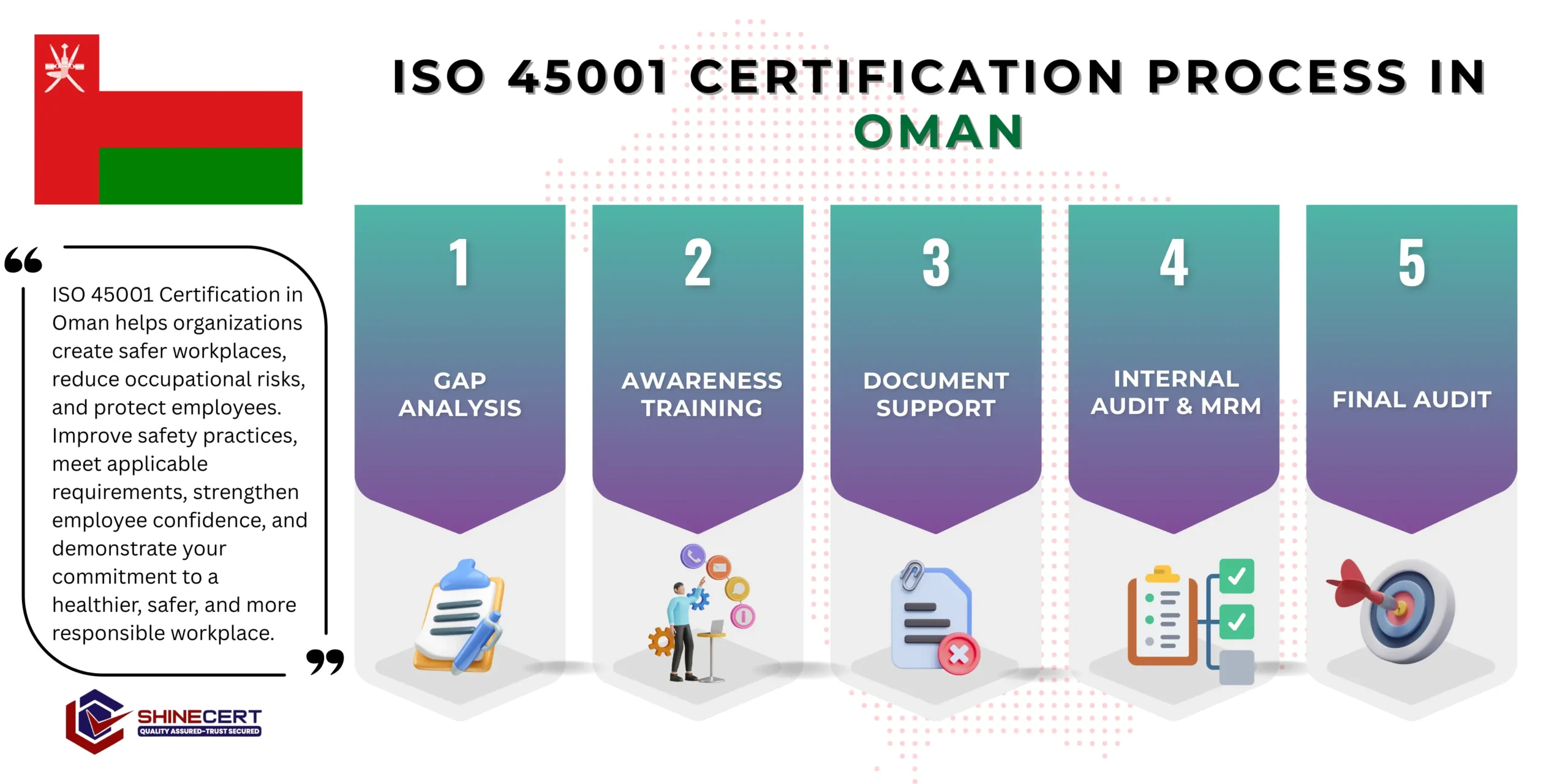
Our Five-Step Certification Process: What to Actually Expect
Gap Assessment
We evaluate your current OHS practices and Ministry of Labour compliance status against ISO 45001's requirements.
An honest picture of the real gap, including any statutory reporting compliance issues worth fixing regardless of certification.
A gap assessment report specific to your operations and site risks.
Documentation Development
Your OHS policy, hazard and risk register, and legal compliance register — including the specific Ministry of Labour reporting timelines — get built around your actual site conditions.
Documentation your own safety staff can genuinely use to meet real deadlines, not a generic binder.
A complete ISO 45001 documentation set.
Implementation and Training
Controls roll out with staff trained on hazard awareness and genuine worker participation mechanisms established.
This phase typically runs longest, since building real trust in worker consultation takes longer than writing a procedure.
Training records and evidence of worker participation functioning.
Internal Audit and Management Review
We test the system internally, surfacing weaknesses before the real audit.
Gaps get caught and fixed in a low-stakes setting.
Internal audit report and management review minutes.
Certification Audit
Stage 1 and Stage 2 audits with a GAC-accredited certification body.
Stage 1 checks documentation readiness; Stage 2 verifies the system genuinely functions on-site, including worker interviews.
Your ISO 45001 certificate and a surveillance audit schedule.
Gap Assessment
We evaluate your current OHS practices and Ministry of Labour compliance status against ISO 45001's requirements.
An honest picture of the real gap, including any statutory reporting compliance issues worth fixing regardless of certification.
A gap assessment report specific to your operations and site risks.
Documentation Development
Your OHS policy, hazard and risk register, and legal compliance register — including the specific Ministry of Labour reporting timelines — get built around your actual site conditions.
Documentation your own safety staff can genuinely use to meet real deadlines, not a generic binder.
A complete ISO 45001 documentation set.
Implementation and Training
Controls roll out with staff trained on hazard awareness and genuine worker participation mechanisms established.
This phase typically runs longest, since building real trust in worker consultation takes longer than writing a procedure.
Training records and evidence of worker participation functioning.
Internal Audit and Management Review
We test the system internally, surfacing weaknesses before the real audit.
Gaps get caught and fixed in a low-stakes setting.
Internal audit report and management review minutes.
Certification Audit
Stage 1 and Stage 2 audits with a GAC-accredited certification body.
Stage 1 checks documentation readiness; Stage 2 verifies the system genuinely functions on-site, including worker interviews.
Your ISO 45001 certificate and a surveillance audit schedule.
What Is ISO 45001, Technically Speaking?
- From OHSAS 18001 to a genuine ISO standard : ISO 45001 replaced OHSAS 18001 in 2018 as the internationally recognized occupational health and safety management system standard, and the shift was more than a rebrand, OHSAS 18001 was a British Standards Institution specification, while ISO 45001 is a genuine ISO management system standard built on the Harmonized Structure shared with ISO 9001, ISO 14001, and ISO 27001. An organization already running ISO 9001 or ISO 14001 can integrate ISO 45001 into the same management review and internal audit infrastructure rather than building a parallel system.
- Worker participation goes beyond a suggestion box : The standard’s most technically significant feature is worker participation and consultation under Clause 5.4. It requires genuine, documented mechanisms for workers, including non-managerial staff, to participate in hazard identification, incident investigation, and the development of OHS policy and objectives. This reflects a deliberate philosophical position: workers doing the actual work often have the clearest visibility into genuine hazards, and a system that doesn’t structurally involve them is treated as incomplete.
- Hazard identification versus risk assessment : Clause 6 planning requirements carry a specific technical distinction: a hazard is a potential source of harm (a forklift operating in a warehouse aisle), while the risk assessment evaluates the likelihood and severity of that hazard causing actual harm given existing controls. Clause 8.1.2 then requires organizations to apply a defined hierarchy of controls: elimination first, then substitution, then engineering controls, then administrative controls, and personal protective equipment last. Auditors specifically test whether an organization actually worked down this hierarchy rather than jumping straight to handing out PPE.
- Root causes versus immediate causes : Clause 10.2’s approach to incident investigation requires distinguishing root causes from immediate causes, an immediate cause might be a worker not wearing a harness, while the root cause might be inadequate harness availability or unrealistic production pressure discouraging proper PPE use. A system that only documents immediate causes tends to see the same incident type recur.
- Legal compliance in Oman specifically : Clause 6.1.3’s legal compliance requirement means your OHS management system needs to explicitly incorporate Royal Decree 35/2003, Ministerial Decision 286/2008, and the specific reporting timelines above as genuine, tracked legal obligations, not treat ISO 45001 as a separate international overlay disconnected from Oman’s actual statutory framework.
Why This Matters So Much in Oman Specifically?
Most generic ISO 45001 implementations build an incident reporting procedure with vague internal timelines, “report promptly,” “notify management as soon as possible.” That doesn’t work in Oman, where the Ministry of Labour’s reporting deadlines are specific, short, and carry real financial penalties for missing them. A fatality report has to move within 24 hours; a serious injury requiring hospitalization within 48; and even where the injury is less severe, a lost-time injury still needs reporting within 7 days, with a full investigation report due within 30. Building your incident management procedure around these exact clocks, not a vague internal standard, is the difference between an OHS system that genuinely protects you from Ministry of Labour penalties and one that looks compliant on paper but fails the moment a real incident tests it.
The zone-driven risk effect is genuinely distinctive in Oman. Duqm’s renewable-manufacturing buildout brings crane operations and construction-adjacent risk; Sohar’s heavy industry corridor carries confined space and chemical handling risk; Salalah’s logistics and port operations carry heavy equipment and forklift risk. A safety system built without genuine reference to which of these environments applies tends to under-prepare for the specific hazards workers actually face day to day.
Riyada Funding: Does Your ISO 45001 Project Qualify for Subsidy?
Riyada’s financing and training programs can apply to occupational health and safety management system implementation, depending on your company’s size, sector, and program eligibility. We generally recommend checking your Riyada eligibility before finalizing your certification budget, since co-funded training support can meaningfully reduce your effective cost. Eligibility criteria shift over time, so confirm current terms directly with Riyada or a consultant familiar with the current program cycle.
What Actually Drives Your Cost?
We don’t quote a flat number, because a flat number would misrepresent how different two Oman companies’ actual OHS risk profiles can be. Here’s what genuinely drives cost.
- Nature and risk level of your operations : A low-risk office environment needs meaningfully less documentation and control depth than a construction site or industrial facility with genuine physical hazards.
- Which zone you operate in : Duqm’s construction and heavy-lift risk, Sohar’s industrial process risk, and Salalah’s logistics risk each need different documentation emphasis.
- Number of sites : Each additional site generally needs its own hazard identification and risk assessment, since site conditions vary meaningfully even within the same company.
- Number of employees : More workers means more training to deliver and a larger pool for auditors to interview, and a larger worker participation mechanism to structure and evidence.
- How mature your existing safety practices already are : Companies with functioning toolbox talks and some incident tracking aren’t starting from zero. Companies where safety knowledge lives entirely with one supervisor need more foundational work.
- Whether you’re bundling with other standards : Pursuing ISO 14001 or ISO 9001 alongside ISO 45001 shares meaningful implementation and audit infrastructure.
- Your internal capacity to lead parts of the work : An internal safety officer who can own documentation and coordinate training reduces consultant hours needed.
- Riyada funding eligibility : Where your project qualifies for co-funding, your genuine out-of-pocket cost can be meaningfully lower.
- Timeline urgency : A compressed timeline driven by a bid deadline sometimes needs more concentrated consultant hours in a shorter window.
Mandatory Documents Required for Certification
- OHS policy : Genuine leadership commitment specific to your operations. What it should contain: a clear statement of your commitment to worker safety, compliance with applicable legal requirements, and a framework for setting and reviewing OHS objectives, signed off by top management.
- Scope of the OHS management system : Documented, defining exactly which sites and activities are covered. What it should contain: the specific sites, processes, and activities included, with justification for any exclusions.
- Hazard identification and risk assessment register : Reflecting your actual site conditions and zone. What it should contain: every identified hazard, the associated risk level, existing controls, and any additional controls required under the hierarchy of controls.
- Legal and other compliance requirements register : Mapped to Royal Decree 35/2003, Ministerial Decision 286/2008, and the specific Ministry of Labour reporting deadlines. What it should contain: each applicable legal requirement, how you meet it, and evidence of periodic compliance evaluation.
- OHS objectives and plans to achieve them : Measurable, tied to genuine risk reduction priorities. What it should contain: specific targets, such as incident rate reduction, who owns each objective, and the timeline for achieving it.
- Incident investigation, internal audit, and management review records : Evidence of genuine, ongoing oversight. What it should contain: incident details, root-cause analysis, corrective actions taken, and verification that the reporting deadline was met.
What Happens When an Oman Company Bids Without Certification on a Safety-Scored Project?
- This is worth understanding concretely. When a major contractor, lender, or insurer expects ISO 45001 as part of pre-qualification, an uncertified Oman company isn’t always disqualified outright, but it often faces additional safety audits, higher insurance premiums, or exclusion from shortlists that certified competitors bypass. Beyond the pre-qualification risk, missing a Ministry of Labour reporting deadline carries a direct financial penalty of OMR 20,000 to OMR 100,000, independent of whatever other consequences the underlying incident produces.
- Companies that discover their reporting procedure doesn’t genuinely meet Ministry of Labour timelines usually find out during an actual incident, exactly the worst moment to discover the gap. We generally recommend Oman contractors and industrial employers verify their reporting procedure against the actual statutory clock now, not after an incident forces the question.
Occupational Health & Safety Requirements, Clause by Clause
- Context of the Organization (Clause 4) : Mapping your genuine workplace hazards and interested parties, for an Oman employer, this explicitly includes the Ministry of Labour’s reporting framework as part of your operating context.
- Leadership and Worker Participation (Clause 5) : Beyond leadership commitment, this clause requires documented mechanisms for worker involvement in hazard identification, a genuine, evidenced process, not a token consultation.
- Planning (Clause 6) : Hazard identification, risk assessment, and legal compliance obligations, mapping Royal Decree 35/2003 and Ministerial Decision 286/2008 as tracked legal requirements.
- Support (Clause 7) : Competence and training requirements ensure workers genuinely understand hazards relevant to their role, tested through worker interviews during audits.
- Operation (Clause 8) : Operational controls following the hierarchy of controls, plus emergency preparedness specific to your actual site risks. One pattern we frequently see in Oman implementations: companies build a single generic emergency plan for all sites, when a Duqm construction site, a Sohar processing facility, and a Salalah warehouse each genuinely need a different response plan reflecting their actual hazards.
- Performance Evaluation (Clause 9) : Monitoring and internal audit test whether the system is genuinely reducing incidents, not just generating paperwork.
- Improvement (Clause 10) : Root-cause incident investigation and structured nonconformity handling, distinguishing immediate causes from underlying systemic causes.
Case Study: A Duqm Contractor’s Safety System Buildout
- The following is an illustrative, composite example based on the kind of project ShineCert typically runs, not a specific named client. A Duqm-based construction contractor with around 120 workers had a functioning but informal safety culture, toolbox talks happened, PPE was generally worn, but incident investigation rarely went beyond “worker error,” and the company’s internal reporting timeline for incidents ran on a vague “report to the site manager promptly” standard with no explicit tie to the Ministry of Labour’s actual deadlines. The trigger was a near-miss involving lifting equipment that made clear the company’s reporting procedure would not have met the 48-hour serious-injury deadline had the incident been worse.
- The gap assessment found the company’s day-to-day practices were reasonably sound, but its incident investigation stopped at the immediate cause almost every time, and its reporting procedure had never been mapped against the actual Ministry of Labour clock. The bulk of implementation work went into rebuilding the incident reporting procedure around the specific 24-hour, 48-hour, and 7-day deadlines, establishing genuine root-cause investigation habits, and building a structured worker participation mechanism through site safety committees. Certification was achieved, and the pattern we typically see afterward held: incident rates dropped measurably in the following year, and, critically, when a real reportable incident did occur, the company met its Ministry of Labour deadline without the scramble the near-miss had exposed as a real risk.
Benefits at a Glance
- Documented alignment with Ministry of Labour reporting deadlines and compliance expectations
- Government tender eligibility and stronger positioning in Duqm, Sohar, and Salalah contractor pre-qualification
- Increased client and insurer trust in your safety management
- International recognition that supports multinational partnerships
- Access to potential Riyada funding support
- Fewer workplace incidents and reduced associated cost
- A foundation that transfers cleanly into ISO 14001 or ISO 9001 later
Certification: What Actually Changes
Certification forces you to build a documented reporting procedure tied to the actual 24-hour, 48-hour, and 7-day deadlines, reducing the real risk of a missed window and the OMR 20,000–100,000 penalty that follows.
A genuinely functioning hazard identification and control system reduces injuries, and with them, the direct and indirect costs of workplace incidents.
Certification is frequently the practical baseline for contractor pre-qualification across Duqm, Sohar, and Salalah developments.
A certificate gives clients, lenders, and insurers independent, third-party proof that your business manages workplace safety systematically.
ISO 45001 is recognized globally, which matters when courting multinational partners with their own safety due-diligence requirements.
The structured worker participation requirements tend to surface real hazards that management alone would miss, and improve morale by giving workers a genuine voice in safety decisions.
Depending on eligibility, certification-related training and consulting costs may be partially offset through Riyada’s programs.
Applicable Standards by Industry
Construction, particularly in Duqm
Contractors bidding on major developments regularly find ISO 45001 either explicitly required or heavily favored in pre-qualification.
Read moreOil, gas, and industrial services, particularly in Sohar
Contractors serving heavy industry routinely need ISO 45001 alongside ISO 14001 for major-project eligibility.
Read moreLogistics and warehousing, particularly in Salalah
Operations involving heavy equipment use ISO 45001 to demonstrate structured safety management to insurers and partners.
Read moreManufacturing
Facilities with genuine physical production risk use ISO 45001 as baseline evidence of systematic hazard control.
Read moreFree zone service providers
Contractors delivering services within OPAZ-governed zones increasingly find ISO 45001 requested as a condition of working within the zone.
Read moreWhy Choose ShineCert for ISO 45001 Certification Oman?
ShineCert brings 10 years of ISO consulting and certification experience to every Oman engagement, coordinated from our Riyadh and Lebanon offices with direct familiarity with Royal Decree 35/2003, Ministerial Decision 286/2008, and the safety realities of Duqm, Sohar, and Salalah specifically. Our team has guided more than 10,000 organizations through ISO certification globally, across sectors including construction, manufacturing, logistics, and oil and gas, the same industries that make up the bulk of our Oman safety management client base. We build every Oman engagement around your actual site risks and workforce size, not a one-size-fits-all package.
Choosing a Certification Body in Oman?
What to Check | Why It Matters |
Accreditation under the GAC framework | Confirms genuine, internationally recognized certification |
Experience with Ministry of Labour reporting requirements | Ensures the auditor understands actual statutory obligations |
Track record in Duqm, Sohar, or Salalah | These zones involve genuinely different hazard profiles |
Sector-specific safety audit experience | Construction, industrial, and logistics differ meaningfully |
Common Pitfalls We See in Oman ISO 45001 Projects
- Building a reporting procedure around vague internal timelines instead of the actual Ministry of Labour deadlines : A “report promptly” standard doesn’t satisfy the specific 24-hour, 48-hour, and 7-day clocks the law actually requires.
- Stopping incident investigation at the immediate cause : Companies that document “worker error” without digging into the underlying systemic cause tend to see the same incident type recur.
- Treating worker participation as a checkbox : A token suggestion box doesn’t satisfy Clause 5.4’s genuine participation requirements.
- Underestimating zone-specific hazard profiles : A system that ignores whether you’re in Duqm, Sohar, or Salalah tends to under-prepare for real site hazards.
Ready to Get Started?
ShineCert supports Oman businesses from initial gap assessment through certification audit, building a reporting procedure genuinely aligned with Ministry of Labour deadlines. Book a free consultation or contact us directly, and we’ll walk through your specific site risks and cost factors before proposing a fixed-scope plan.
Frequently Asked Questions
It’s the international standard for occupational health and safety management systems, setting requirements for identifying, controlling, and continually reducing workplace risk.
It genuinely depends on factors like your operational risk level, number of sites, workforce size, and existing safety maturity, we scope every project individually.
Potentially, Riyada’s financing and training programs can apply to certification-related costs depending on eligibility.
Fatalities within 24 hours, serious injuries within 48 hours, occupational diseases within 7 days, and detailed investigation reports within 30 days.
Fines ranging from OMR 20,000 to OMR 100,000 for failure to report.
Typically three to five months.
No, it supplements statutory requirements under Royal Decree 35/2003 and Royal Decree 53/2023; both need to be genuinely satisfied.
Not always contractually mandatory, but it’s frequently the practical baseline for contractor pre-qualification within OPAZ-governed zones.
Yes, each site generally needs its own hazard identification and risk assessment given genuinely different conditions and zones.
We coordinate Oman engagements from our Riyadh and Lebanon offices, with consultants traveling on-site as needed.