
ISO 9001 Certification in Oman
Quick Answer
Ask ten Oman business owners if their company delivers consistent quality, and most will say yes with real conviction. ISO 9001 asks a harder follow-up question: can you prove it, systematically, to someone who’s never met you? It’s the world’s most widely adopted quality management standard, and in Oman it sits at the intersection of two genuinely active forces, the Directorate General for Standards and Metrology (DGSM), which oversees national quality infrastructure under the Ministry of Commerce, Industry and Investment Promotion, and Oman Vision 2040’s economic diversification agenda, which is pushing Omani businesses to compete for opportunities well beyond their traditional customer base. Certification runs through a body accredited under the Global Accreditation Cooperation (GAC) framework, and most Oman organizations complete the process in three to five months. Cost isn’t a single figure, it depends on genuine factors like company size, process complexity, and how much documentation already exists.
ISO 9001, Explained Simply
Cut through the formal language and here’s what ISO 9001 actually tests: does your business do what it says it will do, reliably, and can an outsider verify that without just taking your word for it? It’s not about producing binders of procedures nobody reads. It’s about building real, repeatable processes, how you take an order, deliver on it, handle it when something goes wrong, and get better over time, and then having an independent auditor confirm you’re genuinely following them, not just documenting them.
Why this matters practically for a business owner deciding whether to pursue it: in competitive tenders and international partnerships, “trust me, we’re reliable” and “here’s an independently verified system proving it” are two very different pitches, and only one of them consistently wins against competitors who happen to have both.
Oman Market Snapshot: Key Facts for ISO 9001
- National standards body: the Directorate General for Standards and Metrology (DGSM), under Royal Decree 39/76 and 1/78 and the Ministry of Commerce, Industry and Investment Promotion, maintains Oman’s national standards infrastructure.
- Tender modernization: Tender Law Royal Decree 36/2008, amended by Royal Decree 120/2011 and Royal Decree 60/2013, governs public procurement, with the Esnad eTendering platform structuring how bids get submitted and evaluated above the OMR 250,000 Tender Board threshold.
- SME financing: Riyada, the Public Authority for SME Development, offers financing in the OMR 15,000–250,000 range that eligible businesses can put toward certification and broader operational investment.
- The bigger picture: Oman Vision 2040 is explicitly pushing economic diversification beyond oil dependence, and quality infrastructure, including widespread ISO 9001 adoption, is part of how that diversification gets built credibly.
What are the steps to get ISO 9001 Certification in Oman?
our services
- ISO Certification Oman
- ISO 9001 Certification Oman
- ISO 14001 Certification Oman
- ISO 27001 Certification Oman
- ISO 22000 Certification Oman
- ISO 45001 Certification Oman
- ISO 13485 Certification Oman
- ISO 17025 Certification Oman
- ISO 31000 Certification Oman
- ISO 22301 Certification Oman
- CE Mark Certification Oman
- GMP Certification Oman
- Halal Certification Oman
- SOC Certification Oman
major citys
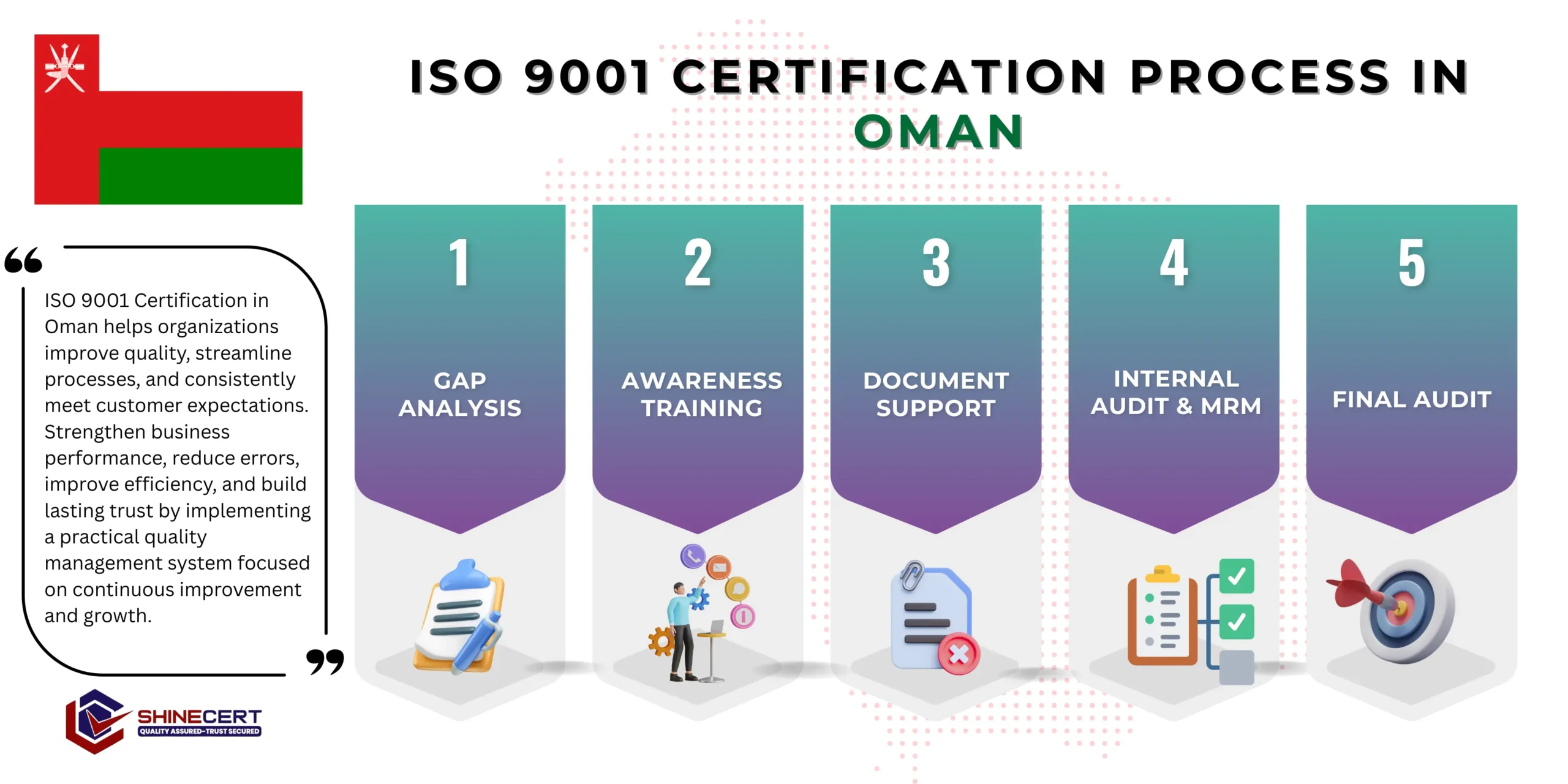
Our Five-Step Certification Process: What to Actually Expect
Gap Assessment
We evaluate your current processes, documentation, and quality practices against what ISO 9001 actually requires.
An honest read on the real gap between your current operations and certification readiness, before you commit a budget to closing it.
A gap assessment report specific to your business and processes.
Documentation Development
Your quality policy, objectives, and process documentation get built around how your organization actually operates.
Documentation your team will genuinely use day to day, not a generic template disconnected from your real workflow.
A complete ISO 9001 documentation set.
Implementation and Training
Processes roll out across relevant functions, with staff trained on their specific role in the quality management system.
Your team develops genuine ownership of the system rather than treating it as an external compliance exercise imposed on them.
Training records and evidence of processes functioning across operations.
Internal Audit and Management Review
We test the system internally, surfacing weaknesses before the real audit does.
Gaps get caught and fixed in a low-stakes setting, before a certification auditor finds them for you.
Internal audit report and management review minutes.
Certification Audit
Stage 1 and Stage 2 audits with a GAC-accredited certification body.
Stage 1 checks your documentation is ready; Stage 2 verifies the system genuinely functions in daily operation, not just on paper.
Your ISO 9001 certificate and a surveillance audit schedule.
Gap Assessment
We evaluate your current processes, documentation, and quality practices against what ISO 9001 actually requires.
An honest read on the real gap between your current operations and certification readiness, before you commit a budget to closing it.
A gap assessment report specific to your business and processes.
Documentation Development
Your quality policy, objectives, and process documentation get built around how your organization actually operates.
Documentation your team will genuinely use day to day, not a generic template disconnected from your real workflow.
A complete ISO 9001 documentation set.
Implementation and Training
Processes roll out across relevant functions, with staff trained on their specific role in the quality management system.
Your team develops genuine ownership of the system rather than treating it as an external compliance exercise imposed on them.
Training records and evidence of processes functioning across operations.
Internal Audit and Management Review
We test the system internally, surfacing weaknesses before the real audit does.
Gaps get caught and fixed in a low-stakes setting, before a certification auditor finds them for you.
Internal audit report and management review minutes.
Certification Audit
Stage 1 and Stage 2 audits with a GAC-accredited certification body.
Stage 1 checks your documentation is ready; Stage 2 verifies the system genuinely functions in daily operation, not just on paper.
Your ISO 9001 certificate and a surveillance audit schedule.
What Is ISO 9001, Technically Speaking?
- Seven principles that shape how every clause gets interpreted : ISO 9001 sits within the broader ISO 9000 family, built around seven core quality management principles: customer focus, leadership, engagement of people, process approach, improvement, evidence-based decision making, and relationship management. These aren’t abstract ideals, they genuinely shape how a competent auditor reads every clause. A documented procedure that technically exists but doesn’t reflect real customer focus or evidence-based decisions won’t satisfy scrutiny, no matter how complete the paperwork looks on paper.
- A shared skeleton across ISO standards : ISO 9001:2015 follows what’s called the Harmonized Structure, a common ten-clause framework shared with ISO 14001, ISO 45001, ISO 27001, and other current management system standards. This matters practically for Oman businesses eyeing multiple certifications: Clauses 4 through 10 map almost directly across standards, so a company that’s genuinely implemented ISO 9001 has already built roughly 60-70% of what ISO 14001 or ISO 45001 would additionally require.
- Risk-based thinking, built in rather than bolted on : A significant shift in the 2015 revision embedded risk-based thinking directly into the standard’s structure instead of treating it as a separate add-on. Clause 6.1 requires organizations to identify risks and opportunities affecting their ability to achieve intended results, and to actually plan around them, meaning quality planning stops being purely reactive, built only around fixing what’s already broken after the fact.
- Context and stakeholders, taken seriously : Clause 4 requires genuine understanding of your organization’s context, internal factors like culture and capability, external factors like the regulatory and competitive environment, and identifying which interested parties’ requirements actually matter to your quality objectives. For Oman businesses, this clause carries real weight given how directly national economic strategy, tender modernization, and evolving customer expectations shape day-to-day operational planning.
Why This Matters So Much in Oman Specifically?
- Vision 2040’s diversification agenda isn’t abstract policy language sitting in a government document, it translates into genuinely new competitive dynamics for Omani businesses, who increasingly find themselves competing not just against local rivals but against regional and international players entering the same tenders and partnership conversations. ISO 9001 certification is one of the more direct, cost-effective ways to compete credibly in that expanded field.
- We’ve noticed a specific pattern with Oman clients: genuinely capable businesses lose competitive ground not because their actual product or service quality is lacking, but because they can’t independently demonstrate the operational consistency a tender evaluator or international partner now expects to see documented, not just claimed. As Esnad’s eTendering platform continues formalizing how public procurement gets evaluated, that gap between genuine quality and demonstrable quality becomes a real, measurable disadvantage.
Riyada Funding: Does Your ISO 9001 Project Qualify for Support?
Riyada’s OMR 15,000–250,000 financing range can, depending on your company’s size and eligibility, help fund the broader operational investment that often accompanies genuine ISO 9001 implementation. Worth checking your eligibility early, alongside your certification planning, since the two often run in parallel rather than certification driving a standalone application later.
What Actually Drives Your Cost?
There’s no flat number here, because two Oman businesses’ actual scope and complexity can look completely different. Here’s what genuinely moves it.
- Nature and complexity of your business : A business with straightforward, standardized processes needs meaningfully less documentation depth than one running complex, highly customized operations across multiple product or service lines.
- Number of locations and departments involved : Each additional site generally needs its own process verification and internal audit coverage, adding real scope for businesses with multiple facilities, and a quality system touching more departments and more staff needs deeper training and change-management investment to genuinely stick.
- Existing documentation maturity : Businesses with some existing process documentation or informal quality discipline, like the case study above, aren't starting from zero. Businesses with nothing documented face more foundational work.
- Whether you're bundling with other standards : Pursuing ISO 14001 or ISO 45001 alongside ISO 9001 shares meaningful implementation and audit infrastructure, given the shared Harmonized Structure.
- Internal capacity to help and Riyada funding eligibility : An internal quality lead who can own documentation and coordination directly reduces the consultant hours required, and where the project qualifies for financing support, your real out-of-pocket cost drops meaningfully.
- Timeline urgency : A compressed timeline tied to a specific tender or export opportunity sometimes needs more concentrated hours in a shorter window.
Mandatory Documents Required for Certification
- Quality policy : What it should contain: genuine leadership commitment specific to your organization’s strategic direction, plus a framework for setting and reviewing quality objectives.
- Scope of the quality management system : What it should contain: exactly which products, services, and locations are covered, with a clear reason for any exclusions from the standard’s requirements.
- Quality objectives and plans to achieve them : What it should contain: specific, measurable targets tied to real business priorities, with responsible parties and timelines attached.
- Risk and opportunity register : What it should contain: risks and opportunities identified from your genuine internal and external context, their potential impact, and the specific actions planned to address each one.
- Process documentation and procedures : What it should contain: step-by-step descriptions of your core operational processes, responsible roles, and the records generated at each stage.
- Records of internal audits, management reviews, and corrective actions : What it should contain: audit findings, management decisions, and the specific corrective actions taken with follow-up verification.
What Happens When an Oman Business Operates Without Certification?
- Here’s the concrete reality. Operating without ISO 9001 certification doesn’t mean poor quality, plenty of uncertified Omani businesses produce genuinely excellent products and services. What it means is relying entirely on relationship-based trust and word-of-mouth reputation to win new business, which is a fundamentally slower, less scalable path than presenting independently verified evidence upfront. In tenders where certification is explicitly required, or partnerships where it’s quietly preferred, uncertified businesses face a real disadvantage regardless of their actual operational quality.
- Businesses that discover this gap only when a specific tender or partnership opportunity demands certification they don’t have often lose that opportunity outright, or face a compressed, pressured certification timeline that proactive planning would have avoided entirely. Build this before the opportunity that requires it shows up, not in response to losing one.
Quality Management Requirements, Clause by Clause
- Context of the Organization (Clause 4) : Genuinely understanding your internal and external context and the interested parties whose requirements shape your quality objectives, particularly relevant given how directly Vision 2040 and tender modernization are reshaping the competitive landscape.
- Leadership (Clause 5) : Real accountability from top management, including genuine resourcing and a quality policy that reflects actual strategic direction rather than a symbolic document nobody references.
- Planning (Clause 6) : Risk-based planning addressing genuine threats and opportunities, plus measurable quality objectives with an actual path to achieving them.
- Support (Clause 7) : Resources, competence, awareness, communication, and documented information requirements that make the system genuinely usable by the people running it day to day.
- Operation (Clause 8) : The operational core, planning and control of production or service delivery, requirements for products and services, design and development where applicable, control of externally provided processes, and control of nonconforming outputs.
- Performance Evaluation (Clause 9) : Monitoring, measurement, analysis, internal audit, and management review testing whether the system genuinely works, not just whether it exists as documentation.
- Improvement (Clause 10) : Structured handling of nonconformities and corrective action, with genuine continual improvement built into how the organization actually operates.
Case Study: An Oman Manufacturing Facility’s Certification Journey
- The following is an illustrative, composite example based on the kind of project ShineCert typically runs, not a specific named client. An Omani manufacturer of industrial components had a loyal regional customer base and genuinely solid production discipline, but relied almost entirely on experienced staff catching problems by instinct rather than any documented, systematic process control. The trigger was a Tender Board bid for a larger government infrastructure contract, where ISO 9001 certification featured explicitly in the evaluation criteria.
- The gap assessment found the company’s actual production discipline was genuinely strong, that was never really in question, but almost none of it existed in a form an external auditor, or the tender evaluation committee, could independently verify. The bulk of implementation work went into formalizing process controls that already existed informally, building a genuine nonconformity and corrective action system rather than relying on informal fixes, and establishing measurable quality objectives tied to defect and rework rates the company could actually track over time. Certification landed in time to submit a compliant bid, and the pattern that followed matches what we typically see: the same documented quality system that satisfied that one tender became reusable credibility infrastructure for every subsequent bid, rather than something built once for a single opportunity and then forgotten.
Benefits at a Glance
- Direct eligibility support for Tender Board and Esnad-managed government tenders
- International recognition supporting partnerships and export relationships
- Increased client trust backed by independently verified evidence, not assurances
- Measurably reduced operational waste and rework
- Access to Riyada-backed financing support
- A foundation that shares meaningful infrastructure with ISO 14001, ISO 45001, and other management system standards
Certification: What Actually Changes
As procurement under Royal Decree 36/2008 and Esnad’s platform gets more structured, independently verified quality credentials increasingly factor into how bids get evaluated, certification isn’t a formality here, it’s a genuine competitive factor.
Structured quality management gives clients concrete, third-party-verified evidence of operational discipline, which matters considerably more than a strong reputation when you’re pursuing a new relationship rather than renewing an existing one.
ISO 9001 is recognized internationally, supporting Omani businesses pursuing partnerships, joint ventures, or export relationships that extend past the domestic and regional market.
Structured process control and nonconformity management reduce rework, delays, and inconsistent output, a real bottom-line benefit independent of any external credibility consideration.
Depending on eligibility, Riyada’s financing range can help fund the broader operational investment that often accompanies genuine quality system implementation.
Applicable Standards by Industry
Construction and infrastructure
Contractors bidding on Tender Board projects, particularly those tied to Vision 2040 development goals, use ISO 9001 to strengthen tender positioning.
Read moreManufacturing
Industrial and light manufacturing businesses across Duqm, Sohar, and Salalah use certification to support both domestic contracts and export credibility.
Read moreOil, gas, and energy services
Companies serving Oman's energy sector use ISO 9001 as baseline expectation for supplier qualification.
Read moreLogistics and supply chain
Businesses supporting Salalah's re-export and logistics hub use certification to demonstrate operational reliability to international shipping partners.
Read moreHealthcare and pharmaceuticals
ISO 9001 frequently underpins broader healthcare quality requirements, often pursued alongside ISO 13485 for device-related businesses.
Read moreWhy Choose ShineCert for ISO 9001 Certification Oman?
Ten years of ISO consulting and certification experience backs every Oman engagement we run, out of our Riyadh and Lebanon offices, with genuine, current familiarity with DGSM’s standards framework, Tender Board and Esnad requirements, and Riyada’s funding programs. We’ve guided more than 10,000 organizations through ISO certification globally, and every Oman engagement gets built around your actual operations, tender goals, and financing options, never a one-size-fits-all package.
Choosing a Certification Body in Oman?
What to Check | Why It Matters |
Accreditation under the GAC framework | Confirms genuine, internationally recognized certification that tender evaluators and partners will trust |
Recognition relevant to your specific target markets | Ensures your certificate carries weight with the tenders, partners, and clients that matter most to your business |
Genuine sector-specific audit experience | Construction, manufacturing, and services each involve meaningfully different quality system expectations |
Familiarity with Oman’s tender and regulatory environment | Understanding of DGSM standards and Tender Board requirements strengthens the practical value of certification |
Common Pitfalls We See in Oman ISO 9001 Projects
- Relying on reputation instead of documented evidence : Many genuinely well-run Omani businesses assume their track record speaks for itself, missing that tender evaluators and international partners increasingly expect independently verifiable documentation, not relationship-based assurance alone.
- Treating certification as a one-time achievement : ISO 9001 requires genuine ongoing internal audit and management review, a certificate obtained once and then neglected loses real value at the next surveillance audit, and more importantly, stops reflecting how the business actually operates.
- Underestimating documentation needs for genuinely good informal processes : Businesses with strong informal quality discipline, like the case study above, often underestimate how much work it takes to make tacit knowledge held by a few experienced staff genuinely auditable and transferable.
- Choosing a certification body without verifying accreditation : Given how much weight tender evaluators and international partners place on the underlying certificate’s credibility, verifying your certification body’s genuine GAC accreditation is worth real attention, not an assumption.
Ready to Get Started?
If your quality processes currently live mainly in experienced staff members’ heads rather than documented, auditable systems, let’s change that before a tender or partnership opportunity forces the issue. Book a free consultation with ShineCert or contact us directly, and we’ll walk through your specific operations and cost factors before proposing a fixed-scope plan.
Frequently Asked Questions
The international standard for quality management systems, it sets requirements for consistently meeting customer and regulatory requirements while continually improving.
It genuinely depends on company size, process complexity, and existing documentation maturity, we scope every project individually.
Not universally mandated across every tender, but certification is explicitly featured in evaluation criteria for many Tender Board and Esnad-managed contracts, particularly larger ones.
Typically three to five months.
Potentially, Riyada’s OMR 15,000–250,000 financing range can apply to certification-related investment depending on eligibility.
We run Oman engagements from our Riyadh and Lebanon offices, with consultants traveling on-site as needed.
DGSM maintains Oman’s national standards infrastructure, but actual ISO 9001 certification is issued by accredited, independent certification bodies, not DGSM directly.
Not by explicit mandate, but the diversification agenda it drives creates real competitive pressure that makes certification increasingly valuable for businesses pursuing new markets and partnerships.
Yes, each additional site generally needs its own process verification and audit coverage, adding real scope.
Yes, our team supports clients across Oman, including Duqm, Sohar, and Salalah, with consultants traveling as needed for site assessments and audits.