
ISO 31000 Certification in Oman
Quick Answer
Correct a common misunderstanding before anything else: ISO 31000 cannot be certified. There is no such thing as an “ISO 31000 certificate,” and any consultant offering to sell you one is misrepresenting the standard. What ISO 31000 actually is: a set of principles and guidelines for building a genuine risk management framework, helping organizations identify, analyze, evaluate, and treat risk in a structured, board-visible way rather than an ad hoc list revisited once a year before an audit. In Oman, this matters increasingly for organizations navigating Central Bank of Oman’s 2026 reforms, tender processes managed through Esnad, and the general governance expectations that come with operating in a more formalized regulatory environment. We deliver this as an implementation and independent conformity review engagement, typically over eight to twelve weeks depending on organizational complexity. Cost depends on genuine factors, organizational complexity, number of business units, existing risk maturity, not a flat number.
ISO 31000, Explained Simply
Here’s the plain version: most organizations already “manage risk” in the sense that someone, somewhere, worries about what could go wrong. ISO 31000 is what happens when you take that scattered worry and turn it into an actual system, a defined way of spotting risks, sizing them up, deciding what to do about each one, and then checking regularly whether that decision still makes sense. It’s not about eliminating risk. It’s about making risk-taking a deliberate, informed choice instead of something that happens to an organization by accident.
Why this matters to a decision-maker: a board that can point to a documented, functioning risk framework is in a fundamentally different conversation with regulators, lenders, and insurers than a board that can only say “we think about risk a lot.” One is evidence. The other is a claim.
Oman Market Snapshot: What Shapes ISO 31000 Demand Here
- No certificate exists : ISO 31000 is explicitly a guidance standard, not a certifiable one, we deliver implementation support and an independent conformity review, never a “certification audit.”
- Financial sector reform is raising the bar : Central Bank of Oman’s 2026 reforms, climate-risk disclosure requirements and Recovery and Resolution Planning among them, are pushing regulated institutions toward more structured, documented risk frameworks than many currently have.
- Procurement is getting more formal : The Tender Board’s Esnad eTendering platform and the broader tender modernization under Royal Decree 36/2008 are increasingly surfacing risk governance as a factor bidders are expected to address, particularly for larger contracts.
- Financing support exists : Riyada’s OMR 15,000–250,000 financing range can, depending on eligibility, help offset the cost of building out a genuine risk management framework.
What are the steps to get ISO 31000 Certification in Oman?
our services
- ISO Certification Oman
- ISO 9001 Certification Oman
- ISO 14001 Certification Oman
- ISO 27001 Certification Oman
- ISO 22000 Certification Oman
- ISO 45001 Certification Oman
- ISO 13485 Certification Oman
- ISO 17025 Certification Oman
- ISO 31000 Certification Oman
- ISO 22301 Certification Oman
- CE Mark Certification Oman
- GMP Certification Oman
- Halal Certification Oman
- SOC Certification Oman
major citys
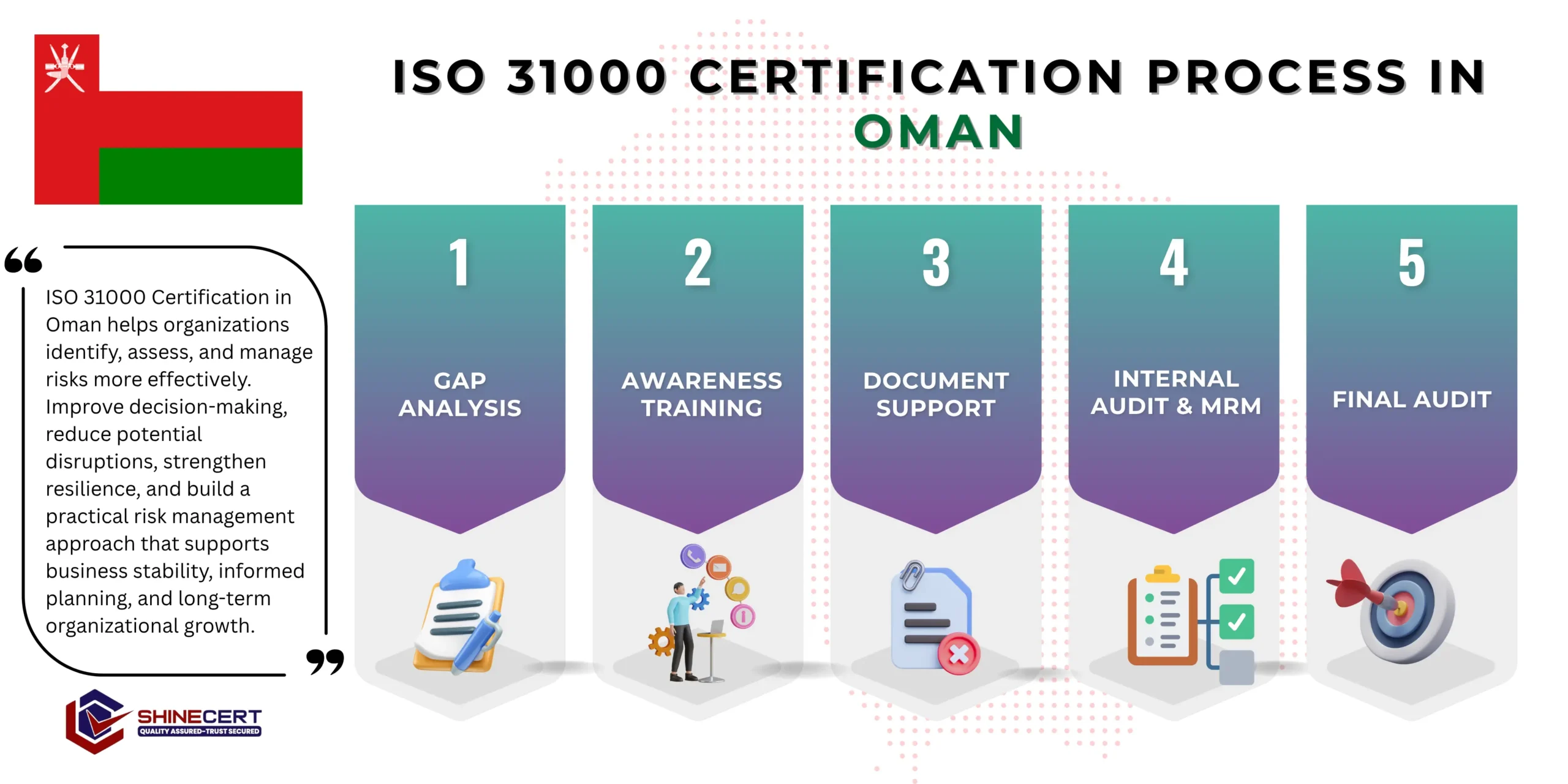
Our Five-Step Implementation Process: What to Actually Expect
Context and Maturity Assessment
We look honestly at how your organization currently handles risk, formally and informally, and map your actual internal and external context.
We're not starting from a blank template; we're building on whatever genuine risk thinking already exists in your organization.
A risk maturity assessment specific to your organization.
Framework Design
Your risk policy, governance structure, and defined risk appetite get built around how your organization actually operates and makes decisions.
A framework leadership will actually use, because it reflects genuine decision-making structures rather than a generic template.
A complete risk management framework document.
Process Implementation
Identification, analysis, evaluation, and treatment processes roll out across relevant business units.
Risk conversations start happening in the rooms where decisions actually get made, not in a separate compliance meeting nobody outside the risk team attends.
A functioning risk register and treatment plans.
Embedding and Training
The framework gets woven into real strategic and operational decision-making, with relevant staff trained on their specific role.
Risk management stops being something one department does and becomes something the organization does.
Evidence of the framework functioning in actual decisions, plus training records.
Independent Conformity Review
We verify the implemented framework genuinely aligns with ISO 31000's principles. This is deliberately not called a certification audit, because no such audit exists for this standard.
Independent, honest confirmation that what you've built actually reflects the standard's intent, not a self-assessment.
A conformity review report you can share with regulators, lenders, or your board.
Context and Maturity Assessment
We look honestly at how your organization currently handles risk, formally and informally, and map your actual internal and external context.
We're not starting from a blank template; we're building on whatever genuine risk thinking already exists in your organization.
A risk maturity assessment specific to your organization.
Framework Design
Your risk policy, governance structure, and defined risk appetite get built around how your organization actually operates and makes decisions.
A framework leadership will actually use, because it reflects genuine decision-making structures rather than a generic template.
A complete risk management framework document.
Process Implementation
Identification, analysis, evaluation, and treatment processes roll out across relevant business units.
Risk conversations start happening in the rooms where decisions actually get made, not in a separate compliance meeting nobody outside the risk team attends.
A functioning risk register and treatment plans.
Embedding and Training
The framework gets woven into real strategic and operational decision-making, with relevant staff trained on their specific role.
Risk management stops being something one department does and becomes something the organization does.
Evidence of the framework functioning in actual decisions, plus training records.
Independent Conformity Review
We verify the implemented framework genuinely aligns with ISO 31000's principles. This is deliberately not called a certification audit, because no such audit exists for this standard.
Independent, honest confirmation that what you've built actually reflects the standard's intent, not a self-assessment.
A conformity review report you can share with regulators, lenders, or your board.
What Is ISO 31000, Technically Speaking?
- A framework standard, deliberately not a checklist : ISO 31000 is built around eight risk management principles, the standard describes risk management as something that should be integrated, structured, customized, inclusive, dynamic, based on the best available information, and that accounts for human and cultural factors while supporting continual improvement. That list matters because it signals the standard’s actual intent: this isn’t meant to be bolted onto an organization as a separate compliance exercise, but woven into how decisions actually get made.
- Three layers, and most implementations fail by skipping one : The standard organizes around three interlocking components, principles (the why), framework (the organizational infrastructure that embeds risk management into governance), and process (the actual, repeatable activity of identifying, analyzing, evaluating, and treating specific risks). A genuinely common failure mode: organizations run the process, they hold risk workshops, they build a risk register, without ever building the framework, meaning risk management stays a periodic activity disconnected from how leadership actually makes decisions day to day.
- The process itself, unpacked : Risk identification means finding sources of risk, not just the risks people already happen to be worried about, a subtle but important distinction, since the risks nobody’s thinking about are usually the ones that cause the most damage. Risk analysis develops an understanding of each risk’s nature and characteristics, including, where useful, its likelihood and consequence. Risk evaluation compares analyzed risk against defined criteria to decide what actually needs treatment and what can be accepted. Risk treatment selects and implements options for addressing risk — which might mean avoiding it, taking on more of it to pursue an opportunity, removing the source, changing likelihood or consequence, sharing it, or simply retaining it as an informed choice.
- Why “guidance standard” isn’t a lesser label : Because ISO 31000 isn’t certifiable, some organizations wrongly assume it’s less rigorous or less useful than a certifiable standard. The opposite is often true in practice, a genuinely implemented risk framework built on ISO 31000’s principles tends to produce more durable organizational change than a certification pursued primarily to satisfy an external audit checklist, precisely because there’s no shortcut version that merely looks compliant on paper.
Why This Matters So Much in Oman Specifically?
- Central Bank of Oman’s 2026 reform agenda, climate-risk disclosure, Recovery and Resolution Planning, the broader push toward more sophisticated prudential oversight, is quietly raising the baseline for what regulators expect regulated institutions’ risk frameworks to actually look like. Organizations still running risk management as an annual spreadsheet exercise are increasingly out of step with where the regulatory conversation is heading.
- We’ve noticed a specific pattern in Oman engagements: leadership teams often already do a reasonable job of informal risk thinking, genuine instinct built from years of operating in the market, but that instinct rarely gets captured anywhere a regulator, lender, or board committee could actually review it. The value of implementing ISO 31000 properly usually isn’t teaching leadership to think about risk for the first time; it’s giving structure and documentation to thinking that was already happening, so it becomes something the organization can demonstrate rather than just claim.
What Actually Drives Your Cost?
We don’t quote a flat number, because two Oman organizations’ actual risk complexity can look completely different. Here’s what genuinely moves it.
- How many business units and locations are involved : Each additional unit generally needs its own risk identification and treatment planning, adding real scope.
- How mature your existing risk practices already are : Organizations with some genuine informal risk discipline, like the case study above, aren’t starting from nothing. Organizations with no structured practice at all face more foundational work.
- Regulatory complexity : Financial institutions navigating Central Bank of Oman’s reform agenda typically need deeper, more rigorous framework design than organizations outside regulated sectors.
- How many stakeholders need to be involved in framework design : Broader consultation across more business units and governance levels takes genuinely more time to get right.
- Whether you’re bundling with other standards : ISO 22301 and ISO 27001 both lean heavily on risk assessment infrastructure that overlaps meaningfully with ISO 31000 implementation.
- Internal capacity to lead parts of the work : A genuine internal risk owner who can drive parts of the process directly reduces the consultant hours required.
- Riyada funding eligibility : Where the project qualifies for co-funding, real out-of-pocket cost drops meaningfully.
- Timeline urgency : A compressed timeline tied to an upcoming regulatory deadline sometimes needs more concentrated hours in a shorter window.
Riyada Funding: Does Your ISO 31000 Project Qualify for Support?
Riyada’s training and business development financing, ranging OMR 15,000–250,000, can in some cases apply to risk management framework implementation, depending on your organization’s size, sector, and eligibility. Worth checking before finalizing your budget, particularly for smaller institutions where this can meaningfully change the numbers.
Documentation That Supports a Genuine Framework
- Risk management policy : What it should contain: leadership’s stated commitment, the framework’s scope, and how risk appetite gets defined and communicated.
- Risk appetite statement : What it should contain: the specific levels and types of risk the organization is willing to accept in pursuit of its objectives.
- Risk register : What it should contain: identified risks, their analysis and evaluation, assigned ownership, and the treatment decision for each.
- Risk governance structure : What it should contain: who’s accountable for risk at each level, and how risk information flows to the board.
- Treatment plans : What it should contain: the specific actions taken for each material risk, responsible owners, and timelines.
- Review and evaluation records : What it should contain: evidence the framework is periodically checked against its own stated purpose, with adjustments made when it falls short.
What Happens When an Oman Organization Skips Structured Risk Management?
- Here’s the honest answer: nothing happens immediately, which is exactly the problem. Organizations without a genuine risk framework don’t usually fail because of one catastrophic blind spot, they fail because risk information consistently arrives too late to change a decision, or never reaches the people making it at all. In a regulatory environment where Central Bank of Oman’s expectations are visibly tightening, that gap becomes harder to explain away with each reform cycle.
- The organizations we see struggle most are the ones treating risk management as a compliance report produced once a year, disconnected from how the business actually operates day to day. By the time a regulator or a major loss event forces the issue, rebuilding trust and demonstrating genuine risk maturity takes considerably longer than building it proactively would have.
Risk Management Framework Components, Explained
- Leadership and Commitment : Genuine, visible ownership from the top, a risk framework that leadership treats as background noise never gets embedded into real decisions.
- Integration : Risk management woven into existing governance, strategy, and operational planning, rather than a separate parallel process running alongside the “real” business.
- Design : Building the framework around your organization’s actual context, its objectives, external and internal environment, and genuine risk appetite.
- Implementation : Rolling the framework into decision-making processes at every relevant level, not just at the top.
- Evaluation : Periodically checking whether the framework is genuinely achieving its purpose, not just whether it technically exists.
- Improvement : Adapting the framework as the organization’s context, risk landscape, or maturity changes over time.
Case Study: An Oman Financial Institution’s Risk Framework Buildout
The following is an illustrative, composite example based on the kind of project ShineCert typically runs, not a specific named client. An Oman-based financial institution had a risk function that produced a genuinely thorough annual risk report, but the process behind it was almost entirely reactive, risks got logged after something had already gone wrong or after a regulator had asked a pointed question, rather than through any ongoing, structured identification process. The catalyst was Central Bank of Oman’s evolving disclosure expectations, which made clear that an annual retrospective report wasn’t going to satisfy where the regulatory conversation was heading.
What the maturity assessment found was a genuinely engaged risk team working with the wrong operating model, reactive by design, disconnected from the actual decision cycle happening elsewhere in the institution. The bulk of the work went into building a risk appetite statement the board could actually stand behind, restructuring the risk register around ongoing identification rather than after-the-fact logging, and, the part that mattered most, creating a real reporting line so risk information reached strategic decisions before they were made, not after. The independent conformity review confirmed genuine alignment with ISO 31000’s principles, and the pattern that followed was the one we generally see: once risk information started arriving early enough to actually influence decisions, the institution’s response to subsequent regulatory reform cycles became measurably faster and less disruptive.
Benefits at a Glance
- Genuine alignment with Central Bank of Oman’s evolving prudential expectations
- Stronger positioning in tenders where risk governance factors into bid evaluation
- Increased confidence from lenders, insurers, and institutional partners
- International credibility supporting cross-border banking and investment relationships
- More informed, defensible strategic decision-making at board level
- A foundation that strengthens ISO 22301 and ISO 27001 risk assessment work
Benefits: What Genuine Implementation Actually Changes
Institutions with a documented, functioning risk framework are simply better positioned to respond to Central Bank of Oman’s evolving reform agenda than those improvising a response each time a new requirement lands.
As procurement processes mature under Royal Decree 36/2008 and its amendments, structured risk governance increasingly becomes part of how larger bids get evaluated, not just cost and technical capability.
A defensible, demonstrable risk framework tends to translate into more favorable terms and faster due diligence in financing and insurance conversations.
Cross-border banking relationships and investment conversations move faster when an Oman institution can show a risk framework that maps to internationally recognized principles.
Properly embedded, risk management surfaces genuinely relevant information earlier in the decision cycle, the whole point isn’t the documentation, it’s better decisions.
Applicable Sectors
Banking and financial services
Institutions navigating Central Bank of Oman's 2026 reform agenda have the clearest, most immediate driver for genuine risk framework implementation.
Read moreConstruction and large infrastructure
Firms bidding on major Tender Board contracts increasingly find risk governance factoring into evaluation, particularly for complex, multi-year projects.
Read moreEnergy and utilities
Organizations managing significant operational and regulatory risk exposure use ISO 31000 to structure board-level risk oversight.
Read moreInsurance
Insurers use the framework to formalize how they assess and manage their own institutional risk, separate from the risk they underwrite for clients.
Read moreGovernment-linked entities
Organizations navigating public accountability expectations use structured risk frameworks to support governance transparency.
Read moreWhy Choose ShineCert for ISO 31000 Certification Oman?
Ten years of hands-on risk and ISO consulting work backs our Oman engagements, run from our Riyadh and Lebanon offices with genuine, current familiarity with Central Bank of Oman’s regulatory direction and the Tender Board’s evolving procurement expectations. We’ve guided more than 10,000 organizations globally, and we’re upfront that ISO 31000 has no certification scheme, what we deliver is a genuinely functioning framework and an honest independent conformity review, built around how your organization actually makes decisions, not a generic template.
Choosing a Certification Body in Oman?
What to Check | Why It Matters |
Honesty that ISO 31000 has no certification scheme | A provider offering to “certify” you against this standard is misrepresenting it |
Genuine board-level and governance experience | Risk framework design needs to reflect how your specific organization actually makes decisions |
Familiarity with Central Bank of Oman’s regulatory direction | Particularly relevant for financial institutions navigating the 2026 reform agenda |
Real experience embedding frameworks into daily decisions | The goal is a functioning framework, not a document that sits unused after delivery |
Common Pitfalls We See in Oman ISO 31000 Projects
- Marketing this as a certification : There is no ISO 31000 certificate, any provider offering to “certify” you against this standard is misrepresenting what the standard actually is, and this is worth being alert to when comparing consultants.
- Building the process without the framework : Running risk workshops and populating a risk register without ever embedding risk management into actual governance and decision-making leaves the whole exercise disconnected from where it needs to matter.
- Treating risk appetite as a one-time statement : An organization’s genuine appetite for risk shifts as strategy, market conditions, and regulatory expectations change, a static statement written once and never revisited stops reflecting reality.
- Confusing risk management with insurance or compliance : ISO 31000 is broader than either, it’s about how the organization makes decisions under uncertainty generally, not just how it transfers financial risk or satisfies a specific regulation.
Ready to Get Started?
If your organization’s risk management still lives mostly in one person’s head or a spreadsheet nobody outside finance opens, let’s talk about what a genuine framework would actually look like for you. Book a free consultation or contact us directly, and we’ll walk through your organizational structure and cost factors before proposing a fixed-scope plan.
Frequently Asked Questions
No, ISO 31000 is not a certifiable standard. It’s a guidance framework for risk management, and no legitimate body issues an “ISO 31000 certificate.”
Implementation support and an independent conformity review confirming your risk framework genuinely aligns with ISO 31000’s principles.
It genuinely depends on organizational complexity, number of business units, and existing risk maturity, we scope every project individually.
Typically eight to twelve weeks, depending on organizational complexity.
Potentially, depending on your organization’s size, sector, and eligibility.
Not by name, but its 2026 reform agenda is pushing regulated institutions toward the kind of structured, documented risk framework ISO 31000 helps build.
The framework is the organizational infrastructure embedding risk management into governance; the process is the actual recurring activity of identifying, analyzing, evaluating, and treating specific risks. Both are needed, one without the other usually fails.
Yes, it strengthens the risk assessment methodology both of those certifiable standards require, and organizations pursuing multiple standards often see meaningful efficiency from doing this work together.
Yes, each unit generally needs its own risk identification and treatment planning, which adds real scope.
We run Oman engagements from our Riyadh and Lebanon offices, with consultants traveling on-site as needed.