
ISO 14001 Certification in Oman
Quick Answer
ISO 14001 is the international standard for environmental management systems, and in Oman it sits close to actual regulatory reality rather than being a purely voluntary add-on. The Environment Authority (EA) administers Royal Decree 114/2001, the Environmental Protection and Pollution Control Law, requiring a permit for any activity with potential environmental impact, and permit renewals, inspections, and project approvals increasingly reference the kind of documented environmental controls ISO 14001 requires. Get certified through a body accredited under the Global Accreditation Cooperation (GAC) framework. Plan for three to five months from kickoff to certificate. Cost depends on genuine factors, your industry’s environmental footprint, number of sites, waste streams involved, and existing documentation maturity, not a flat number. Riyada funding may also apply, and is worth checking early.
ISO 14001, Explained Simply
Strip away the technical language, and ISO 14001 is a structured way of managing everything your business does that touches the environment, the waste you generate, the water and energy you use, the emissions or spills you need to prevent. Rather than handling environmental issues reactively, you build a documented system that identifies your real environmental risks, puts controls in place, and gets independently checked by an auditor to confirm it actually works, not just that it looks good on paper.
For a client trying to decide whether it’s worth pursuing, think of it this way: it’s proof, verified by an outside party, that your business manages its environmental impact responsibly and consistently, proof that matters enormously the moment an Environment Authority inspector, a major customer, or a project lender asks you to demonstrate it.
Oman Market Snapshot: Key Facts for ISO 14001
- National environmental regulator: the Environment Authority (EA) administers Royal Decree 114/2001, the Environmental Protection and Pollution Control Law, covering air quality, marine and groundwater protection, hazardous and non-hazardous waste, and environmental impact assessment.
- Zone-driven industrial pressure: OPAZ’s major economic zones, Duqm, Sohar, and Salalah, host heavy industry, renewable-energy manufacturing, and port operations where international customers, project-finance lenders, and insurers routinely expect ISO 14001 and ISO 45001 alignment from contractors and suppliers.
- SME funding available: Riyada, the Public Authority for Small and Medium Enterprises Development, offers financing and training support that can offset certification-related costs for eligible companies.
- National strategy: Oman Vision 2040 explicitly frames environmental responsibility and economic diversification as connected priorities, not separate commitments.
What are the steps to get ISO 14001 Certification in Oman?
our services
- ISO Certification Oman
- ISO 9001 Certification Oman
- ISO 14001 Certification Oman
- ISO 27001 Certification Oman
- ISO 22000 Certification Oman
- ISO 45001 Certification Oman
- ISO 13485 Certification Oman
- ISO 17025 Certification Oman
- ISO 31000 Certification Oman
- ISO 22301 Certification Oman
- CE Mark Certification Oman
- GMP Certification Oman
- Halal Certification Oman
- SOC Certification Oman
major citys
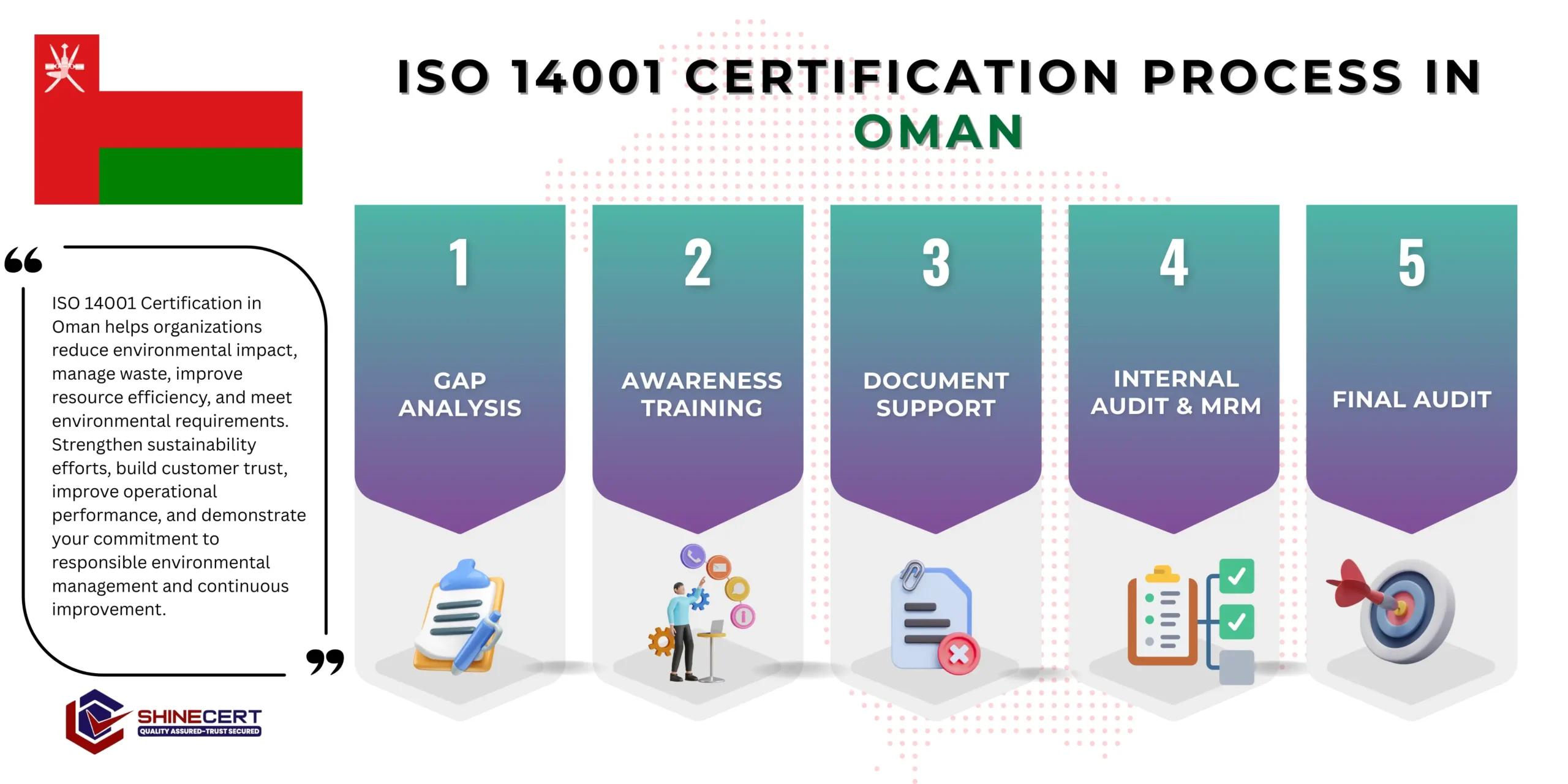
Our Five-Step Certification Process: What to Actually Expect
Gap Assessment
We evaluate your current environmental practices and existing Environment Authority permit compliance against ISO 14001's requirements.
An honest picture of the real gap, before you commit to a budget.
A gap assessment report specific to your operations and site.
Documentation Development
Your environmental policy, aspects and impacts register, and legal compliance register get built around what you actually do.
Documentation that your own environmental or operations staff can genuinely use, not a generic template.
A complete ISO 14001 documentation set.
Implementation and Training
Controls roll out across your sites, with staff trained on their specific environmental responsibilities.
This phase typically takes longest because real behavior change, like consistent waste segregation, takes longer to embed than writing a procedure.
Training records and evidence of controls functioning in daily operations.
Internal Audit and Management Review
We test the system internally before the real audit, surfacing any weaknesses in a low-stakes setting.
Problems get caught and fixed before they can delay your certificate.
Internal audit report and management review minutes.
Certification Audit
Stage 1 and Stage 2 audits with a GAC-accredited certification body.
Stage 1 checks your documentation is ready; Stage 2, usually a few weeks later, verifies the system genuinely functions on-site.
Your ISO 14001 certificate and a surveillance audit schedule.
Gap Assessment
We evaluate your current environmental practices and existing Environment Authority permit compliance against ISO 14001's requirements.
An honest picture of the real gap, before you commit to a budget.
A gap assessment report specific to your operations and site.
Documentation Development
Your environmental policy, aspects and impacts register, and legal compliance register get built around what you actually do.
Documentation that your own environmental or operations staff can genuinely use, not a generic template.
A complete ISO 14001 documentation set.
Implementation and Training
Controls roll out across your sites, with staff trained on their specific environmental responsibilities.
This phase typically takes longest because real behavior change, like consistent waste segregation, takes longer to embed than writing a procedure.
Training records and evidence of controls functioning in daily operations.
Internal Audit and Management Review
We test the system internally before the real audit, surfacing any weaknesses in a low-stakes setting.
Problems get caught and fixed before they can delay your certificate.
Internal audit report and management review minutes.
Certification Audit
Stage 1 and Stage 2 audits with a GAC-accredited certification body.
Stage 1 checks your documentation is ready; Stage 2, usually a few weeks later, verifies the system genuinely functions on-site.
Your ISO 14001 certificate and a surveillance audit schedule.
What Is ISO 14001, Technically Speaking?
- The ISO 14000 family : ISO 14001 is the certifiable standard within the ISO 14000 family of environmental management standards, most of which, like ISO 14004 (general implementation guidance) and ISO 14064 (greenhouse gas quantification), offer guidance rather than certifiable requirements. ISO 14001 is the one an accredited certification body actually audits an organization against.
- Shared structure with other standards : It follows the same Harmonized Structure (formerly Annex SL) shared across ISO 9001, ISO 45001, and ISO 27001, meaning organizations running multiple management systems can share common infrastructure, one management review cycle, one internal audit program, one document control process, rather than maintaining entirely separate systems for each standard.
- Aspects and impacts : The standard’s operating logic centers on “environmental aspects and impacts.” Clause 6.1.2 requires an organization to identify which of its activities, products, or services can interact with the environment (an aspect, such as diesel generator emissions) and what the resulting effect actually is (an impact, such as reduced local air quality). This aspects-and-impacts exercise is the technical backbone of the entire system, a generic, copy-pasted aspects register rarely survives a genuine audit, because the aspects have to reflect what your specific operation actually does.
- The PDCA cycle and life cycle perspective : Like other Harmonized Structure standards, ISO 14001 runs on the Plan-Do-Check-Act cycle: Planning covers context, leadership commitment, and aspects/impacts/legal-requirements analysis (Clauses 4–6); Doing covers operational control and emergency preparedness (Clause 8); Checking covers monitoring, measurement, and internal audit (Clause 9); Acting covers nonconformity handling and continual improvement (Clause 10). A meaningful feature carried over from the 2015 revision is the “life cycle perspective” requirement, organizations must consider environmental impacts not just at their own facility gates, but reasonably upstream (suppliers, raw materials) and downstream (product use, disposal).
- Legal compliance in Oman specifically : Clause 6.1.3 requires organizations to identify which environmental laws actually apply to them and evaluate their compliance status periodically. For an Oman-based operation, this concretely means mapping which Environment Authority permits, waste-handling rules, and Royal Decree 114/2001 provisions apply to your specific activities, not a generic international checklist, but your actual regulatory obligations inside the Sultanate.
- Leadership accountability and emergency preparedness : Beyond aspects and impacts, the standard’s other genuinely distinguishing elements are its emphasis on top management accountability (Clause 5 makes environmental performance explicitly a leadership responsibility, not something delegated entirely to an EHS officer) and its requirement for documented emergency preparedness and response procedures (Clause 8.2) specific to the environmental risks your operation actually carries, a chemical spill response plan looks nothing like a construction dust-control plan.
Why This Matters So Much in Oman Specifically?
- Oman’s environmental pressure points, groundwater scarcity, coastal and marine sensitivity, air quality near industrial zones, are close to daily operational reality rather than abstract concerns, particularly as the country’s economic diversification agenda drives new industrial development. The Environment Authority’s mandate under Royal Decree 114/2001 covers exactly these pressure points, and companies operating anywhere near industrial zones, the coastline, or groundwater-dependent processes increasingly find EA permit renewals and inspections asking for the kind of documented environmental management that ISO 14001 formalizes.
- The zone-driven supply chain effect is genuinely distinctive in Oman. With Duqm’s renewable-manufacturing buildout, Sohar’s heavy industry corridor, and Salalah’s logistics and port operations anchoring large parts of the industrial economy, contractors and suppliers feeding into these zones routinely encounter pre-qualification requirements from international customers, project-finance lenders following IFC Performance Standards, and insurers expecting documentation consistent with international norms, ISO 14001 alongside ISO 45001 is frequently the baseline expectation for getting onto an approved vendor list in the first place, not a nice-to-have.
Riyada Funding: Does Your ISO 14001 Project Qualify for Subsidy?
Riyada, the Public Authority for Small and Medium Enterprises Development, was established to strengthen SME competitiveness under Oman Vision 2040, and its financing and training programs can apply to environmental management system implementation, depending on your company’s size, sector, and program eligibility at the time you apply. We generally recommend checking your Riyada eligibility before finalizing your certification budget, since co-funded training support can meaningfully change your effective cost. Eligibility criteria shift over time, so a direct conversation with Riyada or a consultant familiar with current program terms is worth the time before assuming either full funding or none.
What Actually Drives Your Cost?
We don’t quote a flat number, because it would be misleading, two Oman companies of similar size can end up with meaningfully different ISO 14001 costs depending on their actual environmental footprint and readiness. Here’s what genuinely moves the needle.
- Nature and environmental footprint of your business : A light-industry or services operation with minimal waste streams needs less documentation depth than a manufacturer handling hazardous materials, emissions, or wastewater, the more your operation touches the environment, the more there is to document and control.
- Which zone you operate in, and number of sites : Duqm's construction and manufacturing risk, Sohar's industrial process risk, and Salalah's logistics risk each need different documentation emphasis and Environment Authority permit considerations, and each additional site generally needs its own aspects-and-impacts assessment and audit time, since environmental risk at a warehouse looks nothing like environmental risk at a production facility.
- Number and complexity of waste streams : A business generating a single, straightforward waste category is a genuinely smaller project than one managing multiple hazardous and non-hazardous streams requiring separate handling and disposal tracking.
- How mature your existing environmental practices and compliance history already are : If you already track waste, energy, and water use even informally, and hold a clean, well-documented Environment Authority permit history, you're not starting from zero and typically need less remediation work. If environmental management currently lives in one person's head, or you're catching up on compliance gaps, expect more foundational work.
- Whether you're bundling with other standards, and your internal capacity to lead parts of the work : Pursuing ISO 45001 or ISO 9001 alongside ISO 14001 shares meaningful implementation and audit infrastructure, lowering the marginal cost of each additional standard, and an internal EHS or operations lead who can own documentation reduces the consultant hours needed.
- Riyada funding eligibility and timeline urgency : Where your project qualifies for co-funding, your genuine out-of-pocket cost can be meaningfully lower than the full advisory fee, though a compressed timeline driven by a looming customer deadline sometimes needs more concentrated consultant hours in a shorter window.
Mandatory Documents Required for Certification
- Environmental policy : Genuine leadership commitment specific to your operations. What it should contain: a clear statement of environmental commitment, compliance with applicable legal requirements, and a framework for setting and reviewing environmental objectives, signed off by top management.
- Scope of the environmental management system : Documented, defining exactly which sites and activities are covered. What it should contain: the specific sites, processes, and activities included, with justification for any exclusions.
- Environmental aspects and impacts register : Reflecting your actual activities, not a generic industry list. What it should contain: every activity that interacts with the environment, the resulting impact, and a significance rating used to prioritize controls.
- Legal and other compliance requirements register : Mapped to actual Environment Authority and other applicable Oman regulatory obligations. What it should contain: each applicable law or permit condition, how you meet it, and evidence of periodic compliance evaluation.
- Environmental objectives and plans to achieve them : Measurable, tied to genuine environmental priorities. What it should contain: specific targets, such as waste reduction percentages, who owns each objective, and the timeline for achieving it.
- Records of internal audits, management reviews, and nonconformity handling : Evidence of ongoing, genuine oversight. What it should contain: audit findings, management review decisions, and documented corrective actions with verification of effectiveness.
What Happens When an Oman Company Operates Without Certification in a Certification-Expecting Supply Chain?
- This is worth understanding concretely. When an international customer, or a project lender following IFC Performance Standards, expects ISO 14001 as part of supply chain due diligence, an uncertified Oman supplier isn’t always disqualified outright, but the company typically faces additional audits, questionnaires, and scrutiny that a certified competitor bypasses, and in competitive vendor selection processes for Duqm, Sohar, or Salalah projects, that friction can be the deciding factor.
- Companies that discover this only after losing a contract or vendor slot to a certified competitor often end up starting certification under real time pressure, rather than having it in place before the opportunity arises. We generally recommend Oman manufacturers and contractors serving heavy-industry or export-oriented supply chains treat ISO 14001 as standing infrastructure, not something to pursue only once a specific customer demands it.
Environmental Management Requirements, Clause by Clause
- Context of the Organization (Clause 4) : This clause asks you to map your genuine environmental context, what does your operation actually do that touches air, water, land, or waste, and who are the interested parties (regulators, neighboring communities, customers) with a stake in how you manage it. For an Oman manufacturer, the Environment Authority is unavoidably one of those interested parties.
- Leadership (Clause 5) : Top management has to demonstrate genuine accountability for environmental performance, not delegate it entirely and disappear. Auditors look for evidence that environmental objectives get real attention in leadership reviews, not just a signed policy.
- Planning (Clause 6) : This is where the aspects-and-impacts register and legal compliance obligations live. Getting this right early saves enormous rework later, since nearly everything downstream in the system traces back to what gets identified here.
- Support (Clause 7) : Competence and awareness requirements mean staff genuinely understand their role in environmental control, an auditor might ask a warehouse worker what they’d do if a chemical drum started leaking, and expect a real, trained answer.
- Operation (Clause 8) : Operational controls and emergency preparedness plans specific to your actual environmental risks. For Oman operations, this often includes waste segregation and hazardous material handling procedures that map directly to Environment Authority requirements. One pattern we frequently see in Oman implementations: companies operating in Duqm or Sohar underestimate how much their emergency preparedness plan needs to reflect the specific zone’s risk profile, a plan written for a generic office environment simply doesn’t hold up when an EA inspector asks about your response to a chemical spill on an active industrial site.
- Performance Evaluation (Clause 9) : Monitoring, measurement, and internal audit test whether the system produces genuine environmental performance improvement, not just paperwork.
- Improvement (Clause 10) : Structured handling of environmental nonconformities, with real root-cause analysis rather than a one-time fix.
Case Study: An Oman Manufacturer’s Environmental System Buildout
- The following is an illustrative, composite example based on the kind of project ShineCert typically runs, not a specific named client. A mid-sized Omani industrial manufacturer supplying components into Sohar’s industrial corridor had informal environmental practices: waste was generally handled responsibly, but almost nothing was documented, and the company had no formal aspects-and-impacts assessment. The trigger was a supply chain pre-qualification requirement from an international customer that explicitly listed ISO 14001 as a prerequisite for continuing the relationship.
- The gap assessment found the company’s actual waste handling and resource use were reasonably sound in practice, but its environmental risk awareness was concentrated entirely in one long-tenured operations manager’s informal knowledge, with nothing written down or transferable. The bulk of implementation work went into building a genuine aspects-and-impacts register reflecting the company’s real processes, formalizing waste segregation procedures already partially in place, and training a wider group of staff so environmental knowledge wasn’t a single-person dependency. The company also checked its Riyada eligibility, which reduced its net training cost. Certification was achieved in time to retain the customer relationship, and the pattern we typically see afterward held here too: the aspects register and legal compliance tracking became genuinely useful operational tools, not just audit artifacts, once staff got used to using them.
Migrating from ISO 14001:2015 to ISO 14001:2026: What Oman Businesses Need to Know
- Where things stand today. ISO 14001:2026 represents the most significant update to the environmental management standard since the 2015 revision, and it’s worth understanding now even though it isn’t yet mandatory. The revision strengthens alignment with climate action, ESG expectations, risk-based thinking, and organizational resilience, while maintaining compatibility with the Harmonized Structure shared with ISO 9001 and ISO 27001.
- What this means for Oman businesses : Companies already ISO 14001:2015 certified should expect a transition process similar in scale to what ISO 9001-certified companies face with the 2026 revision of that standard, meaningful but not a ground-up rebuild, since the core aspects-and-impacts and PDCA structure carries forward. Given Oman’s exposure to climate-related environmental pressures, water scarcity, coastal vulnerability, heat stress on outdoor operations, the strengthened climate-risk integration in the 2026 revision is likely to be more than a paperwork update for many Oman operations.
- Our recommendation : As with other Harmonized Structure standards currently mid-revision, we recommend Oman companies pursuing ISO 14001 today proceed under the current 2015 version, the only certifiable version until the new standard is formally published, while building 2026-revision awareness into next year’s recertification planning conversation.
Benefits at a Glance
- Documented alignment with Environment Authority permit and compliance expectations
- Government tender eligibility and stronger positioning in Duqm, Sohar, and Salalah zone-based vendor pre-qualification
- Increased client and lender trust in your environmental risk management
- International recognition that supports export deals and multinational partnerships
- Access to potential Riyada funding support
- Reduced waste, resource use, and associated cost over time
- A foundation that transfers cleanly into ISO 45001 or ISO 9001 later
Certification: What Actually Changes
A documented environmental management system gives inspectors and permit reviewers exactly the kind of evidence they’re looking for, often reducing friction and follow-up requests during renewals.
Certification is frequently the baseline expectation for getting onto approved vendor lists feeding Duqm, Sohar, and Salalah operations, and for satisfying project-finance lender and insurer requirements.
A certificate gives customers, lenders, and regulators independent, third-party proof that your business manages environmental risk responsibly, rather than asking them to take your word for it.
ISO 14001 is recognized and respected globally, which matters when you’re bidding for export contracts or courting multinational partners with their own environmental due-diligence requirements.
Systematic waste, energy, and water management, the practical output of a functioning environmental management system, tends to reduce operating costs over time, not just compliance risk.
Depending on eligibility, certification-related training and consulting costs may be partially offset through Riyada’s SME development programs.
Because ISO 14001 shares the Harmonized Structure with ISO 45001 and ISO 9001, adding either standard later requires meaningfully less duplicate infrastructure.
Applicable Standards by Industry
Manufacturing and heavy industry
Companies in Sohar's industrial corridor and Duqm's renewable-manufacturing buildout regularly find ISO 14001 either explicitly required or heavily favored in vendor pre-qualification.
Read moreConstruction
Contractors working near sensitive coastal or groundwater areas find ISO 14001 supports both Environment Authority permit compliance and Tender Board scoring criteria.
Read moreOil and gas services
Contractors and service providers serving Oman's energy sector routinely need ISO 14001 alongside ISO 45001 for major-project eligibility.
Read moreLogistics and free zone operations
Companies operating through Salalah's port and free zone use ISO 14001 to demonstrate environmental responsibility to international trading partners and lenders.
Read moreRenewable energy manufacturing
Wind and solar component manufacturers in Duqm increasingly need ISO 14001 to satisfy international project-finance environmental due diligence.
Read moreWhy Choose ShineCert for ISO 14001 Certification Oman?
ShineCert brings 10 years of ISO consulting and certification experience to every Oman engagement, coordinated from our Riyadh and Lebanon offices with direct familiarity with Environment Authority permit requirements and Riyada’s funding programs. Our team has guided more than 10,000 organizations through ISO certification globally, across sectors including manufacturing, construction, logistics, and oil and gas — the same industries that make up the bulk of our Oman environmental management client base. We build every Oman engagement around your actual site footprint, waste streams, and funding eligibility, not a one-size-fits-all package.
Choosing a Certification Body in Oman?
What to Check | Why It Matters |
Accreditation under the GAC framework | Confirms genuine, internationally recognized certification |
Experience with Environment Authority-regulated industries | Ensures the auditor understands Oman’s actual permit and compliance landscape |
Track record in Duqm, Sohar, or Salalah | Zone-based industrial supply chains have distinct pre-qualification timelines |
Sector-specific environmental audit experience | Manufacturing, construction, and logistics each involve meaningfully different environmental risk profiles |
Common Pitfalls We See in Oman ISO 14001 Projects
- Building a generic aspects-and-impacts register instead of one reflecting real operations : A copy-pasted register rarely survives a genuine audit and, more importantly, doesn’t actually help you manage real environmental risk, it needs to reflect what your specific site actually does.
- Treating Environment Authority compliance and ISO 14001 as two separate, unrelated efforts : Companies that build their environmental management system without directly mapping it to actual EA permit obligations miss the opportunity to solve both compliance and certification in one motion.
- Underestimating emergency preparedness requirements : Companies with genuine environmental risk, chemical storage, wastewater, hazardous materials, sometimes treat Clause 8.2 as a formality rather than building a response plan that would actually work in a real incident.
- Starting certification only after a customer deadline is already looming : Certification takes three to five months; companies that wait until a specific vendor pre-qualification deadline appears often find themselves scrambling.
Ready to Get Started?
ShineCert supports Oman businesses from initial gap assessment through certification audit, including checking whether your project qualifies for Riyada funding support. Book a free consultation or contact us directly, and we’ll walk through your specific environmental footprint and cost factors before proposing a fixed-scope plan.
Frequently Asked Questions
It’s the international standard for environmental management systems, setting requirements for identifying, controlling, and continually improving how an organization manages its environmental impact.
It genuinely depends on factors like your environmental footprint, number of sites, waste stream complexity, and existing process maturity, we scope every project individually rather than quoting a generic figure.
Potentially, Riyada’s financing and training programs can apply to certification-related costs depending on your company’s eligibility.
Not as a blanket legal mandate, but it directly supports the kind of documented environmental compliance the EA increasingly expects during permit renewals and inspections.
Typically three to five months.
Not always contractually mandatory, but it’s frequently the practical baseline for vendor pre-qualification and is heavily favored in competitive supplier selection.
No, the current 2015 version remains the only valid, certifiable version; companies should certify now and build 2026-revision awareness into their next recertification cycle.
Stronger alignment with climate action, ESG expectations, and organizational resilience, while keeping the same Harmonized Structure and PDCA foundation.
Yes, each site generally needs its own environmental assessment and audit time, since risk profiles differ meaningfully between locations and zones.
We coordinate Oman engagements from our Riyadh and Lebanon offices, with consultants traveling on-site as needed.