
ISO 27001 Certification in Oman
Quick Answer
ISO 27001 is the international standard for information security management systems, and in Oman it sits at the intersection of two genuine regulatory pressures: the Personal Data Protection Law (Royal Decree 6/2022, in force since February 13, 2023, with an Executive Regulation issued February 4, 2024), enforced by the Ministry of Transport, Communications and Information Technology (MTCIT); and, for licensed financial institutions, the Central Bank of Oman’s evolving technology-risk expectations, including climate-related risk disclosure requirements taking effect in 2026. ISO 27001 doesn’t automatically satisfy either framework on its own, but it provides a strong foundation for both. Get certified through a body accredited under the Global Accreditation Cooperation (GAC) framework. Plan for three to five months from kickoff to certificate. Cost depends on genuine factors, data sensitivity, number of systems, regulatory exposure, not a flat number.
ISO 27001, Explained Simply
Strip away the technical language, and ISO 27001 is a structured way of protecting the information your business holds, customer records, financial data, trade secrets, from being lost, stolen, or misused. Instead of relying on scattered technical fixes, you build a documented system that identifies your real information security risks, puts proportionate controls in place, and gets independently checked by an auditor to confirm it actually works.
For a client trying to decide whether certification is worth it: it’s proof, verified by an outside party, that your business takes data security seriously and manages it systematically, proof that matters enormously the moment a bank, a regulator, or an enterprise customer asks you to demonstrate it before trusting you with their data.
Oman Market Snapshot: Key Facts for ISO 27001
- Data protection law: the Personal Data Protection Law (Royal Decree 6/2022), in force since February 13, 2023, with an Executive Regulation issued February 4, 2024, applies to entities collecting, processing, or storing personal data in Oman, enforced by MTCIT.
- Financial sector overlay: the Central Bank of Oman is introducing 2026 banking law reforms, including mandatory climate-related risk disclosure for licensed banks and a Recovery and Resolution Planning framework, both of which touch on information governance expectations.
- National digital strategy: MTCIT’s National Program for Artificial Intelligence and Advanced Digital Technologies and the 2026–2030 Digital Economy Roadmap target cybersecurity and cloud infrastructure as priority areas under Oman Vision 2040.
- SME funding available: Riyada offers financing and training support that can offset certification-related costs for eligible companies.
What are the steps to get ISO 27001 Certification in Oman?
our services
- ISO Certification Oman
- ISO 9001 Certification Oman
- ISO 14001 Certification Oman
- ISO 27001 Certification Oman
- ISO 22000 Certification Oman
- ISO 45001 Certification Oman
- ISO 13485 Certification Oman
- ISO 17025 Certification Oman
- ISO 31000 Certification Oman
- ISO 22301 Certification Oman
- CE Mark Certification Oman
- GMP Certification Oman
- Halal Certification Oman
- SOC Certification Oman
major citys
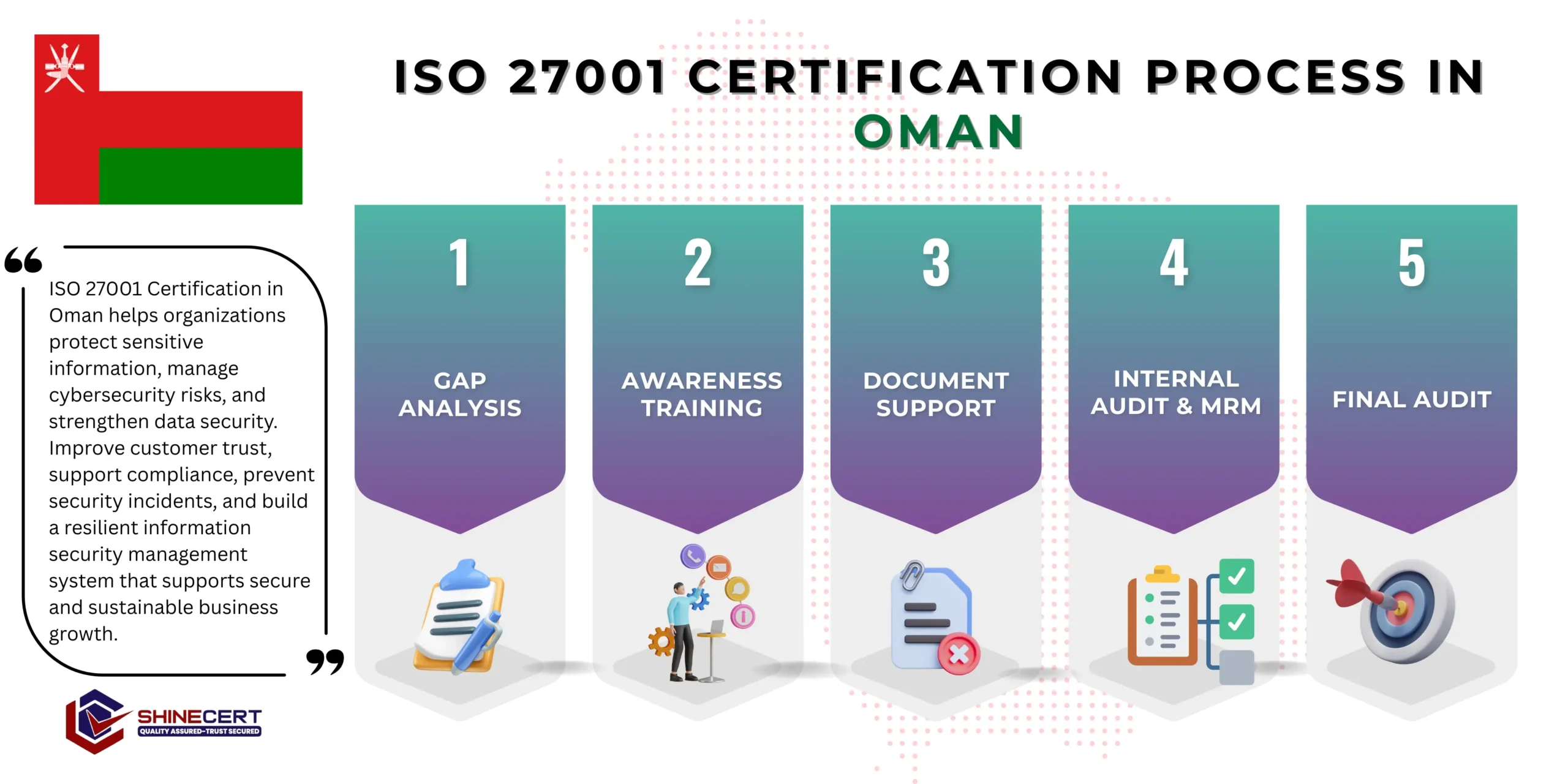
Our Five-Step Certification Process: What to Actually Expect
Gap Assessment
We evaluate your current security posture, including any existing PDPL compliance work, against ISO 27001's requirements.
A clear picture of what genuinely needs to change, avoiding duplicate effort against work you've already done for other compliance obligations.
A gap assessment report specific to your systems and data environment.
Documentation Development
Your risk assessment methodology, risk register, Statement of Applicability, and supporting policies get built around your actual technology environment.
A Statement of Applicability that genuinely reflects your risk profile, not a copy-pasted list of all 93 controls marked "applicable" by default.
A complete ISO 27001 documentation set.
Implementation and Training
Selected controls roll out across your systems, with staff trained on security awareness and their specific responsibilities.
This phase often takes longest for technical controls requiring genuine system or process changes, not just policy writing.
Training records and evidence of controls functioning in daily operations.
Internal Audit and Management Review
We test the system internally, surfacing weaknesses before the real audit.
Control gaps get caught and fixed in a low-stakes setting.
Internal audit report and management review minutes.
Certification Audit
Stage 1 and Stage 2 audits with a GAC-accredited certification body.
Stage 1 checks documentation and SoA readiness; Stage 2 verifies controls genuinely function.
Your ISO 27001 certificate and a surveillance audit schedule.
Gap Assessment
We evaluate your current security posture, including any existing PDPL compliance work, against ISO 27001's requirements.
A clear picture of what genuinely needs to change, avoiding duplicate effort against work you've already done for other compliance obligations.
A gap assessment report specific to your systems and data environment.
Documentation Development
Your risk assessment methodology, risk register, Statement of Applicability, and supporting policies get built around your actual technology environment.
A Statement of Applicability that genuinely reflects your risk profile, not a copy-pasted list of all 93 controls marked "applicable" by default.
A complete ISO 27001 documentation set.
Implementation and Training
Selected controls roll out across your systems, with staff trained on security awareness and their specific responsibilities.
This phase often takes longest for technical controls requiring genuine system or process changes, not just policy writing.
Training records and evidence of controls functioning in daily operations.
Internal Audit and Management Review
We test the system internally, surfacing weaknesses before the real audit.
Control gaps get caught and fixed in a low-stakes setting.
Internal audit report and management review minutes.
Certification Audit
Stage 1 and Stage 2 audits with a GAC-accredited certification body.
Stage 1 checks documentation and SoA readiness; Stage 2 verifies controls genuinely function.
Your ISO 27001 certificate and a surveillance audit schedule.
What Is ISO 27001, Technically Speaking?
- The ISO 27000 family : ISO 27001 is the certifiable standard within the ISO 27000 family of information security standards, which also includes ISO 27002 (a detailed reference for implementing the Annex A controls), ISO 27701 (a privacy-specific extension), and several sector-specific extensions.
- The 2022 restructuring : ISO 27001 follows the same Harmonized Structure as ISO 9001 and ISO 14001, and its most recent major revision, ISO 27001:2022, restructured its Annex A controls from the previous 114 controls across 14 domains down to 93 controls organized into four themes: organizational, people, physical, and technological.
- Risk assessment and the Statement of Applicability : The technical core of ISO 27001 is the risk assessment and Statement of Applicability (SoA) process. Clause 6.1.2 requires organizations to establish and apply an information security risk assessment process, identifying risks to the confidentiality, integrity, and availability of information assets. Critically, Annex A’s 93 controls aren’t all mandatory for every organization — Clause 6.1.3 requires producing a Statement of Applicability that documents which controls are actually applied, and which are formally excluded with justification.
- What’s new in 2022 : Several newer control themes carry particular relevance for Oman’s financial and technology sectors: threat intelligence (actively gathering and using information about emerging threats, not just reacting to past incidents), cloud services security (addressing the shared-responsibility reality of cloud infrastructure), and data masking (formalizing techniques to protect sensitive data during testing or analytics use).
- Overlap with business continuity : ISO 27001 also formally requires an Information Security Continuity plan, meaning the standard genuinely overlaps with business continuity management, which is exactly why organizations pursuing both ISO 27001 and ISO 22301 find significant shared infrastructure between the two.
- Not automatically PDPL compliance : ISO 27001 certification demonstrates a functioning information security management system, but it is not automatically equivalent to PDPL compliance. Oman’s PDPL governs how personal data specifically is collected, processed, and protected, including data subject rights and consent management, areas that extend beyond ISO 27001’s information security scope into genuine legal and privacy-specific territory.
Why This Matters So Much in Oman Specifically?
Oman’s Vision 2040 digital economy push, MTCIT’s National Program for AI and Advanced Digital Technologies, and the 2026–2030 Digital Economy Roadmap all point toward cybersecurity as a genuine national priority, not an abstract international credential. The Personal Data Protection Law creates a real, enforceable obligation for essentially any Oman-based or Oman-serving business handling personal data, and companies that treat data protection as a legal afterthought rather than a structured technical discipline face genuine enforcement exposure. ISO 27001 gives them a recognized, auditable framework for demonstrating the technical and organizational measures data protection laws worldwide, PDPL included, typically require.
For licensed financial institutions specifically, the Central Bank of Oman’s 2026 reforms, mandatory climate-related risk disclosure and the Recovery and Resolution Planning framework, increasingly reference the kind of structured information governance ISO 27001 formalizes. One pattern we frequently see in Oman: companies assume information security and climate-risk disclosure are unrelated workstreams, when in practice the documentation discipline ISO 27001 builds, risk registers, structured reporting, management review, directly supports both.
Riyada Funding: Does Your ISO 27001 Project Qualify for Subsidy?
Riyada’s financing and training programs can apply to information security management system implementation, depending on your company’s size, sector, and program eligibility. We generally recommend checking your Riyada eligibility before finalizing your certification budget, since co-funded training support can meaningfully reduce your effective cost.
What Actually Drives Your Cost?
We don’t quote a flat number, because a flat number would misrepresent how different two Oman companies’ actual information security scope can be. Here’s what genuinely drives cost.
- Nature and sensitivity of the data you handle : A company processing sensitive financial or health data needs meaningfully deeper controls than one handling low-sensitivity operational data.
- Number of systems and applications in scope : Every system holding or processing information within your defined scope needs its own risk assessment and applicable controls.
- Number of locations or data centers : Physical security controls need to be assessed separately for each site or hosting location.
- Regulatory overlay complexity : Companies also subject to Central Bank of Oman requirements need additional mapping work beyond ISO 27001 alone.
- How mature your existing security practices already are : Companies with existing encryption, access control, and monitoring aren’t starting from zero. Companies with informal, undocumented security practices need more foundational work.
- Number of third-party vendors and integrations : Each vendor relationship touching your data needs its own risk consideration under Annex A’s supplier relationship controls.
- Whether you’re bundling with other standards : Pursuing ISO 27701 or ISO 22301 alongside ISO 27001 shares meaningful implementation and audit infrastructure.
- Your internal technical capacity to lead parts of the work : An internal security or IT lead who can own technical implementation reduces consultant hours needed.
- Riyada funding eligibility : Where your project qualifies for co-funding, your genuine out-of-pocket cost can be meaningfully lower.
- Timeline urgency : A compressed timeline driven by a partnership or contract deadline sometimes needs more concentrated consultant hours in a shorter window.
Mandatory Documents Required for Certification
- Information security policy : Genuine leadership commitment specific to your organization. What it should contain: a clear statement of your commitment to information security, compliance with applicable legal requirements, and a framework for setting and reviewing security objectives.
- Scope of the information security management system : Documented, defining exactly which systems, data, and locations are covered. What it should contain: the specific systems, data types, and sites included, with justification for any exclusions.
- Risk assessment methodology and risk register : Reflecting your actual threat landscape, not a generic template. What it should contain: identified risks, their likelihood and impact, existing controls, and residual risk after treatment.
- Statement of Applicability : Documenting which of the 93 Annex A controls apply, with justification for exclusions. What it should contain: each control, whether it’s applied, and a genuine, defensible reason for any exclusion.
- Legal and regulatory compliance register : Mapped to PDPL and, where relevant, Central Bank of Oman obligations. What it should contain: each applicable legal requirement, how you meet it, and evidence of periodic compliance evaluation.
- Records of internal audits, management reviews, and incident handling : Evidence of genuine, ongoing oversight. What it should contain: audit findings, management review decisions, incident details, and corrective actions taken.
What Happens When an Oman Company Operates Without Certification in a Security-Sensitive Sector?
- This is worth understanding concretely. When a financial institution, government body, or security-conscious enterprise customer requires ISO 27001 as part of vendor due diligence, an uncertified Oman company isn’t always disqualified outright, but it typically faces a slower, more manual security questionnaire and audit process that a certified competitor bypasses entirely, and in competitive vendor selection, that friction and delay can be the deciding factor.
- Beyond commercial impact, operating without a structured information security management system genuinely increases breach risk and, if a breach involving personal data occurs, increases enforcement exposure under Royal Decree 6/2022 given the absence of demonstrable technical and organizational measures. Companies that discover this only after a breach or a lost partnership opportunity often end up building security infrastructure under real pressure, rather than having it in place proactively.
Information Security Requirements, Clause by Clause
- Context of the Organization (Clause 4) : Mapping your genuine information security context, what data you hold, which systems matter, and which interested parties (MTCIT, the Central Bank of Oman if regulated, customers, partners) have security expectations of you.
- Leadership (Clause 5) : Top management accountability for information security, auditors look for evidence that security gets genuine attention and resourcing at the leadership level, not just delegation to IT.
- Planning (Clause 6) : The risk assessment and Statement of Applicability process, the technical heart of the entire system, determining which of the 93 Annex A controls genuinely apply to your organization.
- Support (Clause 7) : Competence, awareness, and communication, security awareness training that’s genuinely effective, tested through staff understanding of phishing, data handling, and incident reporting.
- Operation (Clause 8) : Operational planning and control, including the actual implementation of your selected Annex A controls across access management, encryption, secure development, and vendor management.
- Performance Evaluation (Clause 9) : Monitoring, measurement, and internal audit test whether controls are genuinely operating effectively, not just documented.
- Improvement (Clause 10) : Structured handling of security incidents and nonconformities, feeding lessons learned back into the risk assessment.
Case Study: An Oman Fintech’s Certification Journey
- The following is an illustrative, composite example based on the kind of project ShineCert typically runs, not a specific named client. An Oman-based fintech company processing customer financial data had strong technical security instincts, encryption, access controls, and monitoring were all reasonably solid, but no formal risk assessment methodology, no Statement of Applicability, and no documented incident response plan tested against realistic scenarios. The trigger was a partnership requirement from a regional bank that explicitly required ISO 27001 certification before integrating the fintech’s API into its systems.
- The gap assessment found the company’s actual technical controls were genuinely strong, but almost none of it was formally risk-assessed or documented in an auditable way, the security team’s institutional knowledge wasn’t captured anywhere a new hire or auditor could verify it. The bulk of implementation work went into building a genuine risk assessment methodology, formalizing the Statement of Applicability around already-strong existing controls, and building and testing a documented incident response plan. The company also mapped its existing practices against PDPL obligations during the same project, closing several genuine compliance gaps around data subject request handling that had gone unaddressed. Certification was achieved in time for the partnership integration, and the pattern we typically see afterward held: the formal risk assessment process surfaced two genuine, previously unidentified risks in third-party vendor access that the informal security approach had missed entirely.
Benefits at a Glance
- Strong technical foundation supporting PDPL compliance
- Government tender eligibility and stronger positioning with regulated financial and enterprise clients
- Reduced likelihood and impact of data breaches
- Increased client and partner trust in your data handling
- International recognition that supports multinational partnerships
- Access to potential Riyada funding support
- A foundation that transfers cleanly into ISO 27701 or ISO 22301 later
Certification: What Actually Changes
While not automatically equivalent, ISO 27001’s technical and organizational measures directly support the “appropriate security measures” language central to Royal Decree 6/2022, reducing genuine enforcement exposure.
For licensed financial institutions, ISO 27001’s structured approach to information security governance and risk reporting supports the documentation discipline the 2026 reforms increasingly expect.
A functioning risk assessment and control implementation process genuinely reduces both the probability of a security incident and how badly it plays out when one occurs.
A certificate gives customers, regulators, and partners independent, third-party proof that your business protects their data systematically, rather than asking them to take your word for it.
ISO 27001 is recognized globally, which matters when courting multinational partners or enterprise clients with their own security due-diligence requirements.
Depending on eligibility, certification-related training and consulting costs may be partially offset through Riyada’s programs.
Applicable Standards by Industry
Financial services and fintech
Licensed institutions and fintech companies find ISO 27001 directly supports Central Bank of Oman alignment and partner due-diligence requirements.
Read moreTechnology and software
Companies building or hosting software products use ISO 27001 to demonstrate security maturity to enterprise and government customers.
Read moreHealthcare
Providers and health-tech companies handling patient data use ISO 27001 alongside sector-specific requirements to protect sensitive health information.
Read moreTelecommunications
Companies operating within Oman's digital infrastructure use ISO 27001 to demonstrate structured cybersecurity readiness aligned with MTCIT's digital economy priorities.
Read moreProfessional and legal services
Firms handling confidential client data increasingly need demonstrable information security management alongside professional confidentiality obligations.
Read moreWhy Choose ShineCert for ISO 27001 Certification Oman?
ShineCert brings 10 years of ISO consulting and certification experience to every Oman engagement, coordinated from our Riyadh and Lebanon offices with direct familiarity with PDPL, MTCIT enforcement practice, Central Bank of Oman expectations, and Riyada’s funding programs. Our team has guided more than 10,000 organizations through ISO certification globally, across sectors including financial services, technology, healthcare, and telecommunications, the same industries that make up the bulk of our Oman information security client base. We build every Oman engagement around your actual data environment, regulatory exposure, and funding eligibility, not a one-size-fits-all package.
Choosing a Certification Body in Oman?
What to Check | Why It Matters |
Accreditation under the GAC framework | Confirms genuine, internationally recognized certification |
Experience with Central Bank of Oman-regulated institutions | Ensures the auditor understands the evolving technology-risk expectations |
Familiarity with PDPL and MTCIT enforcement practice | Helps ensure your ISMS genuinely supports broader data protection compliance |
Sector-specific audit experience | Fintech, healthcare, and telecom each involve meaningfully different risk profiles |
Common Pitfalls We See in Oman ISO 27001 Projects
- Marking every Annex A control “applicable” without genuine justification : A Statement of Applicability that doesn’t reflect a real, defensible risk assessment doesn’t hold up under audit scrutiny and doesn’t actually help manage risk.
- Assuming ISO 27001 certification automatically means PDPL compliance : The two frameworks overlap substantially but aren’t identical, PDPL-specific requirements like consent management and data subject rights need dedicated attention beyond ISO 27001’s scope.
- Building technical controls without documenting the risk assessment behind them : Strong technical security that isn’t formally risk-assessed and documented doesn’t satisfy the audit trail auditors, or MTCIT investigators, actually need to see.
- Treating incident response plans as untested documents : A plan that’s never been walked through in a tabletop exercise often fails in exactly the ways a real incident would expose.
Ready to Get Started?
ShineCert supports Oman businesses from initial gap assessment through certification audit, including checking whether your project qualifies for Riyada funding support. Book a free consultation or contact us directly, and we’ll walk through your specific data environment and cost factors before proposing a fixed-scope plan.
Frequently Asked Questions
It’s the international standard for information security management systems, setting requirements for identifying, controlling, and continually improving how an organization protects information.
It genuinely depends on factors like data sensitivity, number of systems, regulatory overlay, and existing security maturity, we scope every project individually.
Not automatically, it provides a strong technical foundation for PDPL compliance, but PDPL-specific requirements like consent management need dedicated attention beyond ISO 27001’s information security scope.
Not as a blanket mandate, but it directly supports the technology-risk and information governance expectations building into the Central Bank’s 2026 reforms.
Typically three to five months.
Typically three to five months.
Potentially, Riyada’s financing and training programs can apply to certification-related costs depending on eligibility.
Annex A was restructured from 114 controls across 14 domains to 93 controls across four themes, with new controls added for threat intelligence, cloud security, and data masking.
A required document listing which of the 93 Annex A controls your organization applies, with justification for any that are excluded, based on your genuine risk assessment.
Yes, each system or application in scope needs its own risk assessment and applicable controls.
We coordinate Oman engagements from our Riyadh and Lebanon offices, with consultants traveling on-site as needed.