
ISO 37001 Certification in Oman
Quick Answer
ISO 37001 is the international standard for anti-bribery management systems, and in Oman it addresses a genuine and evolving legal landscape. Bribery offenses are addressed through Oman’s Penal Code, with a newly formed General Directorate for Integrity and Anti-Corruption established under the State Audit Institution around January 2026, alongside the Law for Protection of Public Funds and Avoidance of Conflicts of Interest, which applies to government officials and companies with 40% or greater government ownership. Oman ratified the UN Convention Against Corruption in 2013. Oman Vision 2040 frames institutional integrity as core to the country’s diversification agenda. Get certified through a body accredited under the Global Accreditation Cooperation (GAC) framework. Plan for two to four months from kickoff to certificate. Cost depends on genuine factors, third-party relationship volume, public sector exposure, geographic reach, not a flat number.
ISO 37001, Explained Simply
Strip away the technical language, and ISO 37001 is a structured way of making sure nobody at your company, or anyone acting on its behalf, is paying or accepting bribes to win business or get things done. It requires you to genuinely understand where your real bribery risk sits, which markets, which relationships, which types of payments, and put proportionate, real controls around exactly those risk points, rather than a vague company-wide “we don’t tolerate corruption” statement that nobody actually operationalizes.
For a client trying to decide whether it’s worth pursuing: it’s proof, verified by an outside party, that your business has genuine, working controls against bribery, proof that matters enormously the moment a government tender, an international partner, or an investigation asks you to demonstrate it.
Oman Market Snapshot: Key Facts for ISO 37001
- Legal framework: bribery offenses are addressed through Oman’s Penal Code, supplemented by the Law for Protection of Public Funds and Avoidance of Conflicts of Interest, which applies to government officials and companies with 40% or greater government ownership.
- New enforcement body: the General Directorate for Integrity and Anti-Corruption, newly formed under the State Audit Institution around January 2026, signals intensifying institutional focus on anti-corruption enforcement.
- International commitment: Oman ratified the UN Convention Against Corruption in 2013, reflecting a formal, long-standing commitment to international anti-corruption norms.
- National strategy: Oman Vision 2040 frames institutional integrity and governance quality as core to the Sultanate’s economic diversification agenda.
What are the steps to get ISO 37001 Certification in Oman?
our services
- ISO Certification Oman
- ISO 9001 Certification Oman
- ISO 14001 Certification Oman
- ISO 27001 Certification Oman
- ISO 22000 Certification Oman
- ISO 45001 Certification Oman
- ISO 13485 Certification Oman
- ISO 17025 Certification Oman
- ISO 31000 Certification Oman
- ISO 22301 Certification Oman
- ISO 27701 Certification Oman
- ISO 37001 Certification Oman
- CE Mark Certification Oman
- GMP Certification Oman
- Halal Certification Oman
- SOC Certification Oman
major citys
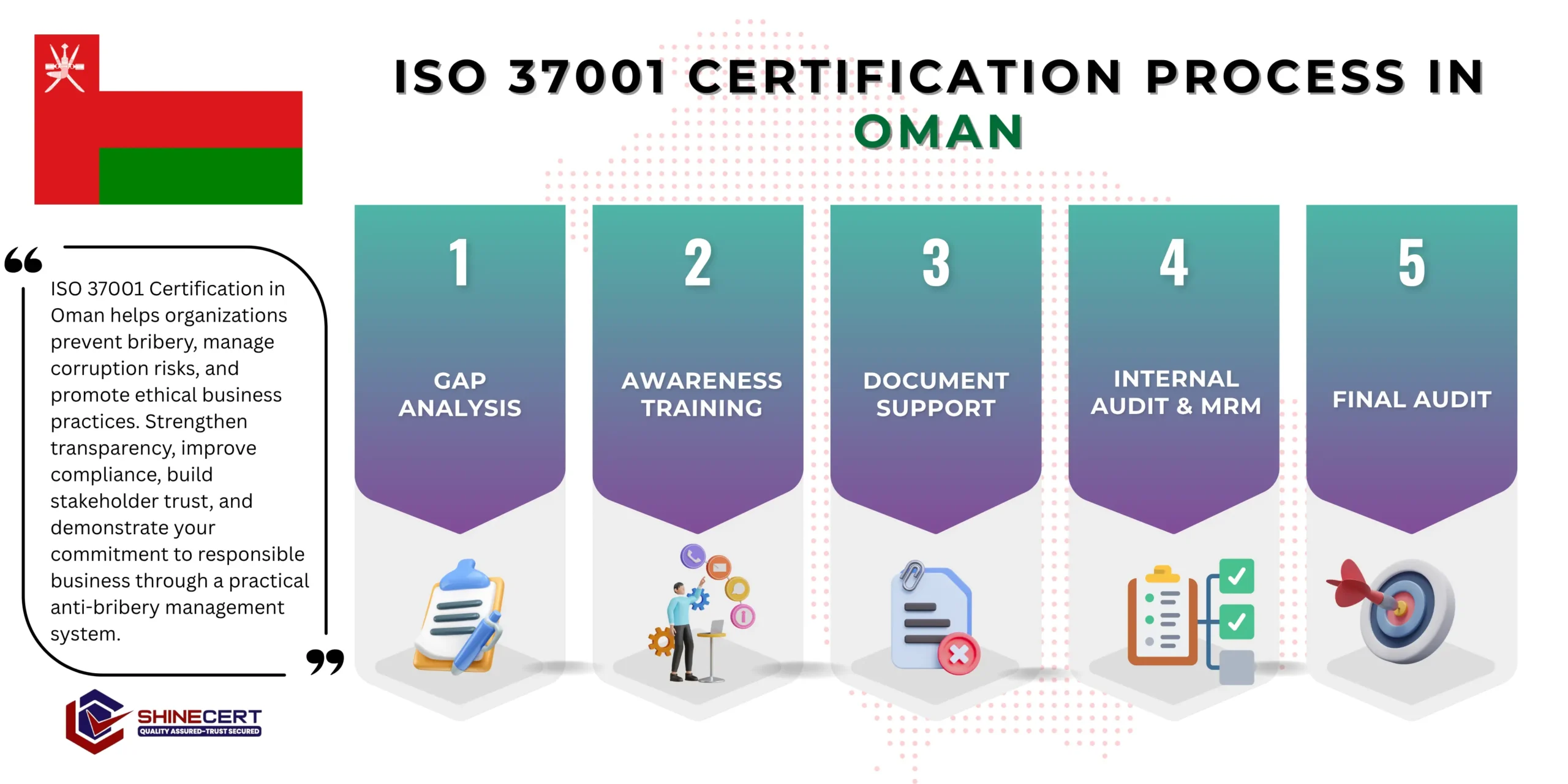
Our Five-Step Certification Process: What to Actually Expect
Bribery Risk Assessment
We evaluate your genuine bribery exposure, which markets, relationships, and transaction types carry real risk.
A risk-based system that focuses genuine scrutiny where it matters, rather than uniform bureaucracy applied everywhere equally.
A bribery risk assessment report specific to your operations.
Documentation Development
Your anti-bribery policy, due diligence framework, and financial controls get built around your actual risk profile.
Controls your finance and procurement teams can genuinely apply, not an abstract policy disconnected from real transaction processes.
A complete ISO 37001 documentation set.
Implementation and Training
Controls roll out across procurement, sales, and third-party relationship management, with staff and key business associates trained on genuine red-flag recognition.
Your team knows what a suspicious payment structure or unusual commission actually looks like, not just abstract policy language.
Training records and evidence of controls functioning in daily operations.
Internal Audit and Management Review
We test the system internally, surfacing weaknesses before the real audit.
Control gaps get caught and fixed in a low-stakes setting.
Internal audit report and management review minutes.
Certification Audit
Stage 1 and Stage 2 audits with a GAC-accredited certification body.
Stage 1 checks documentation readiness; Stage 2 verifies controls genuinely function, including due diligence records and whistleblowing channel evidence.
Your ISO 37001 certificate and a surveillance audit schedule.
Bribery Risk Assessment
We evaluate your genuine bribery exposure, which markets, relationships, and transaction types carry real risk.
A risk-based system that focuses genuine scrutiny where it matters, rather than uniform bureaucracy applied everywhere equally.
A bribery risk assessment report specific to your operations.
Documentation Development
Your anti-bribery policy, due diligence framework, and financial controls get built around your actual risk profile.
Controls your finance and procurement teams can genuinely apply, not an abstract policy disconnected from real transaction processes.
A complete ISO 37001 documentation set.
Implementation and Training
Controls roll out across procurement, sales, and third-party relationship management, with staff and key business associates trained on genuine red-flag recognition.
Your team knows what a suspicious payment structure or unusual commission actually looks like, not just abstract policy language.
Training records and evidence of controls functioning in daily operations.
Internal Audit and Management Review
We test the system internally, surfacing weaknesses before the real audit.
Control gaps get caught and fixed in a low-stakes setting.
Internal audit report and management review minutes.
Certification Audit
Stage 1 and Stage 2 audits with a GAC-accredited certification body.
Stage 1 checks documentation readiness; Stage 2 verifies controls genuinely function, including due diligence records and whistleblowing channel evidence.
Your ISO 37001 certificate and a surveillance audit schedule.
What Is ISO 37001, Technically Speaking?
- Scoped specifically to bribery : ISO 37001 follows the Harmonized Structure shared with ISO 9001, ISO 14001, and ISO 27001, but its technical content addresses a genuinely distinct risk category: bribery specifically, rather than the broader corruption, fraud, cartel, or money-laundering risks that sit adjacent to it but fall outside the standard’s defined scope.
- Risk assessment drives due diligence : The standard’s technical core is bribery risk assessment (Clause 4.5), which requires organizations to identify bribery risks specific to their actual operations, considering factors like the countries and sectors they operate in, the nature and complexity of their transactions, and their genuine exposure to public officials and other third parties. This risk assessment then directly informs the depth of due diligence required under Clause 8.2 for business associates, a genuinely tiered, risk-based approach rather than uniform scrutiny applied identically to every relationship.
- A genuinely independent compliance function : Two technical mechanisms distinguish ISO 37001 from a generic compliance policy. First, the standard requires a genuinely independent anti-bribery compliance function (Clause 5.3), someone with the authority and resources to oversee the system, reporting to a level of management or governing body with sufficient independence from operational pressure.
- Financial controls designed to prevent disguise : Second, Clause 8.9 requires financial, commercial, and contractual controls specifically designed to prevent bribery, tiered approval limits for gifts and hospitality, controls over facilitation payments, and financial controls that would make a bribe genuinely difficult to disguise as a legitimate transaction, such as unusually structured payments or commissions disproportionate to the service genuinely rendered.
- A whistleblowing channel people actually trust : The standard also formally requires a whistleblowing/raising concerns procedure that genuinely protects those reporting suspected bribery from retaliation, a mechanism that only works if employees and business associates genuinely trust it. For organizations bidding on Oman government contracts specifically, ISO 37001’s due diligence and gift/hospitality control requirements map closely onto the kind of integrity expectations increasingly embedded in Tender Board evaluation.
Why This Matters So Much in Oman Specifically?
- Oman’s anti-corruption enforcement architecture is genuinely tightening. The establishment of the General Directorate for Integrity and Anti-Corruption under the State Audit Institution around January 2026 is a meaningful institutional signal, it reflects a deliberate strengthening of enforcement capacity, not just symbolic legislative language. Combined with the Law for Protection of Public Funds and Avoidance of Conflicts of Interest applying specifically to government officials and companies with significant government ownership, organizations working with or adjacent to the Oman government need genuine, operational anti-bribery controls, not an informal assumption of good conduct.
- One pattern we frequently see in Oman: companies treat their Penal Code awareness as sufficient compliance, when the law itself establishes liability but doesn’t prescribe the specific operational structure, due diligence tiers, approval thresholds, whistleblowing channels, an organization actually needs to build. ISO 37001 fills exactly this gap, giving organizations an internationally recognized, structured way to demonstrate genuine anti-bribery diligence.
What Actually Drives Your Cost?
We don’t quote a flat number, because a flat number would misrepresent how different two Oman companies’ actual bribery exposure can be. Here’s what genuinely drives cost.
- Number and risk level of third-party relationships : A company with a handful of low-risk domestic vendor relationships needs meaningfully less due diligence infrastructure than one with dozens of agents and distributors across higher-risk markets.
- Public sector exposure : Companies regularly bidding on Tender Board or other government contracts, or those with significant government ownership under the Law for Protection of Public Funds, need deeper controls around gifts, hospitality, and public official interactions.
- Geographic and market complexity : Operations spanning multiple countries with varying corruption risk levels need a more sophisticated, tiered risk assessment than single-market domestic operations.
- Transaction complexity : Businesses with complex commission structures, intermediary payments, or joint venture arrangements need deeper financial control documentation.
- How mature your existing compliance practices already are : Companies with some existing due diligence or approval processes aren’t starting from zero. Companies relying purely on informal trust need more foundational work.
- Whether you’re bundling with other standards : Pursuing ISO 9001 or ISO 27001 alongside ISO 37001 shares meaningful management review and internal audit infrastructure.
- Your internal capacity to lead parts of the work : An internal compliance or legal lead who can own documentation reduces consultant hours needed.
- Riyada funding eligibility : Where your project qualifies for co-funding, your genuine out-of-pocket cost can be meaningfully lower.
- Timeline urgency : A compressed timeline driven by a partnership or tender deadline sometimes needs more concentrated consultant hours in a shorter window.
Riyada Funding: Does Your ISO 37001 Project Qualify for Subsidy?
Riyada’s training and business development programs can apply to anti-bribery management system implementation, particularly training-related costs, depending on your company’s size, sector, and program eligibility. We generally recommend checking your Riyada eligibility before finalizing your certification budget.
Mandatory Documents Required for Certification
- Anti-bribery policy : Genuine leadership commitment specific to your organization’s risk profile. What it should contain: a clear statement of zero tolerance for bribery, board-level accountability, and a framework for setting and reviewing anti-bribery objectives.
- Scope of the anti-bribery management system : Documented, defining exactly which operations and business associates are covered. What it should contain: the specific entities, geographies, and relationships included, with justification for any exclusions.
- Bribery risk assessment : Reflecting your actual markets, relationships, and transaction types. What it should contain: identified risk factors, risk ratings by relationship or market, and the rationale behind each rating.
- Due diligence procedures and records : Tiered by genuine risk level for business associates. What it should contain: the due diligence steps taken for each risk tier, findings, and approval decisions.
- Financial and commercial controls documentation : Covering gifts, hospitality, facilitation payments, and approval thresholds. What it should contain: specific monetary thresholds, approval chains, and records of gifts or hospitality given or received.
- Whistleblowing procedure and records : Evidence of a genuinely functioning, trusted reporting channel. What it should contain: how reports are received, investigated, and resolved, with protections against retaliation documented.
What Happens When an Oman Company Operates Without Structured Anti-Bribery Controls?
- This is worth understanding concretely. Without structured due diligence and financial controls, a company remains genuinely exposed to bribery committed by an agent, distributor, or subcontractor acting on its behalf, exposure that can trigger real Penal Code liability even where company leadership had no direct knowledge of the specific act. Companies bidding on Tender Board contracts without demonstrable integrity controls also increasingly find themselves at a competitive disadvantage as procurement evaluation criteria give more explicit weight to governance and anti-corruption credentials, particularly as the new General Directorate for Integrity and Anti-Corruption raises the enforcement bar.
- Companies that discover control gaps only after an allegation or investigation face significantly more costly and reputationally damaging remediation than those who build genuine controls proactively. We generally recommend Oman companies with meaningful third-party relationships or public-sector exposure treat ISO 37001 as standing infrastructure, not something to build only once a specific partner or tender requires it.
Anti-Bribery Requirements, Clause by Clause
- Context of the Organization (Clause 4) : Includes the specific bribery risk assessment, genuinely mapping which of your operations, markets, and relationships carry meaningful bribery exposure.
- Leadership (Clause 5) : Requires a genuinely independent anti-bribery compliance function with real authority and reporting access, plus top management commitment that goes beyond a signed policy.
- Planning (Clause 6) : Objectives and plans specifically addressing identified bribery risks, tied to measurable action.
- Support (Clause 7) : Competence and training requirements ensuring staff and relevant business associates genuinely understand bribery red flags relevant to their specific role.
- Operation (Clause 8) : The largest clause, due diligence on business associates, financial and commercial controls, gift and hospitality controls, facilitation payment controls, and the whistleblowing procedure.
- Performance Evaluation (Clause 9) : Monitoring, measurement, and internal audit test whether controls are genuinely catching red flags, not just existing on paper.
- Improvement (Clause 10) : Structured handling of bribery concerns and nonconformities, with genuine investigation and corrective action.
Case Study: An Oman Trading Company’s Anti-Bribery Program Buildout
The following is an illustrative, composite example based on the kind of project ShineCert typically runs, not a specific named client. An Oman-based trading company working with agents across several regional markets had a general anti-corruption statement in its employee handbook, but no formal due diligence process for onboarding new agents and no structured controls around commission payments. The trigger was a new international supplier partnership that specifically required evidence of a certified anti-bribery management system as a condition of the agreement.
The gap assessment found the company’s genuine risk exposure was concentrated in a handful of agent relationships in markets with elevated bribery risk, while most of its operations carried comparatively low exposure. The bulk of implementation work went into building tiered due diligence, deeper scrutiny for the higher-risk agent relationships, lighter-touch review for lower-risk ones, and formalizing commission payment controls that flagged payments disproportionate to the services genuinely documented. The company also established a genuinely independent whistleblowing channel, addressing a prior gap where concerns had nowhere clear to go. Certification was achieved in time to secure the international partnership, and the pattern we typically see afterward held: the tiered due diligence process surfaced a previously unaddressed red flag in one agent relationship, allowing the company to address it proactively rather than discovering it during an actual incident.
Benefits at a Glance
- Structured framework mapping to Oman’s Penal Code bribery provisions and the new anti-corruption directorate’s expectations
- Government tender eligibility and stronger positioning in Tender Board pre-qualification
- Increased partner and lender trust in your governance and integrity controls
- Reduced legal and reputational exposure from third-party relationships
- Access to potential Riyada funding support
- A consistent framework for multi-market GCC and international operations
Benefits: What Certification Actually Changes
In the event of an allegation or investigation, a genuinely functioning ISO 37001 system gives an organization concrete evidence of proactive controls, rather than relying on an informal claim of good faith.
Certification increasingly differentiates bidders on integrity grounds, alongside quality and safety credentials, in competitive government procurement evaluation.
A certificate gives partners, lenders, and government counterparts independent, third-party proof that your business has genuine anti-bribery controls, rather than asking them to take your word for it.
Risk-based due diligence genuinely reduces the likelihood of an agent, distributor, or subcontractor engaging in bribery on the organization’s behalf without its knowledge.
A genuinely functioning, trusted reporting mechanism surfaces problems while they’re still manageable, rather than after they’ve escalated into a genuine scandal.
Depending on eligibility, certification-related training and consulting costs may be partially offset through Riyada’s programs.
Applicable Standards by Industry
Construction and contracting
Companies bidding on Tender Board and large private developments use ISO 37001 to demonstrate integrity alongside quality and safety credentials.
Read moreTrading and distribution
Companies working through agents and distributors across multiple markets use ISO 37001 to structure due diligence and commission controls.
Read moreOil, gas, and industrial services
Contractors and suppliers in high-value industrial supply chains, particularly in Duqm and Sohar, use ISO 37001 given the genuine bribery risk profile of large contract values.
Read moreFinancial services
Institutions use ISO 37001 alongside Central Bank of Oman regulatory expectations to formalize anti-bribery controls within broader governance frameworks.
Read moreProfessional services and consultancies
Firms advising on public sector engagements use ISO 37001 to demonstrate their own integrity standards to clients and regulators.
Read moreWhy Choose ShineCert for ISO 37001 Certification Oman?
ShineCert brings 10 years of ISO consulting and certification experience to every Oman engagement, coordinated from our Riyadh and Lebanon offices with direct familiarity with Oman’s Penal Code bribery provisions, Tender Board integrity expectations, and Riyada’s funding programs. Our team has guided more than 10,000 organizations through ISO certification globally, and we build every Oman anti-bribery engagement around your actual third-party relationships, market exposure, and funding eligibility, not a one-size-fits-all package.
Choosing a Certification Body in Oman?
What to Check | Why It Matters |
Accreditation under the GAC framework | Confirms genuine, internationally recognized certification |
Genuine understanding of Oman’s Penal Code bribery provisions | Ensures the auditor connects the system to actual local legal exposure |
Experience with Tender Board integrity expectations | Helps ensure certification genuinely strengthens government bid competitiveness |
Sector-specific due diligence experience | Trading, construction, and financial services each involve meaningfully different bribery risk profiles |
Common Pitfalls We See in Oman ISO 37001 Projects
- Applying uniform due diligence regardless of actual risk : Treating every business associate with identical, maximum scrutiny wastes resources on low-risk relationships while potentially under-resourcing genuinely high-risk ones.
- Building a whistleblowing channel nobody trusts : A reporting mechanism that exists on paper but that employees don’t genuinely believe protects them from retaliation produces silence, not early warning.
- Treating gift and hospitality controls as a formality : Vague or unenforced thresholds tend to erode in practice, genuine controls need clear limits and consistent, visible enforcement.
- Assuming general Penal Code awareness substitutes for a structured system : Oman’s Penal Code bribery provisions establish legal liability, but they don’t prescribe a specific operational compliance program, companies need to build that structure themselves.
Ready to Get Started?
ShineCert supports Oman organizations from initial bribery risk assessment through certification audit, including checking whether your project qualifies for Riyada funding support. As the best ISO consultant in Oman, book a free consultation or contact us directly, and we’ll walk through your specific third-party relationships and cost factors before proposing a fixed-scope plan.
Frequently Asked Questions
It’s the international standard for anti-bribery management systems, setting requirements for preventing, detecting, and responding to bribery risk.
Bribery is addressed through Oman’s Penal Code, supplemented by the Law for Protection of Public Funds and Avoidance of Conflicts of Interest for government-related entities.
It genuinely depends on factors like third-party relationship volume, public sector exposure, and geographic complexity, we scope every project individually.
Typically two to four months.
Potentially, Riyada’s training and development programs can apply to certification-related costs depending on eligibility.
Not universally mandatory, but integrity and anti-corruption controls increasingly feature in Tender Board pre-qualification and compliance monitoring.
No, it’s specifically scoped to bribery risk, not the broader categories of fraud, cartel behavior, or money laundering, which fall outside its defined scope.
A newly formed enforcement body under Oman’s State Audit Institution, established around January 2026, signaling intensifying anti-corruption enforcement.
Yes, each relationship needs its own risk-based due diligence assessment, so companies with extensive agent networks face meaningfully more implementation work.
We coordinate Oman engagements from our Riyadh and Lebanon offices, with consultants traveling on-site as needed.