
Halal Certification in Oman
Quick Answer
Halal certification confirms that food, products, or services comply with Islamic dietary and production law, and in Oman it operates under the same underlying technical standard used across the Gulf: GSO 2055, developed by the Gulf Standardization Organization and applied within Oman through the Directorate General for Standards and Metrology (DGSM), with religious oversight from the Ministry of Endowments and Religious Affairs. Oman follows GSO 2055 alongside genuine local variation in how the standard is applied domestically, which is a genuinely important detail for exporters to confirm on a product-by-product basis rather than assuming full uniformity across every GCC market. Get certified through a properly accredited Halal certification body working alongside your ISO consultant. Plan for two to four months from kickoff to certificate. Cost depends on genuine factors, product range, supply chain complexity, existing slaughter documentation, not a flat number.
Halal Certification, Explained Simply
Put simply: Halal certification is independent, documented proof that a product genuinely meets Islamic dietary and production requirements, from raw ingredients through to the final package on the shelf. It’s not a label you can just print, it requires an accredited body to actually verify your sourcing, your processing, and, where meat and poultry are involved, the slaughter method itself.
For a client weighing whether it’s worth the investment: in a Muslim-majority market like Oman, and across the wider GCC where GSO 2055 is recognized, certification is often less about legal necessity for every product category and more about removing doubt for your customers and trading partners, which directly affects sales and export approval.
Oman Market Snapshot: Key Facts for Halal Certification
- Governing standard: GSO 2055, developed by the Gulf Standardization Organization, is recognized across Saudi Arabia, UAE, Qatar, Oman, Bahrain, and Kuwait, with GSO 2055-2 setting requirements for the Halal certification bodies themselves and GSO 2055-3 covering the accreditation bodies that oversee them.
- National standards authority: the Directorate General for Standards and Metrology (DGSM), under Oman’s Ministry of Commerce, Industry and Investment Promotion, maintains and applies the GSO 2055 framework domestically.
- Religious oversight: the Ministry of Endowments and Religious Affairs holds responsibility for religious matters in Oman, including the framework within which Halal compliance is understood domestically.
- Genuine local variation: while Oman follows the same core GSO 2055 standard used across the GCC, local application details can vary by product category, which is why we recommend confirming specific requirements before finalizing an export or import plan.
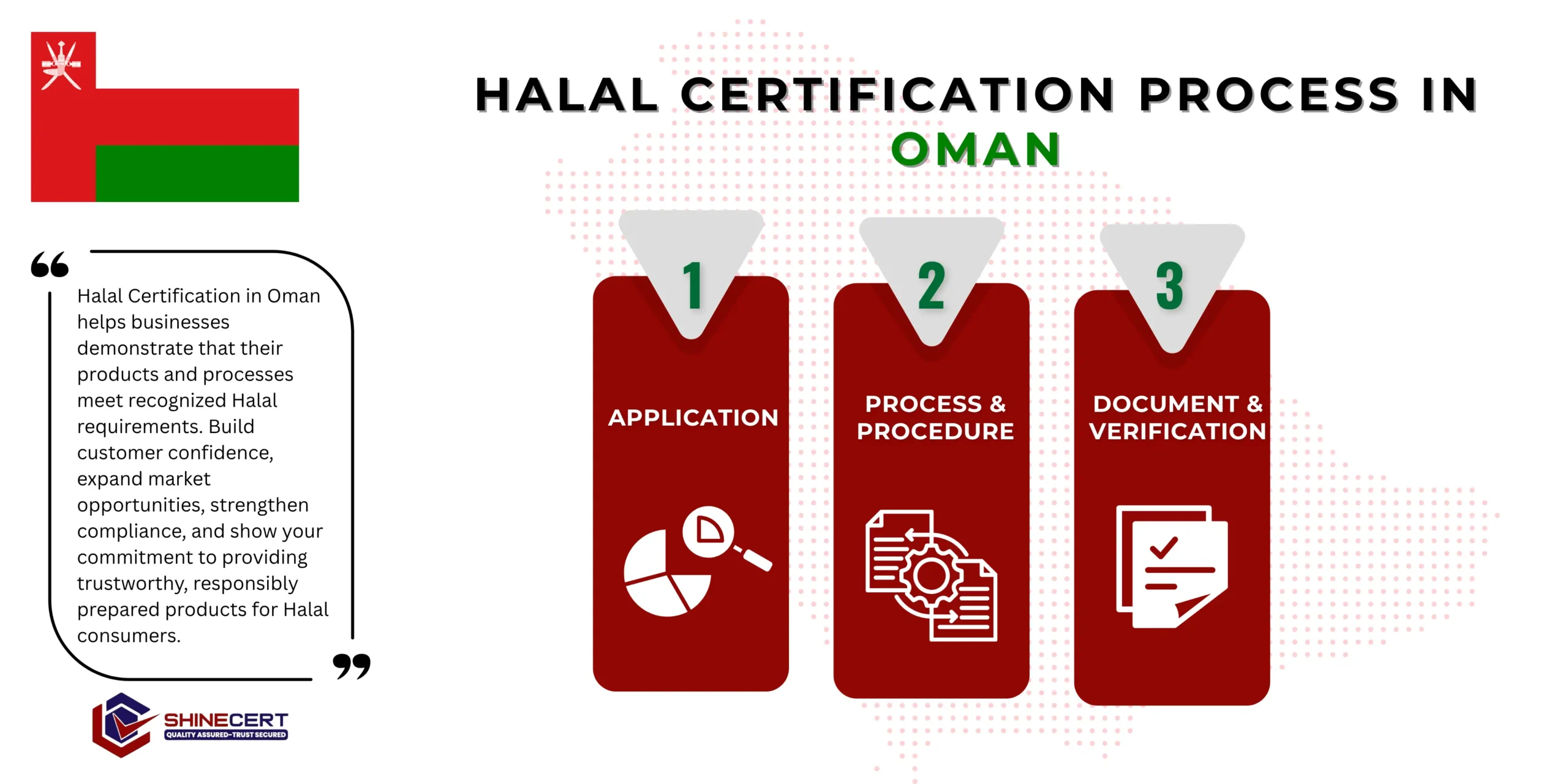
What are the steps to get Halal Certification in Oman?
our services
- ISO Certification Oman
- ISO 9001 Certification Oman
- ISO 14001 Certification Oman
- ISO 27001 Certification Oman
- ISO 22000 Certification Oman
- ISO 20000-1 Certification Oman
- ISO 45001 Certification Oman
- ISO 13485 Certification Oman
- ISO 17025 Certification Oman
- ISO 31000 Certification Oman
- ISO 22301 Certification Oman
- ISO 27701 Certification Oman
- ISO 37001 Certification Oman
- ISO 50001 Certification Oman
- CE Mark Certification Oman
- GMP Certification Oman
- Halal Certification Oman
- SOC Certification Oman
major citys
Our Five-Step Certification Process: What to Actually Expect
Gap Assessment
We evaluate your current ingredient sourcing, processing controls, and supply chain documentation against GSO 2055's requirements.
A clear picture of exactly where your supply chain needs strengthening before submission to a certification body.
A gap assessment report specific to your products and supply chain.
Documentation Development
Your Halal policy, ingredient verification records, and traceability documentation get built around your actual sourcing and production processes.
Documentation your procurement and production teams can genuinely maintain, not a one-time compliance exercise.
A complete Halal compliance documentation set.
Implementation and Training
Segregation controls, traceability systems, and staff training roll out across your operations.
Your team genuinely understands cross-contamination risk and how to prevent it in daily operations, not just in theory.
Training records and evidence of segregation and traceability controls functioning.
Internal Review
We test your documentation and controls internally before submission to a certification body.
Gaps get caught and fixed before they can delay or derail your certification application.
Internal review report.
Certification Audit
Audit conducted by a properly accredited Halal certification body.
A certificate that genuinely supports Oman market entry and GCC-wide recognition, verified against a body whose own accreditation we help you confirm.
Your Halal certificate, valid for use across GSO 2055-recognizing GCC countries.
Gap Assessment
We evaluate your current ingredient sourcing, processing controls, and supply chain documentation against GSO 2055's requirements.
A clear picture of exactly where your supply chain needs strengthening before submission to a certification body.
A gap assessment report specific to your products and supply chain.
Documentation Development
Your Halal policy, ingredient verification records, and traceability documentation get built around your actual sourcing and production processes.
Documentation your procurement and production teams can genuinely maintain, not a one-time compliance exercise.
A complete Halal compliance documentation set.
Implementation and Training
Segregation controls, traceability systems, and staff training roll out across your operations.
Your team genuinely understands cross-contamination risk and how to prevent it in daily operations, not just in theory.
Training records and evidence of segregation and traceability controls functioning.
Internal Review
We test your documentation and controls internally before submission to a certification body.
Gaps get caught and fixed before they can delay or derail your certification application.
Internal review report.
Certification Audit
Audit conducted by a properly accredited Halal certification body.
A certificate that genuinely supports Oman market entry and GCC-wide recognition, verified against a body whose own accreditation we help you confirm.
Your Halal certificate, valid for use across GSO 2055-recognizing GCC countries.
What Is Halal Certification, Technically Speaking?
- A product and process compliance certification, not a management system standard : Halal certification verifies that a product, process, or service complies with Islamic law (Shariah) governing what is permissible for Muslim consumption and use. Unlike ISO management system standards, Halal certification is fundamentally a product and process compliance certification rooted in religious jurisprudence, verified against a defined technical standard, in the Gulf context, GSO 2055 and its associated parts.
- The two-layer structure is worth understanding precisely : GSO 2055-1 sets out the general requirements for Halal food, covering permissible ingredients, prohibited substances (najs) such as pork derivatives and alcohol, and the specific requirements for Islamic slaughter (dhabh) including the animal’s condition, the slaughterer’s qualifications, the method of slaughter, and the invocation requirement. GSO 2055-2 operates at a different level entirely: it sets requirements for the Halal certification bodies themselves, meaning it’s a standard for auditing the auditors, ensuring that any organization issuing Halal certificates meets defined competence, impartiality, and procedural requirements before its certificates carry genuine weight with Gulf regulators. GSO 2055-3 goes one level higher still, governing the accreditation bodies that oversee the certification bodies.
- Why accreditation matters more than the certificate itself : This layered structure exists specifically to prevent low-quality or fraudulent Halal certificates from entering the supply chain, a genuine problem the Gulf region’s harmonized GSO 2055 framework was built to address. A certificate from a Halal certification body without proper accreditation under the Gulf framework, regardless of how legitimate it might genuinely be, carries meaningfully less weight than one from a properly accredited body, this is worth confirming directly rather than assuming from a certificate’s appearance alone.
- Full supply chain coverage : Technically, Halal compliance verification covers the full supply chain, not just the final product: raw material sourcing (verifying ingredients and additives are free of prohibited substances), processing (ensuring no cross-contamination with non-Halal products occurs during manufacturing, particularly relevant for shared production facilities), and, for meat and poultry specifically, the slaughter process itself, which must be documented and verifiable back to a recognized Islamic center or organization.
Why This Matters So Much in Oman Specifically?
- Oman’s status as a Muslim-majority market with genuine GCC trade integration makes Halal certification both a domestic consumer trust factor and an export enabler. One pattern we frequently see with Oman-based exporters: they assume GSO 2055 recognition means completely identical requirements across every GCC country, and are caught off guard by genuine local variation in how individual Gulf states apply the standard in practice, Oman is no exception, and confirming current requirements before shipping is a habit worth building rather than a one-time check.
- Because DGSM is the same national authority responsible for Oman’s broader standards and metrology framework, the same body relevant to quality and product compliance more generally, businesses already working with DGSM on other product certifications often find it efficient to coordinate Halal compliance verification alongside those existing relationships.
What Actually Drives Your Cost?
We don’t quote a flat number, because a flat number would misrepresent how different two Oman food businesses’ actual supply chain complexity can be. Here’s what genuinely drives cost.
- Product range and ingredient complexity : A business with a narrow product range and simple ingredient lists needs meaningfully less verification work than one with complex, multi-ingredient products sourced from numerous suppliers.
- Number of suppliers : Each supplier in your ingredient or product chain needs its own verification, so businesses with extensive supplier networks face genuinely more documentation work.
- Whether meat and poultry products are involved : Products requiring Islamic slaughter certification carry additional documentation requirements beyond general Halal ingredient compliance.
- Shared facility risk : Businesses producing both Halal and non-Halal products need more substantial segregation control documentation than dedicated Halal-only operations.
- Existing certification status : Companies with existing Halal certification from a properly accredited body may only need a transition or verification review; companies starting fresh need the full implementation process.
- Export versus domestic focus : Export-focused businesses need deeper attention to confirming destination-market-specific application of GSO 2055.
- Whether you’re bundling with other standards : Pursuing ISO 22000 alongside Halal certification shares meaningful traceability and supplier verification infrastructure.
- Your internal capacity to lead parts of the work : An internal quality or procurement lead who can own supplier verification reduces consultant hours needed.
- Riyada funding eligibility : Where your project qualifies for co-funding, your genuine out-of-pocket cost can be meaningfully lower.
- Timeline urgency : Companies pursuing a specific time-sensitive export or retail opportunity sometimes need more concentrated consultant hours in a shorter window.
Riyada Funding: Does Your Halal Certification Project Qualify for Subsidy?
Riyada’s training and business development programs can apply to Halal compliance system implementation, depending on your company’s size, sector, and program eligibility. We generally recommend checking your Riyada eligibility before finalizing your certification budget.
Mandatory Documents Required for Certification
- Halal policy : Genuine commitment specific to your organization’s products and sourcing. What it should contain: a clear statement of leadership commitment to Halal compliance, the products and processes it covers, and how compliance is maintained over time.
- Ingredient and supplier verification records : Documenting the Halal status of every ingredient and its source. What it should contain: each ingredient, its supplier, and the supporting evidence confirming its Halal status.
- Certificate of Islamic Slaughter : For meat and poultry products, issued by a recognized Islamic center or organization. What it should contain: the slaughter facility, the slaughterer’s qualification, the method used, and the specific shipment or batch it covers.
- Segregation and cross-contamination control procedures : Documented, particularly for shared production facilities. What it should contain: the specific equipment, storage, and transport controls preventing cross-contamination with non-Halal products.
- Traceability records : Supporting genuine ability to trace products back to verified Halal sources. What it should contain: batch or lot tracking linking finished products back through processing to verified raw material sources.
- Certification body accreditation confirmation : Verification that your chosen certification body is properly accredited. What it should contain: the accreditation body, scope, and validity period covering your certification body.
What Happens When an Oman Business Operates Without Certification?
- This is worth understanding concretely. Operating without accredited Halal certification doesn’t necessarily mean a business’s products aren’t genuinely Halal-compliant, many are, based on sound sourcing and practice, but it does mean an inability to independently prove that compliance to retailers, export partners, or increasingly discerning consumers, which closes off specific commercial opportunities that explicitly require accredited certification as a listing or import condition. Businesses that discover this only when a specific retail or export opportunity requires proof they don’t have often lose that opportunity to a competitor who was already certified.
- We generally recommend Oman food producers and importers treat Halal certification as standing infrastructure to have in place before a specific opportunity demands it, given how routinely accredited certification now appears as a condition in GCC retail and export conversations.
Halal Compliance Requirements, Explained
- Ingredient and Raw Material Verification : Every ingredient and additive in a product needs to be verified as free from prohibited substances (najs), pork derivatives, alcohol used as more than a trace processing aid, and other non-compliant materials, requiring genuine supply chain traceability back to source.
- Slaughter Requirements (for meat and poultry) : Islamic slaughter (dhabh) requires specific conditions: a qualified Muslim slaughterer, the animal facing Qibla where practicable, a sharp instrument causing rapid, humane death, and the invocation of Allah’s name at the time of slaughter, verified and documented through a Certificate of Islamic Slaughter.
- Processing and Cross-Contamination Control : Facilities producing both Halal and non-Halal products need documented segregation controls preventing cross-contamination, shared equipment, storage, or transport requires specific, verifiable cleaning and separation protocols.
- Packaging and Labeling : Halal-certified products need accurate labeling reflecting their certified status, with packaging materials themselves also verified as compliant.
- Certification Body Accreditation : Under GSO 2055-2, the certification body issuing your Halal certificate must itself be properly accredited, a critical, sometimes overlooked verification step, since an otherwise legitimate-seeming certificate from an unaccredited body carries meaningfully less recognition value.
Case Study: An Oman Food Manufacturer’s Certification Journey
The following is an illustrative, composite example based on the kind of project ShineCert typically runs, not a specific named client. An Oman-based food manufacturer producing processed snack products for both domestic and GCC export markets had informal supplier relationships built over years of trust, but no documented verification trail confirming each ingredient’s Halal status independently of the suppliers’ own assurances. The trigger was a new export opportunity into a neighboring GCC market whose retail partner required certification from a specifically accredited body as a condition of listing.
The gap assessment found the company’s actual ingredients were genuinely compliant, the underlying sourcing was sound, but the documentation trail needed to prove it independently simply didn’t exist in a form a certification body could audit. The bulk of implementation work went into building supplier verification records from the ground up, formalizing segregation controls for a shared production line also running non-Halal flavored products, and establishing batch-level traceability connecting finished goods back to verified ingredient sources. Certification was achieved in time to support the export opportunity, and the pattern we typically see afterward held: the documentation built for one export relationship became reusable infrastructure supporting subsequent GCC market conversations without starting from scratch each time.
Benefits at a Glance
- Access to GCC-wide markets recognizing GSO 2055
- Government and institutional tender eligibility for food-sector contracts
- Increased client and consumer trust in a Muslim-majority regional market
- International recognition supporting export approval
- Access to potential Riyada funding support
- Stronger retail and food service placement
What Certification Actually Changes?
Because GSO 2055 is recognized across Saudi Arabia, UAE, Qatar, Oman, Bahrain, and Kuwait, a single properly accredited certification supports broader Gulf region market access, subject to confirming any local application variations.
Public-sector food procurement and institutional catering contracts in Oman increasingly expect verified Halal compliance from accredited bodies, making certification a genuine eligibility factor for these opportunities.
In Oman’s Muslim-majority consumer market, visible, properly accredited Halal certification directly supports purchasing confidence, particularly important as consumer awareness of certification quality issues has grown.
GSO 2055 accreditation supports Oman exporters pursuing entry into other GCC markets and beyond, where recognized Halal certification is often a prerequisite for market entry conversations.
Major retailers and food service operators increasingly verify certification body accreditation specifically, not just the presence of a Halal label, making proper accreditation a genuine competitive requirement.
Depending on eligibility, certification-related training and consulting costs may be partially offset through Riyada’s programs.
Applicable Standards by Industry
Meat and poultry processing and distribution
Directly subject to Islamic slaughter certification and accredited Halal certification requirements.
Read moreFood manufacturing
Manufacturers use Halal certification to access both domestic and GCC-wide export markets recognizing GSO 2055.
Read moreFood service and hospitality
Restaurants and hotels use Halal certification to build consumer trust and support Muslim-majority market positioning.
Read moreRetail and supermarkets
Retailers verify supplier Halal certification and accreditation status as part of their own supply chain compliance obligations.
Read moreCosmetics and personal care
A growing category applying Halal principles to non-food consumer products, particularly for GCC export markets.
Read moreWhy Choose ShineCert for Halal Certification Oman?
ShineCert brings 10 years of ISO consulting and certification experience to every Oman engagement, coordinated from our Riyadh and Lebanon offices with direct familiarity with GSO 2055, DGSM’s national standards framework, and Riyada’s funding programs. Our team has guided more than 10,000 organizations through certification globally, and we help Oman food businesses verify supplier and certification body accreditation, close genuine supply chain compliance gaps, and build every Halal engagement around your actual products and sourcing, not a one-size-fits-all package.
Choosing a Certification Body in Oman?
What to Check | Why It Matters |
Accreditation under the GSO 2055-2 and GSO 2055-3 framework | Verify this directly, not just general Halal credibility, since accreditation status determines how widely your certificate is recognized |
Experience with your specific product category | Meat and poultry, processed foods, and cosmetics each involve genuinely different technical verification requirements |
Recognition across the specific GCC markets you serve | Confirms your certification supports the full geographic market access you need, accounting for local variation |
Genuine supply chain and traceability audit rigor | Ensures your certificate reflects real, verifiable compliance rather than a superficial paperwork exercise |
Common Pitfalls We See in Oman Halal Certification Projects
- Assuming GSO 2055 recognition means fully identical requirements everywhere : Oman applies the standard with genuine local variation in places, and businesses that assume total uniformity across every GCC market sometimes get caught out by a specific destination market’s own additional expectation.
- Not verifying supplier certification body accreditation proactively : Companies that trust supplier-provided Halal certificates without independently confirming the issuing body’s accreditation status risk discovering a gap only when a specific opportunity requires proof.
- Underestimating cross-contamination control for shared facilities : Producers sharing equipment or storage between Halal and non-Halal products sometimes treat segregation informally, missing the documented, verifiable controls genuine compliance requires.
- Treating certification as a one-time event rather than an ongoing supply chain discipline : Suppliers change, certification bodies’ accreditation status can change, and products get reformulated, genuine ongoing compliance requires periodic re-verification, not a single certificate obtained once and never revisited.
Ready to Get Started?
ShineCert supports Oman food businesses in verifying supplier accreditation, closing supply chain compliance gaps, and achieving genuine Halal certification, including checking whether your project qualifies for Riyada funding support. ShineCert is the best Halal consultant in Oman. Book a free consultation or contact us directly, and we’ll walk through your specific products and cost factors before proposing a fixed-scope plan.
Frequently Asked Questions
It verifies that a product, process, or service complies with Islamic law governing what is permissible for Muslim consumption and use, assessed against defined technical standards like GSO 2055.
The Directorate General for Standards and Metrology (DGSM) applies the GSO 2055 framework domestically, with the Ministry of Endowments and Religious Affairs holding responsibility for religious oversight.
It genuinely depends on factors like product range, number of suppliers, and whether meat and poultry products are involved, we scope every project individually.
Verification against the GSO 2055-2 and GSO 2055-3 accreditation framework is essential, we help confirm this directly rather than relying on a certificate’s appearance alone.
Typically two to four months.
Potentially, Riyada’s training and development programs can apply to certification-related costs depending on eligibility.
No, while meat and poultry carry specific Islamic slaughter documentation requirements, Halal certification applies broadly to processed foods, cosmetics, and other consumer products.
Yes, it’s recognized across Saudi Arabia, UAE, Qatar, Oman, Bahrain, and Kuwait, though we recommend confirming any local application variation for your specific destination market.
Yes, each supplier in your chain needs its own verification, adding genuine documentation work for businesses with extensive networks.
We coordinate Oman engagements from our Riyadh and Lebanon offices, with consultants traveling on-site as needed.