
CE Mark Certification in Oman
Quick Answer
Start with the one distinction that trips up almost every first-time exporter: CE Marking has nothing to do with Oman’s own regulatory system. No Oman ministry issues it, no Oman body administers it, and ShineCert cannot certify a product as CE-compliant on Oman soil, the mark belongs entirely to European Union law, and it only becomes relevant to an Oman manufacturer the moment that manufacturer wants to sell a physical product inside the European Economic Area. What we offer Oman exporters is advisory work: figuring out which of the dozens of EU product regulations actually touch your specific item, assembling the technical evidence those regulations demand, and pointing you toward the correct EU-recognized assessment body when third-party testing is required. Three regulatory frameworks are reshaping this landscape through 2026, the AI Act, a substantially rewritten Machinery Regulation, and a new Battery Regulation, alongside Digital Product Passport rules that are rolling out sector by sector. Timelines run two to six months depending on how your product is classified. There’s no single price tag here; cost tracks the regulatory complexity your specific product triggers.
CE Marking, Explained Simply
Here’s a way to think about it that cuts through the jargon: CE Marking works less like a certificate you apply for and more like a customs checkpoint you have to clear before Europe will let your goods cross the border. Nobody in Oman grants you permission to cross that checkpoint, the manufacturer (you) is legally responsible for proving, on your own initiative, that the product satisfies whatever rules Europe has attached to that product category. There’s no application to submit to a Muscat office and no waiting period for an Oman authority to sign off.
Why this matters practically: if your growth plans include European buyers, CE Marking isn’t a credential to add to your marketing materials down the road, it’s closer to a locked door. Without it, the product legally cannot cross into the EU market, full stop, regardless of how good it is or how competitively you’ve priced it.
Oman Market Snapshot: What Shapes CE Marking Advisory Demand Here
- Who actually runs this: CE Marking is a European Union conformity mark, assessed and enforced entirely through EU-recognized bodies and EU market surveillance authorities; no Oman ministry, agency, or regulator has any role in issuing or overseeing it.
- Oman’s export push: Vision 2040’s diversification agenda is pushing manufacturers out of Duqm, Sohar, and Salalah toward markets beyond the traditional GCC trading sphere, and Europe is increasingly one of those target destinations.
- The 2026 rulebook is expanding: the AI Act, a rewritten Machinery Regulation, and the new Battery Regulation are each pulling more product categories under mandatory conformity assessment, often with technical requirements that didn’t exist a few years ago.
- Digital Product Passport is arriving sector by sector: several product categories now need to publish machine-readable product data, material composition, repairability scores, recyclability, going well beyond a paper Technical File.
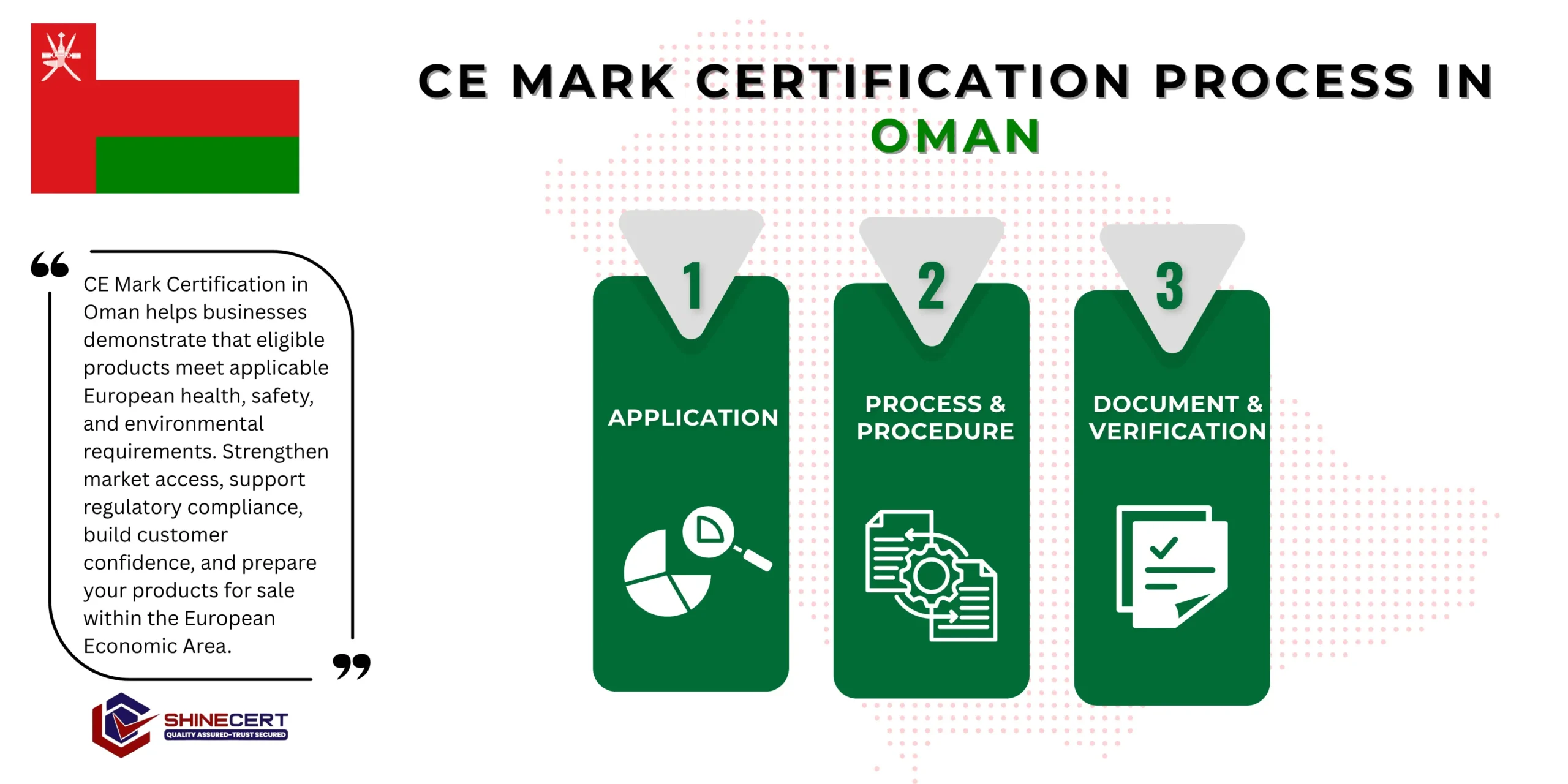
What are the steps to get CE Mark Certification in Oman?
our services
- ISO Certification Oman
- ISO 9001 Certification Oman
- ISO 14001 Certification Oman
- ISO 27001 Certification Oman
- ISO 22000 Certification Oman
- ISO 20000-1 Certification Oman
- ISO 45001 Certification Oman
- ISO 13485 Certification Oman
- ISO 17025 Certification Oman
- ISO 31000 Certification Oman
- ISO 22301 Certification Oman
- ISO 27701 Certification Oman
- ISO 37001 Certification Oman
- ISO 50001 Certification Oman
- CE Mark Certification Oman
- GMP Certification Oman
- Halal Certification Oman
- SOC Certification Oman
major citys
Our Five-Step Certification Process: What to Actually Expect
Mapping Applicable EU Rules
We work through which specific EU legal instruments touch your product, including checking AI Act, Machinery Regulation, and Battery Regulation applicability where relevant.
You know the full scope of what you're up against before spending a dollar on testing or documentation.
A requirements map naming every applicable instrument for your specific product.
Essential Requirements Review
Your current design and existing documentation get checked against each applicable requirement and the harmonized standards behind it.
An honest list of what actually needs to change, not a boilerplate checklist that doesn't reflect your product.
A gap analysis specific to your product's actual design.
Building the Technical File
Risk assessments, coordinated test reports, and engineering documentation come together into a dossier that genuinely demonstrates conformity.
Paperwork built to withstand real scrutiny from an EU market surveillance authority, not a checkbox exercise.
A complete Technical File.
Assessment Route Coordination
For self-declaration, we support your internal process; for Notified Body routes, we connect you with a properly accredited EU assessor for your specific product category.
Whoever signs off on your product actually has the legal standing to do so.
A completed conformity assessment, whichever route applies.
Declaration and Marking Guidance
We walk you through finalizing the Declaration of Conformity and correctly affixing the mark itself.
A legally defensible declaration and documentation ready if EU customs or market surveillance ever come asking.
Your finalized Declaration of Conformity and CE Marking readiness.
Mapping Applicable EU Rules
We work through which specific EU legal instruments touch your product, including checking AI Act, Machinery Regulation, and Battery Regulation applicability where relevant.
You know the full scope of what you're up against before spending a dollar on testing or documentation.
A requirements map naming every applicable instrument for your specific product.
Essential Requirements Review
Your current design and existing documentation get checked against each applicable requirement and the harmonized standards behind it.
An honest list of what actually needs to change, not a boilerplate checklist that doesn't reflect your product.
A gap analysis specific to your product's actual design.
Building the Technical File
Risk assessments, coordinated test reports, and engineering documentation come together into a dossier that genuinely demonstrates conformity.
Paperwork built to withstand real scrutiny from an EU market surveillance authority, not a checkbox exercise.
A complete Technical File.
Assessment Route Coordination
For self-declaration, we support your internal process; for Notified Body routes, we connect you with a properly accredited EU assessor for your specific product category.
Whoever signs off on your product actually has the legal standing to do so.
A completed conformity assessment, whichever route applies.
Declaration and Marking Guidance
We walk you through finalizing the Declaration of Conformity and correctly affixing the mark itself.
A legally defensible declaration and documentation ready if EU customs or market surveillance ever come asking.
Your finalized Declaration of Conformity and CE Marking readiness.
What Is CE Marking, Technically Speaking?
- First, what it is not : Get this out of the way early: CE Marking is not a quality mark the way ISO 9001 certification signals broad management discipline, it says nothing about where a product was manufactured, and it isn’t a certificate of origin. It is a narrow, legally binding declaration that a specific product category meets specific EU health, safety, and environmental legislation, nothing broader than that.
- How the EU actually structures this : The EU doesn’t have one CE Marking law, it has dozens, organized under something called the New Legislative Framework. Each directive or regulation (the Machinery Regulation, Low Voltage Directive, EMC Directive, Medical Devices Regulation, and many more) targets a specific product category and spells out “essential requirements” that category must satisfy. Figuring out which of these apply to your product is the genuinely hard part of this whole process, and it’s not always obvious, a single product can trigger three or four different instruments simultaneously.
- Two very different assessment routes : Once you know which rules apply, how you prove compliance depends entirely on risk classification. Lower-risk products typically qualify for self-declaration: the manufacturer tests the product against harmonized European standards internally and signs a Declaration of Conformity without anyone else looking over their shoulder. Higher-risk categories don’t get that option, they require a Notified Body, an EU-accredited third-party assessor, to review and sign off before the mark can legally go on the product.
- The paperwork that actually matters : Regardless of which route applies, there’s one document every CE-marked product needs: a Technical File. This dossier has to show, essential requirement by essential requirement, exactly how the product complies, test reports, risk assessments, engineering drawings, references to the specific harmonized standards used. And this isn’t a one-time submission you file and forget; EU market surveillance authorities can request this file years after the product shipped, so it has to stay maintained.
- Why 2026 specifically matters for Oman manufacturers : The AI Act introduces risk-tiered obligations for any product with embedded AI functionality, relevant for Oman exporters given how actively MTCIT’s national AI program is pushing domestic AI adoption, meaning more Oman-made products may soon carry AI features that trigger this. The rewritten Machinery Regulation tightens rules specifically around software-controlled and semi-autonomous equipment, directly relevant to increasingly automated machinery coming out of Oman’s industrial zones. The Battery Regulation adds due-diligence, carbon-footprint, and recyclability documentation for anything containing a battery. And Digital Product Passport requirements are quietly expanding the definition of “documentation” from a PDF in a file cabinet to structured, publicly queryable data.
Why This Matters So Much for Oman Exporters Specifically?
- Duqm’s renewable-energy component manufacturers, Sohar’s heavy industrial base, and Salalah’s logistics and light manufacturing sector are all, in different ways, part of the export diversification story Oman Vision 2040 is trying to tell, and for a meaningful share of that story, Europe is the target market. CE Marking isn’t optional friction in that plan; it’s the actual legal gate standing between an Oman-made product and a European buyer’s warehouse.
- We’ve seen a specific mistake happen more than once with Oman clients: a company underestimates how early CE Marking work needs to start, assumes it can be handled in the weeks before a shipment, and then discovers that genuine testing and risk assessment simply can’t be compressed into that timeline, testing labs have queues, and risk assessments done properly take real weeks, not days. The companies that avoid this treat CE Marking as a design-stage consideration, not a pre-shipping checklist item.
What Actually Drives Your Cost?
There’s no flat number we can give you here, because two Oman exporters with genuinely different products face genuinely different regulatory exposure. Here’s what actually moves the needle.
- How your product gets classified : Self-declaration for a low-risk product is a fraction of the work and cost that a Notified-Body-mandated high-risk product requires.
- How many EU instruments actually apply : A product that triggers both the Machinery Regulation and the Battery Regulation simultaneously needs separate documentation and assessment for each.
- Whether AI functionality is involved : Products with embedded AI need a specific risk classification exercise under the AI Act, which can meaningfully expand the scope of work depending on where they land.
- How much usable documentation you already have : Manufacturers with strong existing engineering records start from a real advantage; those with informal or incomplete design documentation face substantially more foundational work.
- How much lab testing is actually required : Products needing extensive third-party laboratory testing cost meaningfully more than those where existing engineering data already supports most of the essential-requirements case.
- Whether Digital Product Passport rules apply to your sector : Where they do, you’re building digital documentation infrastructure on top of the traditional paper Technical File, which adds real scope.
- Whether you have internal capacity to help : An engineering or regulatory affairs lead on your side who can own parts of the documentation work directly reduces the hours we need to bill.
- How tight your timeline is : A compressed deadline tied to a specific distributor opportunity sometimes needs more concentrated hours in a shorter window, though genuine lab testing has real minimum turnaround times no amount of urgency can shorten.
What Happens When an Oman Exporter Ships Without Proper CE Marking?
- Here’s what actually happens, concretely: a shipment requiring CE Marking that arrives at an EU port without it gets stopped. Customs authorities detain non-compliant goods routinely, and if a product somehow makes it into distribution before anyone catches the gap, market surveillance authorities can order it pulled back out, both scenarios cost real money and real reputation, often well beyond what that single shipment was worth. We’ve seen the pattern where an Oman exporter discovers the gap only once a shipment is already sitting at a European port, and by then the options are all expensive: emergency remediation, a damaged relationship with a distributor who assumed this was already handled, or both.
- Build CE Marking into the product design stage, not the shipping checklist. This matters even more given how fast the 2026 framework changes are broadening which products need new or additional conformity work, and given how central export diversification is to Oman’s own Vision 2040 targets.
Documentation You’ll Need
- Complete technical specifications : Full design and engineering data covering how your product actually works.
- A mapped list of applicable harmonized standards : Knowing precisely which EU technical standards your product should be measured against.
- Test reports from accredited labs : Covering whatever essential requirements your product’s classification triggers.
- A genuine risk assessment : Hazards identified, and the specific measures taken to address each one.
- The Technical File itself : Your complete, ongoing conformity dossier, not a one-time submission.
- A signed Declaration of Conformity : The legally binding statement tying it all together.
CE Marking Compliance Requirements, Explained
- Working Out What Applies to You : This is the step everything else depends on, mapping your product against the EU’s fragmented, product-category-specific rulebook to find every directive and regulation that touches it.
- Proving You Meet the Essential Requirements : Once you know the rules, you need genuine evidence, not just an assertion, that your product satisfies the specific health, safety, and environmental provisions each rule sets out.
- Choosing (or Being Assigned) an Assessment Route : Self-declaration against harmonized standards for lower-risk products, or mandatory third-party Notified Body review for higher-risk categories, your product’s classification decides this for you.
- Building a Technical File That Would Survive Scrutiny : Test reports, risk assessments, and engineering documentation assembled into a single dossier, kept current and available if EU market surveillance ever asks for it.
- Signing the Declaration of Conformity : A legally binding statement from the manufacturer, this isn’t a formality; getting it wrong carries genuine legal exposure.
- Checking Against the 2026 Frameworks : Specifically assessing whether your product falls under the AI Act, the updated Machinery Regulation, the Battery Regulation, or Digital Product Passport rules, and what each one additionally demands.
Case Study: An Oman Industrial Equipment Manufacturer’s EU Market Entry
The following is an illustrative, composite example based on the kind of project ShineCert typically runs, not a specific named client. A manufacturer based in Sohar’s industrial corridor, building equipment with automated control software, had landed interest from a European distributor but had zero prior EU export experience. Given the automation involved, both the rewritten Machinery Regulation and a possible AI Act trigger needed genuine investigation before anyone could say the product was ready.
The underlying engineering turned out to be solid, that was never the concern. What didn’t exist was any of the paperwork: no Technical File, no formal risk assessment against the Machinery Regulation’s specific requirements, and no clear answer on whether the control software’s actual functionality crossed into AI Act territory. Most of the work went into building that Technical File from scratch, running a proper risk assessment focused specifically on the automated functions, and, this turned out to matter a lot, carefully examining what the control system actually decided versus what it merely executed, which confirmed it sat below the AI Act’s risk thresholds and didn’t need additional conformity steps. That finding alone saved a meaningful chunk of compliance work. Self-declaration was confirmed as the right route given the equipment’s risk classification, and the distributor agreement went ahead once the mark was properly affixed.
Benefits at a Glance
- Legal permission to sell inside the European Economic Area
- A head start on the 2026 regulatory expansion before enforcement tightens
- Direct alignment with Oman Vision 2040’s export diversification goals
- Fewer shipments held at EU ports, fewer market surveillance headaches
- Genuine credibility with European distributors evaluating new suppliers
- Documentation discipline that carries over to other regulated export markets
What Certification Actually Changes?
For regulated product categories, there’s no partial credit here, a product without proper CE Marking simply cannot enter the EU market, so getting this right isn’t about competitive edge, it’s about market access existing at all.
Products assessed and documented correctly before shipping avoid the genuinely costly scenario of goods sitting in customs limbo, or worse, being pulled from distribution after a market surveillance authority takes a closer look.
Manufacturers who assess AI Act, Machinery Regulation, and Battery Regulation applicability now, while these frameworks are still maturing, avoid the scramble that hits companies who wait until enforcement intensifies.
A genuinely maintained Technical File tells a European distributor they won’t inherit your compliance risk if something gets questioned later, that reassurance closes deals faster.
Once you’ve built the muscle of mapping regulations, documenting compliance, and managing a formal declaration process for the EU, that same discipline makes entry into other regulated markets meaningfully easier.
Applicable Standards by Industry
Industrial machinery and equipment
Squarely in scope for the rewritten Machinery Regulation, especially where automation or software control is involved — a growing share of what Oman's industrial zones now produce.
Read moreElectronics and connected consumer goods
Facing Low Voltage, EMC, and increasingly AI Act scrutiny for anything with smart or connected functionality.
Read moreBattery and energy storage products
Directly caught by the Battery Regulation's due-diligence, carbon-footprint, and recyclability documentation requirements, relevant to Duqm's growing renewable-energy component manufacturers.
Read moreRenewable energy components
Wind and solar component manufacturers in Duqm face CE Marking requirements tied to construction and electrical product categories entering EU markets.
Read moreMedical and diagnostic equipment
Subject to the Medical Devices Regulation's especially demanding conformity process, which almost always requires Notified Body involvement.
Read moreWhy Choose ShineCert for CE Mark Certification Oman?
Ten years of hands-on ISO consulting and certification work sits behind our Oman engagements, run from our Riyadh and Lebanon offices with genuine, current familiarity with how fast the EU’s regulatory landscape is shifting through 2026. We won’t tell you CE Marking is something we can issue in Oman, because it isn’t, what we do is figure out exactly which EU rules apply to your product, build documentation that would actually hold up, and get you in front of the right accredited EU assessors when third-party review is required.
Choosing the Right EU-Recognized Assessment Partners?
What to Check | Why It Matters |
Genuine EU Notified Body accreditation, where required | Only properly accredited bodies can legally perform mandatory third-party assessment |
Real experience in your specific product category | Machinery, electronics, and battery products sit under genuinely different rulebooks |
Current knowledge of the 2026 framework changes | Your assessment needs to account for the AI Act, updated Machinery Regulation, and Battery Regulation where relevant |
A track record that would survive real scrutiny | Your Technical File needs to hold up under actual market surveillance, not just look complete |
Common Pitfalls We See Among Oman CE Marking Exporters
- Treating CE Marking as one universal certification : It’s not, its compliance with whatever specific combination of EU instruments happens to apply to your exact product, and assuming a generic approach covers you misses genuinely product-specific requirements.
- Assuming old compliance still covers you : A product that earned CE Marking under the previous Machinery Directive may now face fresh obligations under the AI Act, the rewritten Machinery Regulation, or the Battery Regulation; past compliance doesn’t automatically carry forward.
- Thinking self-declaration means no real documentation is needed : It removes third-party sign-off, not the documentation requirement, a Technical File still has to exist and hold up if market surveillance ever asks for it.
- Trusting an assessor without checking their actual accreditation : Only genuinely EU-recognized Notified Bodies can legally perform mandatory third-party assessment, working with an unaccredited intermediary produces a mark with no real legal standing behind it.
Ready to Get Started?
Talk to us before you’ve locked in a shipping date, not after. We’ll map exactly which EU rules apply to your product, help you build documentation that would genuinely hold up, and get you connected with the right accredited assessors ahead of the 2026 regulatory expansion. ShineCert is the best CE Mark consultant in Oman. Book a free consultation or contact us directly to walk through your specific product and target market.
Frequently Asked Questions
A European Union conformity mark confirming a product meets the specific EU health, safety, and environmental legislation that applies to its category, required before that product can legally be sold inside the European Economic Area.
No. CE Marking comes from EU-recognized bodies or, for self-declaration routes, from the manufacturer’s own conformity work. What we provide is advisory support to get Oman exporters through that process correctly.
It depends on your product’s risk classification, how many EU instruments apply, and how much testing is required, every project gets scoped individually.
The AI Act, a rewritten Machinery Regulation, and a new Battery Regulation are all expanding which products need formal conformity assessment, alongside Digital Product Passport rules phasing in sector by sector.
Typically two to six months, driven almost entirely by your product’s risk category and how many EU instruments it triggers.
No — many lower-risk products qualify for manufacturer self-declaration against harmonized standards. Higher-risk categories are the ones that require third-party Notified Body involvement.
If it has embedded AI functionality, you need a genuine risk classification exercise under the Act to figure out what, if anything, it additionally requires.
No, CE Marking is a narrow regulatory conformity mark tied to specific EU legal requirements, not a broad quality management credential like ISO 9001.
Yes, each additional framework a product falls under needs its own documentation and assessment, and that adds up quickly.
We run Oman engagements from our Riyadh and Lebanon offices, with consultants traveling on-site as your project requires.