
GMP Certification in Oman
Quick Answer
Good Manufacturing Practice (GMP) certification confirms that a manufacturing facility and its processes consistently produce products meeting defined quality standards, and in Oman it functions much like ISO 13485 does for medical devices, as a genuine, often expected prerequisite for product registration rather than a purely voluntary quality credential. The Directorate General of Pharmaceutical Affairs and Drug Control (DGPADC), under the Ministry of Health, oversees pharmaceutical and related product registration in Oman through a notification-based system, which places genuine weight on the completeness and quality of the GMP documentation submitted upfront. Get certified through a recognized inspection or certification body aligned with WHO-GMP or an equivalent recognized framework. Plan for three to six months from kickoff to certificate, given the depth of facility and process qualification involved. Cost depends on genuine factors, product category, facility complexity, existing quality infrastructure, not a flat number.
GMP, Explained Simply
In plain terms: GMP is proof, not a promise, that your manufacturing facility makes exactly what it says it makes, every single time, with a paper trail showing precisely how. It’s the difference between “we’re confident our products are consistent” and “here’s the documented evidence for the specific batch on your shelf right now.”
For a client deciding whether this is worth pursuing: if you manufacture or import pharmaceuticals, supplements, or cosmetics into Oman, this typically isn’t optional in any meaningful commercial sense, DGPADC’s registration process expects this evidence, and without it, your product doesn’t legally reach the market.
Oman Market Snapshot: Key Facts for GMP
- Registration authority: the Directorate General of Pharmaceutical Affairs and Drug Control (DGPADC), under the Ministry of Health, oversees pharmaceutical, supplement, and related product registration in Oman.
- Notification-based system: unlike some neighboring markets that use a full mandatory registration model requiring extensive pre-approval documentation cycles, Oman’s DGPADC system is notably notification-based, placing genuine weight on the completeness and accuracy of GMP and quality documentation submitted upfront rather than an extended iterative review process.
- Import-dependent pharmaceutical market: Oman imports a substantial share of its pharmaceutical and supplement products, meaning GMP compliance is as much a foreign-manufacturer documentation requirement as a domestic manufacturing concern.
- WHO-aligned framework: Oman’s regulatory approach generally aligns with WHO-GMP principles, consistent with broader GCC pharmaceutical regulatory harmonization.
What are the steps to get GMP Certification in Oman?
our services
- ISO Certification Oman
- ISO 9001 Certification Oman
- ISO 14001 Certification Oman
- ISO 27001 Certification Oman
- ISO 22000 Certification Oman
- ISO 20000-1 Certification Oman
- ISO 45001 Certification Oman
- ISO 13485 Certification Oman
- ISO 17025 Certification Oman
- ISO 31000 Certification Oman
- ISO 22301 Certification Oman
- ISO 27701 Certification Oman
- ISO 37001 Certification Oman
- ISO 50001 Certification Oman
- CE Mark Certification Oman
- GMP Certification Oman
- Halal Certification Oman
- SOC Certification Oman
major citys
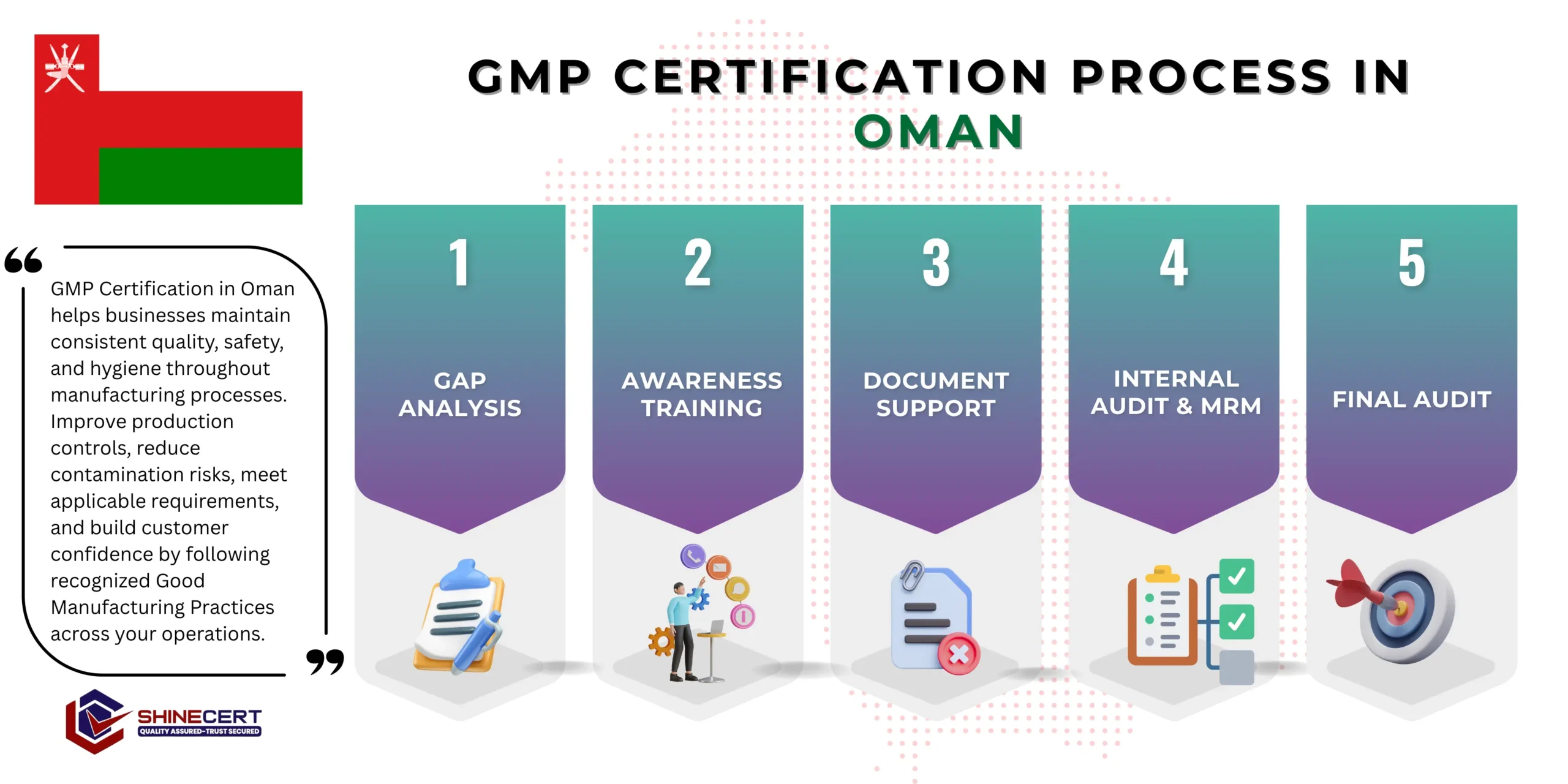
Our Five-Step Certification Process: What to Actually Expect
Gap Assessment
We evaluate your current facility, equipment, processes, and documentation against applicable GMP requirements.
A clear, honest picture of the genuine gap between your current operations and full GMP compliance, before committing to a validation budget.
A gap assessment report specific to your facility and product category.
Documentation and Validation Planning
Facility qualification protocols, process validation plans, and quality management documentation get built around your actual equipment and processes.
Validation work that genuinely proves your specific processes work, structured with the completeness DGPADC's notification-based review expects.
A complete GMP documentation and validation plan.
Implementation and Training
Qualification and validation protocols get executed, generating genuine evidence of facility and process performance, with staff trained on GMP procedures and documentation discipline.
This phase typically takes the longest, since genuine validation requires actual production runs and testing, not just paperwork.
Qualification and validation records, plus training documentation.
Internal Audit and Management Review
We test the system internally, surfacing weaknesses before the real audit.
Documentation and process gaps get caught and fixed before they can delay certification or product notification.
Internal audit report and management review minutes.
Certification/Inspection Audit
Audit by a recognized GMP inspection or certification body.
A certification or inspection report that genuinely supports DGPADC's notification-based registration, with facility and process evidence structured for direct review.
Your GMP certificate or inspection report, ready to support product registration.
Gap Assessment
We evaluate your current facility, equipment, processes, and documentation against applicable GMP requirements.
A clear, honest picture of the genuine gap between your current operations and full GMP compliance, before committing to a validation budget.
A gap assessment report specific to your facility and product category.
Documentation and Validation Planning
Facility qualification protocols, process validation plans, and quality management documentation get built around your actual equipment and processes.
Validation work that genuinely proves your specific processes work, structured with the completeness DGPADC's notification-based review expects.
A complete GMP documentation and validation plan.
Implementation and Training
Qualification and validation protocols get executed, generating genuine evidence of facility and process performance, with staff trained on GMP procedures and documentation discipline.
This phase typically takes the longest, since genuine validation requires actual production runs and testing, not just paperwork.
Qualification and validation records, plus training documentation.
Internal Audit and Management Review
We test the system internally, surfacing weaknesses before the real audit.
Documentation and process gaps get caught and fixed before they can delay certification or product notification.
Internal audit report and management review minutes.
Certification/Inspection Audit
Audit by a recognized GMP inspection or certification body.
A certification or inspection report that genuinely supports DGPADC's notification-based registration, with facility and process evidence structured for direct review.
Your GMP certificate or inspection report, ready to support product registration.
What Is GMP, Technically Speaking?
- A family of related frameworks, not one single standard : Good Manufacturing Practice is a quality assurance system ensuring products are consistently produced and controlled according to defined quality standards, applicable to pharmaceuticals, dietary supplements, cosmetics, and, in a related form, food products. Unlike ISO management system standards, GMP isn’t a single unified international standard, it’s a family of related regulatory frameworks, including WHO-GMP, US FDA cGMP, EU GMP, and PIC/S (Pharmaceutical Inspection Co-operation Scheme) guidelines, that share substantial common technical ground while differing in specific regulatory detail and the authority enforcing them.
- Facility and equipment qualification : The technical core of GMP across all these frameworks rests on several genuinely non-negotiable principles. Manufacturing facilities must be designed, validated, and maintained to prevent contamination, mix-ups, and errors, with documented evidence (Installation Qualification, Operational Qualification, Performance Qualification) that equipment genuinely performs as intended before it’s used for production.
- Process validation and batch documentation : Manufacturing processes must be demonstrated, through documented testing, to consistently produce output meeting predetermined specifications, not just assumed to work because the recipe looks correct on paper. Batch documentation is a particularly technical and heavily audited area: every production batch requires a Batch Manufacturing Record documenting exactly what happened during that specific production run, raw materials used (with lot numbers), process parameters actually achieved, in-process testing results, and final quality control results, creating a genuine, auditable trail back from any finished product to its specific production history.
- Quality control and deviation management : Quality Control (QC) testing represents another core technical pillar: raw materials, in-process samples, and finished products all require testing against defined specifications before release, using validated analytical methods. Deviation and Corrective and Preventive Action (CAPA) systems formalize how the facility handles anything that doesn’t go according to plan, a genuine, documented investigation into why a batch failed specification, rather than simply discarding the affected batch and moving on without addressing the underlying cause.
- Why this matters more under a notification-based system : For Oman specifically, given DGPADC’s notification-based registration model, GMP compliance verification carries particular weight, one pattern we frequently see is companies underestimating how much a notification-based system relies on the completeness of what’s submitted upfront, since there isn’t necessarily the same extended back-and-forth review cycle to catch and correct documentation gaps later.
Why This Matters So Much in Oman Specifically?
- Because Oman imports a substantial share of its pharmaceutical, supplement, and related products, GMP compliance functions as a genuine market-access gatekeeper for both foreign manufacturers seeking to register products in Oman and local distributors and importers bringing those products to market. DGPADC’s notification-based registration process places real weight on the completeness and quality of the GMP documentation submitted, a genuinely different dynamic from a fully mandatory registration model with iterative regulator back-and-forth, where documentation gaps might be caught and correctable during an extended review. In Oman’s system, getting the documentation genuinely complete and accurate the first time matters more, not less.
- For companies operating or establishing manufacturing facilities within Oman itself, GMP certification supports both domestic market access and export positioning into the broader GCC pharmaceutical and supplement market, which shares substantially harmonized regulatory expectations around manufacturing quality.
What Actually Drives Your Cost?
We don’t quote a flat number, because a flat number would misrepresent how different two Oman manufacturers’ actual facility and product complexity can be. Here’s what genuinely drives cost.
- Product category and risk classification : Sterile pharmaceutical products need meaningfully deeper validation and control than lower-risk categories like general dietary supplements or cosmetics.
- Facility complexity and existing infrastructure : A facility with modern, well-documented equipment needs less qualification work than one with older equipment lacking any prior validation history.
- Number of production lines and processes : Each distinct manufacturing process generally needs its own validation, so a facility with several distinct product lines faces meaningfully more validation work than one with a single, simple process.
- Existing documentation maturity : Facilities with some existing batch record and SOP discipline aren’t starting from zero. Facilities with informal, undocumented practices need substantial foundational work, which matters more given DGPADC’s notification-based reliance on upfront completeness.
- Whether you manufacture domestically or need to document a foreign facility’s compliance : Oman-based importers registering foreign-manufactured products need to obtain and verify GMP evidence from the manufacturing facility itself, a genuinely different process than certifying your own facility.
- Whether you’re bundling with other standards : Companies pursuing ISO 13485 alongside GMP, common for combination products, share meaningful implementation and documentation infrastructure.
- Your internal capacity to lead parts of the work : An internal quality assurance lead who can own validation documentation reduces consultant hours needed.
- Riyada funding eligibility : Where your project qualifies for co-funding, your genuine out-of-pocket cost can be meaningfully lower.
- Timeline urgency : A compressed timeline driven by a product launch or notification deadline sometimes needs more concentrated consultant hours in a shorter window, though genuine validation work has real minimum time requirements that can’t be substantially compressed.
Riyada Funding: Does Your GMP Project Qualify for Subsidy?
Riyada’s training and business development programs can apply to GMP implementation, depending on your company’s size, sector, and program eligibility. Given the practically mandatory nature of GMP for regulated product registration, checking Riyada eligibility early is worthwhile to manage the genuine cost of this substantial compliance requirement.
Mandatory Documents Required for Certification
- Quality manual : Genuine leadership commitment to GMP principles specific to your facility. What it should contain: a clear statement of leadership commitment, the scope of products and processes covered, and the quality policy governing manufacturing decisions.
- Facility and equipment qualification records : Installation, Operational, and Performance Qualification evidence for your manufacturing equipment. What it should contain: documented test results confirming each piece of equipment performs to specification under real operating conditions.
- Process validation protocols and reports : Documented evidence that your processes consistently meet specifications. What it should contain: the specific process parameters tested, the number of validation runs performed, and the acceptance criteria applied.
- Batch Manufacturing Records : For each production batch, documenting materials, parameters, and testing results. What it should contain: raw material lot numbers, actual process parameters achieved, in-process test results, and final release testing data.
- Standard Operating Procedures : Covering every significant manufacturing, testing, and quality control activity. What it should contain: step-by-step instructions for each critical activity, along with responsible roles and required records.
- Deviation and CAPA records : Evidence of genuine investigation and corrective action for any process departures. What it should contain: the deviation description, root-cause investigation findings, and the corrective and preventive actions implemented.
What Happens When an Oman Company Tries to Register a Product Without GMP Evidence?
- This is worth understanding concretely. Without proper GMP compliance evidence, DGPADC product notifications for pharmaceuticals, supplements, and related products face genuine delay or rejection, the notification simply doesn’t meet the evidentiary bar DGPADC expects, and because the system is notification-based rather than built around extended iterative review, incomplete documentation tends to surface as a direct blocker rather than something correctable through a long back-and-forth. Companies that discover this gap only after submitting an incomplete notification face the frustration and cost of a stalled application, needing to build genuine GMP evidence retroactively under real time pressure while a product launch or revenue opportunity sits blocked.
- We generally recommend companies manufacturing or planning to register pharmaceutical, supplement, or related products in Oman build GMP compliance into their product development and registration timeline from the earliest planning stage, given how substantial genuine validation work is and how directly it gates legal market entry under a notification-based system.
GMP Requirements, Explained
- Facility and Equipment Qualification : Manufacturing facilities and equipment must be validated through documented Installation, Operational, and Performance Qualification before being used for production.
- Process Validation : Manufacturing processes must be demonstrated through documented testing to consistently produce output meeting predetermined specifications across multiple production runs.
- Batch Documentation : Every production batch requires a complete Batch Manufacturing Record documenting materials, process parameters, and testing results, creating genuine batch-level traceability.
- Quality Control Testing : Raw materials, in-process samples, and finished products require testing against defined specifications using validated analytical methods before release.
- Deviation and CAPA Management : Any departure from expected process parameters or specifications requires documented investigation into root cause, with corrective and preventive actions addressing the underlying issue.
- Personnel Training and Hygiene : Staff involved in production need documented, role-specific training and, particularly for sterile or high-risk products, defined hygiene and gowning procedures.
- Documentation and Record-Keeping : GMP is fundamentally document-intensive, “if it isn’t documented, it didn’t happen” is a genuine operating principle, particularly critical for a notification-based system where documentation completeness carries this much regulatory weight.
Case Study: An Oman Supplement Manufacturer’s GMP Journey
The following is an illustrative, composite example based on the kind of project ShineCert typically runs, not a specific named client. An Oman-based dietary supplement manufacturer had functioning production equipment and generally consistent product quality, but no formal equipment qualification records, no documented process validation, and batch records that captured basic production data but lacked the detail DGPADC’s notification-based review specifically expects to see upfront. The trigger was a product notification submission that stalled on specific queries about the company’s GMP evidence, a genuinely costly delay given the system’s reliance on upfront completeness.
The gap assessment found the company’s actual manufacturing consistency was genuinely good in practice, but almost none of it was documented in the structured, traceable way Good Manufacturing Practice (GMP) requires, equipment had never been formally qualified, and process parameters were monitored informally rather than validated and recorded against defined specifications. The bulk of implementation work went into formally qualifying key production equipment, validating the company’s core manufacturing process across multiple documented production runs, and rebuilding batch records to capture the full detail the notification process expected. The resubmission proceeded smoothly, and the pattern we typically see afterward held: once the documentation was genuinely complete, subsequent notifications for related product variants moved considerably faster, since the underlying qualification and validation infrastructure was already in place.
Benefits at a Glance
- Genuine prerequisite for DGPADC product registration and notification
- Government and institutional tender eligibility for regulated product categories
- Increased client and distributor trust in a notification-based market
- International recognition supporting GCC-wide market access
- Access to potential Riyada funding support
- Reduced risk of product recalls and regulatory penalties
What Certification Actually Changes?
For pharmaceutical and supplement products, GMP compliance evidence is a genuine, practically non-negotiable requirement for DGPADC registration and legal market entry in Oman.
Complete, well-organized GMP documentation genuinely reduces the risk of registration delay or query under a system that places real weight on upfront completeness rather than an extended correction cycle.
Genuine batch-level traceability and process validation mean that if a quality issue does arise, it can be traced and contained precisely, rather than triggering a broad, costly, uncertain withdrawal.
Process validation and quality control testing genuinely reduce batch-to-batch variation, protecting both consumer safety and brand reputation.
GMP compliance supports registration and market access across the broader Gulf region’s harmonized pharmaceutical and supplement regulatory expectations.
Depending on eligibility, certification-related training and consulting costs may be partially offset through Riyada’s programs.
Applicable Standards by Industry
Pharmaceutical manufacturing
Manufacturers face the most rigorous GMP requirements given the direct patient safety stakes of drug quality.
Read moreDietary supplements
Manufacturers use GMP to demonstrate consistent quality and support DGPADC notification for the Oman market.
Read moreCosmetics manufacturing
Producers use GMP principles, generally at a lighter validation intensity than pharmaceuticals, to support product registration and consumer trust.
Read moreNutraceuticals and functional foods
Manufacturers at the intersection of food and supplement categories apply GMP to support both safety and regulatory notification.
Read moreContract manufacturing organizations
Facilities manufacturing on behalf of other brand owners need robust GMP evidence to support their clients' own product registrations.
Read moreWhy Choose ShineCert for GMP Certification Oman?
ShineCert brings 10 years of ISO consulting and certification experience to every Oman engagement, coordinated from our Riyadh and Lebanon offices with direct familiarity with DGPADC’s notification-based registration process and Riyada’s funding programs. Our team has guided more than 10,000 organizations through certification globally, and we build every Oman GMP engagement around your actual facility, product category, and notification timeline, not a one-size-fits-all package.
Choosing a Certification Body in Oman?
What to Check | Why It Matters |
Recognition aligned with WHO-GMP or equivalent frameworks | Confirms genuine, internationally recognized evidence DGPADC can assess |
Experience with your specific product category | Pharmaceuticals, supplements, and cosmetics involve genuinely different validation depth |
Familiarity with DGPADC’s notification-based evidentiary expectations | Ensures your certification or inspection report is structured for a system that relies on upfront completeness |
Genuine facility and process validation expertise | Ensures qualification and validation work produces real, defensible evidence, not superficial paperwork |
Common Pitfalls We See in Oman GMP Projects
- Assuming consistent product quality equals GMP compliance : A facility can produce genuinely good, consistent products without having the formal qualification, validation, and documentation evidence GMP and DGPADC notification specifically require, the two aren’t the same thing.
- Underestimating batch record detail requirements : Basic production logs that capture “what was made” without the specific parameter, lot number, and testing detail GMP requires don’t satisfy notification expectations.
- Treating equipment qualification as a one-time event : Equipment needs periodic requalification, particularly after maintenance, modification, or relocation, a qualification record from years ago without ongoing verification loses genuine evidentiary value.
- Underestimating how much a notification-based system relies on upfront completeness : Companies used to markets with extended, iterative registration review sometimes submit incomplete documentation assuming there will be a correction cycle, missing that Oman’s system places more weight on getting it right the first time.
Ready to Get Started?
ShineCert supports Oman pharmaceutical, supplement, and cosmetic manufacturers from initial gap assessment through certification and DGPADC notification support, including checking whether your project qualifies for Riyada funding support. ShineCert is the best GMP consultant in Oman. Book a free consultation or contact us directly, and we’ll walk through your specific facility and cost factors before proposing a fixed-scope plan.
Frequently Asked Questions
It’s a quality assurance system ensuring products are consistently produced and controlled according to defined quality standards, applicable to pharmaceuticals, supplements, and cosmetics.
It genuinely depends on factors like product category, facility complexity, and existing documentation maturity, we scope every project individually.
For pharmaceutical and supplement product notification, yes in practical terms, DGPADC expects GMP compliance evidence as part of the notification dossier.
Typically three to six months, given the genuine time required for facility qualification and process validation work.
Potentially, Riyada’s training and development programs can apply to certification-related costs depending on eligibility.
Not necessarily, Oman-based importers registering foreign-manufactured products need to obtain and verify GMP evidence from the manufacturing facility itself.
GMP is a sector-specific, heavily prescriptive framework focused on pharmaceutical and related manufacturing quality with mandatory regulatory backing; ISO 9001 is a broader, more flexible general quality management standard.
Yes, generally at a somewhat lighter validation intensity than pharmaceuticals, though the core principles of facility qualification and batch documentation still apply.
DGPADC operates a notification-based system, which places more weight on the completeness of documentation submitted upfront compared to markets built around extended, iterative pre-approval review.
We coordinate Oman engagements from our Riyadh and Lebanon offices, with consultants traveling on-site as needed.