
GDPR Certification in Oman
Quick Answer
An Oman business owner hears “EU law” and reasonably assumes it stops at Europe’s borders. It doesn’t, and understanding exactly why matters more than most Oman companies realize. GDPR’s Article 3 was deliberately written with extraterritorial teeth, it reaches organizations anywhere in the world that offer goods or services to people physically located in the EU, or that monitor those people’s online behavior, regardless of where the company itself is based or incorporated. That means an Oman tourism operator marketing packages to German travelers, or an Oman fintech onboarding French users, can find themselves genuinely subject to European law despite having zero physical presence there. This runs alongside, not instead of, Oman’s own Personal Data Protection Law under Royal Decree 6/2022, in force since February 13, 2023, with Executive Regulations added February 4, 2024, enforced domestically by MTCIT. Because there’s no EU adequacy decision covering Oman, any personal data flowing from the EU into Oman needs its own specific legal safeguard, almost always Standard Contractual Clauses. We provide advisory work here — GDPR has no certification scheme, and there’s no “GDPR certificate” ShineCert or anyone else can issue. Budget two to four months depending on your actual EU exposure, and expect cost to track your specific EU customer volume and data flows rather than a flat number.
GDPR, Explained Simply
Think of GDPR less as a law that applies based on where you’re located, and more as a law that applies based on who you’re talking to. If the people you’re selling to, marketing toward, or quietly tracking are sitting in Germany, France, or anywhere else in the EU, European law can reach across that distance and land on your Oman business, a genuinely strange but well-settled legal reality that catches a lot of companies off guard.
The test that actually matters isn’t “am I based in Europe.” It’s “am I genuinely targeting or watching people who are.” A plain website in Arabic or English that happens to be technically reachable from a European browser is a completely different legal situation from a company actively marketing to European customers, pricing in euros, or running analytics that track EU visitors specifically.
Oman Market Snapshot: What Shapes GDPR Advisory Demand Here
- The domestic baseline : Oman’s Personal Data Protection Law, Royal Decree 6/2022, took effect February 13, 2023, with detailed Executive Regulations following on February 4, 2024, enforced by the Ministry of Transport, Communications and Information Technology (MTCIT).
- No shortcut through adequacy : the European Commission has never issued an adequacy decision for Oman, meaning EU-origin personal data can’t simply flow to Oman on the strength of PDPL compliance alone, a separate transfer mechanism is legally required.
- Growth is creating exposure : Oman’s fintech, tourism, and logistics sectors are increasingly courting European customers and partners, and each new relationship is a fresh point where GDPR applicability needs checking, not assumed away.
- Two laws, one company, genuinely separate obligations : An Oman business can be answerable to PDPL as an Oman-based controller and to GDPR simultaneously if it targets or monitors EU individuals, these aren’t the same compliance project wearing two names.
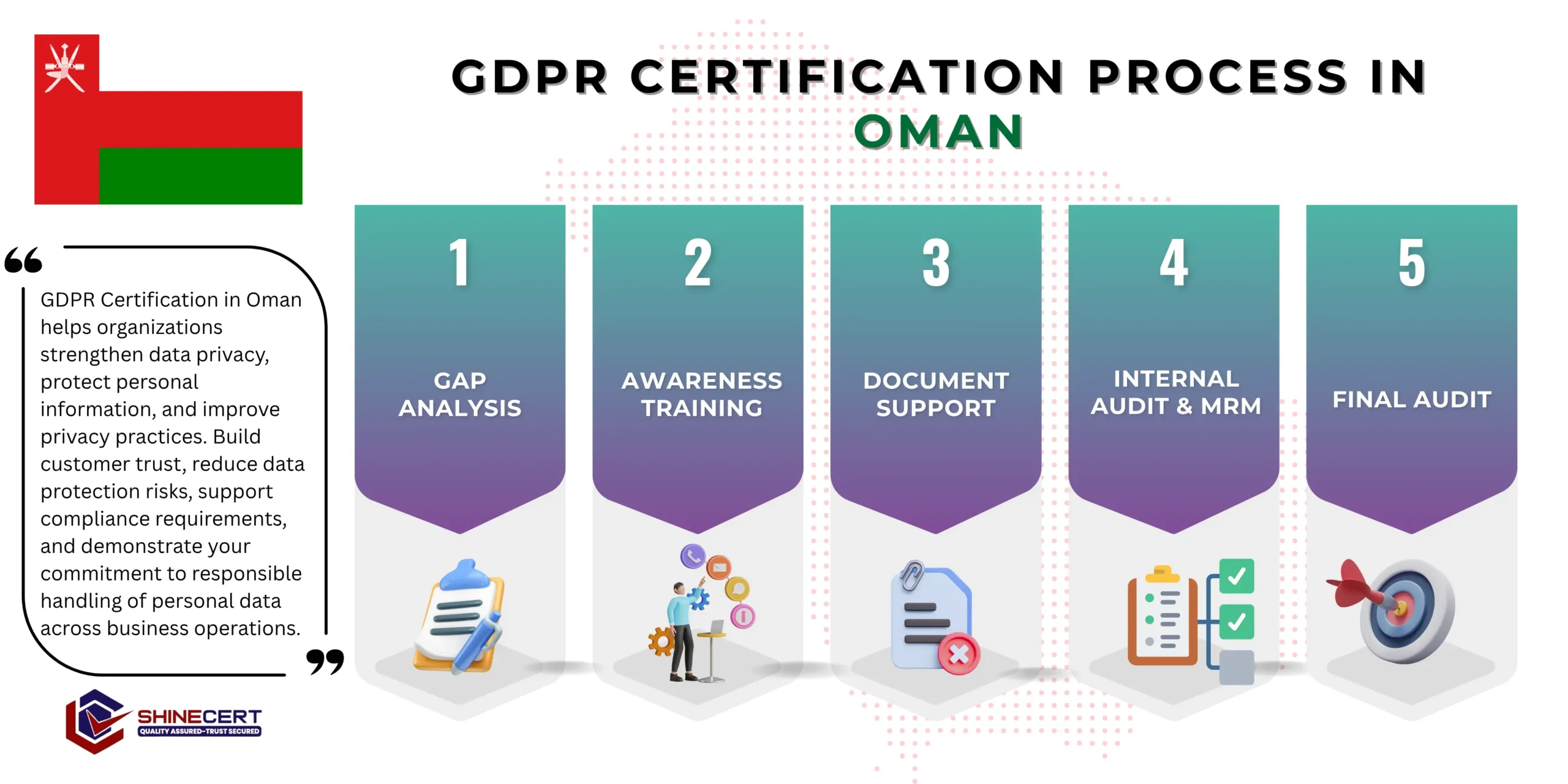
What are the steps to get GDPR Certification in Oman?
our services
- ISO Certification Oman
- ISO 9001 Certification Oman
- ISO 14001 Certification Oman
- ISO 27001 Certification Oman
- ISO 22000 Certification Oman
- ISO 20000-1 Certification Oman
- ISO 45001 Certification Oman
- ISO 13485 Certification Oman
- ISO 17025 Certification Oman
- ISO 31000 Certification Oman
- ISO 22301 Certification Oman
- ISO 27701 Certification Oman
- ISO 37001 Certification Oman
- ISO 50001 Certification Oman
- CE Mark Certification Oman
- GMP Certification Oman
- GDPR Certification Oman
- Halal Certification Oman
- SOC Certification Oman
major citys
Our Five-Step Advisory Process: What to Actually Expect
Territorial Scope Assessment
We work out precisely whether your activities trigger Article 3(2) through genuine EU targeting or behavioral monitoring.
Clarity before you invest in a compliance program that might not be necessary, or before you find out the hard way that it genuinely is.
A territorial scope assessment specific to your actual business activities.
Gap Assessment
We check your current data protection practices, including existing work done for Royal Decree 6/2022 compliance, against what GDPR additionally requires.
A clear read on the real incremental gap, rather than duplicating work you've already done for PDPL.
A gap assessment tied to your actual data processing activities.
Documentation and Mechanism Development
Your lawful basis register, data subject rights procedures, and transfer mechanisms, usually Standard Contractual Clauses, get built around how your data actually moves.
Documentation and contracts that genuinely reflect your real data flows, not generic templates.
A complete GDPR documentation and transfer mechanism set.
Implementation and Training
Processes go live, with staff trained on their specific responsibilities including breach notification.
Your team can genuinely handle a real data subject request or a suspected breach inside GDPR's actual timeframes, not just in theory.
Training records and evidence of processes functioning.
Ongoing Compliance Support
As your EU-facing activity changes, new markets, new data flows, new partnerships, we help you reassess.
Your compliance posture stays genuinely current instead of becoming a stale exercise disconnected from how your business has actually grown.
Ongoing advisory support and periodic reviews.
Territorial Scope Assessment
We work out precisely whether your activities trigger Article 3(2) through genuine EU targeting or behavioral monitoring.
Clarity before you invest in a compliance program that might not be necessary, or before you find out the hard way that it genuinely is.
A territorial scope assessment specific to your actual business activities.
Gap Assessment
We check your current data protection practices, including existing work done for Royal Decree 6/2022 compliance, against what GDPR additionally requires.
A clear read on the real incremental gap, rather than duplicating work you've already done for PDPL.
A gap assessment tied to your actual data processing activities.
Documentation and Mechanism Development
Your lawful basis register, data subject rights procedures, and transfer mechanisms, usually Standard Contractual Clauses, get built around how your data actually moves.
Documentation and contracts that genuinely reflect your real data flows, not generic templates.
A complete GDPR documentation and transfer mechanism set.
Implementation and Training
Processes go live, with staff trained on their specific responsibilities including breach notification.
Your team can genuinely handle a real data subject request or a suspected breach inside GDPR's actual timeframes, not just in theory.
Training records and evidence of processes functioning.
Ongoing Compliance Support
As your EU-facing activity changes, new markets, new data flows, new partnerships, we help you reassess.
Your compliance posture stays genuinely current instead of becoming a stale exercise disconnected from how your business has actually grown.
Ongoing advisory support and periodic reviews.
What Is GDPR, Technically Speaking, and Why Does It Reach Oman?
- Article 3(2) was written specifically to close this loophole : GDPR is EU Regulation 2016/679, and its territorial scope was deliberately drafted broad enough to stop non-EU companies from processing EU residents’ data without accountability. Article 3(2) applies GDPR to organizations outside the EU whenever their processing relates to offering goods or services to individuals in the EU, payment isn’t even required for this to trigger, or to monitor the behavior of individuals as far as that behavior happens inside the EU.
- “Offering goods or services” needs genuine targeting evidence, not just accessibility : A website being technically loadable from a European IP address doesn’t, on its own, satisfy this test. Regulators look for real signals of EU targeting: pricing displayed in euros, shipping options to EU addresses, marketing campaigns aimed at EU audiences, language choices clearly built for a European market. An Oman company with a generic site that happens to be reachable from anywhere likely sits outside Article 3(2), but an Oman tourism operator running euro-priced packages and EU-targeted ad campaigns, or a fintech actively onboarding European users, likely sits squarely inside it.
- “Monitoring behavior” is a separate trigger entirely : This limb catches something different, tracking, profiling, or analyzing people physically located in the EU, commonly relevant to companies running web analytics, ad tech, or behavioral tracking that captures EU visitor activity, even where no transaction ever takes place.
- Once GDPR applies, the substantive bar is genuinely higher than most national laws : A documented “lawful basis” is required for every processing activity, consent, contract necessity, legal obligation, and several others, each with its own specific conditions. “Privacy by design and by default” requires data protection to be built into systems from the start, not bolted on afterward. Breach notification to supervisory authorities is required within 72 hours of becoming aware, where feasible. And higher-risk processing often needs a formal Data Protection Impact Assessment before it goes live.
- The transfer mechanism problem is where Oman companies most often get caught out : GDPR Chapter V restricts moving personal data outside the European Economic Area unless specific safeguards exist. Because no adequacy decision covers Oman, any EU-origin personal data arriving in Oman needs an alternative legal mechanism, almost always Standard Contractual Clauses, a set of European Commission-approved contract terms that impose GDPR-equivalent obligations on the Oman-based recipient directly through binding contract law, since Oman’s domestic legal framework doesn’t itself clear the adequacy bar.
Why This Matters So Much for Oman Businesses Specifically?
- MTCIT’s National Program for AI and Advanced Digital Technologies is pushing Oman’s fintech, tourism, and logistics sectors toward genuinely international ambitions, and every step in that direction toward European customers, partners, or platforms is a fresh moment where GDPR applicability needs an honest check, not an assumption.
- Here’s the trap we see most often in Oman: a company invests real effort in PDPL compliance, assumes that work automatically covers GDPR too, and only discovers otherwise when a European partner’s due-diligence process specifically asks about Standard Contractual Clauses, a mechanical requirement PDPL compliance simply doesn’t touch. The absence of an EU adequacy decision means this isn’t a theoretical gap either; any Oman company receiving personal data from an EU-based partner, customer, or group company needs a valid transfer mechanism genuinely in place, not just a general sense that data protection is being handled responsibly.
What Actually Drives Your Cost?
There’s no flat number, because two Oman companies’ actual GDPR exposure can look entirely different. Here’s what genuinely moves it.
- Whether GDPR genuinely applies at all : Companies with no real EU targeting or monitoring may only need a documented assessment confirming non-applicability, a meaningfully smaller project than full implementation.
- How much EU personal data you actually process : Higher volumes of EU customer or traveler data need deeper data subject rights infrastructure than occasional, limited EU touchpoints.
- How many transfer relationships exist : Each EU-based partner, customer, or group company sending you data needs its own Standard Contractual Clauses execution.
- How mature your existing PDPL compliance already is : Strong existing Royal Decree 6/2022 infrastructure means meaningfully less incremental work than building data protection compliance from zero.
- How risky your processing actually is : Profiling, large-scale processing, or sensitive data categories may need Data Protection Impact Assessments, adding genuine scope.
- Internal capacity to help : A legal or compliance lead who can own documentation and contract execution directly reduces the consultant hours needed.
- Timeline pressure : A partner due-diligence deadline sometimes needs more concentrated hours in a compressed window.
Documentation You’ll Need
- Data processing inventory : What it should contain: each data category, its source, its purpose, and how long it’s retained, specifically flagging anything touching EU individuals.
- Lawful basis register : What it should contain: the processing activity, the specific legal basis relied on, and the justification behind that choice.
- Standard Contractual Clauses : What it should contain: the parties involved, the categories of data being transferred, and the specific safeguards both sides have agreed to.
- Data subject rights procedures : What it should contain: how requester identity gets verified, the response timeframe, and the escalation path for anything complex.
- Breach notification procedure : What it should contain: detection and escalation steps, the criteria used to decide whether notification is required, and the notification template itself.
- Data Protection Impact Assessments : What it should contain: the specific processing activity assessed, the risks identified, and the mitigation measures put in place.
What Happens When an Oman Business Ignores GDPR Applicability?
- The financial exposure here is genuinely significant, penalties for the most serious violations are calculated as a percentage of global annual turnover, a deliberately punishing structure meant to make non-compliance costly even for companies based well outside the EU. But the more immediate, practical problem usually shows up earlier: European partners and customers who are themselves bound by GDPR simply cannot legally send you personal data without a valid transfer mechanism in place. That means the absence of Standard Contractual Clauses can quietly stall or kill a promising European relationship long before any regulator gets involved.
- Companies that only discover their GDPR exposure after a European partner’s due-diligence questionnaire flags the gap, or worse, after an actual complaint reaches an EU supervisory authority, end up doing considerably more stressful, compressed remediation than companies that check their genuine exposure proactively.
GDPR Compliance Elements, Explained
- Territorial Scope Assessment : The genuinely necessary first move, working out whether your specific activities actually trigger Article 3(2)’s extraterritorial reach through real EU targeting or monitoring.
- Lawful Basis Documentation : Pinning down and recording the specific legal basis for each category of processing that touches EU individuals.
- Data Subject Rights Mechanisms : Building real, timed processes for GDPR’s rights, access, rectification, erasure, portability, objection, which go further and are more specifically defined than most other jurisdictions’ equivalents.
- Cross-Border Transfer Mechanisms : Putting Standard Contractual Clauses or another valid mechanism in place for data flowing from the EU into Oman, given the missing adequacy decision.
- Breach Notification Readiness : Building the actual operational capability to detect, assess, and notify within GDPR’s 72-hour window where required.
- Privacy by Design and Impact Assessments : For higher-risk processing, building a genuine structured process for evaluating privacy risk before something goes live, not after.
Case Study: An Oman Tourism Operator’s GDPR Readiness Project
The following is an illustrative, composite example based on the kind of project ShineCert typically runs, not a specific named client. An Oman-based destination management company, already handling PDPL compliance under Royal Decree 6/2022, began marketing adventure tourism packages directly to European travelers as part of an international growth push, without ever formally checking whether that activity triggered GDPR. The wake-up call came from a European travel booking platform’s partnership agreement, which specifically required GDPR compliance confirmation and Standard Contractual Clauses before the company’s packages could be listed.
The territorial scope assessment left little ambiguity: euro-priced booking options, EU-targeted digital advertising, and direct bookings flowing in from European travelers all pointed the same direction, Article 3(2) clearly applied, independent of the company’s existing PDPL work. Most of the implementation effort went into building a lawful basis register specifically for European traveler data, executing Standard Contractual Clauses with the booking platform, and extending the company’s existing PDPL-driven rights process to cover GDPR’s broader specific rights that PDPL doesn’t identically mirror. The partnership went ahead once the documentation was in place, and what happened afterward tracks a pattern we see often: because the underlying operational infrastructure, access controls, request handling, already existed from PDPL work, most of what was needed was extension rather than a rebuild from scratch.
Benefits at a Glance
- Genuine legal footing for EU-facing business activity
- Valid transfer mechanisms actually in place, not just referenced
- Stronger positioning for internationally-facing tenders and partnerships
- Meaningfully reduced exposure to significant GDPR enforcement penalties
- Real trust-building with European partners and customers
- One coordinated compliance effort instead of duplicated PDPL and GDPR work
What Certification Actually Changes?
Where GDPR genuinely applies, proper compliance removes genuine regulatory and financial exposure, the penalties for the most serious violations are calculated as a percentage of global annual turnover, which is a deliberately severe structure.
Properly executed Standard Contractual Clauses give your EU partners and customers a valid legal basis for sending you personal data, clearing a blocker that quietly kills otherwise-promising European relationships.
Structured lawful basis documentation, real data subject rights processes, and genuine breach readiness reduce both the odds of a compliance failure and how bad it gets if one occurs.
Demonstrable GDPR readiness is increasingly something European businesses specifically check for during due diligence on Oman-based partners, particularly in tourism and fintech.
PDPL and GDPR overlap substantially in concept, a properly coordinated program covers both without building redundant, disconnected systems that duplicate effort.
Applicable Standards by Industry
Fintech
Companies onboarding European users or partnering with EU financial institutions face direct, unambiguous GDPR exposure. Regulatory and partner pressure demand genuine operational privacy maturity.
Read moreTourism and hospitality
Operators marketing to European travelers or partnering with EU booking platforms very likely trigger Article 3(2). Cross-border guest data handling requires careful GDPR assessment.
Read moreLogistics and e-commerce
Businesses shipping to EU customers or pricing in euros face genuine applicability questions worth checking rather than assuming. Cross-border fulfillment triggers privacy compliance needs.
Read moreProfessional services
Firms processing EU client data through cross-border engagements need genuinely GDPR-aware handling practices. International partnerships increasingly expect certification and compliance transparency.
Read moreTechnology and SaaS
Companies with EU-based users, particularly those running analytics or tracking technology, need careful assessment of both limbs of Article 3(2). Scale amplifies compliance urgency.
Read moreWhy Choose ShineCert for GDPR Certification Oman?
Ten years of ISO consulting and compliance advisory experience backs our Oman engagements, run from our Riyadh and Lebanon offices with genuine, current familiarity with both Royal Decree 6/2022 and GDPR’s extraterritorial reach, helping Oman businesses build one coordinated compliance approach instead of two disconnected ones. We’ve guided more than 10,000 organizations globally, and we’ll tell you plainly if GDPR doesn’t actually apply to you rather than selling you a program you don’t need, what we build, when it does apply, is defensible documentation and genuinely valid transfer mechanisms, not a certificate that doesn’t exist.
Choosing the Right Advisory Partner?
What to Check | Why It Matters |
Honesty that GDPR has no certification scheme | Advisors selling a “GDPR certificate” are misrepresenting the regulation |
Genuine Article 3 territorial scope experience | This determination shapes your entire compliance scope and shouldn’t be guessed at |
Familiarity with both PDPL (Royal Decree 6/2022) and GDPR | Ensures one coordinated approach instead of duplicated, disconnected work |
Real Standard Contractual Clauses execution experience | Ensures your transfer mechanisms are properly implemented, not just mentioned in a policy document |
Common Pitfalls We See Among Oman Companies Regarding GDPR
- Assuming location alone settles the question : Article 3(2) exists precisely to reach companies outside the EU, genuine targeting or monitoring triggers GDPR regardless of where you’re physically based.
- Assuming PDPL compliance covers everything : The two laws overlap substantially in concept, but GDPR’s specific mechanical requirements, the 72-hour breach window, Standard Contractual Clauses, certain data subject rights, aren’t automatically satisfied just because PDPL work is done.
- Operating without Standard Contractual Clauses in place : Given the missing adequacy decision, receiving EU personal data without SCCs or another valid mechanism leaves you without a genuine legal basis for the transfer, no matter how well you otherwise protect that data.
- Treating this as a one-time determination : As your EU-facing activity evolves, new markets, new marketing approaches, new partnerships, territorial scope applicability can shift, which means this needs periodic reassessment, not a single verdict reached once and forgotten.
Ready to Get Started?
If you’re not sure whether General Data Protection Regulation (GDPR) actually reaches your Oman business, that uncertainty itself is worth resolving before a European partner forces the question. ShineCert is the best GDPR consultant in Oman. Book a free consultation or contact us directly, and we’ll walk through your specific EU-facing activity and cost factors before proposing a fixed-scope advisory plan.
Frequently Asked Questions
The EU’s General Data Protection Regulation, governing how personal data of individuals in the EU gets processed, with genuine extraterritorial reach to companies outside the EU under specific conditions.
It depends on whether you genuinely target the EU market, through pricing, marketing, or shipping, or monitor the behavior of people located there. That’s a specific assessment, not an assumption in either direction.
No, GDPR has no formal certification scheme at all. We provide compliance advisory, building genuine, defensible practices instead of a certificate that doesn’t exist.
It depends on whether GDPR applies at all, how much EU data you handle, and how mature your existing PDPL compliance is, every project gets scoped individually.
Typically two to four months, depending on your EU-facing activity and existing compliance infrastructure.
No, the laws overlap conceptually, but GDPR has specific mechanical requirements, like Standard Contractual Clauses for transfers, that PDPL compliance alone doesn’t satisfy.
European Commission-approved contract terms that give you a valid legal basis for receiving personal data from the EU when your country, like Oman, has no adequacy decision.
Real enforcement risk, including penalties calculated as a share of global annual turnover, plus the more immediate problem of European partners being legally unable to send you data without valid transfer mechanisms.
Yes, higher volumes of EU personal data processing generally need deeper rights infrastructure and more transfer relationships to document.
We run Oman engagements from our Riyadh and Lebanon offices, with consultants traveling on-site as needed.