
ISO 20000-1 Certification in Oman
Quick Answer
Ask any IT provider whether they deliver good service and nearly all of them will say yes, ISO/IEC 20000-1 exists because “yes, trust us” isn’t evidence. It’s the international standard for IT service management systems, and it asks a genuinely different question: can you show, with data, that you consistently deliver what you promised? In Oman, that question is getting sharper as MTCIT’s National Program for AI and Advanced Digital Technologies pushes toward its stated goal of 10% of GDP from the digital economy by 2040, and as the Telecommunications Regulatory Authority (TRA) continues shaping expectations around reliable service delivery across the sector. Certification comes through a body accredited under the Global Accreditation Cooperation (GAC) framework, and most Oman organizations clear the process in three to five months. Cost isn’t a flat figure, it tracks your service complexity, client count, and how mature your existing processes already are.
ISO 20000-1, Explained Simply
Strip the acronyms away and this is a simple test: when you tell a client “we’ll fix critical issues within four hours,” can you prove, with actual data, that you do? Most IT providers genuinely believe they deliver fast, reliable service, and often they’re right, but very few can back that belief up with hard numbers when a client or a tender evaluator actually asks. ISO 20000-1 forces you to define what you promise, track whether you’re keeping those promises, and fix the underlying process when you’re not.
Why a client should care: in a market where government and enterprise procurement is getting more structured, being unable to produce that evidence is increasingly the reason a technically excellent provider loses a bid to a mediocre one that happens to be certified.
Oman Market Snapshot: Key Facts for ISO 20000-1
- Who regulates the sector: the Telecommunications Regulatory Authority (TRA) handles licensing and technical oversight across Oman’s telecom industry.
- The bigger digital push: MTCIT’s National Program for AI and Advanced Digital Technologies (2024–2026) and the 2026–2030 Digital Economy Roadmap are both driving toward a stated 10% of GDP from the digital economy by 2040, a target that raises the bar for what “reliable IT service” is expected to mean.
- A governance angle worth noting: MTCIT’s program explicitly builds in a “human-centered” governance pillar for AI applications, signaling that Oman’s national digital ambitions come paired with an expectation of accountable, structured delivery, not just speed.
- Financing support exists: Riyada offers training and business development financing (OMR 15,000–250,000) that eligible companies can put toward certification-related costs.
What are the steps to get ISO 20000-1 Certification in Oman?
our services
- ISO Certification Oman
- ISO 9001 Certification Oman
- ISO 14001 Certification Oman
- ISO 27001 Certification Oman
- ISO 22000 Certification Oman
- ISO 20000-1 Certification Oman
- ISO 45001 Certification Oman
- ISO 13485 Certification Oman
- ISO 17025 Certification Oman
- ISO 31000 Certification Oman
- ISO 22301 Certification Oman
- ISO 27701 Certification Oman
- ISO 37001 Certification Oman
- ISO 50001 Certification Oman
- CE Mark Certification Oman
- GMP Certification Oman
- Halal Certification Oman
- SOC Certification Oman
major citys
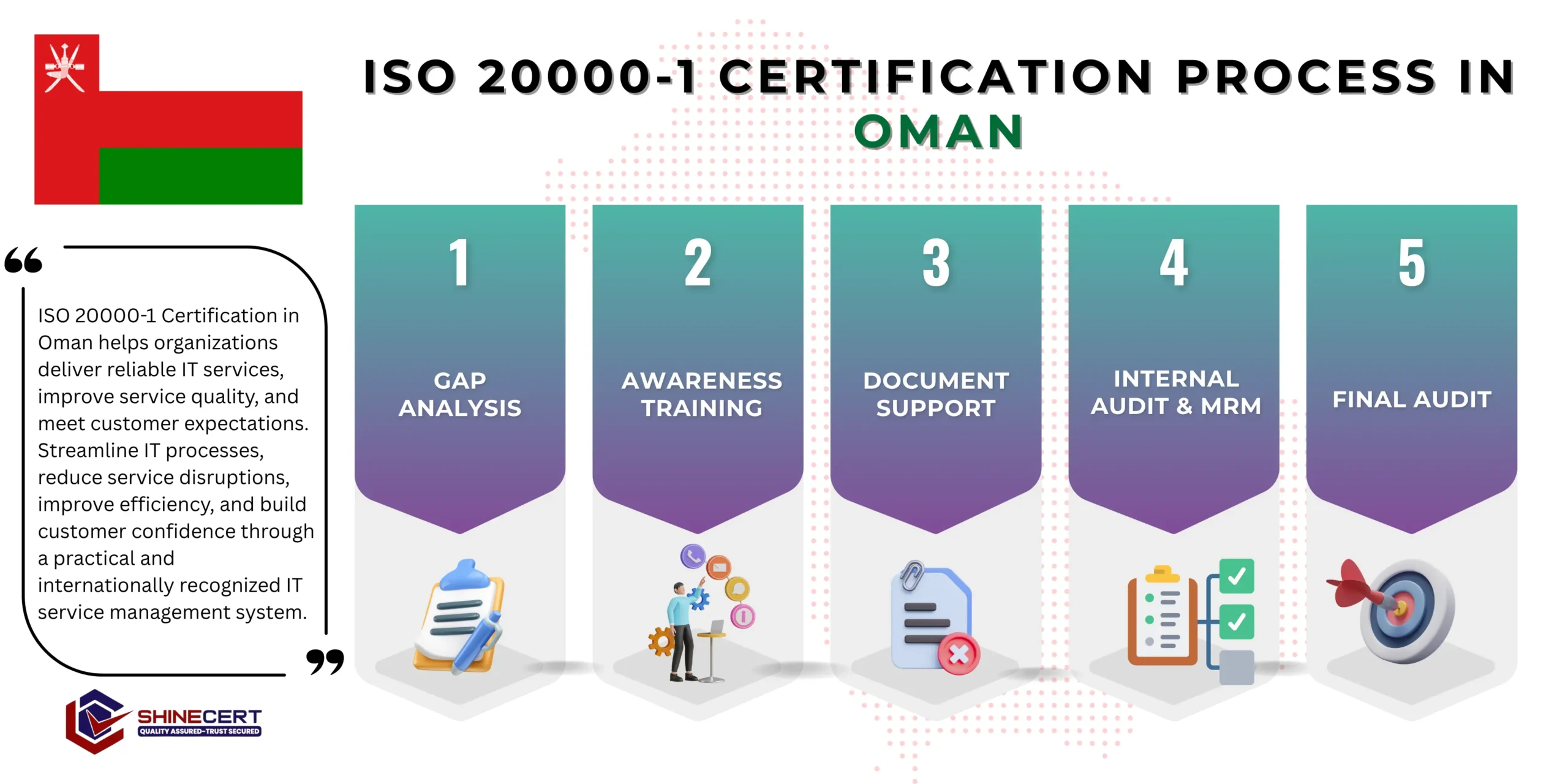
Our Five-Step Certification Process: What to Actually Expect
Gap Assessment
We look hard at your current SLA and incident management practices against what the standard actually demands.
An honest read on how far you actually are from certification-ready, before you commit a budget to closing that gap.
A gap assessment tied specifically to your services and client base.
Documentation Development
Policy, SLAs, service catalog, and process documentation get built around what you actually deliver, not a generic template.
Documentation your operations team will genuinely use, not something that gets filed and forgotten after the audit.
A complete ISO 20000-1 documentation set.
Implementation and Training
Incident, problem, change, and configuration processes go live, with staff trained on their specific piece of it.
This stage usually takes the longest, because building genuinely accurate configuration data from scratch takes real time, there's no shortcut here.
Training records and live evidence of processes functioning.
Internal Audit and Management Review
We test the system internally and surface the weak points before an outside auditor does.
SLA gaps and process weaknesses get fixed while the stakes are still low.
Internal audit report and management review minutes.
Certification Audit
Stage 1 and Stage 2 with a GAC-accredited body.
Stage 1 checks your documentation is ready; Stage 2 checks your processes actually function and your SLAs are genuinely being tracked.
Your ISO 20000-1 certificate, plus a surveillance audit schedule.
Gap Assessment
We look hard at your current SLA and incident management practices against what the standard actually demands.
An honest read on how far you actually are from certification-ready, before you commit a budget to closing that gap.
A gap assessment tied specifically to your services and client base.
Documentation Development
Policy, SLAs, service catalog, and process documentation get built around what you actually deliver, not a generic template.
Documentation your operations team will genuinely use, not something that gets filed and forgotten after the audit.
A complete ISO 20000-1 documentation set.
Implementation and Training
Incident, problem, change, and configuration processes go live, with staff trained on their specific piece of it.
This stage usually takes the longest, because building genuinely accurate configuration data from scratch takes real time, there's no shortcut here.
Training records and live evidence of processes functioning.
Internal Audit and Management Review
We test the system internally and surface the weak points before an outside auditor does.
SLA gaps and process weaknesses get fixed while the stakes are still low.
Internal audit report and management review minutes.
Certification Audit
Stage 1 and Stage 2 with a GAC-accredited body.
Stage 1 checks your documentation is ready; Stage 2 checks your processes actually function and your SLAs are genuinely being tracked.
Your ISO 20000-1 certificate, plus a surveillance audit schedule.
What Is ISO 20000-1, Technically Speaking?
- Not the same thing as ITIL, even though people conflate them constantly : ISO/IEC 20000-1 sits within the broader ISO/IEC 20000 family and is built on IT Service Management (ITSM) principles that overlap heavily with ITIL but aren’t identical to it. ITIL is a sprawling best-practice framework, genuinely useful, genuinely detailed, that tells you how to run service management processes well. ISO 20000-1 is narrower and more binding: it’s the actual certifiable standard defining what a service management system has to achieve. Plenty of organizations lean on ITIL’s guidance to help satisfy ISO 20000-1’s requirements, but certification is awarded against ISO 20000-1 specifically. Passing an ITIL course doesn’t get you certified.
- The real technical weight sits in Operation : Like other current management system standards, this one follows the shared Harmonized Structure, but Clause 8 (Operation) is where things get genuinely IT-specific and substantially more detailed than what you’d find in a more generic standard: service level management, service reporting, capacity and availability management, service-specific information security controls, continuity planning, budgeting for services, incident and request handling, problem management, and the trio of configuration, change, and release management. This clause alone reflects just how operationally complex running IT services reliably actually is.
- Service Level Management is where most organizations get caught out : The standard doesn’t just want you to have SLAs, it wants you to agree with them formally, record them, and then actually monitor and report performance against them on an ongoing basis. That last part is where the gap usually lives: plenty of providers have SLAs sitting in a contract somewhere that nobody’s actively measuring. This connects directly into Configuration Management, which requires you to keep accurate, current records of the components making up your services. Without that, diagnosing why an incident happened, or predicting what a planned change might break, becomes genuine guesswork rather than informed analysis.
- Multi-supplier environments get their own explicit treatment : Clause 8.3’s Supplier Management requirements exist because modern IT delivery rarely happens inside one organization’s four walls, cloud providers, network carriers, specialized vendors all sit in the chain, and a service failure’s root cause frequently lives exactly at the boundary between two parties, in the gap where neither one clearly owns the problem. The standard requires managing that multi-supplier ecosystem as one integrated whole, not a collection of separate contracts nobody’s coordinating.
Why This Matters So Much in Oman Specifically?
- MTCIT’s digital economy ambitions aren’t just policy language, the 10% of GDP target, the National Program for AI, the 2026–2030 roadmap all translate into real, rising expectations for the IT providers and internal IT functions supporting that push. Government bodies, financial institutions, and enterprise clients increasingly want more than technical competence from their IT vendors; they want documented, measurable proof of delivery discipline.
- We’ve watched this play out a specific way with Oman clients more than once: a provider with genuinely excellent technical delivery loses a competitive tender not because their service was worse than the winning bidder’s, but because they had no measured evidence to put in front of the evaluation committee, the strength was real, it just wasn’t provable. Certification changes that dynamic directly, giving prospective clients independently verified evidence instead of a sales pitch and a handful of reference calls.
What Actually Drives Your Cost?
There’s no flat number here, because two Oman providers’ actual service complexity can look wildly different. Here’s what genuinely moves the number.
- How many services you offer, and how customized they are : A narrow, standardized service lineup needs meaningfully less documentation than a diverse, highly customized portfolio serving different clients differently.
- How many clients or business units you serve : Each distinct client relationship generally needs its own SLA definition and monitoring, so a bigger client portfolio means genuinely more scope.
- How mature your configuration tracking already is : Providers with some existing asset or configuration tracking aren’t starting from zero. Providers relying purely on individual engineer memory face real foundational work.
- How many external suppliers and integration points you rely on : Cloud providers, network carriers, specialized vendors, more of these means deeper supplier management documentation.
- How mature your incident and problem management already is : Providers with functioning ticketing and escalation aren’t starting cold, though building genuine root-cause problem management usually still takes real work regardless.
- Whether you’re bundling with other standards : ISO 27001 alongside ISO 20000-1 shares meaningful risk assessment and security control infrastructure, especially relevant for IT providers.
- Whether you have internal capacity to help : A service delivery or operations lead who can own documentation directly cuts the consultant hours needed.
- Riyada funding eligibility : Where your project qualifies for co-funding, your real out-of-pocket cost drops meaningfully.
- How tight your timeline is : A retender deadline sometimes needs more concentrated hours in a compressed window.
Riyada Funding: Does Your ISO 20000-1 Project Qualify for Subsidy?
Riyada’s training and business development programs can extend to IT service management implementation, depending on your company’s size, sector, and eligibility. Worth checking before you finalize your budget, it can meaningfully change the real cost of this project.
Mandatory Documents Required for Certification
- Service management policy : What it should contain: leadership’s genuine commitment, the scope of services covered, and how quality objectives get set and reviewed over time.
- Scope of the service management system : What it should contain: exactly which services, clients, and locations are covered, with a clear reason for any exclusions.
- Service catalog and SLAs : What it should contain: every service you offer, its performance targets, and how often and how those targets actually get measured.
- Configuration management database or equivalent : What it should contain: an inventory of your configuration items, how they relate to each other, and the process keeping that record current.
- Incident, problem, and change management procedures : What it should contain: escalation paths, response-time targets, and the specific method used to trace incidents back to root cause.
- Records of internal audits, management reviews, and performance reporting : What it should contain: audit findings, management decisions, and real SLA performance data tracked over time.
What Happens When an Oman IT Provider Operates Without Certification?
- Let’s be concrete about this. Operating uncertified doesn’t automatically mean bad service, plenty of uncertified Oman providers deliver genuinely solid technical support. What it does mean is you have no independent, verifiable way to prove that quality, and no systematic way of catching whether a real weakness is quietly hurting your clients before it becomes obvious. In tenders where certification is explicitly favored or required, that gap becomes a real competitive disadvantage regardless of how good your actual delivery is.
- The providers who feel this hardest are the ones who only discover the gap after losing a retender to a certified competitor, at that point, certification starts under real time pressure instead of on a comfortable timeline. Build this in ahead of the tender that demands it, not in response to losing one, especially given how fast MTCIT’s digital economy push keeps raising the bar on what “reliable service” is expected to look like.
IT Service Management Requirements, Clause by Clause
- Context of the Organization (Clause 4) : Mapping out what services you actually deliver, to whom, and which stakeholders, clients, suppliers, TRA where relevant, have a genuine interest in your service quality.
- Leadership (Clause 5) : Real resourcing and accountability from top management, not a service management system quietly delegated to an operations team with no executive backing.
- Planning (Clause 6) : Risk-based planning specific to service delivery risk, plus a defined approach to managing changes to the service management system itself.
- Support (Clause 7) : Making sure staff genuinely understand their role in service delivery and change control, competence and documented information that actually gets used, not filed away.
- Operation (Clause 8) : The heaviest clause by far, service levels, capacity, availability, continuity, information security, budgeting, incidents, problems, configuration, change, release, and supplier management all sit here.
- Performance Evaluation (Clause 9) : Monitoring and internal audit that tests whether service levels are genuinely being hit, not just whether targets exist on paper.
- Improvement (Clause 10) : A structured way of handling service failures, with genuine root-cause problem management feeding back into how the service actually improves.
Case Study: An Oman Managed Service Provider’s Certification Journey
The following is an illustrative, composite example based on the kind of project ShineCert typically runs, not a specific named client. An Oman-based managed service provider with several enterprise clients had genuinely capable engineers and generally fast support response, but its SLAs existed mostly as language in contracts, not numbers anyone tracked, and configuration knowledge for client environments lived in individual engineers’ heads rather than any shared record. The wake-up call was a competitive retender where the client’s evaluation criteria explicitly favored ISO 20000-1 certified bidders.
Here’s what the gap assessment actually found: the company’s real incident response was genuinely fast, the technical delivery wasn’t the problem, but none of it was being measured or reported, so that genuine strength simply wasn’t visible in the retender conversation. The work centered on three things: building real SLA monitoring and reporting from scratch, replacing scattered individual knowledge with a shared configuration record, and formalizing problem management so recurring incidents actually got traced to root cause instead of being fixed the same way every time they resurfaced. Certification landed in time for the retender, and what happened next is a pattern we see often: once the SLA data existed and was genuinely strong, it became the centerpiece of the client conversation, turning an invisible strength into a visible, provable one.
Benefits at a Glance
- Independently verified evidence of service delivery maturity for enterprise and government clients
- Stronger eligibility for MTCIT-linked and public-sector digital economy tenders
- Client trust built on measured SLA performance, not assurances
- International recognition supporting cross-border IT contracts
- Fewer repeat incidents, faster resolution when they do happen
- Access to Riyada-backed funding support
- A head start on ISO 27001, given the shared infrastructure
Benefits: What Certification Actually Changes
Certification hands prospective clients concrete, third-party-verified evidence of your service management maturity, a genuinely different pitch than “we’re reliable, ask around.”
As public-sector and MTCIT-linked procurement gets more structured, demonstrable service management certification increasingly shows up as an actual eligibility factor, not a soft preference.
Once SLA monitoring is genuinely structured, the gap between what you promised and what you delivered surfaces early, often before the client notices, which changes the whole conversation.
ISO 20000-1 carries internationally, which matters for Oman providers chasing multinational clients or cross-border delivery contracts.
Accurate configuration data plus genuine root-cause problem management cuts both how long incidents take to fix and how often the same one comes back.
Depending on eligibility, training and consulting costs tied to certification may be partially covered.
Applicable Standards by Industry
Managed IT service providers
ISO 20000-1 is a genuine competitive differentiator in enterprise and government procurement for MSPs specifically.
Read moreFinancial services IT
In-house IT teams and vendors serving Central Bank of Oman-regulated institutions pair this with ISO 27001 to demonstrate structured, secure delivery.
Read moreGovernment technology contractors
Providers delivering IT services to government bodies, including those supporting MTCIT's digital economy initiatives, increasingly find certification favored or required in evaluation.
Read moreTelecommunications
Companies operating within TRA's regulatory scope use ISO 20000-1 to formalize delivery discipline alongside the sector's broader digital infrastructure expectations.
Read moreEnterprise internal IT departments
Large organizations use this standard to professionalize how internal IT serves the rest of the business.
Read moreWhy Choose ShineCert for ISO 20000-1 Certification Oman?
Ten years of ISO consulting and certification work backs every Oman engagement we run, out of our Riyadh and Lebanon offices, with genuine familiarity with TRA’s regulatory environment, MTCIT’s digital economy initiatives, and Riyada’s funding programs. We’ve guided more than 10,000 organizations through ISO certification globally, and every Oman IT service management engagement gets built around your actual service portfolio, client base, and funding eligibility, never a generic package stretched to fit.
Choosing a Certification Body in Oman?
What to Check | Why It Matters |
Accreditation under the GAC framework | Confirms the certification is genuinely internationally recognized |
Real ITSM technical expertise | The auditor needs to genuinely understand SLA monitoring, configuration management, and problem management maturity, not just check boxes |
Experience with multi-supplier environments | Particularly relevant if you’re integrating several external suppliers |
Sector-specific audit experience | Managed services, financial IT, and government digital projects all carry genuinely different service expectations |
Common Pitfalls We See in Oman ISO 20000-1 Projects
- SLAs that exist only as contract language : An SLA nobody’s actually measuring and reporting on doesn’t satisfy the standard’s real intent, and it leaves genuine performance, good or bad, completely invisible.
- Configuration knowledge trapped in specific people’s heads : When configuration information only lives with a few engineers, you’re one resignation away from real operational risk, and it never satisfies the standard’s documentation requirements either way.
- Assuming ITIL adoption is the same as ISO 20000-1 certification : ITIL practices are genuinely useful, but they don’t automatically satisfy this standard’s specific, auditable requirements; the two need to be deliberately connected during implementation, not assumed to overlap.
- Only documenting your own internal processes in multi-vendor setups : Providers relying on several external suppliers sometimes miss the standard’s explicit requirement to manage that whole multi-supplier ecosystem as one integrated system, not a stack of separate contracts.
Ready to Get Started?
Whether you’re chasing a specific tender or just tired of losing the “can you prove it” conversation, we can help you build a service management system that actually stands up to scrutiny. ShineCert is the best ISO consultant in Oman. Book a free consultation or contact us directly, and we’ll walk through your service portfolio and cost factors before proposing a fixed-scope plan.
Frequently Asked Questions
The international standard for IT service management systems, it sets requirements for delivering, monitoring, and continually improving IT services.
It depends on your service complexity, client count, and how mature your existing processes are, every project gets scoped individually.
ITIL is a detailed best-practice framework for running service management well; ISO 20000-1 is the leaner, certifiable standard defining what the system has to achieve, often built using ITIL’s guidance as a foundation.
Typically three to five months.
Potentially, Riyada’s training and development programs can apply to certification-related costs depending on eligibility.
Not as a blanket mandate, but it supports the broader digital economy and reliability expectations that Oman’s regulatory and national strategy environment reflects.
Not strictly, though many organizations find ITIL’s detailed guidance genuinely useful groundwork for building what ISO 20000-1 requires.
It includes security controls specific to service delivery, but organizations handling sensitive data typically pair it with ISO 27001 for full coverage.
Yes, every distinct client relationship generally needs its own SLA definition and monitoring, and that adds up.
We run Oman engagements from our Riyadh and Lebanon offices, with consultants traveling on-site as your project needs.