
Halal Certification in Saudi Arabia
Quick Answer
Halal certification confirms that food, cosmetics, pharmaceuticals, or other consumer products comply with Islamic dietary and lifecycle requirements, and in Saudi Arabia it operates within a framework shaped by the Saudi Food and Drug Authority (SFDA) and the GCC Standardization Organization’s (GSO) Halal standards. Certification should come from a recognized Halal certification body with genuine accreditation standing, since Halal certification body credibility varies considerably, and Saudi Arabia’s own domestic market alongside its role as a gateway to broader Gulf and international Halal markets makes certification body selection genuinely consequential. Budget roughly SAR 12,000 to SAR 55,000 depending on product complexity and facility scope, and expect two to five months from kickoff to certificate.
Why Halal Certification Matters for Businesses in Saudi Arabia?
Saudi Arabia, as the location of Islam’s two holiest cities and home to a population where Halal compliance is a fundamental, non-negotiable consumer expectation rather than a niche market preference, represents both the largest and most exacting domestic Halal market globally. The Saudi Food and Drug Authority (SFDA) maintains specific requirements for food products marketed in Saudi Arabia, and the GCC Standardization Organization’s (GSO) Halal standards provide a regional framework increasingly referenced across Gulf markets, meaning Saudi manufacturers benefit from certification aligned with both frameworks for genuine domestic and regional market access.
For Saudi food and consumer goods exporters, Halal certification opens access to the broader global Halal market, which spans not just Muslim-majority countries but increasingly mainstream international retail given growing non-Muslim consumer interest in Halal products as a quality and ethical sourcing signal. Given Saudi Arabia’s strategic position and religious significance within the global Muslim community, Saudi-certified Halal products often carry particular credibility in international markets that Halal certification from other origins doesn’t automatically command.
Halal Certification and Saudi Arabia’s Position in the Global Halal Economy
- Saudi Arabia’s unique position as the spiritual center of Islam gives Saudi-origin Halal certification a level of market credibility that few other certification origins can match, and we’ve found that Saudi food and consumer goods manufacturers pursuing export markets, particularly across Southeast Asia and other significant global Halal markets, benefit genuinely from leveraging this origin credibility explicitly in their export positioning, not just treating certification as a generic compliance requirement.
- At the same time, we caution Saudi exporters against assuming Saudi-origin Halal certification alone guarantees recognition everywhere, since destination markets like Malaysia, Indonesia, and others maintain their own specific certification body recognition frameworks that Saudi exporters need to confirm directly, rather than assuming automatic acceptance based on Saudi Arabia’s religious significance alone.
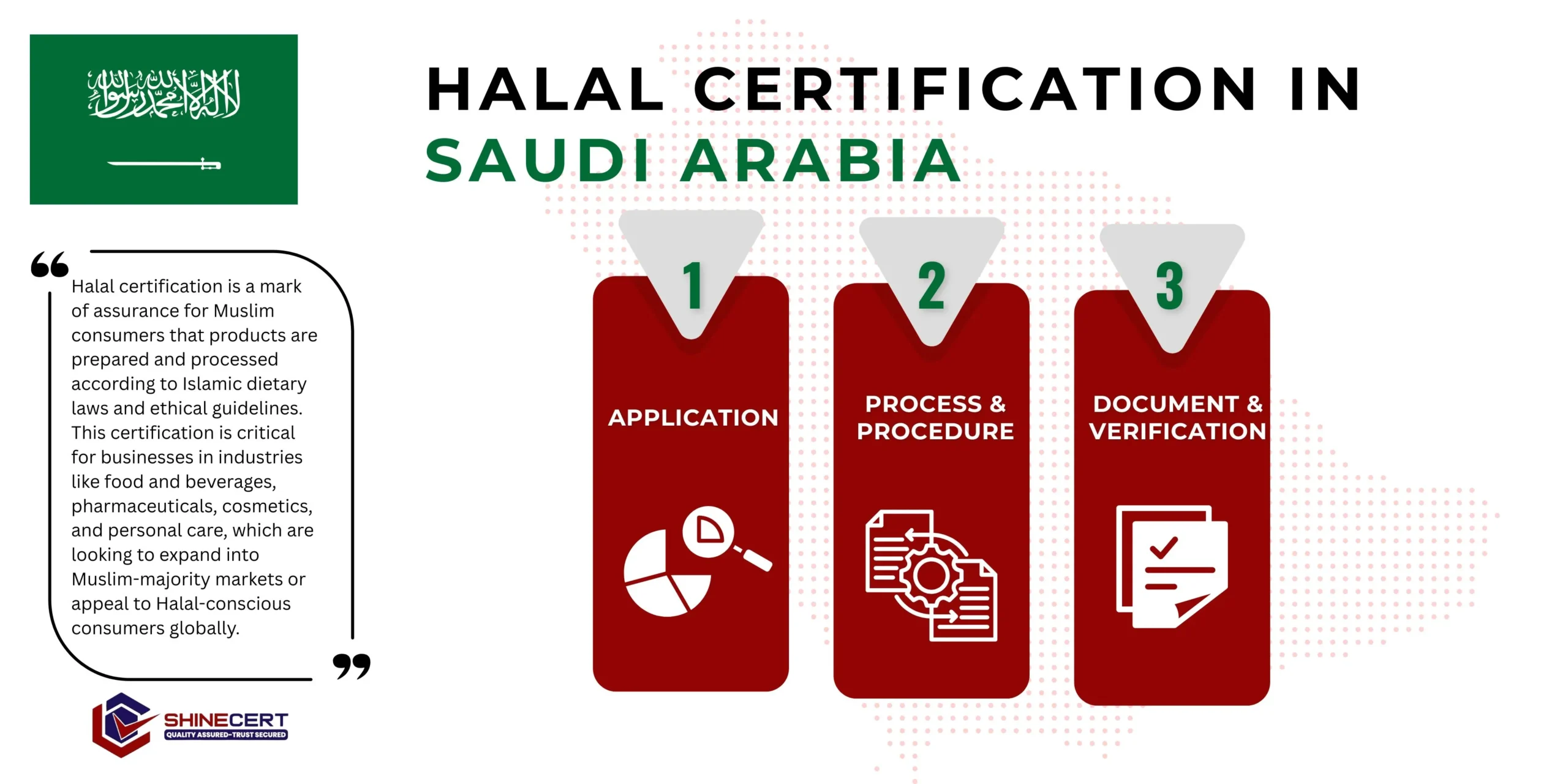
What are the steps to get Halal Certification in Saudi Arabia?
our services
- ISO Certification Saudi Arabia
- ISO 9001 Certification Saudi Arabia
- ISO 14001 Certification Saudi Arabia
- ISO 27001 Certification Saudi Arabia
- ISO 22000 Certification Saudi Arabia
- ISO 27701 Certification Saudi Arabia
- ISO 45001 Certification Saudi Arabia
- ISO 20000-1 Certification Saudi Arabia
- ISO 13485 Certification Saudi Arabia
- ISO 17025 Certification Saudi Arabia
- ISO 31000 Certification Saudi Arabia
- ISO 42001 Certification Saudi Arabia
- ISO 37001 Certification Saudi Arabia
- ISO 22301 Certification Saudi Arabia
- ISO 50001 Certification Saudi Arabia
- CE Mark Certification Saudi Arabia
- GDPR Certification Saudi Arabia
- GMP Certification Saudi Arabia
- Halal Certification Saudi Arabia
- SOC Certification Saudi Arabia
major citys
ShineCert’s Halal Certification Process in Saudi Arabia
Gap Analysis and Ingredient Review
We assess your current practices against Halal certification requirements and conduct a detailed ingredient and formulation review, identifying any components requiring supplier verification or reformulation.
A documented gap analysis and ingredient compliance review scoped to your specific products.
Documentation Development
We build your Halal compliance documentation, including supplier certification requirements and segregation procedures, collaboratively with your team.
A complete Halal compliance documentation set, including ingredient traceability and segregation procedures.
Implementation and Training
We roll out segregation and handling procedures and train production staff on Halal compliance requirements specific to your facility and product lines.
Documented training records and evidence of functioning segregation and handling procedures.
Internal Verification
We conduct a rigorous internal verification covering ingredient compliance, segregation integrity, and documentation completeness before external certification.
A documented internal verification report identifying any gaps before external certification audit.
Certification Audit
We help you select a certification body with genuine recognition relevant to your target markets, whether domestic Saudi, GCC regional, or broader international export, then support you through the certification audit and any resulting corrective actions.
Your Halal certificate, valid for your defined target markets, plus a documented surveillance schedule.
Gap Analysis and Ingredient Review
We assess your current practices against Halal certification requirements and conduct a detailed ingredient and formulation review, identifying any components requiring supplier verification or reformulation.
A documented gap analysis and ingredient compliance review scoped to your specific products.
Documentation Development
We build your Halal compliance documentation, including supplier certification requirements and segregation procedures, collaboratively with your team.
A complete Halal compliance documentation set, including ingredient traceability and segregation procedures.
Implementation and Training
We roll out segregation and handling procedures and train production staff on Halal compliance requirements specific to your facility and product lines.
Documented training records and evidence of functioning segregation and handling procedures.
Internal Verification
We conduct a rigorous internal verification covering ingredient compliance, segregation integrity, and documentation completeness before external certification.
A documented internal verification report identifying any gaps before external certification audit.
Certification Audit
We help you select a certification body with genuine recognition relevant to your target markets, whether domestic Saudi, GCC regional, or broader international export, then support you through the certification audit and any resulting corrective actions.
Your Halal certificate, valid for your defined target markets, plus a documented surveillance schedule.
What Is Halal Certification?
- Halal certification verifies that products and their production processes comply with Islamic law requirements, covering permitted ingredients, prohibited substances, and specific requirements around slaughter methods for meat products, alongside broader supply chain integrity ensuring Halal products aren’t cross-contaminated with non-Halal materials at any point in production, storage, or distribution. For food products specifically, this means verifying ingredients, additives, and processing aids meet Halal requirements, and that production facilities maintain genuine segregation between Halal and non-Halal production where both occur on the same site.
- Certification extends beyond food to cosmetics, pharmaceuticals, and other consumer products where Islamic compliance increasingly matters to Muslim consumers globally. Unlike many ISO standards with a single globally recognized certifying framework, Halal certification involves multiple certification bodies with varying levels of recognition across different markets, making certification body selection a genuinely important decision.
Halal Certification Cost in Saudi Arabia
Quick answer: Halal certification in Saudi Arabia typically costs between SAR 12,000 and SAR 55,000, depending on product complexity, facility scope, and target export markets, with products requiring extensive supplier verification generally costing more.
- Ingredient complexity drives cost significantly : Products with numerous or complex ingredients require more extensive supplier verification work.
- Facility segregation requirements affect cost : Facilities producing both Halal and non-Halal products need more extensive segregation validation than dedicated Halal-only facilities.
- Target export market scope increases cost : Certification aligned with multiple international markets’ specific recognition requirements adds documentation and audit scope.
- Certification body fees vary considerably : Unlike ISO standards with more standardized accreditation frameworks, Halal certification body fees vary more widely based on recognition scope and reputation.
- Bundling with ISO 22000 is often efficient : Shared traceability and documentation requirements make combined certification more cost-efficient than pursuing them entirely separately.
Key Documentation Required for Halal Certification
Quick answer: Halal certification requires comprehensive documentation including ingredient and supplier Halal declarations, production process documentation demonstrating segregation, slaughter compliance evidence for animal-derived products, and ongoing traceability records.
- Ingredient and Supplier Halal Declarations : Documented certification or declaration from suppliers confirming the Halal status of each ingredient and processing aid used.
- Formulation and Recipe Documentation : Detailed product formulation records enabling verification of full ingredient compliance.
- Slaughter Compliance Certificates : For meat and animal-derived products, documented evidence of compliant slaughter practices throughout the supply chain.
- Segregation and Cross-Contamination Prevention Procedures : Documentation of physical or procedural controls preventing Halal and non-Halal product cross-contamination.
- Cleaning and Sanitation Validation Records : Evidence that shared equipment is genuinely cleaned to prevent cross-contamination between production runs.
- Traceability Records : Documentation enabling tracing of Halal status from raw material through finished product distribution.
Key Requirements for Halal Certification
Halal certification requirements center on verified compliance across several core areas:
- Ingredient and Formulation Compliance : Every ingredient, additive, and processing aid used in a certified product must be verified as Halal-compliant, requiring detailed ingredient documentation and, for complex formulated products, supplier certification confirming the Halal status of individual components. Saudi food manufacturers using imported ingredients or additives need particularly rigorous supplier documentation, since ingredient-level Halal status isn’t always self-evident from packaging alone and requires genuine supply chain verification.
- Slaughter and Animal-Derived Ingredient Compliance : For meat and animal-derived products, certification requires verified compliance with Islamic slaughter requirements, including the specific method, the state of the animal at slaughter, and the invocation requirements Islamic law specifies. Saudi meat processors and importers need documented evidence of slaughter compliance extending through their full supply chain, particularly important for imported meat products where compliance must be verified at the point of origin, not assumed based on the exporting country’s general reputation.
- Production Facility Segregation : Facilities producing both Halal and non-Halal products, or using shared equipment, must demonstrate genuine physical or procedural segregation preventing cross-contamination, including cleaning validation between production runs and, where relevant, dedicated equipment or production lines for Halal products.
- Storage and Distribution Integrity : Certification requires maintaining Halal integrity throughout storage and distribution, not just at the point of production, including preventing cross-contamination during warehousing and transportation shared with non-Halal products.
- Documentation and Traceability : Comprehensive documentation demonstrating Halal compliance throughout the supply chain, from raw material sourcing through finished product distribution, similar in spirit to but distinct in specific requirements from ISO 22000’s food safety traceability requirements.
- Ongoing Surveillance and Renewal : Halal certification typically requires periodic surveillance audits and renewal, verifying continued compliance rather than treating initial certification as a permanent, unchecked credential.
Benefits of Halal Certification in Saudi Arabia
Certification provides the credibility Saudi consumers expect as a baseline market access requirement, not a differentiator.
GSO-aligned certification supports market access across broader Gulf markets sharing similar Halal expectations.
Certification opens access to the substantial global Halal market, spanning Muslim-majority countries and increasingly mainstream international retail.
Saudi-certified Halal products often carry particular credibility given the Kingdom’s position within the global Muslim community.
The certification process genuinely strengthens supply chain documentation and verification practices beyond Halal compliance alone.
Halal certification and ISO 22000 food safety certification address distinct but complementary requirements, often pursued together by Saudi food manufacturers.
Halal Certification Timeline in Saudi Arabia
Phase | Typical Duration |
Gap analysis and ingredient review | 2–3 weeks |
Documentation development | 3–5 weeks |
Implementation and training | 2–4 weeks |
Internal verification | 1–2 weeks |
Certification audit | 2–3 weeks |
Total | 2–5 months |
Industries in Saudi Arabia That Need Halal Certification
Food and beverage manufacturing
The most direct and universal application, essential for both domestic Saudi market credibility and export.
Read moreMeat and poultry processing
Particularly stringent requirements given slaughter compliance and animal welfare considerations central to Halal status.
Read moreCosmetics and personal care
Growing Saudi and global demand for Halal-certified cosmetics free from alcohol and animal-derived non-Halal ingredients.
Read morePharmaceuticals and nutraceuticals
Increasing attention to Halal compliance for medications and supplements, particularly those with animal-derived components.
Read moreHospitality and food service
Large-scale catering and hospitality operations, including those supporting Vision 2030 giga-project workforces and tourism ambitions, increasingly seek Halal certification for supply chain assurance.
Read moreWhy Choose ShineCert for Halal Certification in Saudi Arabia?
We’re headquartered in Riyadh, giving us direct familiarity with SFDA requirements, GSO Halal standards, and the practical realities of Saudi food and consumer goods manufacturing. Our team has guided more than 10,000 organizations through international certification globally, with specific depth in coordinating Halal certification alongside ISO 22000 and other quality and food safety standards.
Choosing a Halal Certification Body in Saudi Arabia?
What to Check | Why It Matters |
Recognition by SFDA and alignment with GSO Halal standards | Confirms genuine domestic Saudi and regional GCC market credibility |
Recognition in your specific target export markets | Halal certification body recognition varies by destination market, unlike more standardized ISO accreditation |
Genuine, verifiable Islamic scholarly oversight | A credible Halal certification body maintains real religious authority oversight, not just administrative certification issuance |
Experience with your specific product category | Meat processing, cosmetics, and pharmaceuticals each involve distinct Halal compliance considerations |
Common Challenges with Halal Certification in Saudi Arabia
- Assuming ingredient Halal status without supplier verification : An ingredient that appears Halal-compatible on its surface may involve non-Halal processing aids or cross-contamination risk that only supplier-level documentation reveals.
- Underestimating facility segregation requirements : Shared production facilities often need more substantial procedural or physical segregation than initially anticipated.
- Choosing a certification body without confirming target market recognition : Certification from a body without recognition in your specific export destination provides limited practical market access value there.
- Treating Halal and ISO 22000 as entirely separate projects : Significant documentation and traceability requirements overlap, and coordinating both efforts avoids duplicated work.
Get Halal Certified in Saudi Arabia
ShineCert supports Saudi food and consumer goods manufacturers end to end, from ingredient review through certification audit, with direct experience across domestic and export Halal market requirements. Book a free consultation or contact us directly, and we’ll review your products and target markets before proposing a fixed-scope plan.
Frequently Asked Questions
Typically SAR 12,000 to SAR 55,000, depending on product complexity and target export markets.
For most food products marketed domestically, it’s an essential, near-universal market expectation rather than a formal blanket legal mandate, though specific product categories may face additional regulatory requirements.
Typically two to five months from kickoff to certificate.
No, destination markets often maintain their own specific certification body recognition requirements that need separate confirmation.
Yes, significant documentation and traceability requirements overlap, making combined certification efficient for food manufacturers.
Growing consumer demand extends Halal certification relevance well beyond food into cosmetics, pharmaceuticals, and other consumer products.
Yes, Riyadh is one of ShineCert’s genuine physical offices, alongside Lebanon and India.