
GMP Certification in Saudi Arabia
Quick Answer
Good Manufacturing Practice (GMP) certification confirms that manufacturing facilities and processes meet quality standards ensuring products are consistently produced and controlled according to defined quality specifications, and in Saudi Arabia it operates within a framework closely tied to the Saudi Food and Drug Authority’s (SFDA) manufacturing requirements for pharmaceuticals, medical devices, food, and cosmetics. Certification should come from a recognized certification body with genuine sector-specific GMP audit expertise, since GMP requirements vary meaningfully across pharmaceutical, food, and cosmetic manufacturing. Budget roughly SAR 20,000 to SAR 95,000 depending on sector and facility complexity, and expect three to seven months from kickoff to certificate.
Why GMP Certification Matters for Businesses in Saudi Arabia?
The Saudi Food and Drug Authority (SFDA) maintains specific GMP requirements as a core component of manufacturing license and product registration processes across pharmaceuticals, medical devices, food, and cosmetics, making GMP compliance a genuine legal and practical prerequisite for manufacturers operating in these sectors within Saudi Arabia, not simply a voluntary quality enhancement. Saudi Arabia’s Health Sector Transformation Program and broader Vision 2030 industrial diversification agenda have driven substantial investment in domestic pharmaceutical and food manufacturing capacity, creating both genuine opportunity and correspondingly rigorous regulatory expectations for manufacturers entering or expanding within these sectors.
For Saudi manufacturers pursuing export markets, GMP certification recognized by international regulatory frameworks provides essential market access, since most international pharmaceutical, food, and cosmetics markets require documented GMP compliance as a baseline import and distribution requirement, distinct from and often in addition to Saudi domestic SFDA compliance.
GMP Certification and Saudi Arabia’s Pharmaceutical Manufacturing Ambitions
- Saudi Arabia’s Health Sector Transformation Program has explicitly targeted expanded domestic pharmaceutical manufacturing capacity as part of broader healthcare sovereignty and economic diversification goals, reducing historical reliance on pharmaceutical imports while building genuine export capability over time.
- We’ve found that pharmaceutical manufacturers entering this space, whether international companies establishing Saudi operations or domestic Saudi companies building manufacturing capacity for the first time, benefit considerably from treating GMP certification as inseparable from their broader SFDA regulatory strategy rather than a standalone quality credential pursued after manufacturing licensing is already secured. This integrated approach, building GMP compliance directly into facility design and process development from the earliest planning stages, consistently produces smoother regulatory outcomes than retrofitting GMP compliance onto an already-operational facility designed without these requirements in mind from the start.
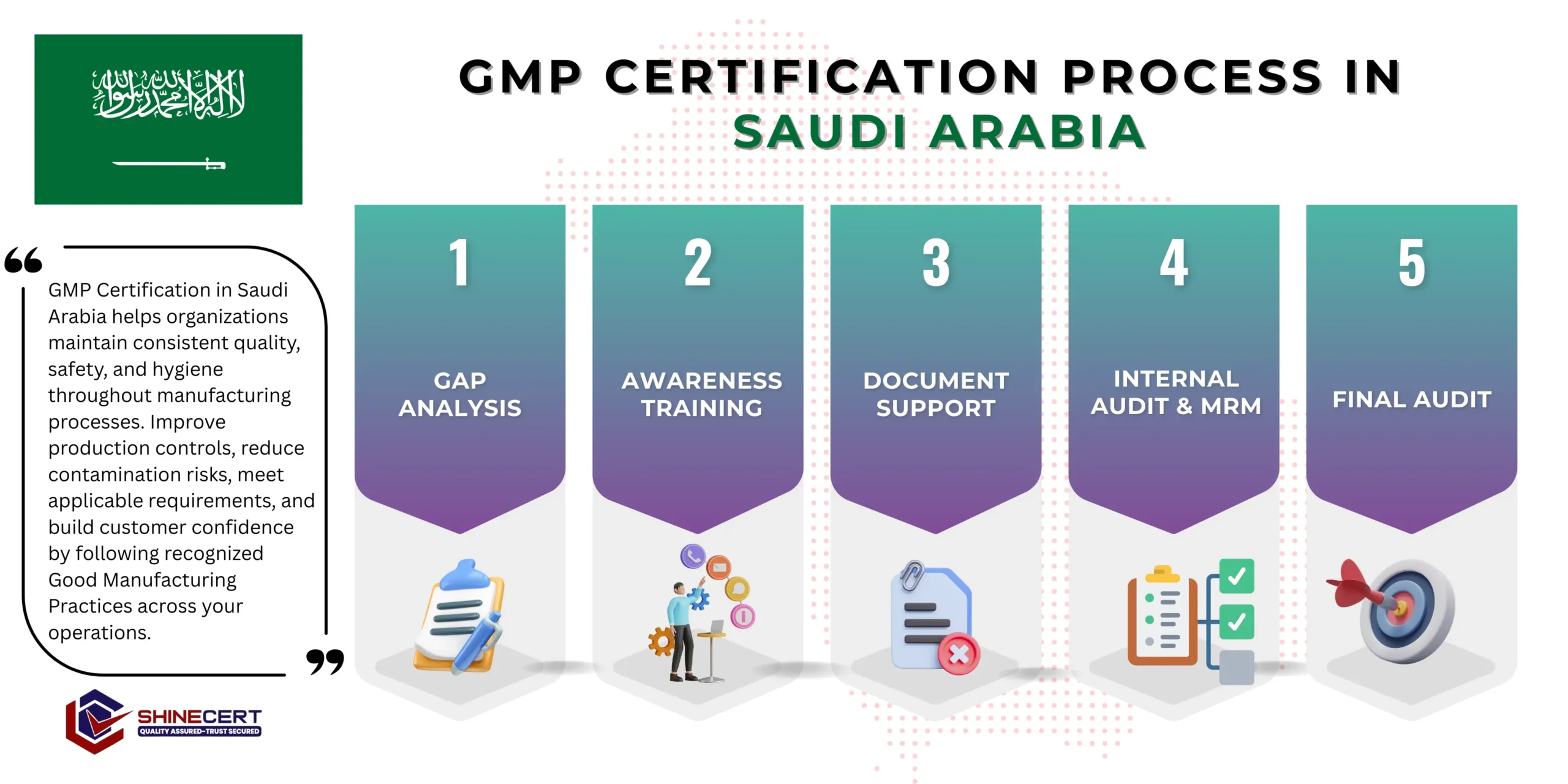
What are the steps to get GMP Certification in Saudi Arabia?
our services
- ISO Certification Saudi Arabia
- ISO 9001 Certification Saudi Arabia
- ISO 14001 Certification Saudi Arabia
- ISO 27001 Certification Saudi Arabia
- ISO 22000 Certification Saudi Arabia
- ISO 27701 Certification Saudi Arabia
- ISO 45001 Certification Saudi Arabia
- ISO 20000-1 Certification Saudi Arabia
- ISO 13485 Certification Saudi Arabia
- ISO 17025 Certification Saudi Arabia
- ISO 31000 Certification Saudi Arabia
- ISO 42001 Certification Saudi Arabia
- ISO 37001 Certification Saudi Arabia
- ISO 22301 Certification Saudi Arabia
- ISO 50001 Certification Saudi Arabia
- CE Mark Certification Saudi Arabia
- GDPR Certification Saudi Arabia
- GMP Certification Saudi Arabia
- Halal Certification Saudi Arabia
- SOC Certification Saudi Arabia
major citys
ShineCert’s GMP Certification Process in Saudi Arabia
Gap Analysis and Regulatory Mapping
We assess your current manufacturing practices against applicable GMP requirements and map them directly against SFDA's specific expectations for your product sector and classification.
A documented gap analysis and regulatory mapping scoped to your specific manufacturing operations.
Documentation Development
We build your quality manual, batch record templates, and validation protocols collaboratively, ensuring SFDA requirements are explicitly addressed alongside broader GMP principles.
A complete GMP documentation set, including validated batch record templates and quality control procedures.
Implementation and Validation
We support facility and process validation activities and train production and quality staff on GMP requirements specific to your sector and products.
Documented validation records and training records demonstrating genuine GMP compliance in practice.
Internal Audit and Management Review
We conduct a rigorous internal audit covering manufacturing and quality control practices, then facilitate a management review addressing quality performance and any deviations.
A documented internal audit report and management review minutes demonstrating leadership engagement with manufacturing quality.
Certification Audit
We coordinate the certification audit with a recognized certification body experienced in your specific sector, supporting you through any resulting corrective actions, then help establish your ongoing compliance and surveillance schedule.
Your GMP certificate and a documented surveillance and revalidation plan.
Gap Analysis and Regulatory Mapping
We assess your current manufacturing practices against applicable GMP requirements and map them directly against SFDA's specific expectations for your product sector and classification.
A documented gap analysis and regulatory mapping scoped to your specific manufacturing operations.
Documentation Development
We build your quality manual, batch record templates, and validation protocols collaboratively, ensuring SFDA requirements are explicitly addressed alongside broader GMP principles.
A complete GMP documentation set, including validated batch record templates and quality control procedures.
Implementation and Validation
We support facility and process validation activities and train production and quality staff on GMP requirements specific to your sector and products.
Documented validation records and training records demonstrating genuine GMP compliance in practice.
Internal Audit and Management Review
We conduct a rigorous internal audit covering manufacturing and quality control practices, then facilitate a management review addressing quality performance and any deviations.
A documented internal audit report and management review minutes demonstrating leadership engagement with manufacturing quality.
Certification Audit
We coordinate the certification audit with a recognized certification body experienced in your specific sector, supporting you through any resulting corrective actions, then help establish your ongoing compliance and surveillance schedule.
Your GMP certificate and a documented surveillance and revalidation plan.
What Is GMP Certification?
- GMP, or Good Manufacturing Practice, is a system of quality assurance requirements ensuring products are consistently manufactured and controlled according to defined quality standards, minimizing risks involved in production that cannot be eliminated through testing the finished product alone. GMP requirements cover facility design and cleanliness, equipment qualification and maintenance, raw material control, production process validation, quality control testing, documentation practices, and personnel training, reflecting the reality that product quality and safety must be built into the manufacturing process itself, not verified only after production is complete.
- GMP requirements differ meaningfully across sectors, with pharmaceutical GMP generally the most rigorous given direct patient safety implications, followed by food and cosmetic GMP requirements addressing sector-specific risk profiles. Certification means an accredited or recognized auditor has verified your manufacturing facility and processes genuinely meet applicable GMP requirements, not just that quality procedures exist on paper.
GMP Surveillance and the Cost of Non-Compliance in Saudi Arabia
- Beyond the initial certification project, we consistently advise Saudi manufacturers to budget genuine ongoing attention for GMP surveillance and maintenance, since SFDA inspections and certification body surveillance audits both continue well after initial certification is achieved. Manufacturers who treat GMP certification as a one-time achievement, rather than an ongoing operational discipline, often find their systems drift out of genuine compliance between formal audits, creating real risk of findings during subsequent SFDA inspections or surveillance audits that could have been caught and corrected through consistent internal monitoring.
- The practical cost of a serious GMP compliance failure, whether a product recall, manufacturing license suspension, or lost export market access, is considerably higher than the ongoing cost of maintaining genuine day-to-day compliance discipline, making sustained investment in your quality team’s ongoing GMP competence a genuinely worthwhile long-term commitment rather than a cost to minimize once initial certification is achieved.
GMP Certification Cost in Saudi Arabia
Quick answer: GMP certification in Saudi Arabia typically costs between SAR 20,000 and SAR 95,000, depending on sector and facility complexity, with pharmaceutical manufacturing generally costing more than food or cosmetics given more rigorous validation requirements.
- Sector and product risk classification drives cost significantly : Pharmaceutical manufacturing requires considerably more extensive validation than lower-risk food or cosmetics production.
- Existing quality system maturity reduces cost : Facilities with established quality control practices need less foundational work than those building GMP compliance from scratch.
- Facility and equipment qualification scope affects cost : Complex production facilities with numerous equipment types need more extensive qualification work.
- Certification body fees vary by sector expertise required : Pharmaceutical GMP audits generally command higher certification body fees given specialized auditor expertise needed.
- Bundling with ISO 9001 or ISO 22000 improves efficiency : Shared quality management principles make combined implementation more efficient than pursuing them entirely separately.
Key Documentation Required for GMP Certification
Quick answer: GMP certification requires comprehensive documentation including a quality manual, validated batch records for each product, equipment qualification and validation records, supplier qualification documentation, and records covering deviations, corrective actions, and internal audits.
- Quality Manual and Standard Operating Procedures : Documentation establishing your manufacturing quality system and detailed procedures for each critical production activity.
- Batch Manufacturing Records : Contemporaneous, complete records for each production batch, including materials, process parameters, and quality control results.
- Equipment Qualification and Validation Records : Documentation demonstrating manufacturing equipment is qualified for its intended use and consistently performs as required.
- Supplier Qualification Records : Documentation of raw material and component supplier evaluation and ongoing qualification.
- Deviation and Corrective Action Records : Documentation of any deviations from defined processes, their investigation, and corrective actions taken.
- Personnel Training Records : Evidence that manufacturing and quality personnel have received appropriate GMP training.
- Internal Audit and Management Review Records : Documented audit findings and management review minutes addressing manufacturing quality performance.
Key Requirements for GMP Certification
GMP requirements center on several core areas, with specific emphasis varying by sector:
- Facility and Equipment Qualification : Manufacturing facilities must be designed and maintained to prevent contamination and ensure consistent production conditions, with equipment formally qualified and validated for its intended use. For Saudi pharmaceutical manufacturers, this includes documented evidence that facility design accounts for Saudi Arabia’s climate conditions, particularly relevant for temperature and humidity-sensitive production processes and storage requirements.
- Raw Material and Supplier Control : GMP requires documented qualification of raw material suppliers and testing or verification of incoming materials before use in production, particularly critical for pharmaceutical manufacturers where raw material quality directly affects product safety and efficacy.
- Production Process Validation : Manufacturing processes must be validated to demonstrate they consistently produce products meeting defined quality specifications, requiring documented evidence from actual production runs, not just theoretical process design. Saudi manufacturers scaling up production to meet growing domestic and export demand need to ensure process validation genuinely reflects production at commercial scale, not just smaller pilot batches.
- Quality Control Testing : GMP requires documented quality control testing at appropriate points throughout production, with defined acceptance criteria and documented handling of any out-of-specification results, including investigation into root causes rather than simply discarding non-conforming batches without understanding why they occurred.
- Documentation and Batch Records : Comprehensive, contemporaneous documentation of each production batch, including raw materials used, process parameters, and quality control results, providing full traceability essential for both regulatory compliance and any necessary product recall or investigation.
- Personnel Training and Hygiene : Documented training ensuring personnel understand and consistently follow GMP requirements, plus hygiene practices appropriate to the manufacturing sector, particularly rigorous for pharmaceutical and food production given direct product safety implications.
Benefits of GMP Certification in Saudi Arabia
Certification provides essential evidence supporting manufacturing license and product registration processes across regulated sectors.
GMP certification recognized by international regulatory frameworks supports Saudi manufacturers’ export ambitions across pharmaceutical, food, and cosmetics markets.
Certification positions pharmaceutical and medical manufacturers favorably as Saudi Arabia’s healthcare investment continues expanding.
Systematic manufacturing controls genuinely reduce the likelihood of quality failures reaching the market.
GMP compliance demonstrates operational maturity increasingly expected by investors in Saudi Arabia’s expanding pharmaceutical and food manufacturing sectors.
GMP requirements complement ISO 9001 and, for food manufacturers, ISO 22000, supporting a coherent overall quality management approach.
GMP Certification Timeline in Saudi Arabia
Phase | Typical Duration |
Gap analysis and regulatory mapping | 3–5 weeks |
Documentation development | 5–7 weeks |
Implementation and validation | 5–8 weeks |
Internal audit and management review | 1–2 weeks |
Certification audit | 3–4 weeks |
Total | 3–7 months |
Industries in Saudi Arabia That Need GMP Certification
Pharmaceutical manufacturing
The most rigorous GMP application given direct patient safety implications, essential for SFDA manufacturing licensing.
Read moreMedical devices
GMP principles integrate closely with ISO 13485's quality management requirements for device manufacturers.
Read moreFood manufacturing
GMP provides foundational manufacturing controls complementing ISO 22000's broader food safety management system.
Read moreCosmetics manufacturing
Growing Saudi cosmetics manufacturing sector faces increasing GMP expectations aligned with both domestic and export market requirements.
Read moreNutraceuticals and dietary supplements
This growing category faces GMP expectations bridging pharmaceutical and food manufacturing requirements.
Read moreWhy Choose ShineCert for GMP Certification in Saudi Arabia?
We’re headquartered in Riyadh, giving us direct familiarity with SFDA’s manufacturing requirements across pharmaceutical, food, and cosmetics sectors. Our team has guided more than 10,000 organizations through international certification globally, with specific depth in coordinating GMP certification alongside SFDA licensing and broader quality management standards.
Choosing a GMP Certification Body in Saudi Arabia?
What to Check | Why It Matters |
Genuine sector-specific GMP audit expertise | Pharmaceutical, food, and cosmetics GMP requirements differ meaningfully; ensure your auditor understands your specific sector |
SFDA familiarity | Helps ensure certification genuinely supports your manufacturing license and product registration processes |
International market recognition | Relevant for manufacturers pursuing export markets requiring specific GMP recognition |
Validation and qualification technical depth | Essential for a meaningful assessment of your facility and process validation work |
Common Challenges with GMP Certification in Saudi Arabia
- Underestimating validation documentation rigor : Process and equipment validation requires genuinely thorough documentation from real production data, not theoretical process design alone.
- Incomplete batch record contemporaneous documentation : Records completed after the fact rather than in real time during production are a common, serious audit finding.
- Treating supplier qualification as a one-time exercise : Ongoing supplier monitoring, not just initial qualification, is genuinely expected under GMP requirements.
- Confusing GMP with ISO 9001 or ISO 22000 requirements : While complementary, GMP has distinct, often more prescriptive manufacturing-specific requirements that generic quality management certification doesn’t fully address.
Get GMP Certified in Saudi Arabia
ShineCert supports Saudi pharmaceutical, food, and cosmetics manufacturers end to end, from validation planning through certification audit, with direct experience navigating SFDA requirements. Book a free consultation or contact us directly, and we’ll review your facility and products before proposing a fixed-scope plan.
Frequently Asked Questions
Typically SAR 20,000 to SAR 95,000, depending on sector and facility complexity.
For pharmaceutical, medical device, and many food and cosmetics manufacturers, GMP compliance is effectively required through SFDA’s licensing and registration processes.
Typically three to seven months from kickoff to certificate.
No, GMP addresses foundational manufacturing controls while ISO 22000 provides a broader food safety management system; they’re complementary.
Yes, GMP compliance evidence is typically a core requirement within SFDA’s manufacturing licensing and product registration processes.
Yes, shared quality management principles make combined implementation efficient.
Yes, Riyadh is one of ShineCert’s genuine physical offices, alongside Lebanon and India.