
ISO 50001 Certification in Saudi Arabia
Quick Answer
ISO 50001 is the international standard for energy management systems, and in Saudi Arabia it’s increasingly relevant given the Saudi Energy Efficiency Center’s (SEEC) energy efficiency programs and the Saudi Green Initiative’s emissions reduction targets. Certification should come from a body accredited by the Saudi Accreditation Center (SAAC) or another IAF-recognized national accreditation body. Budget roughly SAR 20,000 to SAR 90,000 depending on facility size and energy consumption complexity, and expect three to six months from kickoff to certificate.
Why ISO 50001 Matters for Businesses in Saudi Arabia?
The Saudi Energy Efficiency Center (SEEC), established to drive the Kingdom’s energy efficiency agenda, runs programs specifically targeting industrial and commercial energy consumption reduction, reflecting Saudi Arabia’s recognition that domestic energy efficiency directly supports both the Saudi Green Initiative’s emissions targets and the broader economic logic of freeing up hydrocarbon resources for export rather than domestic consumption. Saudi Arabia’s historically subsidized energy pricing has meant energy efficiency received less commercial attention than in many other markets, but as energy pricing reform continues under Vision 2030’s broader economic diversification agenda, energy costs are becoming a more significant and increasingly visible line item for Saudi industrial and commercial operations.
For Saudi manufacturers and industrial facilities, particularly energy-intensive operations in sectors like petrochemicals, cement, and metals, ISO 50001 certification provides both a structured pathway to genuine cost savings through improved energy performance and increasingly, a credential relevant to SEEC’s energy efficiency program participation and broader alignment with Saudi Arabia’s Green Initiative sustainability positioning.
ISO 50001 and Saudi Arabia’s Energy Pricing Reform
- Saudi Arabia’s gradual energy pricing reform, part of the broader Vision 2030 economic diversification and fiscal sustainability agenda, has meaningfully changed the commercial calculus around energy efficiency for Saudi industrial and commercial operations that historically operated under significantly subsidized energy costs.
- We’ve found that facilities that began building energy management capability proactively, ahead of pricing changes taking full effect, position themselves considerably more favorably than those reacting only after energy costs become a genuinely material line item, since energy performance improvement typically requires sustained management attention and capital planning rather than quick fixes once costs already sting. This context makes ISO 50001 implementation timing a genuinely strategic decision for Saudi industrial operators, not simply a certification pursued reactively once energy costs become impossible to ignore.
What are the steps to get ISO 50001 Certification in Saudi Arabia?
our services
- ISO Certification Saudi Arabia
- ISO 9001 Certification Saudi Arabia
- ISO 14001 Certification Saudi Arabia
- ISO 27001 Certification Saudi Arabia
- ISO 22000 Certification Saudi Arabia
- ISO 27701 Certification Saudi Arabia
- ISO 45001 Certification Saudi Arabia
- ISO 20000-1 Certification Saudi Arabia
- ISO 13485 Certification Saudi Arabia
- ISO 17025 Certification Saudi Arabia
- ISO 31000 Certification Saudi Arabia
- ISO 42001 Certification Saudi Arabia
- ISO 37001 Certification Saudi Arabia
- ISO 22301 Certification Saudi Arabia
- ISO 50001 Certification Saudi Arabia
- CE Mark Certification Saudi Arabia
- GDPR Certification Saudi Arabia
- GMP Certification Saudi Arabia
- Halal Certification Saudi Arabia
- SOC Certification Saudi Arabia
major citys
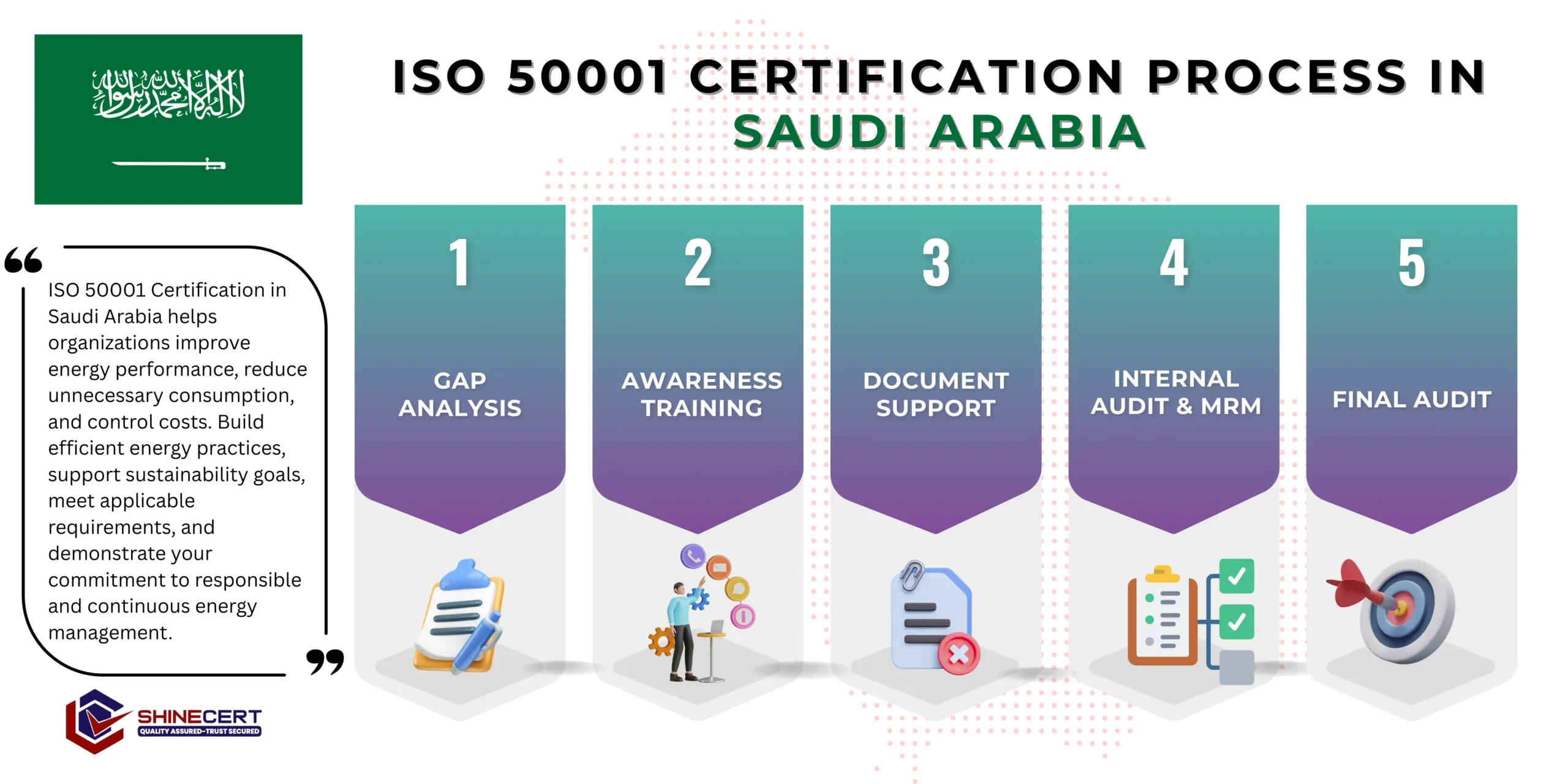
ShineCert’s ISO 50001 Certification Process in Saudi Arabia
Gap Analysis and Energy Review
We assess your current energy management practices against ISO 50001's requirements and conduct a structured energy review identifying your significant energy uses and establishing an energy baseline.
A documented gap analysis, energy baseline, and significant energy uses register scoped to your facility.
Documentation Development
We build your energy policy, energy performance indicators, and required procedures collaboratively, ensuring they genuinely reflect your facility's specific energy consumption profile.
A complete energy management system documentation set, including your energy baseline and performance objectives.
Implementation and Training
We roll out operational controls for significant energy uses and train relevant staff on energy performance monitoring specific to your processes.
Documented training records and evidence of functioning energy performance monitoring.
Internal Audit and Management Review
We conduct a rigorous internal audit covering energy performance against baseline, then facilitate a management review addressing performance trends and improvement opportunities.
A documented internal audit report and management review minutes demonstrating leadership engagement with energy performance.
Certification Audit
We coordinate Stage 1 and Stage 2 audits with a SAAC-accredited or IAF-recognized certification body, supporting you through any resulting corrective actions, then help establish your surveillance audit schedule.
Your ISO 50001 certificate and a documented surveillance audit plan.
Gap Analysis and Energy Review
We assess your current energy management practices against ISO 50001's requirements and conduct a structured energy review identifying your significant energy uses and establishing an energy baseline.
A documented gap analysis, energy baseline, and significant energy uses register scoped to your facility.
Documentation Development
We build your energy policy, energy performance indicators, and required procedures collaboratively, ensuring they genuinely reflect your facility's specific energy consumption profile.
A complete energy management system documentation set, including your energy baseline and performance objectives.
Implementation and Training
We roll out operational controls for significant energy uses and train relevant staff on energy performance monitoring specific to your processes.
Documented training records and evidence of functioning energy performance monitoring.
Internal Audit and Management Review
We conduct a rigorous internal audit covering energy performance against baseline, then facilitate a management review addressing performance trends and improvement opportunities.
A documented internal audit report and management review minutes demonstrating leadership engagement with energy performance.
Certification Audit
We coordinate Stage 1 and Stage 2 audits with a SAAC-accredited or IAF-recognized certification body, supporting you through any resulting corrective actions, then help establish your surveillance audit schedule.
Your ISO 50001 certificate and a documented surveillance audit plan.
What Is ISO 50001?
ISO 50001 is the international standard for energy management systems, published by the International Organization for Standardization to help organizations systematically improve energy performance, including energy efficiency, use, and consumption. It requires organizations to establish an energy baseline, identify significant energy uses, set measurable energy performance objectives, and implement a structured management system that drives continual energy performance improvement over time. Unlike a one-time energy audit, ISO 50001 requires ongoing energy performance monitoring and improvement embedded within genuine management processes, ensuring energy efficiency gains are sustained rather than achieved once and gradually eroded. Certification means an accredited auditor has verified your energy management system genuinely drives measurable energy performance improvement, not just that an energy policy exists on paper.
ISO 50001 Certification Cost in Saudi Arabia
Quick answer: ISO 50001 certification in Saudi Arabia typically costs between SAR 20,000 and SAR 90,000, depending on facility size and energy consumption complexity, with energy-intensive industrial facilities generally costing more given more extensive energy review requirements.
- Energy consumption complexity drives cost significantly : Facilities with numerous significant energy uses require more extensive energy review and baseline establishment work.
- Existing energy monitoring infrastructure reduces cost : Facilities with sub-metering and existing energy data collection need less foundational work than those starting without reliable energy data.
- Certification body fees are separate from consulting fees : The accredited certification body’s audit fee is distinct from ShineCert’s implementation support.
- Multi-facility operations increase cost : Certification bodies sample multiple sites, each typically needing its own energy review.
- Bundling with ISO 14001 reduces per-standard cost : Shared environmental and energy management focus makes combined certification more efficient.
Mandatory Documents for ISO 50001
Quick answer: ISO 50001 requires documented information including an energy policy, an energy baseline and review, energy performance indicators, energy objectives and targets, and records covering monitoring, internal audits, and management review.
- Energy Policy : A documented, top-management-issued policy establishing genuine energy performance improvement commitments.
- Energy Review and Baseline : A documented assessment of energy consumption sources, significant energy uses, and the baseline against which future performance is measured.
- Energy Performance Indicators : Documented metrics used to track and verify energy performance improvement.
- Energy Objectives, Targets, and Action Plans : Measurable energy performance goals with documented plans for achieving them.
- Operational Control Procedures : Documentation covering how significant energy uses are managed and controlled.
- Monitoring and Measurement Records : Evidence of ongoing energy performance tracking against the baseline and indicators.
- Internal Audit and Management Review Records : Documented audit findings and management review minutes addressing energy performance.
Key Requirements of ISO 50001
ISO 50001 follows the Harmonised Structure shared with other modern ISO management system standards, with substantive requirements centered on energy performance:
- Context of the Organization (Clause 4) : Requires identifying energy-related issues relevant to your operations and interested parties whose energy expectations matter, including SEEC, energy regulators, and increasingly, giga-project developers with their own sustainability commitments. Saudi industrial facilities with multiple energy-consuming processes need a scope statement clearly defining which facilities and energy uses the energy management system genuinely covers.
- Leadership (Clause 5) : Top management must establish an energy policy and ensure genuine resourcing for energy performance improvement, not treat energy management as a purely technical facilities function disconnected from business strategy. We’ve found that Saudi industrial operators sometimes underestimate this requirement, given historically low energy cost sensitivity, but as Saudi Arabia’s energy pricing reform continues, leadership engagement with energy performance is becoming a genuinely material business consideration, not just a compliance exercise.
- Planning (Clause 6) : Requires establishing an energy baseline, identifying significant energy uses through a structured energy review, and setting measurable energy performance objectives and targets. For Saudi industrial facilities, particularly those in energy-intensive sectors like petrochemicals and cement production concentrated in industrial cities like Jubail and Yanbu, this energy review needs to genuinely identify the specific processes driving the majority of energy consumption, rather than treating all energy use as equally significant.
- Support (Clause 7) : Covers resources, competence, and communication specific to energy management, including documented evidence that personnel involved in energy-significant processes have appropriate energy awareness training and that energy performance data is genuinely communicated to relevant decision-makers, not just collected and filed.
- Operation (Clause 8) : Requires implementing operational controls for significant energy uses and considering energy performance in procurement decisions for equipment and services, including energy efficiency criteria when purchasing new industrial equipment, a genuinely practical requirement for Saudi facilities planning capital equipment investments.
- Performance Evaluation (Clause 9) : Requires monitoring energy performance against the established baseline using appropriate energy performance indicators, internal audit, and management review addressing energy performance trends and improvement opportunities.
- Improvement (Clause 10) : Requires structured response to energy performance gaps or nonconformities, plus continual improvement of energy performance over time, genuinely demonstrated through measurable trend data, not just a static baseline that’s never revisited.
Benefits of ISO 50001 in Saudi Arabia
Systematic energy performance management genuinely reduces energy consumption and cost, increasingly material as Saudi energy pricing reform continues.
Certification demonstrates genuine energy efficiency commitment supporting the Kingdom’s emissions reduction targets.
Certification supports participation in Saudi Energy Efficiency Center programs targeting industrial and commercial energy performance.
Energy performance data collected for ISO 50001 directly supports emerging carbon and sustainability reporting expectations.
Energy-efficient procurement criteria reduce long-term operational costs for capital equipment investments.
ISO 50001’s shared Harmonised Structure with ISO 9001 and ISO 14001 makes combined certification efficient for industrial facilities pursuing multiple standards.
ISO 50001 Certification Timeline in Saudi Arabia
Phase | Typical Duration |
Gap analysis and energy review | 3–5 weeks |
Documentation development | 4–6 weeks |
Implementation and training | 3–5 weeks |
Internal audit and management review | 1–2 weeks |
Certification audit (Stage 1 + Stage 2) | 3–4 weeks |
Total | 3–6 months |
Industries in Saudi Arabia That Need ISO 50001
Petrochemicals and cement
Energy-intensive industrial cities like Jubail and Yanbu face substantial energy consumption, making systematic management genuinely valuable.
Read moreManufacturing
The broader Saudi manufacturing sector benefits from structured energy performance management as energy pricing reform continues.
Read moreCommercial real estate and facilities management
Large commercial and mixed-use developments, including those tied to Vision 2030 giga-projects, increasingly adopt ISO 50001 for building energy performance.
Read moreMetals and mining
Energy-intensive processing operations in Saudi Arabia's developing mining sector benefit from structured energy management.
Read moreHospitality and tourism
Large-scale hospitality developments supporting Saudi Arabia's tourism ambitions increasingly consider energy performance given operational cost implications.
Read moreWhy Choose ShineCert for ISO 50001 Certification in Saudi Arabia?
We’re headquartered in Riyadh, giving us direct familiarity with SEEC’s energy efficiency programs and the Saudi Green Initiative’s energy-related sustainability direction. Our team has guided more than 10,000 organizations through ISO certification globally, with specific depth in Saudi Arabia’s energy-intensive industrial sectors.
Choosing an Accredited Certification Body for ISO 50001 in Saudi Arabia?
What to Check | Why It Matters |
SAAC accreditation, or accreditation from another IAF-recognized body | Confirms genuine international recognition |
Industrial energy audit experience | Matters for energy-intensive facilities with complex consumption profiles |
Familiarity with SEEC program requirements | Helps ensure certification genuinely supports broader energy efficiency program participation |
Genuine technical energy engineering competence | Essential for auditors to meaningfully assess energy performance indicators and baseline methodology |
Common Challenges with ISO 50001 in Saudi Arabia
- Establishing an unreliable energy baseline : A baseline built on incomplete or poorly measured energy data undermines the entire management system’s credibility.
- Treating energy management as purely a facilities function : Genuine leadership engagement and procurement integration are required, not just technical monitoring disconnected from business decisions.
- Underestimating the significant energy uses the identification process : A superficial energy review that misses genuinely significant consumption sources fails to target improvement efforts effectively.
- Not integrating energy performance into capital planning : Procurement decisions for new equipment should genuinely weigh energy efficiency, not treat it as a secondary consideration after certification.
Get ISO 50001 Certified in Saudi Arabia
ShineCert supports Saudi industrial and commercial facilities end to end, from energy review through certification audit, with direct experience across the Kingdom’s energy-intensive sectors. Book a free consultation or contact us directly, and we’ll review your energy consumption profile before proposing a fixed-scope plan.
Frequently Asked Questions
Typically SAR 20,000 to SAR 90,000, depending on facility size and energy consumption complexity.
No, it’s voluntary, though SEEC program alignment and Saudi Arabia’s ongoing energy pricing reform increasingly make it a practical advantage.
Typically three to six months from kickoff to certificate.
It doesn’t guarantee a specific savings figure, but systematic energy performance management genuinely tends to reduce consumption and cost over time.
Yes, both share environmental and resource management focus, making combined certification efficient.
It helps considerably but isn’t strictly required; establishing baseline monitoring can be part of the certification project itself.
Yes, Riyadh is one of ShineCert’s genuine physical offices, alongside Lebanon and India.