
ISO 27001 Certification in Saudi Arabia
Quick Answer
ISO 27001 is the international standard for information security management systems, and in Saudi Arabia it’s increasingly relevant given the National Cybersecurity Authority’s (NCA) Essential Cybersecurity Controls framework and the Personal Data Protection Law (PDPL) enforced by the Saudi Data and AI Authority (SDAIA). Certification should come from a body accredited by the Saudi Accreditation Center (SAAC) or another IAF-recognized national accreditation body. ISO 27001 doesn’t replace NCA or PDPL compliance obligations, but it provides a structured management framework that supports both. Budget roughly SAR 20,000 to SAR 95,000 depending on company size and data sensitivity, and expect three to seven months from kickoff to certificate.
Why ISO 27001 Matters for Businesses in Saudi Arabia?
The National Cybersecurity Authority (NCA) has established Saudi Arabia as one of the region’s most active cybersecurity regulatory environments, with its Essential Cybersecurity Controls (ECC) framework mandatory for government entities and critical national infrastructure operators, and increasingly referenced as a benchmark expectation across the private sector. Saudi Arabia’s Personal Data Protection Law (PDPL), enforced by the Saudi Data and AI Authority (SDAIA), adds a distinct legal compliance layer specifically around personal data handling, with meaningful penalties for noncompliance. ISO 27001 certification gives Saudi businesses a structured, internationally recognized management framework that supports both NCA and PDPL compliance efforts, though it’s important to understand certification doesn’t automatically satisfy either legal requirement on its own.
Beyond direct regulatory pressure, Saudi Arabia’s rapid digital transformation under Vision 2030, including major investments in fintech, e-government services, and giga-project digital infrastructure, has made information security credentials an increasingly common requirement in vendor qualification, particularly for companies serving government entities, financial institutions regulated by the Saudi Central Bank (SAMA), or the Kingdom’s expanding technology sector.
ISO 27001 vs. NCA Essential Cybersecurity Controls in Saudi Arabia
- A question we hear constantly from Saudi organizations, particularly those serving government or critical infrastructure clients, is whether ISO 27001 certification is sufficient on its own or whether NCA ECC compliance is still separately required. The honest answer is that both frameworks serve distinct purposes: NCA ECC is a mandatory regulatory framework for government entities and critical national infrastructure, with specific, prescriptive control requirements, while ISO 27001 is a voluntary, internationally recognized management system standard built around risk-based control selection.
- In our experience, organizations that build their ISO 27001 risk assessment and Statement of Applicability with explicit cross-referencing to ECC control domains from the outset avoid duplicating compliance work later, since much of the underlying control implementation genuinely overlaps between the two frameworks. Organizations that treat them as entirely separate compliance projects typically end up doing considerably more work than necessary, maintaining two parallel and poorly connected sets of security documentation.
What are the steps to get ISO 27001 Certification in Saudi Arabia?
our services
- ISO Certification Saudi Arabia
- ISO 9001 Certification Saudi Arabia
- ISO 14001 Certification Saudi Arabia
- ISO 27001 Certification Saudi Arabia
- ISO 22000 Certification Saudi Arabia
- ISO 27701 Certification Saudi Arabia
- ISO 45001 Certification Saudi Arabia
- ISO 20000-1 Certification Saudi Arabia
- ISO 13485 Certification Saudi Arabia
- ISO 17025 Certification Saudi Arabia
- ISO 31000 Certification Saudi Arabia
- ISO 42001 Certification Saudi Arabia
- ISO 37001 Certification Saudi Arabia
- ISO 22301 Certification Saudi Arabia
- ISO 50001 Certification Saudi Arabia
- CE Mark Certification Saudi Arabia
- GDPR Certification Saudi Arabia
- GMP Certification Saudi Arabia
- Halal Certification Saudi Arabia
- SOC Certification Saudi Arabia
major citys
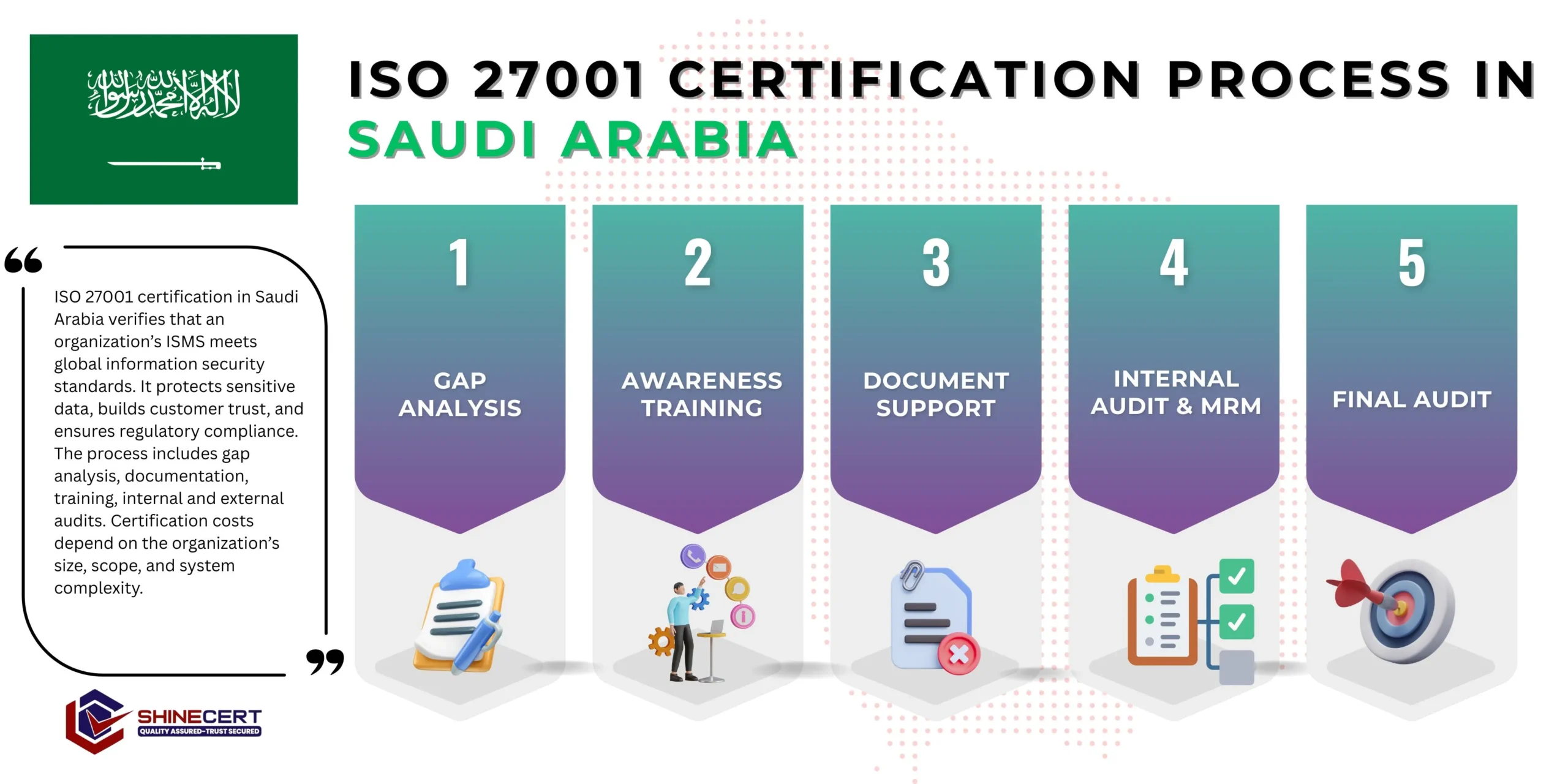
ShineCert’s ISO 27001 Certification Process in Saudi Arabia
Gap Analysis and Risk Assessment
We assess your current security practices against ISO 27001's requirements and conduct a formal information security risk assessment, cross-referencing NCA ECC and PDPL obligations where relevant to your sector.
A documented gap analysis, risk assessment, and draft Statement of Applicability.
Documentation Development
We build your information security policy, risk treatment plan, and required procedures collaboratively, ensuring PDPL-relevant personal data handling requirements and any NCA ECC obligations are explicitly addressed.
A complete ISMS documentation set, including your finalized Statement of Applicability and risk treatment plan.
Implementation and Training
We roll out selected controls and deliver role-specific security awareness training, with particular attention to staff handling personal data or privileged system access.
Documented training records and evidence of operational controls functioning, including access control and incident response procedures.
Internal Audit and Management Review
We conduct a rigorous internal audit covering control effectiveness and legal compliance evaluation, then facilitate a management review addressing security incidents and risk treatment progress.
A documented internal audit report and management review minutes demonstrating leadership engagement with security risk.
Certification Audit
We coordinate Stage 1 and Stage 2 audits with a SAAC-accredited or IAF-recognized certification body, supporting you through any resulting corrective actions, then help establish your surveillance audit schedule.
Your ISO 27001 certificate and a documented surveillance audit plan.
Gap Analysis and Risk Assessment
We assess your current security practices against ISO 27001's requirements and conduct a formal information security risk assessment, cross-referencing NCA ECC and PDPL obligations where relevant to your sector.
A documented gap analysis, risk assessment, and draft Statement of Applicability.
Documentation Development
We build your information security policy, risk treatment plan, and required procedures collaboratively, ensuring PDPL-relevant personal data handling requirements and any NCA ECC obligations are explicitly addressed.
A complete ISMS documentation set, including your finalized Statement of Applicability and risk treatment plan.
Implementation and Training
We roll out selected controls and deliver role-specific security awareness training, with particular attention to staff handling personal data or privileged system access.
Documented training records and evidence of operational controls functioning, including access control and incident response procedures.
Internal Audit and Management Review
We conduct a rigorous internal audit covering control effectiveness and legal compliance evaluation, then facilitate a management review addressing security incidents and risk treatment progress.
A documented internal audit report and management review minutes demonstrating leadership engagement with security risk.
Certification Audit
We coordinate Stage 1 and Stage 2 audits with a SAAC-accredited or IAF-recognized certification body, supporting you through any resulting corrective actions, then help establish your surveillance audit schedule.
Your ISO 27001 certificate and a documented surveillance audit plan.
What Is ISO 27001?
ISO 27001 is the international standard for information security management systems (ISMS), published by the International Organization for Standardization to help organizations systematically protect the confidentiality, integrity, and availability of information assets. Rather than prescribing specific technical controls in isolation, it requires organizations to conduct a formal risk assessment, select and implement appropriate controls from Annex A based on genuine identified risks, and build a management system that continually monitors and improves information security over time. The standard covers people, process, and technology dimensions of security, not just IT infrastructure, requiring documented policies, defined roles and responsibilities, and evidence that controls are genuinely operating, not just configured once and forgotten. Certification means an accredited auditor has independently verified your ISMS meets these requirements.
ISO 27001 Certification Cost in Saudi Arabia
Quick answer: ISO 27001 certification in Saudi Arabia typically costs between SAR 20,000 and SAR 95,000, depending on company size, data sensitivity, and IT infrastructure complexity, with financial services and technology companies generally costing more given more extensive risk assessment needs.
- Data sensitivity and infrastructure complexity drive cost significantly : Organizations handling extensive personal or financial data face more extensive risk assessment and control implementation work.
- Existing NCA ECC compliance reduces consultant hours : Organizations already aligned with ECC requirements need less foundational security work than those starting from scratch.
- Certification body fees are separate from consulting fees : The accredited certification body’s audit fee is distinct from ShineCert’s implementation support.
- Cloud and third-party service dependencies increase scope : Organizations relying heavily on outsourced IT or cloud services need additional supplier security assessment work.
- Bundling with ISO 27701 reduces future certification cost : Organizations anticipating privacy management needs given PDPL should plan for this extension early.
Mandatory Documents for ISO 27001
Quick answer: ISO 27001 requires documented information including an information security policy, risk assessment methodology and results, a Statement of Applicability, a risk treatment plan, and records covering internal audits, management review, and incident management.
- Information Security Policy : A documented, top-management-issued policy setting genuine security commitments and objectives.
- Risk Assessment and Risk Treatment Plan : A documented methodology and results identifying information security risks and the controls selected to address them.
- Statement of Applicability : A required document listing all Annex A controls, which are applied or excluded, and the justification for each decision.
- Asset Inventory : A documented register of information assets requiring protection, including data classification where relevant to PDPL compliance.
- Access Control and Incident Response Procedures : Documentation covering how access is granted and reviewed, and how security incidents are detected, reported, and managed.
- Internal Audit and Management Review Records : Documented audit findings and management review minutes addressing security performance and risk.
- Legal and Regulatory Compliance Register : A tracked list of applicable requirements, including PDPL obligations and any NCA ECC requirements relevant to your sector.
Key Requirements of ISO 27001
ISO 27001 shares the same Harmonised Structure as ISO 9001 and ISO 14001, with its substantive focus on information security:
- Context of the Organization (Clause 4) : Requires identifying internal and external issues relevant to information security, including interested parties like NCA, SDAIA, customers with contractual security requirements, and for financial institutions, SAMA’s cybersecurity framework. Saudi businesses handling government data or operating in regulated sectors need a scope statement that clearly addresses which systems, data, and locations the ISMS genuinely covers, since scope gaps are a common source of Stage 2 audit findings.
- Leadership (Clause 5) : Top management must establish an information security policy and ensure security responsibilities are genuinely assigned, not delegated entirely to an IT department disconnected from business risk decisions. We’ve found that Saudi organizations pursuing ISO 27001 for government or financial sector contracts sometimes treat this as a technical IT project, but auditors specifically look for evidence that leadership understands and actively manages information security as a genuine business risk, not just a compliance checkbox.
- Planning (Clause 6) : Requires a formal information security risk assessment methodology and a risk treatment plan selecting appropriate controls from Annex A, documented in a Statement of Applicability explaining which controls apply and why. For Saudi organizations subject to NCA’s ECC framework, this risk assessment should explicitly cross-reference ECC control domains where relevant, since aligning the two frameworks from the start avoids duplicated compliance effort later.
- Support (Clause 7) : Covers resources, competence, and awareness specific to information security, including documented evidence that staff handling sensitive data, particularly personal data covered under PDPL, have appropriate security awareness training, and that the organization has clear internal and external communication protocols for security matters.
- Operation (Clause 8) : Requires implementing the risk treatment plan and operational controls addressing identified risks, covering access control, incident response, and for organizations handling third-party or cloud-hosted data, supplier and outsourced service security requirements. Saudi financial institutions and fintech companies operating under SAMA’s regulatory sandbox or licensing frameworks need operational controls that explicitly address SAMA’s cybersecurity expectations alongside ISO 27001’s requirements.
- Performance Evaluation (Clause 9) : Requires monitoring security control effectiveness, internal audit, and management review, plus systematic evaluation of compliance with legal requirements, which for Saudi organizations means actively tracking PDPL and, where applicable, NCA ECC compliance status as part of ongoing performance evaluation.
- Improvement (Clause 10) : Requires structured incident response and corrective action for security incidents and nonconformities, plus continual improvement of the ISMS based on evolving threats, audit findings, and regulatory changes, including PDPL amendments or NCA framework updates.
Benefits of ISO 27001 in Saudi Arabia
Certification increasingly supports vendor evaluation for entities requiring demonstrated information security maturity.
A well-built ISMS provides a genuine management framework that helps organize NCA compliance efforts, though it doesn’t automatically satisfy ECC requirements on its own.
ISO 27001’s risk-based approach to data protection complements the specific legal obligations PDPL imposes around personal data handling.
Systematic risk assessment and control implementation genuinely reduce the likelihood and impact of security incidents.
Multinational clients and investors increasingly expect ISO 27001 as baseline evidence of information security maturity.
ISO 27001 certification is the prerequisite for pursuing ISO 27701, the privacy information management extension increasingly relevant given PDPL.
ISO 27001 Certification Timeline in Saudi Arabia
Phase | Typical Duration |
Gap analysis and risk assessment | 3–5 weeks |
Documentation development | 5–7 weeks |
Implementation and training | 4–6 weeks |
Internal audit and management review | 1–2 weeks |
Certification audit (Stage 1 + Stage 2) | 3–5 weeks |
Total | 3–7 months |
Industries in Saudi Arabia That Need ISO 27001
Financial services and fintech
SAMA's regulatory expectations and the sensitivity of financial data make ISO 27001 close to a baseline requirement.
Read moreGovernment contracting
Vendors serving government entities increasingly need demonstrated information security maturity aligned with NCA expectations.
Read moreTechnology and SaaS
Saudi Arabia's growing technology sector, supporting both domestic digital transformation and international expansion, relies on ISO 27001 for enterprise customer trust.
Read moreHealthcare
Patient data sensitivity and SFDA's regulatory environment make information security management increasingly important for Saudi healthcare providers.
Read moreTelecommunications
Critical infrastructure status under NCA's framework makes robust information security management a near-necessity for Saudi telecom operators.
Read moreWhy Choose ShineCert for ISO 27001 Certification in Saudi Arabia?
We’re headquartered in Riyadh, giving us direct familiarity with NCA’s Essential Cybersecurity Controls, PDPL requirements, and SAMA’s cybersecurity expectations for regulated financial institutions. Our team has guided more than 10,000 organizations through ISO certification globally, with specific depth in Saudi Arabia’s evolving cybersecurity and data protection regulatory landscape.
Choosing an Accredited Certification Body for ISO 27001 in Saudi Arabia?
What to Check | Why It Matters |
SAAC accreditation, or accreditation from another IAF-recognized body | Confirms genuine international recognition |
NCA ECC and PDPL familiarity | Helps ensure the certification genuinely supports your broader Saudi regulatory compliance needs |
Financial or government sector audit experience | Matters for organizations serving SAMA-regulated or government clients |
Technical depth for cloud and third-party risk assessment | Relevant for organizations with significant outsourced IT dependencies |
Common Challenges with ISO 27001 in Saudi Arabia
- Assuming ISO 27001 automatically satisfies NCA ECC or PDPL requirements : Certification provides a supporting management framework, but specific legal and regulatory obligations must still be independently verified and met.
- Treating the Statement of Applicability as a one-time exercise : It needs to be actively maintained and updated as your risk environment and control implementation evolve.
- Underestimating third-party and cloud service risk assessment : Organizations relying on outsourced infrastructure often overlook the supplier security evaluation this clause requires.
- Delivering security training that doesn’t reach the full workforce : Awareness training limited to IT staff, when personal data handling extends across sales, HR, and customer service functions, leaves a genuine PDPL compliance gap.
Get ISO 27001 Certified in Saudi Arabia
ShineCert supports Saudi businesses end to end, from risk assessment through certification audit, with direct experience navigating NCA and PDPL alongside ISO 27001. Book a free consultation or contact us directly, and we’ll review your data environment and regulatory obligations before proposing a fixed-scope plan.
Frequently Asked Questions
Typically SAR 20,000 to SAR 95,000, depending on company size and data sensitivity.
No, it’s voluntary, though government and financial sector vendor qualification increasingly make it a practical necessity.
Typically three to seven months from kickoff to certificate.
No, it provides a supporting management framework, but ECC’s specific mandatory controls must still be independently verified for applicable organizations.
No, it supports PDPL compliance efforts through structured risk management, but PDPL’s specific legal obligations must still be met independently.
Yes, ISO 27701 is a privacy-specific extension built on an existing ISO 27001 certification, increasingly relevant given PDPL.
Yes, Riyadh is one of ShineCert’s genuine physical offices, alongside Lebanon and India.