
ISO 9001 Certification in Saudi Arabia
Quick Answer
ISO 9001 is the world’s most widely adopted quality management system standard, and in Saudi Arabia it’s increasingly a practical requirement for government tenders, Vision 2030-linked contracts, and supplier qualification with larger local and multinational buyers. Certification must come from a body accredited by the Saudi Accreditation Center (SAAC) or another IAF-recognized national accreditation body for the certificate to carry genuine weight. A freshness note worth knowing: ISO 9001 itself is currently undergoing its first major revision since 2015, with the updated edition expected for publication later in 2026, organizations starting certification now should ask their consultant how the transition will be handled. Budget roughly SAR 15,000 to SAR 75,000 depending on company size, and expect three to six months from kickoff to certificate.
Why ISO 9001 Matters for Businesses in Saudi Arabia?
Saudi Arabia’s Vision 2030 economic diversification program has fundamentally reshaped how businesses compete for contracts across construction, manufacturing, logistics, and government services. Large government entities and Vision 2030 giga-projects, including NEOM, the Red Sea Project, and Qiddiya, increasingly reference ISO 9001 certification as either an explicit prequalification requirement or a strong evaluation factor for contractors and suppliers bidding on infrastructure and industrial work. Beyond direct government contracting, Saudi Arabia’s Local Content and Government Procurement Authority (LCGPA) framework and the broader push toward Saudization and localized industrial capacity mean that domestically certified quality systems increasingly matter for companies trying to build long-term relationships with major Saudi buyers, not just for one-off international tenders.
For manufacturing and industrial businesses specifically, ISO 9001 certification also supports participation in the National Industrial Development and Logistics Program (NIDLP), which has made quality management credentials a meaningful factor in how manufacturers are evaluated for incentive programs and industrial zone participation.
The ISO 9001 Revision: What Saudi Businesses Should Know
- ISO 9001 is currently undergoing its first substantive revision since the 2015 edition, with the updated standard expected for publication later in 2026 following the standard technical committee review and public comment process that all ISO standards go through before a new edition is released. While the final scope of changes won’t be confirmed until publication, standards undergoing this kind of update in recent years, including ISO 14001’s own 2026 revision, have generally moved toward clearer integration of risk-based thinking, sustainability considerations, and closer alignment with the Harmonised Structure shared across modern ISO management system standards.
- For Saudi businesses beginning ISO 9001 certification now, this means asking your certification body directly about anticipated transition timelines and requirements once the new edition publishes, rather than being caught off guard by a transition deadline announced after certification is already underway. Existing ISO 9001:2015 certificate holders typically get a multi-year transition window once a new edition publishes, based on the pattern followed by previous ISO 9001 and ISO 14001 revisions, but confirming this directly with your certification body as the 2026 edition approaches is the safer approach.
What are the steps to get ISO 9001 Certification in Saudi Arabia?
our services
- ISO Certification Saudi Arabia
- ISO 9001 Certification Saudi Arabia
- ISO 14001 Certification Saudi Arabia
- ISO 27001 Certification Saudi Arabia
- ISO 22000 Certification Saudi Arabia
- ISO 27701 Certification Saudi Arabia
- ISO 45001 Certification Saudi Arabia
- ISO 20000-1 Certification Saudi Arabia
- ISO 13485 Certification Saudi Arabia
- ISO 17025 Certification Saudi Arabia
- ISO 31000 Certification Saudi Arabia
- ISO 42001 Certification Saudi Arabia
- ISO 37001 Certification Saudi Arabia
- ISO 22301 Certification Saudi Arabia
- ISO 50001 Certification Saudi Arabia
- CE Mark Certification Saudi Arabia
- GDPR Certification Saudi Arabia
- GMP Certification Saudi Arabia
- Halal Certification Saudi Arabia
- SOC Certification Saudi Arabia
major citys
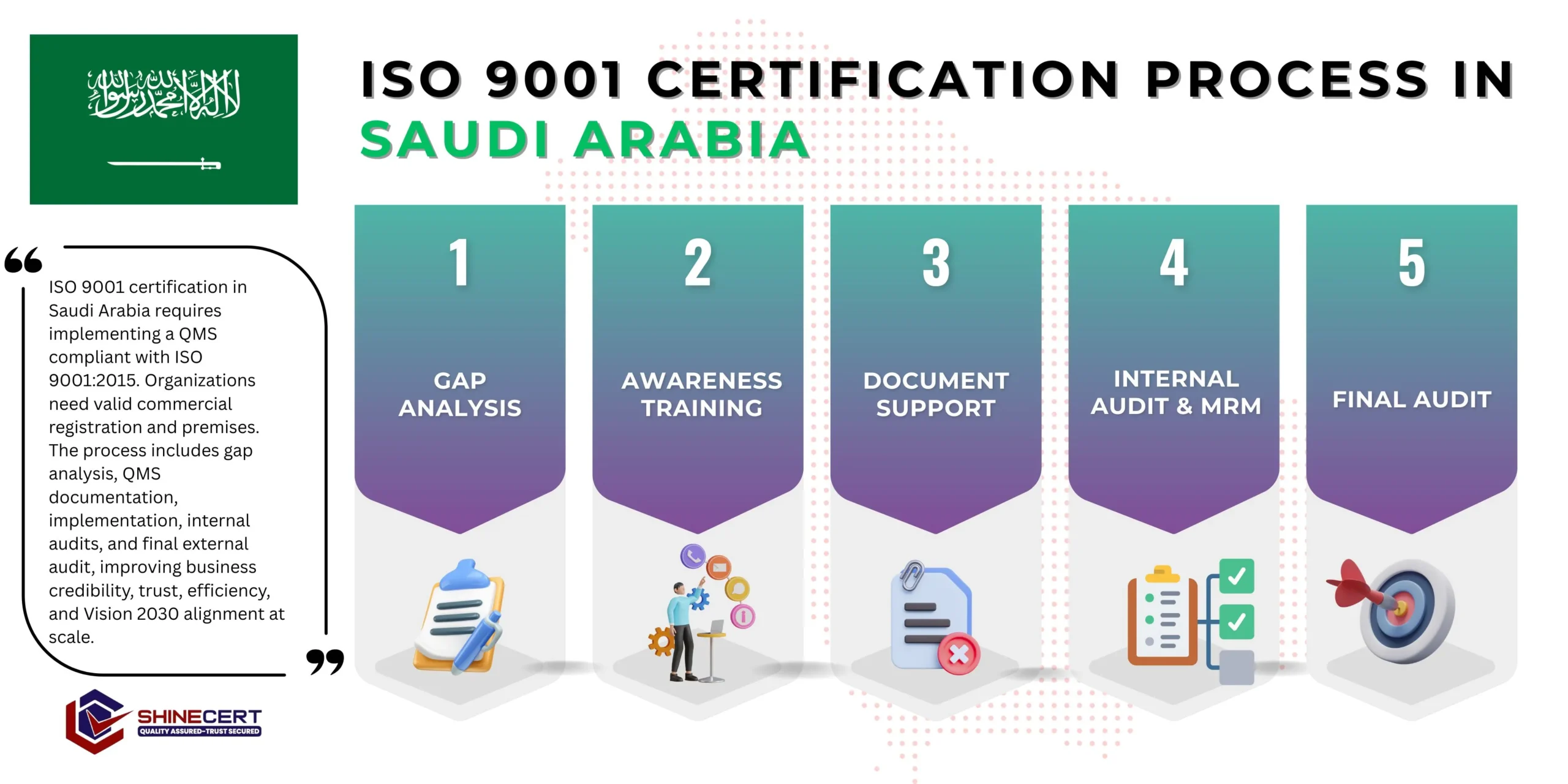
ShineCert’s ISO 9001 Certification Process in Saudi Arabia
Gap Analysis
We start with a structured, on-site or remote assessment of your current processes against every applicable ISO 9001:2015 clause, mapping what you have against what's genuinely missing. This involves reviewing documentation, interviewing department heads across operations, procurement, and HR, and observing key processes where relevant, such as production floor controls or site safety checkpoints. The output becomes the actual project plan for everything that follows.
A documented gap analysis report scoped to your organization, prioritized by audit risk.
Documentation Development
We build your quality manual, procedures, work instructions, and records system collaboratively with your team, available in Arabic, English, or bilingually depending on your workforce and tender requirements. This stage takes the longest because it requires genuine input from the people who run each process, not just management sign-off. We document how your organization actually operates today, with improvements layered in deliberately.
A complete, version-controlled documentation set covering your quality policy, objectives, scope statement, and all clause-required procedures and records.
Implementation and Training
We roll out new processes through practical, role-specific training grounded in your actual operations and documentation. Organizations with a mixed Saudi and expatriate workforce often need training in multiple languages, which we plan for directly. This stage includes a settling-in period so staff apply new processes to real work, letting us catch friction points before the internal audit.
Documented training records for all relevant staff, plus evidence that new processes are genuinely operating.
Internal Audit and Management Review
We conduct a rigorous internal audit covering every clause, using auditors with genuine independence from the processes reviewed, then facilitate a formal management review covering all Clause 9 inputs and outputs. This surfaces nonconformities before the external certification body does.
A documented internal audit report with findings, plus management review minutes showing leadership engagement.
Certification Audit
We coordinate Stage 1 (documentation review) and Stage 2 (full on-site implementation audit) with a SAAC-accredited or other IAF-recognized certification body of your choosing, staying involved through both stages and supporting any corrective actions raised. Once certified, we help set up your ongoing surveillance audit schedule.
Your ISO 9001 certificate, plus a documented surveillance audit plan.
Gap Analysis
We start with a structured, on-site or remote assessment of your current processes against every applicable ISO 9001:2015 clause, mapping what you have against what's genuinely missing. This involves reviewing documentation, interviewing department heads across operations, procurement, and HR, and observing key processes where relevant, such as production floor controls or site safety checkpoints. The output becomes the actual project plan for everything that follows.
A documented gap analysis report scoped to your organization, prioritized by audit risk.
Documentation Development
We build your quality manual, procedures, work instructions, and records system collaboratively with your team, available in Arabic, English, or bilingually depending on your workforce and tender requirements. This stage takes the longest because it requires genuine input from the people who run each process, not just management sign-off. We document how your organization actually operates today, with improvements layered in deliberately.
A complete, version-controlled documentation set covering your quality policy, objectives, scope statement, and all clause-required procedures and records.
Implementation and Training
We roll out new processes through practical, role-specific training grounded in your actual operations and documentation. Organizations with a mixed Saudi and expatriate workforce often need training in multiple languages, which we plan for directly. This stage includes a settling-in period so staff apply new processes to real work, letting us catch friction points before the internal audit.
Documented training records for all relevant staff, plus evidence that new processes are genuinely operating.
Internal Audit and Management Review
We conduct a rigorous internal audit covering every clause, using auditors with genuine independence from the processes reviewed, then facilitate a formal management review covering all Clause 9 inputs and outputs. This surfaces nonconformities before the external certification body does.
A documented internal audit report with findings, plus management review minutes showing leadership engagement.
Certification Audit
We coordinate Stage 1 (documentation review) and Stage 2 (full on-site implementation audit) with a SAAC-accredited or other IAF-recognized certification body of your choosing, staying involved through both stages and supporting any corrective actions raised. Once certified, we help set up your ongoing surveillance audit schedule.
Your ISO 9001 certificate, plus a documented surveillance audit plan.
What Is ISO 9001?
ISO 9001 is the international standard for quality management systems, published by the International Organization for Standardization and used by more than a million certified organizations worldwide. Rather than dictating specific products or outcomes, it sets out a structured framework for how an organization plans, controls, and continually improves the processes that affect the quality of what it delivers to customers. The standard is built around seven core management principles: customer focus, leadership, engagement of people, process approach, improvement, evidence-based decision making, and relationship management. Certification means an accredited, independent auditor has verified that your organization’s quality management system genuinely meets these requirements, not just that you’ve written a policy document claiming so.
ISO 9001 Certification Cost in Saudi Arabia
ISO 9001 certification in Saudi Arabia typically costs between SAR 15,000 and SAR 75,000, depending mainly on company size, site count, and how much quality documentation already exists. Small single-site businesses sit toward the lower end; multi-site organizations with limited existing documentation sit toward the higher end.
- Company size is the primary driver : A small business with a single site and under 25 employees typically pays toward the SAR 15,000-25,000 range, while larger multi-site organizations can see costs climb well past SAR 75,000.
- Documentation maturity affects consultant hours : Organizations with some existing process documentation need less foundational work than those building a quality system entirely from scratch.
- Certification body fees are separate from consulting fees : The audit itself, charged by the accredited certification body, is a distinct cost from the implementation support ShineCert provides.
- Multi-site operations increase both time and cost : Certification bodies sample multiple sites during audits, and consulting support usually needs to cover each location individually.
- Bundling with other standards reduces per-standard cost : Pursuing ISO 9001 alongside ISO 14001 or ISO 45001 together is more cost-efficient than certifying separately later, given the shared Harmonised Structure.
Mandatory Documents for ISO 9001
ISO 9001 certification in Saudi Arabia typically costs between SAR 15,000 and SAR 75,000, depending mainly on company size, site count, and how much quality documentation already exists. Small single-site businesses sit toward the lower end; multi-site organizations with limited existing documentation sit toward the higher end.
- Scope of the Quality Management System : A written statement defining exactly which sites, products, services, and processes your certification covers — critical for Saudi organizations with multiple branches or project-specific scopes tied to a single giga-project or economic zone.
- Quality Policy and Quality Objectives : A documented policy statement from top management, plus measurable objectives at relevant functions and levels, both of which auditors expect to see actively referenced in daily operations, not filed away and forgotten.
- Records of Competence, Training, and Operational Planning : Evidence that staff in quality-critical roles have appropriate qualifications and training, particularly important for Saudi businesses with mixed Saudi and expatriate teams, alongside documentation covering customer requirement reviews, design and development controls where applicable, supplier evaluation and monitoring records, and production or service delivery controls.
- Monitoring, Measurement, and Internal Audit Records : Evidence that measuring equipment is calibrated and maintained, that product or service conformity is genuinely being checked against defined criteria, and a documented internal audit schedule with resulting findings, conducted by personnel independent of the process being audited.
- Management Review and Corrective Action Records : Minutes from management review meetings covering the specific inputs and outputs Clause 9.3 requires, including customer feedback, audit results, and resource decisions, alongside documentation of nonconformities, root cause investigation, and the corrective action taken under Clause 10.
Key Requirements of ISO 9001
ISO 9001:2015, the current edition, is structured around ten clauses, with the substantive requirements concentrated in seven of them:
- Context of the Organization (Clause 4). Identify internal and external issues relevant to your business (market conditions, regulatory shifts, competitive pressure, capability gaps) and the interested parties whose requirements matter, including customers, regulators, and bodies like SFDA or SASO. Then define your quality management system's scope in writing, which sites, products, services, and processes it covers. For Saudi businesses with multiple branches or operations in zones like NEOM or KAEC, precision matters, since auditors sample against exactly what's declared, and Vision 2030 evaluators check that certified scope covers the work being bid on.
- Leadership (Clause 5). Top management must show genuine, documented commitment, not delegate it to a quality manager disconnected from real decisions. The owner or CEO needs to personally set the quality policy, allocate resources, and attend management reviews. This is where many Saudi SMEs stumble at Stage 2: documentation looks complete, but auditor interviews reveal ownership never truly engaged.
- Planning (Clause 6). Identify risks and opportunities affecting quality objectives and set measurable objectives tied to business strategy. A contractor might flag supply chain delay risk through Jeddah Islamic Port, then set a target like reducing material-related delays by a defined percentage. Objectives must be trackable, since Clause 9 later requires evidence of measured progress.
- Support (Clause 7). Covers resources, competence, awareness, communication, and documented information. Competence matters especially for mixed Saudi-expatriate workforces, requiring documented training records. Document control also matters for multi-site operations needing access to current approved procedures.
- Operation (Clause 8). Plan and control processes that deliver your product or service, including supplier and outsourced process control. Requires documented evidence of customer requirement reviews, design controls, supplier evaluation, and delivery control. For contractors on Vision 2030-linked projects, supplier records increasingly need to show ongoing monitoring, not a one-time checklist.
- Performance Evaluation (Clause 9). Requires monitoring, measurement, internal audit, and management review to confirm the system works. Audits need genuine independence, a hurdle for small businesses where one or two people handle quality. Reviews need documented minutes covering required inputs (feedback, audit results, performance data) and outputs (resource decisions).
- Improvement (Clause 10). Requires a structured approach to nonconformity, corrective action, and continual improvement. When something goes wrong, document how you contained it, investigated root cause, and implemented corrective action preventing recurrence. Auditors expect this applied consistently, even to smaller recurring issues.
Benefits of ISO 9001 in Saudi Arabia
Certification supports prequalification for giga-projects and government-linked infrastructure work where quality management credentials are increasingly scrutinized.
LCGPA-aligned procurement processes increasingly favor certified suppliers, particularly for construction, industrial, and logistics contracts.
A properly implemented quality management system identifies and addresses process inefficiencies that otherwise quietly erode margins.
Structured complaint handling and continual improvement processes give Saudi businesses a systematic way to address customer concerns before they escalate into lost relationships.
International joint venture partners and multinational clients operating in Saudi Arabia frequently require ISO 9001 as a baseline supplier qualification.
ISO 9001’s Harmonised Structure makes it considerably easier to layer on ISO 14001, ISO 45001, or sector-specific standards later without duplicating documentation effort.
ISO 9001 vs. Sector-Specific Frameworks
A question we hear often from Saudi manufacturers and contractors already operating under sector-specific quality frameworks, such as automotive supplier systems or SFDA requirements for pharmaceutical and medical device manufacturers, is whether ISO 9001 is still worth pursuing separately. In almost every case, yes, sector-specific frameworks typically layer additional requirements on top of ISO 9001’s foundation rather than replacing it. We recommend pursuing ISO 9001 first, or in close parallel, since it gives auditors and partners outside the regulated sector a globally recognized reference point that sector-specific certification alone doesn’t provide, particularly for exporters targeting buyers unfamiliar with SFDA requirements.
Industries in Saudi Arabia That Need ISO 9001
Construction and infrastructure
Vision 2030 giga-projects and government contracting increasingly treat ISO 9001 as a baseline prequalification credential.
Read moreManufacturing
NIDLP-aligned industrial development incentives and export market access both benefit from demonstrated quality maturity.
Read moreOil, gas & petrochemicals
The Kingdom's dominant energy sector uses ISO 9001 as a foundation standard for supplier qualification.
Read moreLogistics and supply chain
Firms supporting the Kingdom's push to become a regional logistics hub use ISO 9001 to prove process reliability.
Read moreHealthcare and pharmaceuticals
ISO 9001 underpins broader healthcare quality frameworks, working alongside SFDA regulatory requirements.
Read moreCommon Challenges with ISO 9001 in Saudi Arabia
- Treating documentation as the end goal rather than the starting point. A quality manual that doesn’t reflect how work actually happens fails audits and delivers no real operational value.
- Underestimating leadership involvement requirements. Clause 5’s leadership commitment requirements catch many organizations off guard when top management delegates the entire initiative without staying engaged.
- Rushing the internal audit stage : Skipping a genuinely rigorous internal audit before the external certification audit is one of the most common reasons Stage 2 audits surface unexpected nonconformities.
- Not planning for the upcoming 2026 revision : Organizations certifying now should ask their consultant how the transition to the revised standard, once published, will affect their surveillance and recertification timeline.
Choosing an Accredited Certification Body for ISO 9001 in Saudi Arabia?
What to Check | Why It Matters |
SAAC accreditation, or accreditation from another IAF-recognized body | Confirms your certificate carries genuine international recognition, not just a locally issued document |
Sector-specific audit experience | Matters for construction, oil and gas, or healthcare organizations with specialized process risks |
Audit team Arabic and English fluency | Reduces communication friction during Stage 1 and Stage 2 audits |
Transparent, itemized fee structure | Avoids surprise costs tied to multi-site sampling or additional audit days |
Why Choose ShineCert for ISO 9001 Certification in Saudi Arabia?
We’re headquartered in Riyadh, giving us direct, on-the-ground familiarity with Vision 2030 project requirements, LCGPA procurement expectations, and the practical realities of running a certification project across Saudi Arabia’s construction, manufacturing, and government contracting sectors. Our team has guided more than 10,000 organizations through ISO certification globally, with specific depth in Saudi Arabia’s evolving quality management expectations.
ISO 9001 Certification Timeline in Saudi Arabia
ISO 9001 certification in Saudi Arabia typically takes three to six months from kickoff to certificate for a single-site organization, spanning gap analysis, documentation, implementation, internal audit, and the two-stage certification audit.
Phase | Typical Duration |
Gap analysis | 2–3 weeks |
Documentation development | 4–6 weeks |
Implementation and training | 3–5 weeks |
Internal audit and management review | 1–2 weeks |
Certification audit (Stage 1 + Stage 2) | 3–4 weeks |
Total | 3–6 months |
Get ISO 9001 Certified in Saudi Arabia
ShineCert supports Saudi businesses end to end, from gap analysis through certification audit, with direct on-the-ground experience from our Riyadh headquarters. Book a free consultation or contact us directly, and we’ll review your sector and current quality processes before proposing a fixed-scope plan.
Frequently Asked Questions
Typically SAR 15,000 to SAR 75,000, depending heavily on company size and number of sites.
No, it’s voluntary, though Vision 2030 project prequalification and government tenders increasingly treat it as a practical necessity.
Typically three to six months from kickoff to certificate, depending on organizational readiness.
Look for SAAC accreditation or accreditation from another IAF-recognized national accreditation body to ensure your certificate carries genuine international recognition.
The revised edition is expected for publication later in 2026; existing certificate holders will typically receive a multi-year transition window based on past ISO revision patterns.
Yes, ISO 9001 shares a Harmonised Structure with standards like ISO 14001 and ISO 45001, making combined certification more cost-efficient than pursuing them separately.
Yes, Riyadh is one of ShineCert’s genuine physical offices, alongside Lebanon and India.