
ISO 14001 Certification in Saudi Arabia
Quick Answer
ISO 14001 is the international standard for environmental management systems, and in Saudi Arabia it’s increasingly relevant given the Kingdom’s Saudi Green Initiative, Vision 2030’s sustainability commitments, and tightening environmental compliance oversight from the National Center for Environmental Compliance (NCEC). Certification should come from a body accredited by the Saudi Accreditation Center (SAAC) or another IAF-recognized national accreditation body. A major freshness signal: ISO 14001 was substantively revised and republished as ISO 14001:2026 on April 15, 2026, with a three-year transition window for existing certificate holders ending in May 2029, Saudi businesses currently certified under the 2015 edition should start transition planning now. Budget roughly SAR 18,000 to SAR 85,000 depending on company size and environmental complexity, and expect three to six months from kickoff to certificate.
Why ISO 14001 Matters for Businesses in Saudi Arabia?
The Saudi Green Initiative, launched as part of the Kingdom’s broader Vision 2030 sustainability agenda, has set ambitious national targets including a commitment to net-zero emissions by 2060, large-scale tree planting programs, and expanded renewable energy capacity. This national push has real practical consequences for businesses: the National Center for Environmental Compliance (NCEC), operating under the Ministry of Environment, Water and Agriculture (MEWA), has meaningfully increased environmental compliance enforcement in recent years, and companies bidding on Vision 2030 giga-projects, including NEOM and the Red Sea Project, increasingly find environmental management credentials factored into contractor evaluation given these projects’ explicit sustainability branding. ISO 14001 certification gives Saudi businesses a structured, internationally recognized way to demonstrate environmental management maturity to both regulators and giga-project developers who are actively scrutinizing contractor environmental practices.
Beyond direct regulatory and tender pressure, Saudi Arabia’s push to diversify its industrial base under NIDLP means new manufacturing facilities, particularly in sectors like petrochemicals, mining, and heavy industry, face environmental permitting processes where a functioning ISO 14001 system can meaningfully streamline ongoing regulatory interactions with NCEC and MEWA.
ISO 14001:2026: What Saudi Businesses Need to Know
- ISO 14001 received its first major revision since 2015, published as ISO 14001:2026 on April 15, 2026, with a three-year transition period meaning certificates issued under the 2015 edition remain valid only until May 2029. The revised standard introduces clearer requirements around climate change, biodiversity, and resource efficiency as explicit factors organizations must analyze within their environmental context, which aligns closely with Saudi Arabia’s own Saudi Green Initiative priorities around emissions reduction and ecosystem protection.
- For Saudi businesses currently certified under the 2015 edition, particularly those in industrial sectors already navigating NCEC’s evolving compliance expectations, we recommend beginning transition planning well before the 2029 deadline rather than treating it as a routine recertification detail. Organizations not yet certified but beginning the process now should confirm with their certification body whether to certify directly against the new 2026 edition, avoiding the need to transition again shortly after initial certification.
What are the steps to get ISO 14001 Certification in Saudi Arabia?
our services
- ISO Certification Saudi Arabia
- ISO 9001 Certification Saudi Arabia
- ISO 14001 Certification Saudi Arabia
- ISO 27001 Certification Saudi Arabia
- ISO 22000 Certification Saudi Arabia
- ISO 27701 Certification Saudi Arabia
- ISO 45001 Certification Saudi Arabia
- ISO 20000-1 Certification Saudi Arabia
- ISO 13485 Certification Saudi Arabia
- ISO 17025 Certification Saudi Arabia
- ISO 31000 Certification Saudi Arabia
- ISO 42001 Certification Saudi Arabia
- ISO 37001 Certification Saudi Arabia
- ISO 22301 Certification Saudi Arabia
- ISO 50001 Certification Saudi Arabia
- CE Mark Certification Saudi Arabia
- GDPR Certification Saudi Arabia
- GMP Certification Saudi Arabia
- Halal Certification Saudi Arabia
- SOC Certification Saudi Arabia
major citys
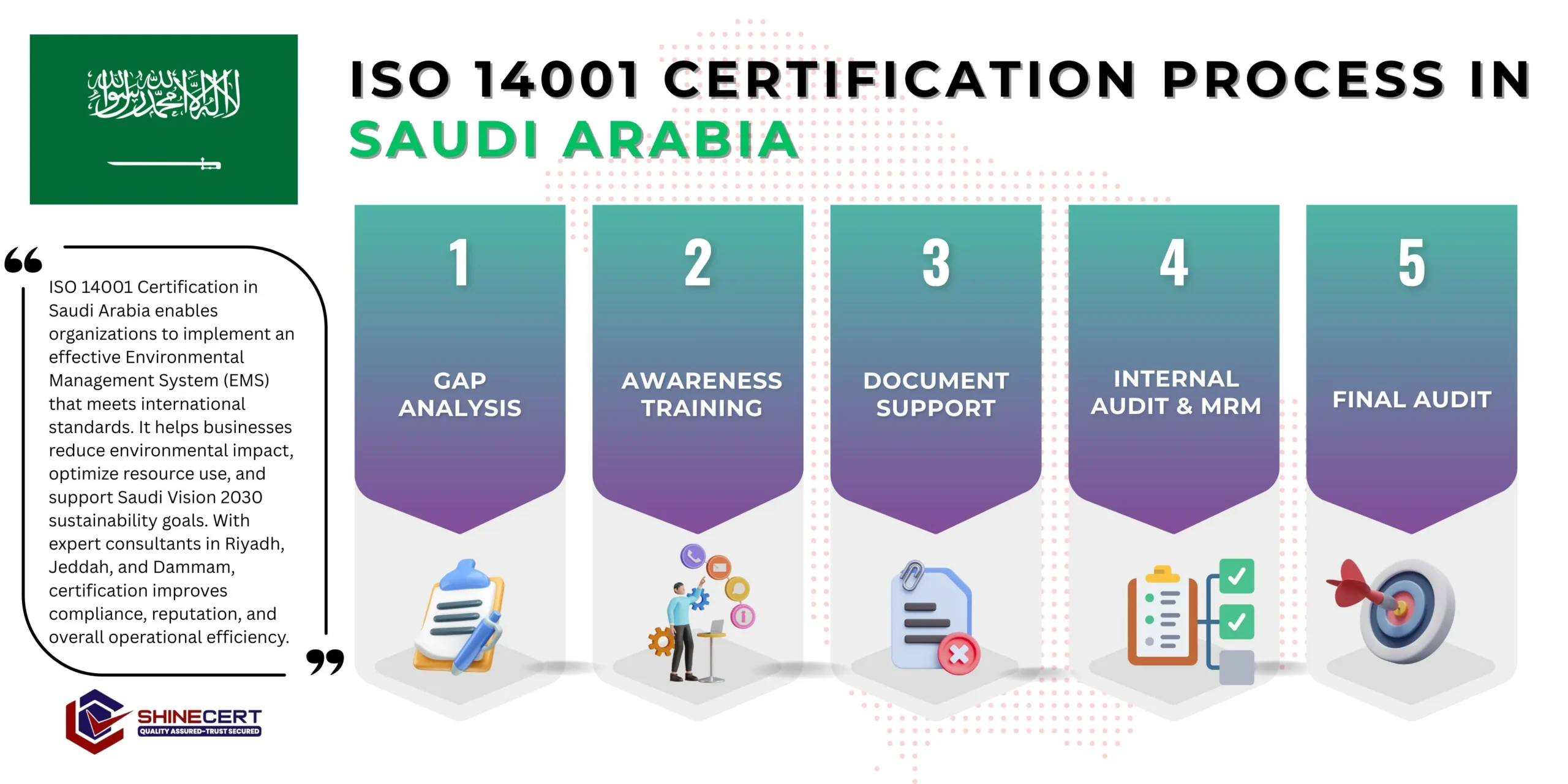
ShineCert’s ISO 14001 Certification Process in Saudi Arabia
Gap Analysis and Environmental Aspects Identification
We assess your current environmental practices against ISO 14001's requirements and conduct a structured environmental aspects and impacts identification exercise covering your specific operations, whether that's a manufacturing facility's emissions and waste streams or a construction contractor's site-level environmental footprint.
A documented gap analysis and environmental aspects register scoped to your operations.
Documentation Development
We build your environmental policy, objectives, and required procedures collaboratively with your team, ensuring compliance obligations tied to NCEC permitting and any project-specific sustainability commitments are explicitly addressed rather than left as generic environmental boilerplate.
A complete environmental management system documentation set, including your environmental policy and compliance obligations register.
Implementation and Training
We roll out operational controls and train staff on environmentally significant activities specific to their roles, from hazardous materials handling to emergency response procedures relevant to your site and sector.
Documented environmental training records and evidence of operational controls functioning in practice.
Internal Audit and Management Review
We conduct a rigorous internal audit covering environmental performance and compliance evaluation, then facilitate a management review addressing environmental objectives progress and any compliance findings.
A documented internal audit report and management review minutes demonstrating leadership engagement with environmental performance.
Certification Audit
We coordinate Stage 1 and Stage 2 audits with a SAAC-accredited or IAF-recognized certification body, supporting you through any resulting corrective actions, then help establish your surveillance audit schedule.
Your ISO 14001 certificate and a documented surveillance audit plan.
Gap Analysis and Environmental Aspects Identification
We assess your current environmental practices against ISO 14001's requirements and conduct a structured environmental aspects and impacts identification exercise covering your specific operations, whether that's a manufacturing facility's emissions and waste streams or a construction contractor's site-level environmental footprint.
A documented gap analysis and environmental aspects register scoped to your operations.
Documentation Development
We build your environmental policy, objectives, and required procedures collaboratively with your team, ensuring compliance obligations tied to NCEC permitting and any project-specific sustainability commitments are explicitly addressed rather than left as generic environmental boilerplate.
A complete environmental management system documentation set, including your environmental policy and compliance obligations register.
Implementation and Training
We roll out operational controls and train staff on environmentally significant activities specific to their roles, from hazardous materials handling to emergency response procedures relevant to your site and sector.
Documented environmental training records and evidence of operational controls functioning in practice.
Internal Audit and Management Review
We conduct a rigorous internal audit covering environmental performance and compliance evaluation, then facilitate a management review addressing environmental objectives progress and any compliance findings.
A documented internal audit report and management review minutes demonstrating leadership engagement with environmental performance.
Certification Audit
We coordinate Stage 1 and Stage 2 audits with a SAAC-accredited or IAF-recognized certification body, supporting you through any resulting corrective actions, then help establish your surveillance audit schedule.
Your ISO 14001 certificate and a documented surveillance audit plan.
What Is ISO 14001?
ISO 14001 is the international standard for environmental management systems, published by the International Organization for Standardization and used by hundreds of thousands of certified organizations worldwide. It provides a structured framework for identifying, controlling, and continually reducing an organization’s environmental impact, covering everything from waste management and emissions to resource use and regulatory compliance. Unlike a simple environmental compliance checklist, ISO 14001 requires organizations to take a genuinely systematic approach: identifying environmental aspects of their operations, understanding the impacts those aspects create, and building a management system that drives continual improvement rather than one-time fixes. Certification means an accredited, independent auditor has verified your environmental management system genuinely meets these requirements.
ISO 14001 Certification Cost in Saudi Arabia
Quick answer: ISO 14001 certification in Saudi Arabia typically costs between SAR 18,000 and SAR 85,000, depending on company size, environmental complexity, and number of sites, with industrial facilities generally costing more than office-based operations given more extensive environmental aspects assessment.
- Environmental complexity drives cost more than company size alone : A small office-based business costs considerably less than a similarly sized industrial facility with complex emissions and waste streams.
- Existing environmental compliance activity reduces consultant hours : Organizations already tracking NCEC compliance obligations need less foundational work than those starting from scratch.
- Certification body fees are separate from consulting fees : The accredited certification body’s audit fee is distinct from ShineCert’s implementation support cost.
- Multi-site industrial operations increase cost substantially : Certification bodies sample multiple sites, and each site typically needs its own environmental aspects assessment.
- Bundling with ISO 9001 or ISO 45001 reduces per-standard cost : The shared Harmonised Structure makes combined certification meaningfully more efficient than certifying separately.
Mandatory Documents for ISO 14001
Quick answer: ISO 14001 requires documented information including an environmental policy, environmental objectives, an aspects and impacts register, a compliance obligations register, and records covering monitoring, internal audits, and management review.
- Environmental Policy : A documented, top-management-issued policy statement setting genuine environmental commitments, not generic language copied from another organization.
- Environmental Aspects and Impacts Register : A documented assessment identifying every way your operations affect the environment and which aspects represent significant impacts requiring management.
- Compliance Obligations Register : A tracked list of applicable environmental legal and regulatory requirements, including NCEC permit conditions and any project-specific sustainability commitments for Saudi operations.
- Environmental Objectives and Action Plans : Measurable environmental targets with documented plans for achieving them.
- Operational Control Procedures : Documentation covering activities tied to significant environmental aspects, including emergency preparedness and response plans.
- Monitoring and Measurement Records : Evidence of environmental performance tracking against objectives and compliance status.
- Internal Audit and Management Review Records : Documented audit findings and management review minutes addressing environmental performance.
Key Requirements of ISO 14001
ISO 14001 shares the same Harmonised Structure as ISO 9001, but its substantive requirements focus specifically on environmental performance:
- Context of the Organization (Clause 4) : Beyond the general business context requirements shared with ISO 9001, this clause specifically requires identifying environmental conditions relevant to your organization, including local environmental factors like water scarcity concerns relevant across much of Saudi Arabia, and interested parties whose environmental expectations matter, which increasingly includes NCEC, MEWA, and for giga-project contractors, project-level sustainability requirements set by developers like NEOM Company. Getting your environmental management system scope right matters particularly for multi-site Saudi operations, since a manufacturing facility in Jubail’s industrial city faces different environmental compliance obligations than an office-based operation in Riyadh.
- Leadership (Clause 5) : Top management must establish an environmental policy and ensure environmental responsibilities are genuinely assigned and understood throughout the organization, not treated as a side responsibility for whoever happens to handle HSE. We’ve found that Saudi manufacturers pursuing ISO 14001 for the first time often already have some environmental compliance activity happening informally, driven by NCEC inspection requirements, but leadership engagement with a formal environmental policy and objectives is a distinct step auditors specifically look for evidence of.
- Planning (Clause 6) : This is where ISO 14001’s environmental aspects and impacts assessment lives — a formal, documented process for identifying every way your operations interact with the environment (water use, emissions, waste generation, resource consumption) and evaluating which of these represent significant impacts requiring management action. For Saudi industrial operations, this assessment needs to explicitly address compliance obligations tied to NCEC’s environmental permitting requirements and any project-specific sustainability commitments made to Vision 2030 giga-project developers, not just generic environmental risk categories copied from a template.
- Support (Clause 7) : Covers resources, competence, and communication specific to environmental management, including ensuring staff handling environmentally significant activities, such as hazardous waste handling at an industrial facility, have documented environmental competence and training, distinct from general quality or safety training.
- Operation (Clause 8) : Requires documented operational controls for activities tied to significant environmental aspects, plus emergency preparedness and response planning for potential environmental incidents, such as chemical spills at a petrochemical facility or dust management at a construction site near a populated area. Saudi construction contractors working on Vision 2030 projects increasingly need to demonstrate specific operational controls addressing desert ecosystem impact and water conservation given the Kingdom’s arid climate and the Saudi Green Initiative’s environmental priorities.
- Performance Evaluation (Clause 9) : Requires monitoring and measuring environmental performance against objectives, plus compliance evaluation confirming ongoing conformity with legal and regulatory requirements, which for Saudi businesses means systematically tracking NCEC permit conditions and any environmental reporting obligations rather than treating regulatory compliance as a background assumption.
- Improvement (Clause 10) : Requires a structured response to environmental nonconformities, whether an internal deviation from your own environmental targets or an external NCEC compliance finding, plus genuine continual improvement of environmental performance over time, not a one-time baseline that never gets revisited.
Benefits of ISO 14001 in Saudi Arabia
Certification gives businesses a structured way to demonstrate genuine environmental management maturity supporting the Kingdom’s net-zero and sustainability commitments.
NEOM, the Red Sea Project, and similar developments increasingly factor environmental management credentials into contractor evaluation given their sustainability positioning.
A functioning environmental management system helps streamline ongoing compliance interactions with environmental permitting and inspection processes.
Systematic environmental aspects assessment frequently identifies genuine waste and resource inefficiencies that translate into direct operational savings.
International joint venture partners increasingly expect environmental management credentials alongside quality certification.
ISO 14001’s shared Harmonised Structure with ISO 9001 and ISO 45001 makes combined certification considerably more efficient than pursuing each separately.
ISO 14001 vs. NCEC Compliance
A question we hear frequently from Saudi industrial clients is whether ISO 14001 certification is necessary if a facility already maintains its NCEC environmental permits and passes routine compliance inspections. In our experience, the answer is generally yes. NCEC compliance confirms you’re meeting minimum legal environmental requirements at a point in time, while ISO 14001 requires a systematic, continually improving management approach that identifies environmental risks proactively. Facilities relying solely on reactive NCEC compliance often struggle when regulations tighten, lacking the structured assessment ISO 14001 requires. Facilities with genuine ISO 14001 systems tend to navigate NCEC renewals and inspections more smoothly, since documentation already exists in organized, audit-ready form.
Industries in Saudi Arabia That Need ISO 14001
Petrochemicals and heavy industry
Facilities in industrial cities like Jubail and Yanbu face significant NCEC environmental permitting scrutiny, making ISO 14001 a practical near-necessity.
Read moreConstruction
Vision 2030 giga-project contractors increasingly need to demonstrate environmental management credentials given projects' explicit sustainability positioning.
Read moreManufacturing
NIDLP-aligned industrial development combined with export market expectations drives ISO 14001 adoption among Saudi manufacturers.
Read moreMining and minerals
Saudi Arabia's push to develop its mining sector under Vision 2030 brings substantial environmental compliance obligations that ISO 14001 helps structure.
Read moreEnergy and utilities
Both conventional energy operations and Saudi Arabia's expanding renewable energy sector rely on ISO 14001 to demonstrate environmental management maturity to investors and regulators.
Read moreCommon Challenges with ISO 14001 in Saudi Arabia
- Treating the environmental aspects assessment as a formality : A superficial aspects register that doesn’t genuinely reflect your operations’ environmental footprint fails to support real compliance obligations tracking.
- Disconnecting the compliance obligations register from actual NCEC interactions : The register needs to be a living document actively used during permit renewals, not a static file created once for certification.
- Underestimating industrial site complexity : Petrochemical and heavy manufacturing facilities often need considerably more detailed environmental documentation than initially anticipated.
- Not planning for the ISO 14001:2026 transition : Organizations currently certified under the 2015 edition need a documented transition plan well before the May 2029 deadline.
Choosing an Accredited Certification Body for ISO 14001 in Saudi Arabia?
What to Check | Why It Matters |
SAAC accreditation, or accreditation from another IAF-recognized body | Confirms genuine international recognition |
ISO 14001:2026 transition experience | Essential for organizations currently certified under the 2015 edition |
Industrial sector environmental audit experience | Matters for petrochemical, mining, or heavy manufacturing facilities with complex environmental risks |
Familiarity with NCEC compliance expectations | Helps ensure your management system genuinely supports regulatory interactions, not just certification |
Why Choose ShineCert for ISO 14001 Certification in Saudi Arabia?
We’re headquartered in Riyadh, giving us direct familiarity with NCEC compliance expectations, Vision 2030 giga-project environmental requirements, and the practical realities of implementing environmental management systems across Saudi Arabia’s industrial and construction sectors. Our team has guided more than 10,000 organizations through ISO certification globally, with specific depth in Saudi Arabia’s evolving environmental regulatory landscape.
ISO 14001 Certification Timeline in Saudi Arabia
Quick answer: ISO 14001 certification in Saudi Arabia typically takes three to six months from kickoff to certificate for a single-site organization, similar to ISO 9001’s timeline, though industrial facilities with complex environmental aspects sometimes need longer for the assessment and documentation phases.
Phase | Typical Duration |
Gap analysis and aspects identification | 2–4 weeks |
Documentation development | 4–6 weeks |
Implementation and training | 3–5 weeks |
Internal audit and management review | 1–2 weeks |
Certification audit (Stage 1 + Stage 2) | 3–4 weeks |
Total | 3–6 months |
Get ISO 14001 Certified in Saudi Arabia
ShineCert supports Saudi businesses end to end, from environmental aspects assessment through certification audit, including ISO 14001:2026 transition planning. Book a free consultation or contact us directly, and we’ll review your sector and environmental footprint before proposing a fixed-scope plan.
Frequently Asked Questions
Typically SAR 18,000 to SAR 85,000, depending on company size and environmental complexity.
No, it’s voluntary, though Vision 2030 giga-project contracting and NCEC’s tightening compliance environment increasingly make it a practical advantage.
Typically three to six months from kickoff to certificate.
ISO 14001:2026 was published April 15, 2026, with a stronger focus on climate change, biodiversity, and resource efficiency, and a three-year transition window ending May 2029.
No, it complements them by providing a systematic management approach, but legal compliance obligations must still be met independently.
Yes, both share the same Harmonised Structure, making combined certification more efficient than pursuing them separately.
Yes, Riyadh is one of ShineCert’s genuine physical offices, alongside Lebanon and India.