
ISO 45001 Certification in Saudi Arabia
Quick Answer
ISO 45001 is the international standard for occupational health and safety management systems, and in Saudi Arabia it’s increasingly relevant given the scale of Vision 2030 construction activity and the Ministry of Human Resources and Social Development’s (MHRSD) tightening workplace safety enforcement. Certification should come from a body accredited by the Saudi Accreditation Center (SAAC) or another IAF-recognized national accreditation body. ISO 45001 shares the same Harmonised Structure as ISO 9001 and ISO 14001, making combined certification efficient for contractors pursuing all three. Budget roughly SAR 18,000 to SAR 90,000 depending on company size and workforce risk profile, and expect three to six months from kickoff to certificate.
Why ISO 45001 Matters for Businesses in Saudi Arabia?
Saudi Arabia’s construction sector, driven by the scale of Vision 2030 giga-projects including NEOM, the Red Sea Project, and Qiddiya, represents one of the largest concentrated construction workforces globally, and workplace safety has become an increasingly visible priority for both government regulators and international project stakeholders. The Ministry of Human Resources and Social Development (MHRSD) has expanded workplace safety inspection activity in recent years, and the General Organization for Social Insurance (GOSI), which administers Saudi Arabia’s workplace injury insurance scheme, has correspondingly sharpened its focus on employer safety practices given the direct cost implications of workplace injury claims. ISO 45001 certification gives Saudi employers a structured, internationally recognized way to demonstrate genuine safety management maturity to regulators, giga-project developers, and insurers alike.
Beyond direct regulatory pressure, Saudi Arabia’s Saudization (Nitaqat) program has meant many Saudi nationals are entering industrial and construction roles for the first time, and employers face a genuine practical need to build robust safety training and induction processes for a workforce with varying levels of prior industrial safety experience, something ISO 45001’s competence and awareness requirements directly address.
ISO 45001 and Saudi Arabia’s Construction Safety Landscape
- Saudi Arabia’s construction sector, given the scale of concurrent Vision 2030 giga-project activity, faces safety management challenges that differ meaningfully from more mature, slower-growing construction markets: rapid workforce scaling, extensive subcontractor networks with varying safety maturity, and extreme climate conditions that make heat stress a leading, well-documented risk category rather than a secondary concern.
- We’ve found that contractors who build ISO 45001 systems specifically designed around these realities, rather than adapting a generic template built for temperate-climate construction markets, achieve considerably stronger real safety outcomes, not just smoother certification audits. This matters particularly for main contractors managing multi-tier subcontractor networks on giga-projects, where safety management system requirements increasingly flow down contractually, making a genuinely functioning ISO 45001 system a competitive differentiator in subcontractor selection, not just a compliance box to check.
What are the steps to get ISO 45001 Certification in Saudi Arabia?
our services
- ISO Certification Saudi Arabia
- ISO 9001 Certification Saudi Arabia
- ISO 14001 Certification Saudi Arabia
- ISO 27001 Certification Saudi Arabia
- ISO 22000 Certification Saudi Arabia
- ISO 27701 Certification Saudi Arabia
- ISO 45001 Certification Saudi Arabia
- ISO 20000-1 Certification Saudi Arabia
- ISO 13485 Certification Saudi Arabia
- ISO 17025 Certification Saudi Arabia
- ISO 31000 Certification Saudi Arabia
- ISO 42001 Certification Saudi Arabia
- ISO 37001 Certification Saudi Arabia
- ISO 22301 Certification Saudi Arabia
- ISO 50001 Certification Saudi Arabia
- CE Mark Certification Saudi Arabia
- GDPR Certification Saudi Arabia
- GMP Certification Saudi Arabia
- Halal Certification Saudi Arabia
- SOC Certification Saudi Arabia
major citys
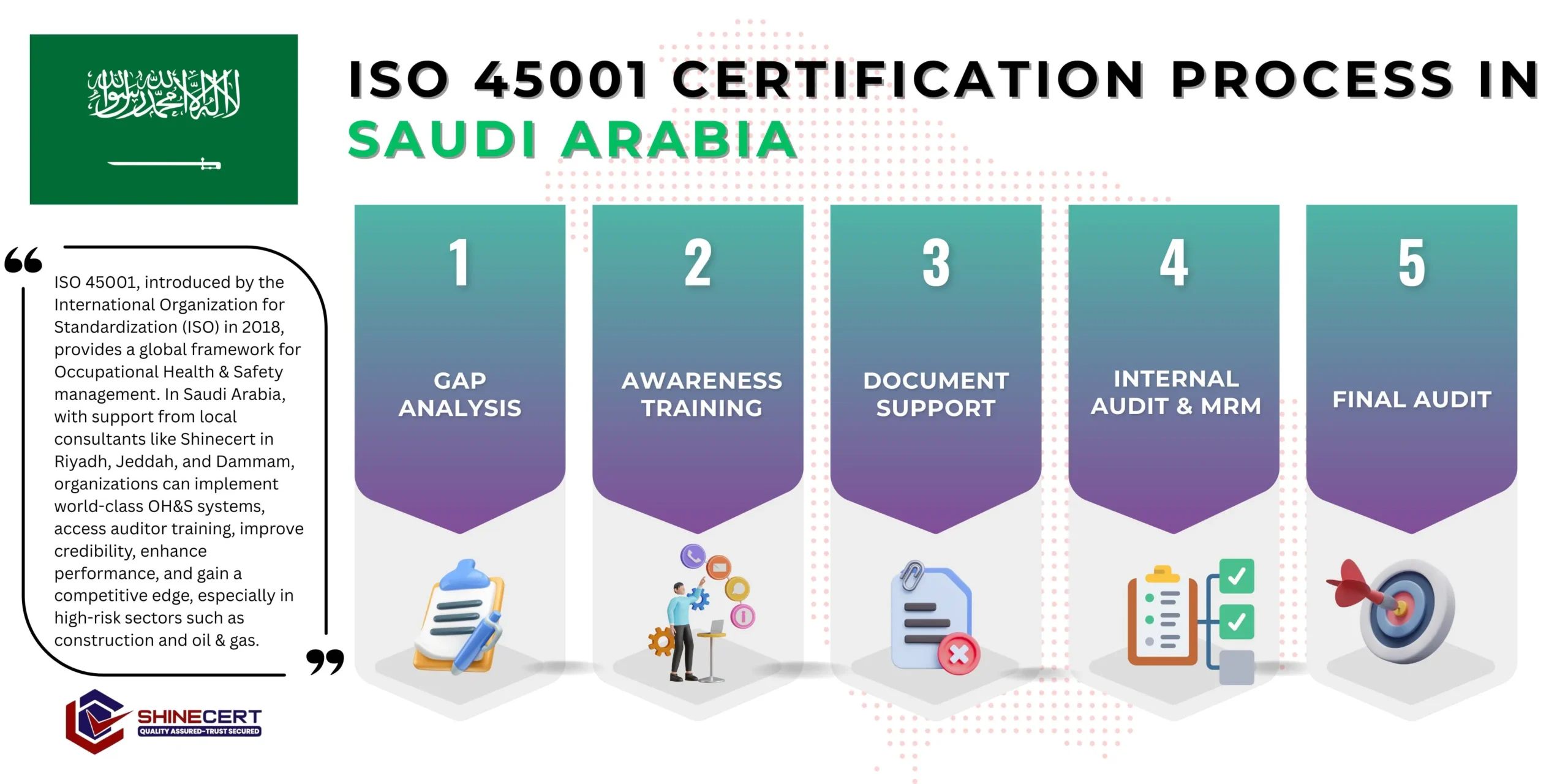
ShineCert’s ISO 45001 Certification Process in Saudi Arabia
Gap Analysis and Hazard Identification
We assess your current safety practices against ISO 45001's requirements and conduct site-specific hazard identification covering your actual operations, whether that's a construction site's fall and heat stress risks or a manufacturing facility's machinery and chemical handling hazards.
A documented gap analysis and hazard register scoped to your specific sites and workforce.
Documentation Development
We build your OHS policy, procedures, and worker consultation mechanisms collaboratively, ensuring genuine worker participation processes are built in from the start rather than added as an afterthought before the audit.
A complete OHS management system documentation set, including your safety policy and hazard and risk register.
Implementation and Training
We roll out safety controls and deliver role-specific, language-appropriate training for your workforce, addressing genuine communication needs across a diverse expatriate and Saudi national workforce.
Documented training records and evidence of functioning worker consultation and participation mechanisms.
Internal Audit and Management Review
We conduct a rigorous internal audit covering safety performance and legal compliance evaluation, then facilitate a management review addressing incident trends and safety objective progress.
A documented internal audit report and management review minutes demonstrating leadership engagement with safety performance.
Certification Audit
We coordinate Stage 1 and Stage 2 audits with a SAAC-accredited or IAF-recognized certification body, including auditor interviews with frontline workers to verify genuine participation, then support you through any resulting corrective actions.
Your ISO 45001 certificate and a documented surveillance audit plan.
Gap Analysis and Hazard Identification
We assess your current safety practices against ISO 45001's requirements and conduct site-specific hazard identification covering your actual operations, whether that's a construction site's fall and heat stress risks or a manufacturing facility's machinery and chemical handling hazards.
A documented gap analysis and hazard register scoped to your specific sites and workforce.
Documentation Development
We build your OHS policy, procedures, and worker consultation mechanisms collaboratively, ensuring genuine worker participation processes are built in from the start rather than added as an afterthought before the audit.
A complete OHS management system documentation set, including your safety policy and hazard and risk register.
Implementation and Training
We roll out safety controls and deliver role-specific, language-appropriate training for your workforce, addressing genuine communication needs across a diverse expatriate and Saudi national workforce.
Documented training records and evidence of functioning worker consultation and participation mechanisms.
Internal Audit and Management Review
We conduct a rigorous internal audit covering safety performance and legal compliance evaluation, then facilitate a management review addressing incident trends and safety objective progress.
A documented internal audit report and management review minutes demonstrating leadership engagement with safety performance.
Certification Audit
We coordinate Stage 1 and Stage 2 audits with a SAAC-accredited or IAF-recognized certification body, including auditor interviews with frontline workers to verify genuine participation, then support you through any resulting corrective actions.
Your ISO 45001 certificate and a documented surveillance audit plan.
What Is ISO 45001?
ISO 45001 is the international standard for occupational health and safety (OHS) management systems, published by the International Organization for Standardization to help organizations reduce workplace injuries and illnesses through a structured, proactive management approach. It replaced the older OHSAS 18001 standard and, unlike that predecessor, follows the same Harmonised Structure used across modern ISO management system standards, making it considerably easier to integrate with ISO 9001 and ISO 14001. The standard requires organizations to identify workplace hazards, assess and control risks, involve workers directly in safety decision-making, and continually improve safety performance rather than simply reacting to incidents after they occur. Certification means an accredited auditor has verified your safety management system genuinely functions, not just that safety policies exist on paper.
ISO 45001 Certification Cost in Saudi Arabia
Quick answer: ISO 45001 certification in Saudi Arabia typically costs between SAR 18,000 and SAR 90,000, depending on company size, workforce risk profile, and number of sites, with high-hazard industries like construction and petrochemicals generally costing more than lower-risk office environments.
- Workforce risk profile drives cost significantly : A high-hazard construction or industrial workforce requires more extensive hazard assessment than a lower-risk office-based operation.
- Multi-site construction operations increase cost : Each active project site typically needs its own hazard identification and risk assessment work.
- Certification body fees are separate from consulting fees : The accredited certification body’s audit fee is distinct from ShineCert’s implementation support.
- Worker consultation mechanism development takes genuine time : Building functioning, multilingual worker participation processes is more involved than simply issuing a safety policy.
- Bundling with ISO 9001 or ISO 14001 reduces per-standard cost : The shared Harmonised Structure makes combined certification meaningfully more efficient.
Mandatory Documents for ISO 45001
Quick answer: ISO 45001 requires documented information including an OHS policy, a hazard identification and risk assessment register, worker consultation and participation records, and records covering incident investigation, internal audits, and management review.
- OHS Policy : A documented, top-management-issued policy demonstrating genuine commitment to worker safety and health, not generic boilerplate language.
- Hazard Identification and Risk Assessment Register : A documented, site-specific assessment of workplace hazards and the risk controls in place, covering both routine and non-routine activities.
- Legal and Other Requirements Register : A tracked list of applicable MHRSD and GOSI-relevant occupational safety requirements.
- Worker Consultation and Participation Records : Documented evidence of genuine worker involvement in safety decision-making, a distinctive ISO 45001 requirement auditors probe closely.
- Emergency Preparedness and Response Procedures : Documentation covering emergency scenarios relevant to your operations, including heat stress protocols for outdoor Saudi work environments.
- Incident Investigation and Corrective Action Records : Documentation of workplace incidents and near-misses, root cause investigation, and corrective actions taken.
- Training and Competence Records : Evidence that workers performing hazardous tasks have appropriate, genuinely understood safety training.
Key Requirements of ISO 45001
ISO 45001 shares ISO 9001 and ISO 14001’s Harmonised Structure, but its substantive requirements center on worker safety and health:
- Context of the Organization (Clause 4) : Requires identifying internal and external issues relevant to occupational health and safety, including interested parties like MHRSD, GOSI, and for construction contractors, the specific safety requirements set by Vision 2030 giga-project developers. Saudi employers operating across multiple sites, such as a contractor with active projects in both Riyadh and NEOM, need a scope statement that clearly reflects which sites and workforce populations the safety management system genuinely covers.
- Leadership and Worker Participation (Clause 5) : This clause carries a distinctive requirement not present in ISO 9001 or 14001: genuine worker participation and consultation in safety decision-making, not just top-down policy issuance. For Saudi employers with a mixed Saudi and expatriate workforce, this means establishing genuine consultation mechanisms, such as worker safety committees, that function across language and cultural differences, not a token committee that exists only on paper. Auditors specifically interview frontline workers during Stage 2 audits to verify genuine participation, not just management’s description of the process.
- Planning (Clause 6) : Requires systematic hazard identification and risk assessment covering routine and non-routine activities, plus a documented process for managing change when introducing new equipment, processes, or work locations. For a Saudi construction contractor moving between project sites, this means hazard assessments need to be genuinely site-specific rather than a single generic assessment applied across every project regardless of local conditions, such as extreme summer heat exposure risk, which is a particularly significant and well-documented hazard category across Saudi Arabia’s construction sector.
- Support (Clause 7) : Covers competence, training, and communication specific to occupational safety, including documented evidence that workers performing hazardous tasks have appropriate safety training delivered in a language they genuinely understand, a meaningful practical requirement given Saudi Arabia’s diverse expatriate construction workforce drawn from many different countries.
- Operation (Clause 8) : Requires documented operational controls for managing identified hazards, plus specific emergency preparedness and response planning, including heat stress management protocols relevant to outdoor work during Saudi Arabia’s extreme summer conditions, and procedures for managing contractors and subcontractors on multi-tier construction projects common on Vision 2030 giga-projects.
- Performance Evaluation (Clause 9) : Requires monitoring safety performance, including both leading indicators like near-miss reporting and lagging indicators like injury rates, plus systematic compliance evaluation against MHRSD and GOSI-relevant legal requirements. Saudi employers should track GOSI injury claim data as part of this performance evaluation, since it provides an independently verified data source auditors often ask about directly.
- Improvement (Clause 10) : Requires structured incident investigation and corrective action for workplace incidents and near-misses, plus genuine continual improvement of safety performance, addressing both the immediate cause of an incident and any systemic safety management gaps it reveals.
Benefits of ISO 45001 in Saudi Arabia
Giga-project developers increasingly require demonstrated OHS management maturity from construction contractors and subcontractors.
A functioning safety management system genuinely reduces workplace incidents, with direct downstream cost benefits through Saudi Arabia’s occupational injury insurance scheme.
Certification provides structured evidence of safety management maturity during labor inspection and compliance interactions.
A genuinely safer, more consultative workplace culture helps Saudi employers retain skilled workers in a competitive labor market shaped by Saudization requirements.
Fewer workplace incidents means fewer regulatory stoppages and schedule disruptions on time-sensitive Vision 2030 projects.
ISO 45001’s shared Harmonised Structure with ISO 9001 and ISO 14001 makes combined certification considerably more efficient for construction contractors pursuing all three.
ISO 45001 Certification Timeline: Saudi Arabia
Phase | Typical Duration |
Gap analysis and hazard identification | 2–4 weeks |
Documentation development | 4–6 weeks |
Implementation and training | 3–6 weeks |
Internal audit and management review | 1–2 weeks |
Certification audit (Stage 1 + Stage 2) | 3–4 weeks |
Total | 3–6 months |
Industries in Saudi Arabia That Need ISO 45001
Construction
Vision 2030 giga-project contractors face the most significant safety management scrutiny given project scale and heat-related risk exposure.
Read moreManufacturing
Machinery, chemical handling, and industrial process safety make ISO 45001 a near-necessity for Saudi manufacturers.
Read moreOil, gas, and petrochemicals
High-hazard process industries in Jubail and Yanbu rely on ISO 45001 alongside sector-specific process safety frameworks.
Read moreLogistics and warehousing
Material handling and vehicle safety risks make ISO 45001 relevant for Saudi Arabia's expanding logistics sector.
Read moreMining
Saudi Arabia's developing mining sector under Vision 2030 brings substantial occupational safety obligations that ISO 45001 helps structure.
Read moreWhy Choose ShineCert for ISO 45001 Certification in Saudi Arabia?
We’re headquartered in Riyadh, giving us direct familiarity with MHRSD and GOSI expectations, Vision 2030 giga-project safety requirements, and the practical realities of building functioning safety management systems across Saudi Arabia’s diverse, multilingual construction and industrial workforce. Our team has guided more than 10,000 organizations through ISO certification globally, with specific depth in Saudi Arabia’s high-hazard sectors.
Choosing an Accredited Certification Body for ISO 45001 in Saudi Arabia?
What to Check | Why It Matters |
SAAC accreditation, or accreditation from another IAF-recognized body | Confirms genuine international recognition |
Construction or industrial sector audit experience | Matters for high-hazard operations with complex safety risks |
Auditor familiarity with worker consultation verification | Ensures the audit genuinely tests participation, not just documentation |
Familiarity with MHRSD and GOSI expectations | Helps ensure your system supports real regulatory interactions |
Common Challenges with ISO 45001 in Saudi Arabia
- Treating worker consultation as a paperwork exercise : Auditors specifically interview frontline workers, and a consultation process that exists only on paper fails Stage 2 audits.
- Underestimating heat stress management requirements : Saudi Arabia’s extreme summer conditions make heat-related hazard management a genuine, well-scrutinized risk category, not a minor addition to generic safety procedures.
- Language barriers undermining safety training : Training delivered only in a language part of the workforce doesn’t genuinely understand fails to meet Clause 7’s competence requirements in substance, even if training records exist.
- Disconnecting the system from GOSI and MHRSD data : Safety performance evaluation should actively reference GOSI injury data and MHRSD inspection history, not rely solely on internal reporting.
Get ISO 45001 Certified in Saudi Arabia
ShineCert supports Saudi businesses end to end, from hazard identification through certification audit, with direct experience across the Kingdom’s high-hazard construction and industrial sectors. Book a free consultation or contact us directly, and we’ll review your workforce and safety practices before proposing a fixed-scope plan.
Frequently Asked Questions
Typically SAR 18,000 to SAR 90,000, depending on company size and workforce risk profile.
No, it’s voluntary, though Vision 2030 project contracting and GOSI cost pressures increasingly make it a practical advantage.
Typically three to six months from kickoff to certificate.
No, it complements them with a systematic management approach, but legal compliance obligations must still be met independently.
Its distinctive requirement for genuine worker participation and consultation in safety decision-making, verified directly through worker interviews during audits.
Yes, it shares the same Harmonised Structure as ISO 9001 and ISO 14001, making combined certification more efficient.
Yes, Riyadh is one of ShineCert’s genuine physical offices, alongside Lebanon and India.