
ISO 42001 Certification in Oman
Quick Answer
ISO/IEC 42001 is the world’s first international standard for AI management systems, and Oman’s own national AI strategy already frames the exact governance thinking the standard formalizes. MTCIT’s National Program for Artificial Intelligence and Advanced Digital Technologies, part of Oman Vision 2040, explicitly names “AI Applications Governance with a Human-Centered Vision” as one of its three core pillars, meaning ISO 42001 certification directly demonstrates alignment with Oman’s own stated national AI direction, not just abstract international good practice. Get certified through a body accredited under the Global Accreditation Cooperation (GAC) framework. Plan for three to four months from kickoff to certificate, typically faster than other management system standards, since most certifying organizations already have partial AI governance in place. Cost depends on genuine factors, number and risk level of your AI systems, data sensitivity, deployment scale, not a flat number.
ISO 42001, Explained Simply
Strip away the technical language, and ISO 42001 is a structured way of making sure your AI systems behave responsibly, that they don’t produce biased or unfair outcomes, that their decisions can genuinely be explained when someone asks why, and that you’re actively watching for the system’s performance quietly degrading over time. Rather than treating “responsible AI” as a marketing phrase, you build a documented governance system that gets independently checked by an auditor to confirm it actually works in practice, not just on paper.
For a client trying to decide whether it’s worth pursuing: it’s proof, verified by an outside party, that your business manages its AI systems responsibly, proof that matters enormously the moment a government client, a regulator, or an enterprise customer asks how you actually govern the AI you’re building or deploying.
Oman Market Snapshot: Key Facts for ISO 42001
- National AI strategy: MTCIT’s National Program for Artificial Intelligence and Advanced Digital Technologies (2024–2026), part of Oman Vision 2040, is built on three pillars: enhancing and adopting AI in economic sectors, localizing AI technologies, and AI applications governance with a human-centered vision.
- Digital Economy Roadmap: the 2026–2030 Digital Economy Roadmap targets AI, cybersecurity, and cloud infrastructure as priority areas, with an ambition of 10% of GDP from the digital economy by 2040.
- Governance-first framing: unlike jurisdictions where AI governance is an afterthought bolted onto innovation policy, Oman’s national program treats AI governance as one of its three foundational pillars from the outset.
- SME funding available: Riyada offers financing and training support that can offset certification-related costs for eligible companies.
What are the steps to get ISO 42001 Certification in Oman?
our services
- ISO Certification Oman
- ISO 9001 Certification Oman
- ISO 14001 Certification Oman
- ISO 27001 Certification Oman
- ISO 22000 Certification Oman
- ISO 45001 Certification Oman
- ISO 13485 Certification Oman
- ISO 17025 Certification Oman
- ISO 31000 Certification Oman
- ISO 22301 Certification Oman
- CE Mark Certification Oman
- GMP Certification Oman
- Halal Certification Oman
- SOC Certification Oman
major citys
- ISO Certification Muscat
- ISO Certification Salalah
- ISO Certification Sohar
- ISO Certification Seeb
- ISO Certification Nizwa
- ISO Certification Sur
- ISO Certification Duqm
- ISO Certification Bawshar
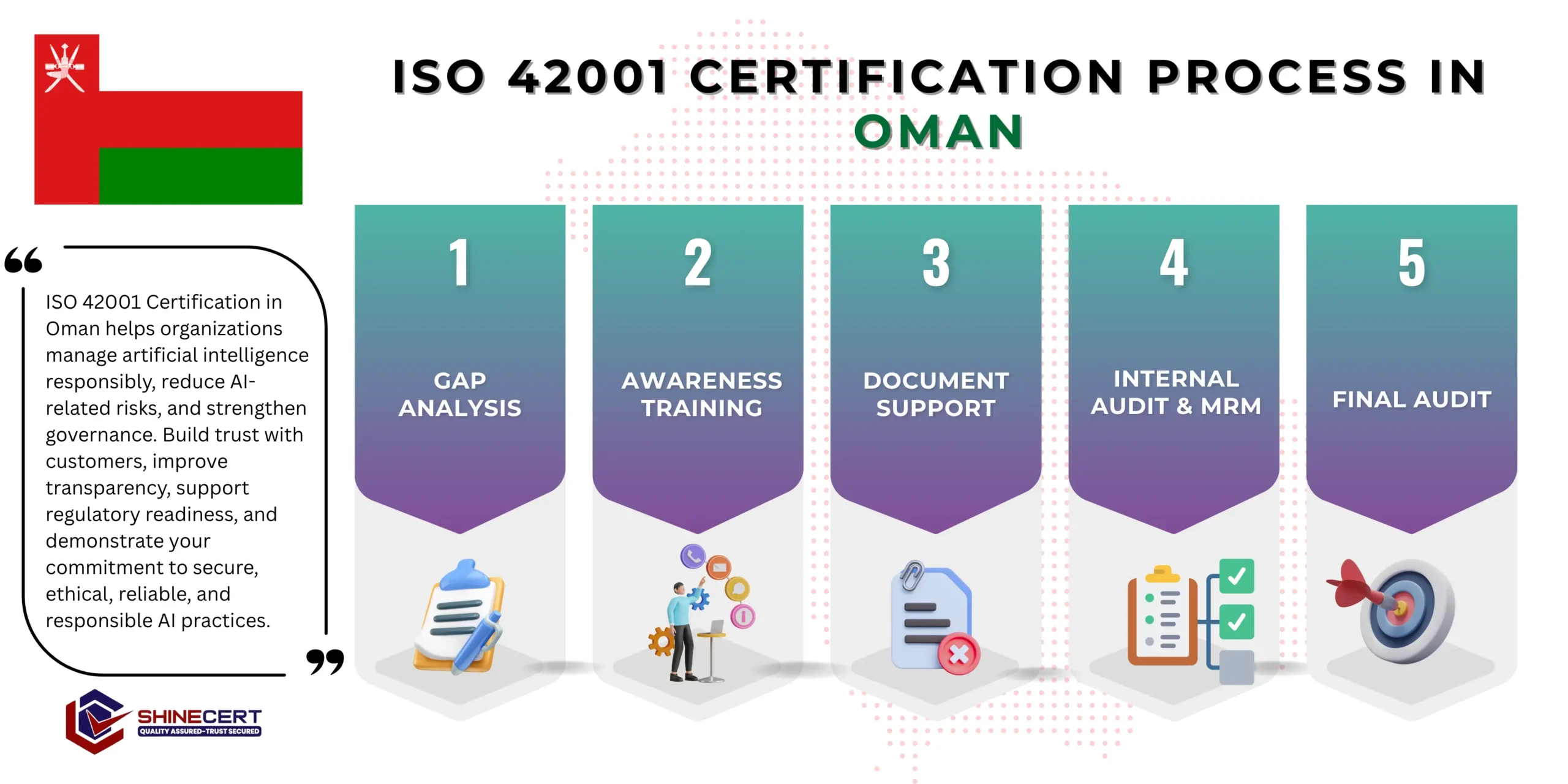
Our Five-Step Certification Process: What to Actually Expect
Gap Assessment
We evaluate your current AI development and deployment practices against ISO 42001's requirements.
A clear picture of which AI systems genuinely need governance attention and which practices are already reasonably sound.
A gap assessment report specific to your AI systems and use cases.
Documentation Development
Your AI policy, risk assessment methodology, and impact assessment framework get built around your actual AI systems, not generic templates.
A governance framework your data science and engineering teams can genuinely use, not paperwork disconnected from real development practices.
A complete ISO 42001 documentation set.
Implementation and Training
Governance controls roll out across your AI development and deployment lifecycle, with staff trained on bias, explainability, and monitoring responsibilities.
Your team builds genuine habits around impact assessment and drift monitoring, not a one-time compliance exercise.
Training records and evidence of controls functioning across your AI lifecycle.
Internal Audit and Management Review
We test the system internally, surfacing weaknesses before the real audit.
Governance gaps get caught and fixed before they can delay certification.
Internal audit report and management review minutes.
Certification Audit
Stage 1 and Stage 2 audits with a GAC-accredited certification body.
Stage 1 checks documentation readiness; Stage 2 verifies your AI governance genuinely functions in practice.
Your ISO 42001 certificate and a surveillance audit schedule.
Gap Assessment
We evaluate your current AI development and deployment practices against ISO 42001's requirements.
A clear picture of which AI systems genuinely need governance attention and which practices are already reasonably sound.
A gap assessment report specific to your AI systems and use cases.
Documentation Development
Your AI policy, risk assessment methodology, and impact assessment framework get built around your actual AI systems, not generic templates.
A governance framework your data science and engineering teams can genuinely use, not paperwork disconnected from real development practices.
A complete ISO 42001 documentation set.
Implementation and Training
Governance controls roll out across your AI development and deployment lifecycle, with staff trained on bias, explainability, and monitoring responsibilities.
Your team builds genuine habits around impact assessment and drift monitoring, not a one-time compliance exercise.
Training records and evidence of controls functioning across your AI lifecycle.
Internal Audit and Management Review
We test the system internally, surfacing weaknesses before the real audit.
Governance gaps get caught and fixed before they can delay certification.
Internal audit report and management review minutes.
Certification Audit
Stage 1 and Stage 2 audits with a GAC-accredited certification body.
Stage 1 checks documentation readiness; Stage 2 verifies your AI governance genuinely functions in practice.
Your ISO 42001 certificate and a surveillance audit schedule.
What Is ISO 42001, Technically Speaking?
- The first certifiable AI management standard : ISO/IEC 42001:2023 is the first international, certifiable management system standard specifically for artificial intelligence, published jointly by ISO and IEC. Like ISO 9001 and ISO 27001, it follows the Harmonized Structure, but its subject matter requires genuinely new technical concepts, because AI systems carry risks, bias, explainability, autonomous decision drift, that traditional quality or security frameworks weren’t built to address.
- AI risk assessment and impact assessment : The standard’s central technical mechanism is the AI risk assessment combined with an AI system impact assessment, a genuinely distinct concept from a conventional security or quality risk assessment. Where ISO 27001’s risk assessment focuses on confidentiality, integrity, and availability of information, ISO 42001’s impact assessment specifically evaluates how an AI system’s outputs affect individuals and groups: could this system produce biased or discriminatory outcomes, could its decisions be adequately explained to an affected person, and what happens when it makes a genuinely wrong prediction with real consequences.
- Governing the full AI lifecycle : A genuinely distinguishing feature of ISO 42001 compared to other management system standards is its treatment of the full AI lifecycle rather than a single deployment snapshot, the standard expects organizations to govern AI systems from data sourcing and model development through deployment, monitoring, and eventual retirement, recognizing that an AI system’s risk profile can shift meaningfully after deployment through what’s sometimes called “model drift.”
- Provider versus deployer : The standard also formally addresses the role distinction between an AI provider (an organization developing or supplying an AI system) and an AI user or deployer (an organization applying a third-party AI system within its own operations), recognizing that governance obligations differ meaningfully between building an AI system and simply using one.
- Direct alignment with Oman’s own framework : For Oman organizations specifically, ISO 42001’s structured approach to AI ethics, transparency, and human oversight maps closely onto the “human-centered vision” language MTCIT itself uses in its national AI program, meaning certification doesn’t just demonstrate abstract international good practice, it demonstrates genuine alignment with Oman’s own stated governance pillar.
Why This Matters So Much in Oman Specifically?
- Oman has deliberately built AI governance into its national digital strategy from the outset rather than treating it as a regulatory afterthought, MTCIT’s decision to name “AI Applications Governance with a Human-Centered Vision” as one of only three pillars in its national AI program is a genuine, structural signal, not a token mention. Organizations building or deploying AI systems that touch government services, financial services, or healthcare, sectors central to Oman’s digital economy ambitions, increasingly need to demonstrate the kind of structured governance ISO 42001 formalizes, both to satisfy emerging expectations and to get ahead of whatever specific regulatory requirements eventually formalize under the broader 2026–2030 Digital Economy Roadmap.
- One pattern we frequently see in Oman: technology companies build genuinely capable AI systems but treat governance as something to document only if a client asks, rather than as standing infrastructure. Given that Oman’s own national program explicitly prioritizes AI governance alongside AI adoption, positioning your organization with a certified management system ahead of demand, not reactively once a government tender or enterprise client requires it, is a genuine competitive advantage.
Riyada Funding: Does Your ISO 42001 Project Qualify for Subsidy?
Riyada’s financing and training programs can apply to AI management system implementation, particularly training-related costs, depending on your company’s size, sector, and program eligibility. Given the genuine novelty of AI governance projects, checking Riyada eligibility early is especially worthwhile, since dedicated AI governance training is a genuine cost component many companies underestimate.
What Actually Drives Your Cost?
We don’t quote a flat number, because a flat number would misrepresent how different two organizations’ actual AI footprint can be. Here’s what genuinely drives cost.
- Number and risk level of your AI systems : A single, low-stakes internal AI tool needs meaningfully less governance depth than multiple customer-facing systems making consequential decisions.
- Nature of AI use, provider versus deployer : Organizations building their own AI models face more extensive technical governance requirements than those deploying third-party AI systems within defined boundaries.
- Data sensitivity and volume : Systems trained on or processing sensitive personal, financial, or health data need deeper data governance controls.
- Deployment scale : A pilot AI system serving a small internal team is a genuinely smaller governance project than a production system serving thousands of citizens or customers.
- How mature your existing AI development practices already are : Companies with established model testing and review processes aren’t starting from zero. Companies where AI development happens ad hoc need more foundational work.
- Whether you’re bundling with other standards : Pursuing ISO 27001 alongside ISO 42001 shares meaningful risk assessment and management review infrastructure, particularly for AI systems handling sensitive data.
- Your internal technical capacity to lead parts of the work : An internal AI or data science lead who can own technical documentation reduces consultant hours needed.
- Riyada funding eligibility : Where your project qualifies for co-funding, your genuine out-of-pocket cost can be meaningfully lower.
- Timeline urgency : A compressed timeline driven by a procurement or partnership deadline sometimes needs more concentrated consultant hours in a shorter window.
Mandatory Documents Required for Certification
- AI policy. Genuine leadership commitment to responsible AI development and deployment : What it should contain: a clear statement of your organization’s AI governance principles, alignment with applicable requirements, and a framework for setting and reviewing AI governance objectives.
- Scope of the AI management system : Documented, defining exactly which AI systems and use cases are covered. What it should contain: the specific AI systems, data types, and deployment contexts included, with justification for any exclusions.
- AI risk assessment and impact assessment register : Reflecting your actual systems, data, and affected stakeholders. What it should contain: each AI system, its risk classification, potential impacts on individuals or groups, and mitigation controls.
- Data governance and quality documentation : Covering training data sourcing, quality, and bias mitigation practices. What it should contain: data provenance, quality checks performed, and specific steps taken to identify and reduce bias.
- AI system lifecycle and monitoring records : Evidence of ongoing performance and drift monitoring post-deployment. What it should contain: monitoring frequency, metrics tracked, and documented responses to detected performance changes.
- Records of internal audits, management reviews, and incident handling : Evidence of genuine, ongoing oversight. What it should contain: audit findings, management review decisions, incident details, and corrective actions taken.
What Happens When an Oman Organization Deploys AI Without Structured Governance?
- This is worth understanding concretely. Deploying an AI system without structured governance doesn’t just create abstract compliance risk, it creates genuine operational risk: biased outputs that damage trust, unexplainable decisions that create legal exposure, and model drift that silently degrades performance until a customer or regulator notices. Organizations that discover governance gaps only after an incident, a biased hiring-screening tool, an inaccurate government-service chatbot response, face significantly more expensive and reputationally damaging remediation than those who build governance proactively.
- As Oman’s Digital Economy Roadmap matures toward its 2030 targets, organizations without structured governance today are also positioned poorly for whatever specific regulatory requirements eventually formalize, likely facing a compressed retrofit timeline rather than a comfortable, planned transition.
AI Management System Requirements, Clause by Clause
- Context of the Organization (Clause 4) : Mapping your genuine AI use, which systems you build or deploy, what data they use, and which interested parties (MTCIT, regulators, affected individuals, customers) have a stake in how those systems behave.
- Leadership (Clause 5) : Top management accountability for AI governance, including genuine commitment to responsible AI principles, not a signed ethics statement disconnected from actual development and deployment decisions.
- Planning (Clause 6) : AI risk assessment and AI system impact assessment — identifying not just technical risks but genuine impacts on individuals and groups affected by your AI systems’ outputs.
- Support (Clause 7) : Competence requirements specific to AI, ensuring staff developing or overseeing AI systems genuinely understand bias, explainability, and the specific risks of the systems they’re building or managing.
- Operation (Clause 8) : Operational controls across the AI lifecycle, data quality management, model development practices, deployment controls, and ongoing performance monitoring for drift.
- Performance Evaluation (Clause 9) : Monitoring, measurement, and internal audit test whether AI systems are genuinely performing as intended and whether governance controls are catching real issues.
- Improvement (Clause 10) : Structured handling of AI-related incidents, a biased output, an explainability failure, a drift-related performance drop, with genuine root-cause analysis feeding back into system design.
Case Study: An Oman GovTech Provider’s AI Governance Buildout
- The following is an illustrative, composite example based on the kind of project ShineCert typically runs, not a specific named client. An Oman-based technology company supplying an AI-powered citizen-services chatbot to a government-adjacent client had built a technically capable system, but governance was informal, model updates happened without a documented review process, and there was no structured way to track or investigate cases where the chatbot gave a wrong or unclear answer. The trigger was a procurement requirement from the government client explicitly referencing alignment with MTCIT’s national AI governance principles.
- The gap assessment found the company’s underlying AI engineering was genuinely solid, but almost none of the governance layer, impact assessment, bias testing, explainability documentation, monitoring for drift after updates, existed in a documented, auditable form. The bulk of implementation work went into building a genuine AI risk and impact assessment process, formalizing a model-update review procedure, and establishing ongoing monitoring specifically designed to catch degraded response quality after data or model changes. Certification was achieved in time to support the government procurement process, and the pattern we typically see afterward held: the formal monitoring process caught a genuine quality regression after a model update within the first quarter, something the previous informal review process had missed for weeks in a prior incident.
Benefits at a Glance
- Genuine alignment with MTCIT’s National AI Program governance pillar
- Government tender eligibility and stronger positioning in Digital Economy Roadmap-linked procurement
- Differentiation in government and enterprise AI vendor selection
- Increased client and partner trust in your AI systems
- International recognition that supports multinational partnerships
- Access to potential Riyada funding support
- A foundation that transfers cleanly into ISO 27001 for AI systems handling sensitive data
Benefits: What Certification Actually Changes
As Oman’s Digital Economy Roadmap matures toward 2030, organizations that build ISO 42001 governance now are positioned well ahead of whatever statutory requirements eventually emerge, rather than scrambling to retrofit governance under regulatory pressure.
As government bodies and larger enterprises increasingly ask AI vendors how they manage bias, explainability, and model risk, certification gives you a credible, independently verified answer rather than an internal policy document nobody outside the company has reviewed.
A certificate gives customers, government bodies, and partners independent, third-party proof that your AI systems are governed responsibly, rather than asking them to take your word for it.
ISO 42001 is recognized globally, which matters when courting multinational partners or enterprise clients with their own AI due-diligence requirements.
Structured impact assessment and ongoing drift monitoring genuinely reduce the risk of a biased or wrong AI decision causing real harm, and the reputational and legal fallout that follows.
Depending on eligibility, certification-related training and consulting costs may be partially offset through Riyada’s programs.
Applicable Standards by Industry
Government and digital services
Providers building AI-powered citizen services find ISO 42001 directly supports alignment with MTCIT's national AI governance pillar and government procurement expectations.
Read moreFinancial services and fintech
Companies using AI for credit scoring, fraud detection, or customer service increasingly need demonstrable AI governance alongside Central Bank of Oman regulatory expectations.
Read moreHealthcare technology
AI-powered diagnostic or triage tools need especially rigorous impact assessment given the direct consequences of errors on patient outcomes.
Read moreHuman resources technology
AI-powered recruitment and screening tools carry genuine bias risk, making structured governance particularly important.
Read moreRetail and customer service technology
Companies deploying AI chatbots and recommendation systems use ISO 42001 to demonstrate responsible use of customer-facing AI.
Read moreWhy Choose ShineCert for ISO 42001 Certification Oman?
ShineCert brings 10 years of ISO consulting and certification experience to every Oman engagement, coordinated from our Riyadh and Lebanon offices with direct familiarity with MTCIT’s National AI Program, the Digital Economy Roadmap, and Riyada’s funding programs.
Our team has guided more than 10,000 organizations through ISO certification globally, across sectors including government technology, financial services, and healthcare technology, the same industries that make up the bulk of our Oman AI governance client base. We build every Oman engagement around your actual AI systems, deployment scale, and use cases, not a one-size-fits-all package.
Choosing a Certification Body in Oman?
What to Check | Why It Matters |
Accreditation under the GAC framework | Confirms genuine, internationally recognized certification |
Genuine technical understanding of AI systems | ISO 42001 audits require assessors who understand model risk, not just generic management system auditing |
Familiarity with MTCIT’s National AI Program | Ensures your governance framework genuinely aligns with national direction |
Experience with government or regulated-sector AI procurement | Helps ensure your certificate supports genuine procurement and partnership goals |
Common Pitfalls We See in Oman ISO 42001 Projects
- Treating AI governance as a one-time documentation exercise : ISO 42001 explicitly expects ongoing lifecycle monitoring for drift and degraded performance, a static policy document that’s never revisited doesn’t satisfy the standard’s genuine intent.
- Confusing AI provider and AI deployer governance requirements : Companies using a third-party AI model sometimes build governance as if they developed the model themselves, missing the more relevant deployer-specific controls around monitoring and appropriate use.
- Underestimating impact assessment depth for consequential decisions : Systems making decisions that genuinely affect people, hiring, credit, government services, need deeper impact assessment than internal productivity tools, and treating them identically under-serves the higher-risk systems.
- Building governance disconnected from actual engineering practice : A governance framework that data science teams don’t genuinely use in their daily workflow tends to exist only on paper, and fails exactly when an audit or incident tests whether it’s real.
Ready to Get Started?
ShineCert supports Oman organizations from initial gap assessment through certification audit, including checking whether your project qualifies for Riyada funding support. Book a free consultation or contact us directly, and we’ll walk through your specific AI systems and cost factors before proposing a fixed-scope plan.
Frequently Asked Questions
It’s the first international standard for AI management systems, setting requirements for the responsible development, deployment, and ongoing governance of AI systems.
It genuinely depends on factors like the number and risk level of your AI systems, data sensitivity, and deployment scale, we scope every project individually.
Not currently as a specific statutory mandate, but it directly supports MTCIT’s National AI Program governance pillar and positions organizations well ahead of eventual regulatory requirements under the Digital Economy Roadmap.
Typically three to four months, often somewhat faster than other management system standards since organizations frequently have partial AI governance already in place.
Potentially, Riyada’s training and development programs can apply to certification-related training costs depending on eligibility.
Yes, the standard distinguishes between AI providers and AI deployers, with governance requirements tailored to each role.
ISO 27001 focuses on information security broadly; ISO 42001 specifically addresses AI-specific risks like bias, explainability, and model drift across the AI system lifecycle.
Yes, each system’s risk level and use case genuinely shapes the depth of impact assessment and monitoring required.
We coordinate Oman engagements from our Riyadh and Lebanon offices, with consultants traveling on-site as needed.